
Guides
Pricing Strategy Best Practices: Customer Evidence, Full Economics, and Review
Pricing strategy best practices connect one decision with customer evidence, full economics, architecture, clear terms, tested transactions, controls, and review.
What to take away
- Best practice is a chainone named decision, customer evidence, full economics, a metric and package designed together, tested operations, and a dated review.
- Frame the decision in six steps, then write down what it excludes.
- Gather customer evidence with a method that fits the decision, and write the evidence standard before you collect it.
- Build the model before the priceunit, metric, volume, delivery cost, fees, cash timing, and capacity.
- Monitor realized price, contribution, and complaints on fixed intervals, against thresholds set before launch.
Framing one pricing decision at a time
A pricing review fails when it settles everything at once. Narrow it to one decision, with one owner and one date.
- Write the decision as a single question with a deadline and a named owner.
- Name the offer, the segment, and the transactionnew business or renewal, region, channel, volume band.
- List the constraints, including live contracts, billing limits, channel commitments, and support capacity.
- List the alternatives, including doing nothing and repackaging without a price change.
- Write the exclusions, and say which questions this decision will not answer.
- Set the evidence standard now, stating what would change your mind and what would not.
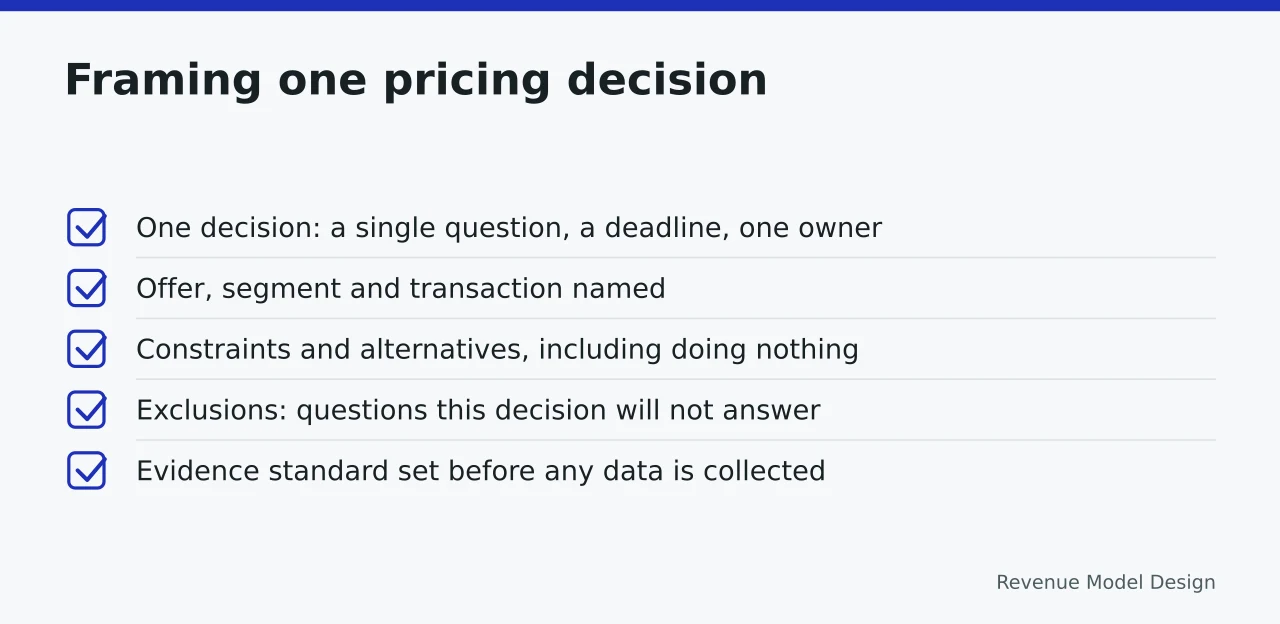
That structure lets a committee approve or reject in one meeting. The pricing strategy checklist applies the same six steps before a price goes live.
Customer evidence before the number
Customer evidence answers one question: do buyers value this offer enough at the price you are considering? Pick the method that fits the decision and the time you have.
- Customer interviews ask about the job the product does, what buyers pay for it now, and what would make them switch. They give direction, not a price point.
- The Van Westendorp price sensitivity meter asks four questions: at what price the product feels too cheap, a bargain, getting expensive, and too expensive. It maps a range of acceptable prices.
- Gabor-Granger asks purchase intent at a series of set prices, so you can estimate revenue at each one.
- Conjoint analysis shows buyers product profiles that trade features against price, then estimates what each feature is worth to them.
- A price test shows live visitors one price each, with a control group, and measures conversion and revenue. It needs enough traffic to read.
A survey that is not tied to the offer you will actually sell measures a different product. Write the evidence standard into the decision frame before you collect any answers.
Economic model before price
Start with revenue: price metric multiplied by billable units, then by accounts. Subtract delivery, service, channel, payment, return, and support costs per unit.
Separate fixed cost from variable cost. A support hire is a step cost, not a per-unit cost, and treating it as variable hides your break-even point.
Add capacity, currency, tax, and cash timing. A signed annual contract can still leave a cash hole in month three.
Revenue recognition timing matters as much as the invoice date. The principles behind ASC 606 decide when a sale counts.
Run conservative, central, and upside cases. Vary demand, mix, and retention separately, so you can see which assumption carries the result.
Test the model at the volume where your next delivery hire starts, not at the current average. Keep one input per line, with a source beside each one.
Show contribution per account, not only the blended margin. Compare the outcome against the pricing strategy benchmarks, using the margin and contribution definitions your finance team already uses, and record the source and period for each one.
Price metric and package shape
Test a candidate metric on five questions. Is it understandable to the buyer, measurable in your systems, forecastable a year out, tied to value, and defensible across the customer base?
Seats are easy to meter and easy to game. Usage events track value, but they swing with customer volume. Pick the swings you can survive.
Usage charging has a long history outside software. Pay-as-you-go pricing shows how insurance and utilities handle metering, allowances, and overages.
Then design the package around it: inclusions, allowances, overage rate, minimum commitment, term, renewal, discount rules, exception process, and migration path.
Common starting approaches for the price itself are value-based pricing, which sets price from the outcome the buyer gets; cost-plus pricing, which adds a margin to cost; and competitor-based pricing, which sets price relative to alternatives. Each ignores something the others see, so compare them against the customer evidence rather than picking one by habit.
Example: one metric change, worked through
Figures here are illustrative. An account-management tool charges 500 dollars per month, with 1,000 automation runs included, then 0.40 dollars per run.
Two hundred accounts averaging 3,000 runs each produce 100,000 dollars in base fees and 160,000 dollars in overage. Revenue totals 260,000 dollars per month.
Delivery costs 0.08 dollars per run, so 600,000 runs cost 48,000 dollars. Contribution is 212,000 dollars per month, about 82 percent of revenue.
Migration: existing accounts keep current terms for twelve months, then move at renewal. Discounts above 15 percent need finance approval.
Every exception gets a record, an owner, and an expiry date. The model innovation case study follows a comparable shift to two-part pricing through two quarters.
Price display and reference price rules
In the United States, the FTC Guides Against Deceptive Pricing, 16 CFR Part 233, govern former price comparisons and comparable value claims. State consumer protection statutes sit on top of them.
Keep mandatory fees, eligibility, renewal, cancellation, usage limits, and taxes visible before checkout. Ads, quotes, checkout, contract, and invoice must agree.
Monitoring, review and retirement triggers
Monitoring and review triggers
| Signal | Interval | Trigger to act |
|---|---|---|
| Realized price against list | Monthly | Gap wider than the threshold set at launch |
| Contribution per account | Monthly | Falls below the modelled floor |
| Overage revenue share | Quarterly | One metric carries most of the revenue |
| Complaints and billing errors | Monthly | A rise after a change |
| Migration completion | Weekly during migration | Accounts miss the renewal deadline |
Set thresholds before launch. A limit chosen after the result is not a limit.
Willingness-to-pay data can be personal data, depending on how it is collected and linked to a person. The NIST Privacy Framework sets out a voluntary process for assigning ownership of that data and of the records that justify a price.
Governance decays in predictable ways, and the pricing strategy mistakes review names the cost-only logic and copied prices that survive longest.
Retire temporary rules on a stated date. Keep the version history, the approval, the effective date, and the correction for each decision.