
Guides
Testing Pricing Strategy Tools Before You Sign: Four Cases, Records and Exit Terms
What to test before signing a pricing strategy tool: price books, discount stacking, versioning, tax and refunds, realized price reporting, a proof-of-concept, and exit terms.
What to take away
- Judge a pricing tool on the decisions it has to enforce: price books, effective dates, discount stacking, approvals, and exceptions.
- Test four cases before signinga discount conflict, a mid-term price change, a refund with tax, and an export of your full price history.
- A vendor page describes intended capability. Configured behavior, migration effort, and exit terms are yours to verify.
- Realized price, not list price, is the number that tells you whether the tool is working.
- Ask what leaves with you. A price history you cannot export is a renewal you cannot refuse.
Pricing strategy decides what you charge. The tool decides whether that decision survives contact with a quote, a renewal, and a refund. Feature counts do not separate vendors, because two systems with the same list behave differently once rules start interacting.
Start with the price book, not the feature list
A price book is the record of what each customer pays, in which currency, from which effective date. A new price should create a new version and leave the old one readable. Stripe's documentation on products and prices describes the same approach: archive a price rather than editing its amount in place.
If history is overwritten, you cannot explain last quarter's invoice. That is a finance problem wearing a software costume.
Discount stacking is where quotes go wrong
Most pricing engines allow several adjustments to apply to one line. Microsoft's price-adjustment and discount documentation sets out adjustment types, discount codes, price groups, channels, and configuration limits. It also explains how adjustments combine. Read the current release notes for your version, because behavior changes between releases.
Configure two discounts that should not stack, then quote a customer who qualifies for both. If the engine applies both silently, your sales team will find that before your finance team does.
Versioning, tax, and refunds tie back to one record
A price change mid-contract raises three questions at once: which version applies, what tax is charged, and what a refund reverses. All three should resolve from the same record. If the customer's credit and the finance ledger disagree, the tool is generating reconciliation work rather than removing it.
Evaluate these billing cases: recurring charges, usage-based charges, prorated changes, minimum commitments, credits, and cancellations. Confirm the supported markets, who remits tax, and what the invoice shows. A polished price page cannot repair an incorrect invoice.
Report realized price, not list price
Realized price is what customers actually paid after discounts, credits, and refunds. It is the first report to build, because it is the only figure that shows whether your discounting is doing what you intended.
Wire it before you add anything clever. A tool that reports list price beautifully and realized price not at all will flatter every quarter.
Vendor categories to shortlist
Vendors fall into three rough groups. Price-management suites hold price books and approvals, and examples include PROS, Vendavo, Zilliant, and Pricefx. Quoting tools apply prices to deals, such as Salesforce CPQ. Subscription billing platforms handle recurring charges, proration, and invoices, such as Chargebee and Recurly.
These groups are a starting point, not a ranking. Check any name against the four test cases before you put it on a shortlist.
Governance questions that belong in the contract
Ask who can approve a price change, what the exception log captures, and how long records are retained. AI-assisted recommendations need a stated purpose, a named human owner, an override path, and monitoring matched to the consequence of a wrong price.
Run a proof of concept with your own cases rather than the vendor's demo data. Score task success, error recovery, explainability, and accessibility. Also score integration effort, security, support, total cost, and data portability. Put the answers in the contract and check references. The pricing architecture questions you settled earlier are the script for that test.
Pricing-tool proof of concept
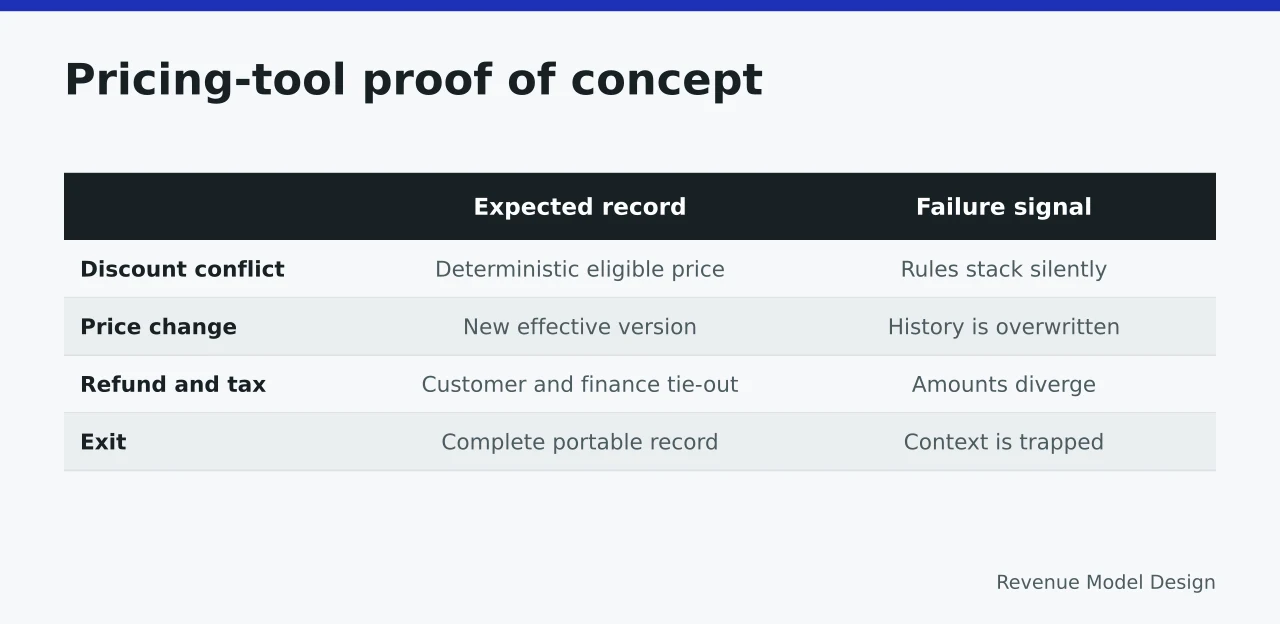
Expected record
- Discount conflict
- Deterministic eligible price
- Price change
- New effective version
- Refund and tax
- Customer and finance tie-out
- Exit
- Complete portable record
Failure signal
- Discount conflict
- Rules stack silently
- Price change
- History is overwritten
- Refund and tax
- Amounts diverge
- Exit
- Context is trapped
Test the operating burden
Test who configures the rules, how long a price change takes to go live, and how many people must approve it. Record the answer in hours and named roles rather than adjectives, because a tool that needs a specialist for every change adds cost after the contract is signed.
Test whether your price definitions and price history can move to another system. If an export needs a support ticket, count that as a cost in the total, and write the export format into the contract.
Common questions
Which pricing strategy tool is best?
There is no universal winner. Select against the decisions the tool must enforce, the users, transaction volume, controls, integrations, total cost, support, and exit terms. A tool that fits a subscription business with usage billing rarely fits a project-quoting business.
Can a spreadsheet manage pricing?
A spreadsheet can work while definitions, permissions, versions, review, and reconciliation stay controlled and transaction volume stays modest. The moment two people can edit the same price book without an approval step, move to a tool.
Should AI recommend prices?
Only inside a defined use case with a stated purpose. It needs protected inputs, evaluation, monitoring, a human owner, and a reversal path. Consequence should set how much of that you require.
What should we test before signing?
A discount conflict, a mid-contract price change, a refund with tax, and a full export of your price history. If any of the four fails, the rest of the demo does not matter.