
Guides
Pricing strategy examples with the reasoning laid bare
Pricing strategy examples show eight fictional patterns for subscriptions, projects, usage, packages, launches, geography, renewals, and service recovery.
What to take away
- The eight patterns map to recurring value, scoped work, measurable usage, packages, entry terms, localization, renewal, and recovery.
- Each pattern exposes a different pricing task and a testable decision.
These pricing strategy examples pair real named anchors with decision structures, not recommendations or performance claims. Each illustrates a tradeoff. Validate customer evidence, economics, demand, fairness, law, systems, and communication before adapting any approach.
Named real anchors include Netflix's tiered subscription packages, Costco's annual membership fee, and AWS Lambda's request-based pricing. Netflix's tiers segment willingness to pay and content spend. Costco's fee supports low product markups and renewal. AWS Lambda charges per request and GB-second, matching cost to consumption.
Real named examples with reasoning follow. Adobe Creative Cloud charges $59.99 per month for All Apps. Adobe tracks activation and retention to justify annual plans, a subscription with activation guardrails.
Stripe Atlas charges a $500 one-time fee to incorporate a US company. The fixed fee covers scope and compliance work, with change control for extra work.
Twilio charges $0.0079 per US SMS message segment. Alerts and caps help customers estimate usage cost, a usage pricing with predictability example.
Slack Pro costs $8.75 per user per month, and Business+ costs $15 per user per month. Tiers differ by message history, SSO, and support, a tiered package by outcome.
Amazon Prime launched at $79 per year. It later raised the price to $99, $119, and $139 per year. The known future price made the launch offer clear.
Netflix offers a mobile plan in India at 149 INR per month. The price is lower than its US plans, reflecting local willingness to pay.
Netflix raised its US Standard plan from $15.49 to $17.99 per month in 2025. Advance notice and a price hold supported the renewal price change.
Amazon offers refunds or replacements for late deliveries. The rule ties recovery to customer impact, not a disguised promotional discount.
Subscription with activation guardrails
A monthly plan is evaluated on contribution and retention, not signups alone. The team tracks activation, support, cancellation, refunds, payment failure, renewal understanding, and mature cohorts before changing price.
A typical test uses a $20 to $50 monthly price and a 14-day trial; contribution margin and churn set the exact figure.
Fixed-fee professional service
Scope, assumptions, included revisions, client responsibilities, exclusions, milestones, change control, taxes, expenses, and acceptance are explicit. Complexity outside the boundary triggers a quoted change rather than an improvised discount.
A typical fixed fee runs $5,000 to $50,000, with $500 to $2,500 per extra revision round; scope and risk set the number.
Usage pricing with predictability
Usage pricing requires more than a rate. Stripe's usage-based billing tools document meters, alerts, and invoices. These are product capabilities to verify in the live plan, not proof that usage pricing fits a customer. Stripe's public US card rate is 2.9 percent plus 30 cents per successful charge.
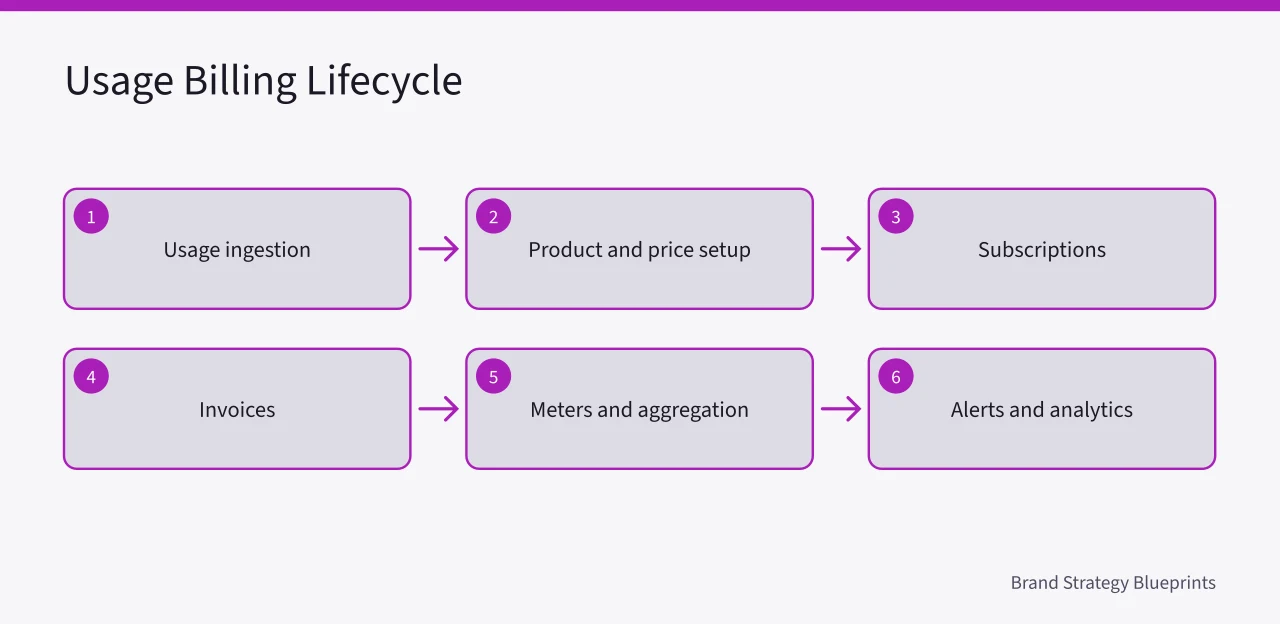
AWS Lambda's public free tier includes 1 million requests and 400,000 GB-seconds per month. A typical plan might set $0.001 to $0.01 per API call, include 1 million calls, and charge $0.002 to $0.02 per 1,000 overage calls.
The offer includes a clear unit, included allowance, measurement method, alerts, caps, overage, rounding, corrections, and dispute process. The unit is the price metric, one of the standing pricing strategy questions. Research tests whether customers can estimate likely cost.
Tiered packages by outcome
Packages differ in scope, service, capacity, proof, and support rather than arbitrary feature removal. Upgrade, downgrade, add-on, renewal, and migration rules are designed before launch.
A typical three-tier structure might run $49 to $99 for 10 seats, $149 to $299 for 50 seats, and $399 to $799 for 200 seats per month.
Launch pricing with an expiry
An introductory offer names eligibility, period, included value, future price, notification, cancellation, inventory, margin, and customer guardrails. The temporary price is not used as a deceptive reference.
A typical launch offer might be $19 to $29 per month for six months, then $29 to $49; future price and margin set the discount.
Geographic pricing
Differences reflect currency, tax, regulation, logistics, service, access, and local evidence. The company reviews arbitrage, fairness, contracts, systems, and communication rather than converting one list price mechanically.
This site treats the US as the primary market and Canada as a second market. The US and Canada framing applies unless a section says otherwise.
For a US company with Canada as a second market, keep the US list price in USD and the Canadian price in CAD. A typical pair might be USD 29 and CAD 39; local tax, currency, service cost, and willingness to pay set the gap.
Renewal price change
Recurring consumer offers can carry jurisdiction-specific duties. The CFPB's negative-option marketing circular addresses disclosures, informed consent, cancellation, and recurring charges for covered persons and service providers under the CFPA. Other businesses must check the current rules that govern them.
Current customers receive advance clear communication, complete terms, options, support, and lawful cancellation. The team models value, tenure, use, concessions, churn, complaints, collection, and migration.
A typical renewal might raise a $99 to $149 annual plan by 10 to 20 percent, with 60 days notice and a 12-month price hold.
Recovery after a service failure
Credits or refunds follow consistent severity and customer-impact rules with approval, communication, accounting, tax, and expiry. Recovery is not disguised as a promotional discount. Pricing strategy development sets the approval path these credits run through.
A typical credit might be 10 to 25 percent of the monthly fee, capped at $500, with manager approval above that.
For every example, document the reference price, full price, fees, terms, owner, system source, customer eligibility, evidence, effective dates, exceptions, guardrails, and retirement. Test the complete transaction before publication.
Example adaptation record
| Pattern | Central decision | Critical safeguard |
|---|---|---|
| Subscription | Recurring customer value | Renewal clarity |
| Usage | Meter and predictability | Alerts and disputes |
| Geographic | Local economics and access | Qualified review |
| Recovery | Remedy for customer effect | Consistent severity rule |
Turn examples into test cases
The NIST Privacy Framework starting guide offers a voluntary process for privacy risk. Use it to assign data and response owners when a pricing test touches personal data; it is not legal clearance.
The W3C information and relationships explanation says visual structure and relationships should also be programmatically available. Apply that check to pricing pages, then test with the users and technology in scope. The marketing strategy examples raise the same questions outside pricing.
Common questions
Are these real pricing case studies?
No. They are decision structures, not case studies.
Which example should a company copy?
None should be copied. Select a structure only after customer research, economics, operational tests, and qualified review support it.
Can two examples be combined?
Yes, if the combined metric, package, fees, terms, system behavior, customer understanding, and exception rules remain coherent and testable.