Guides
Usage-Based Pricing Model Design: Which Metric Should You Charge For?
Usage-based pricing model design starts with the metric you charge for. Compare per-seat, per-unit, and hybrid approaches on cost, risk, and buyer fit.
What to take away
- The metric you charge for decides who carries demand risk, you or the customer.
- Per-seat pricing is predictable and easy to forecast; usage pricing tracks value but swings month to month.
- Hybrid pricing, a platform fee plus metered units, is the most common compromise for US SaaS companies.
- No metric fixes a product whose usage does not rise with the value customers receive.
- Pick the metric you can explain in one sentence and measure without argument.
What is being compared
Three approaches dominate US SaaS pricing conversations. Per-seat pricing charges a flat fee for each named user. Usage pricing charges for a metered unit, such as API calls, gigabytes stored, or tokens processed. Hybrid pricing combines a recurring platform fee with a usage component.
AWS popularized the third model at scale, billing by compute hours, storage, and data transfer. Snowflake bills on compute credits consumed, which separates storage from query cost. Both show that usage pricing works when the unit is visible to the buyer and tied to work performed.
The criteria that matter
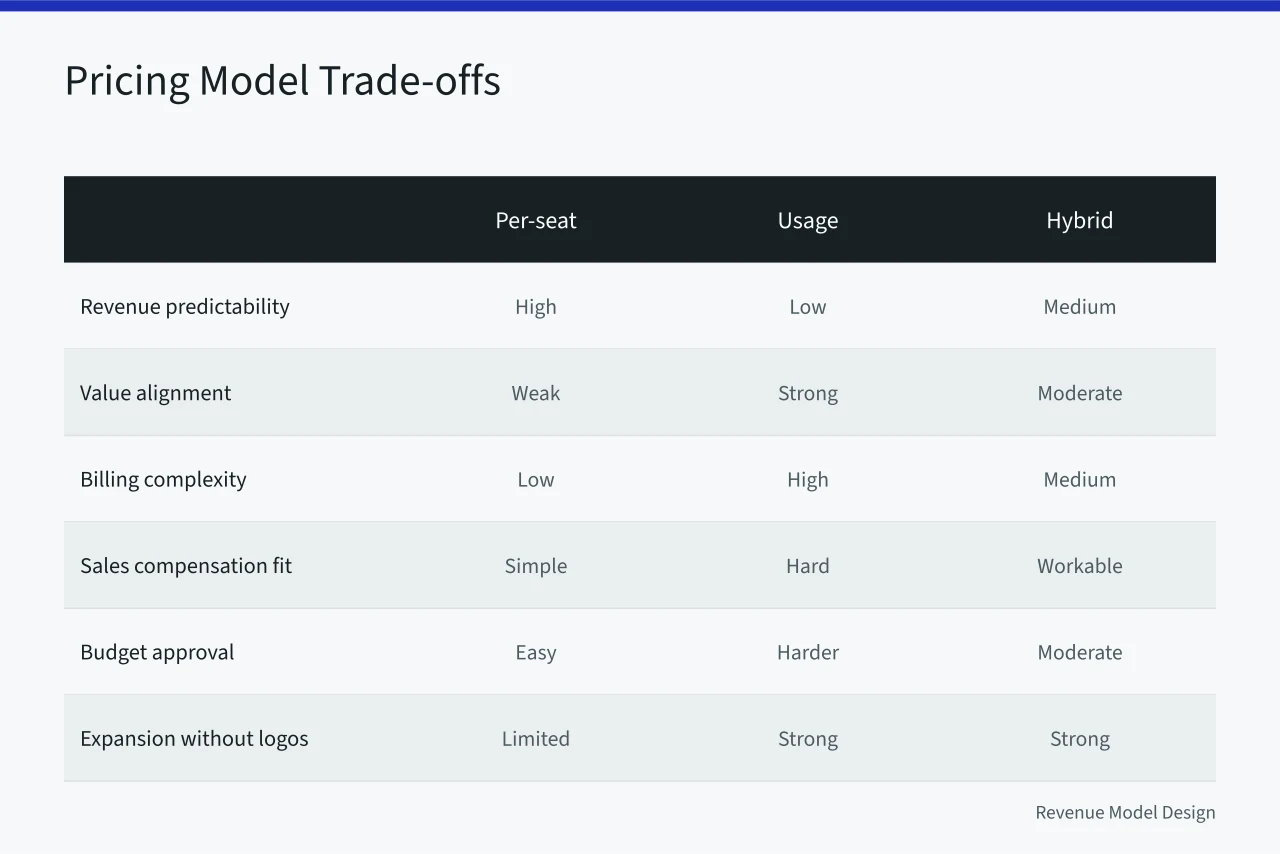
| Criterion | Per-seat | Usage | Hybrid |
|---|---|---|---|
| Revenue predictability | High | Low | Medium |
| Alignment with customer value | Weak | Strong | Moderate |
| Billing complexity | Low | High | Medium |
| Sales compensation fit | Simple | Hard | Workable |
| Buyer budget approval | Easy | Harder | Moderate |
| Expansion without new logos | Limited | Strong | Strong |
Each row is a trade-off, not a score. A company with a small finance team and long enterprise sales cycles will weight predictability and approval difficulty heavily. A developer tool selling to engineering teams will weight value alignment higher.
Option by option
Per-seat pricing. The customer knows the bill before the month starts. Procurement approves seat counts easily because the number maps to headcount. The weakness is that one power user and one occasional viewer cost the same, so value and price drift apart. Buyers also learn to share logins, which caps expansion.
Usage pricing. The bill follows consumption, so a customer who doubles usage pays roughly double. This aligns price with value and removes the login-sharing problem. It also transfers demand risk to the customer, who may cut usage during a slow quarter. Pay-as-you-go pricing describes the pattern and its common metrics.
Hybrid pricing. A platform fee covers baseline access and support; metered units cover growth. This keeps some revenue predictable while rewarding expansion. It is harder to explain than either pure model, and the platform fee must be low enough that customers do not feel they are paying twice.
Where each one wins
Per-seat pricing is right when the buyer's value scales with the number of people using the product, and when the finance team needs a flat forecast. Collaboration software and compliance tools fit here.
Usage pricing is right when consumption varies widely across customers and the unit is already tracked in the product. Infrastructure, data processing, and API products fit here. Review unit economics examples before committing, because the obvious unit is often the wrong one.
Hybrid pricing is right when you sell to both small teams and large enterprises with one product. The platform fee filters out low-intent trials; the usage component captures expansion.
The metric is not a billing detail. It is the sentence a customer repeats to their boss when asked why the invoice grew.
What none of them solve
All three models fail when usage does not track value. A customer can consume enormous compute while getting little benefit, or use a product lightly while saving millions. No pricing metric repairs that gap.
All three also depend on clean measurement. If two teams disagree about what counts as a billable unit, disputes will consume support time regardless of the model. Revenue recognition rules add another layer: metered contracts need careful treatment under ASC 606, and revenue recognition explains why timing questions get complicated.
A final shared limit is buyer tolerance for variance. US enterprise buyers increasingly ask for spend caps and committed-use discounts, which push any usage model back toward a fixed contract. Build the cap into the design rather than treating it as a concession.
Before you commit, run the same discipline you would apply to pricing architecture mistakes: write the metric down, test it against three real invoices, and check that sales can explain it without a spreadsheet.
A worked comparison
Example: a data pipeline vendor with 40 customers under per-seat pricing at a flat rate sees flat revenue and near-zero forecast error.
Under usage pricing, monthly revenue varies with customer volume. The top two accounts can swing the total by 20 percent or more. Under hybrid pricing, the platform fee covers roughly the fixed cost base, and usage covers the rest.
The vendor should test the metric against its own cost structure. If serving one customer costs almost nothing until they cross a threshold, usage pricing matches cost. If every customer requires onboarding and support regardless of volume, a seat or platform fee matches cost better. Subscription models questions covers how the recurring layer interacts with metered billing.
Common questions
Is usage-based pricing always better than per-seat? No. It fits products where consumption varies and is already measured. For steady collaboration tools, per-seat pricing is simpler and easier to sell.
How many metrics should a hybrid model charge for? One primary metric, plus at most one secondary. More than that and buyers cannot forecast, which slows every deal.
Do US buyers accept uncapped usage bills? Rarely at enterprise scale. Most ask for a cap, an alert threshold, or a committed-use discount. Design for that request from the start.
What breaks first when usage pricing goes wrong? Billing disputes. If the billable unit is ambiguous, support and finance spend months resolving invoices instead of improving the product.