
Guides
Seven pricing strategy mistakes and the repair priorities that follow
Seven pricing strategy mistakes, from cost plus and copied prices to hidden fees and unready systems, plus repair priorities and proof checks.
The repair order
Fix the mistakes in this order, because the first ones harm customers or create legal exposure while the last ones only limit growth.
- Mistake 1, an unready operation, and Mistake 7, a headline smaller than the bill.Both can charge customers incorrectly or mislead them, so correct affected charges and disclosures first.
- Mistake 6, concessions that become permanent.Close open-ended discounts next, because each renewal keeps leaking revenue.
- Mistake 3, a unit customers cannot trust.Fix the metric before it causes billing disputes.
- Mistakes 2 and 4, cost-led and copied prices.Redo the analysis before the next price change.
- Mistake 5, tiers carved from feature switches.Redesign at the next packaging cycle.
Each mistake below ends with the fix for that item.
Mistake 1: Launching a price into an unready operation
What goes wrong: Releasing a price before the full commercial and service path is ready is the costliest failure. Catalogs, quotes, checkout, contracts, tax, payment, billing, provisioning, refunds, reporting, and support can drift out of step, leaving customers with inconsistent charges and the business with unreliable records.
Why it compounds: The damage is not limited to an incorrect number. Disconnected systems and teams can create old charges, inconsistent tax records, contract conflicts, service problems, and misleading performance results. If a price or cost record was wrong, conclusions that relied on it may also need to be reconsidered.
Fix it: Name one owner, map the affected customers and periods, and coordinate qualified customer, economic, legal, tax, contract, system, and service reviewers. Test standard, exception, migration, cancellation, and rollback paths before launch. Correct affected transactions fairly, update systems and teams, and monitor the repair, using pricing architecture tools that keep an audit trail.
| Failure signal | First repair | Evidence to check |
|---|---|---|
| Misleading price | Correct customer-facing surfaces | Comprehension check |
| Billing mismatch | Reconcile affected transactions | Finance tie-out |
| Uncontrolled discount | Close the rule and exceptions | Approval log |
| Wrong conclusion | Reopen the analysis | Corrected decision |
Mistake 2: Letting cost decide the number
What goes wrong: Cost-plus pricing treats production cost as proof of what buyers will pay. A markup can produce a neat list price, but it does not establish customer value, the strength of alternatives, the offer's positioning, product mix, or demand.
Why it fails: Cost still matters as a constraint, but it answers a different question from willingness to pay. A price can cover costs and still fail to fit what buyers value or what they can choose instead. Looking only at the cost base can therefore hide important trade-offs between price, product, and demand.
A simple check: Suppose materials and labor cost $20 and a 50 percent markup produces a $30 list price. If buyers can choose a $25 alternative for the same job, the markup alone does not tell you whether they will accept $30 or whether the offer is competitive.
Fix it: Keep full cost in the analysis, then compare value evidence and model more than one price and product combination. Use unit economics to make cost constraints visible, and compare choices against the conditions they must satisfy with a revenue models framework.
Mistake 3: Charging on a unit customers cannot trust
What goes wrong: A charge unit that fails to track value can feel arbitrary, while a metric buyers cannot count or verify can make bills difficult to trust.
Per seat can fit independent user value, per usage unit can fit a metered service, and per outcome can fit work tied to a result.
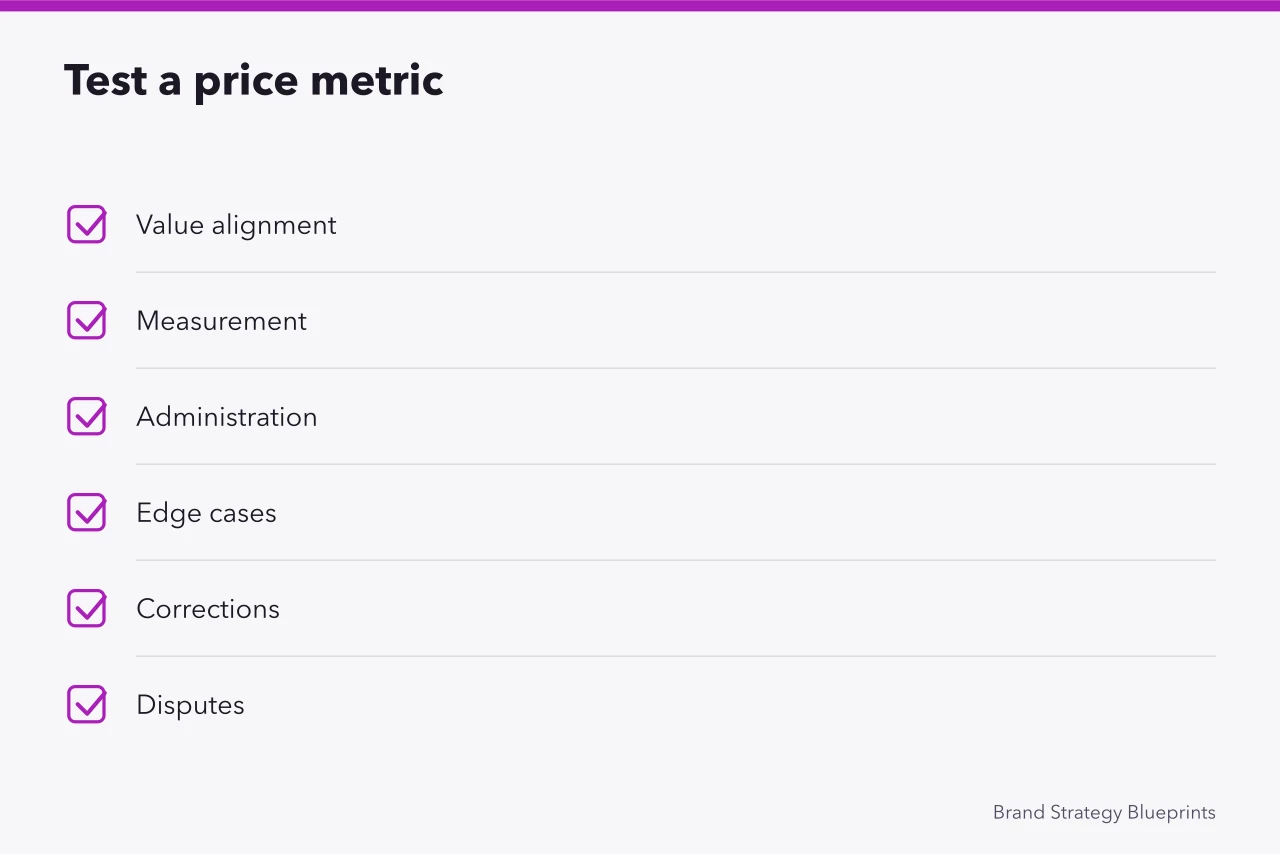
Why it fails: A metric that buyers do not track, that does not rise and fall with received value, or that cannot be metered without disputes creates avoidable friction. Compare candidate units against the six tests in the figure, score each one, and pilot with a sample of customers before choosing. Compare revenue, margin, and complaints during the pilot.
Fix it: A scheduling tool could charge per seat for planners, per booking for a calendar API, or per completed appointment for an outcomes package. Assess each against the same tests, then select a unit the buyer tracks and trusts. The pricing architecture metrics and usage-based pricing metric resources relate to this choice.
Mistake 4: Borrowing a rival's price as a decision
What goes wrong: A competitor's public price is dated context, not a ready-made answer for your offer. Differences in scope, quality, customers, economics, and terms can make a headline comparison unreliable, even when the offers look similar at first glance.
Why it matters: Copying a visible price can replace analysis of your own offer with an assumption that another business's conditions also apply to you. Keep comparisons independent, and do not coordinate future prices. See the DOJ's antitrust price-fixing guidance for official information on price fixing.
Fix it: Compare complete offers, including their scope and terms, then decide what fits your own customers and economics. A pricing architecture guide can keep the comparison focused on your own offer rather than on copying a rival's visible price.
Mistake 5: Carving tiers from feature switches
What goes wrong: Removing arbitrary features can produce packages that buyers cannot distinguish in a useful way. A feature being switched off does not, by itself, create a meaningful difference in customer outcome or a clear reason to choose one tier over another.
Why it fails: Minor changes can leave packages nearly alike while making the choice harder to understand. A report disabled in one tier, for example, may not give a buyer a clear basis for deciding which package fits. Tiers need a distinction buyers can recognize in the offer they receive.
Fix it: Organize packages around coherent differences in scope, service, access, capacity, and support. Define how customers move between tiers and how existing customers are treated. Review the package design alongside service model mistakes rather than relying on feature removal alone.
Mistake 6: Letting temporary concessions become permanent
What goes wrong: Uncontrolled discounts can weaken forecasts and fairness when one-off concessions turn into durable customer terms. Without defined boundaries, an exception may continue long after the reason for granting it has passed.
Why it persists: A one-time 20 percent concession that renews automatically for three years has become a lasting price, not a temporary adjustment. If its duration, renewal treatment, or stacking with other discounts is unclear, teams may not know when the exception should end or what price applies next.
Fix it: Set eligibility, the customer's exchange, approval authority, maximum reduction, duration, stacking rules, communication, expiry, renewal, and audit requirements before granting an exception. Keep the undiscounted reference visible and state the end date and renewal treatment clearly. Use pricing architecture mistakes to check the rules for live offers.
Mistake 7: Making the headline smaller than the bill
What goes wrong: A low headline amount can mislead when required costs, renewal terms, limits, or cancellation conditions change what customers must pay or accept. For example, a $39 nightly rate that becomes $61 after a mandatory fee does not communicate the full cost in its headline.
Why it matters: Customers need to see the actual price and material conditions clearly. The scope of a particular pricing rule should not be assumed to cover every offer or sector; check the requirements that apply to the market and offer in question.
Fix it: For covered US live-event tickets and short-term lodging, 16 CFR Part 464 sets total-price, prominence, and fee-representation requirements. Show the total price and material conditions clearly, and review disclosures for each relevant market and sector instead of assuming one rule applies everywhere.