
Guides
No shortcuts here: pricing strategy is decided by the basics
Pricing strategy for 2027 connects customer value, full economics, demand, architecture, lawful communication, operations, testing, controls, and review.
What to take away
- A pricing strategy decides what you charge, on which metric, under which terms, and who may approve an exception. The metric, the packages, and the terms decide what customers actually pay.
- Connect customer evidence and alternatives with full cost, demand, contribution, cash, capacity, access, and long-term outcomes.
- Use dated evidence, scenarios, controlled tests, clear terms, end-to-end transaction checks, accountable approvals, and reversible change.
Pricing strategy determines how a business translates customer value, competitive context, economics, access, and risk into prices and commercial terms. It covers more than choosing a number. Architecture, metrics, units, packages, discounts, fees, contracts, channels, geography, timing, communication, approvals, and exceptions all shape the price customers experience.
A 2027 process starts with the strategic choice and verified customer evidence.
That choice belongs to the marketing strategy, not the price list, and then links willingness and ability to pay with cost, capacity, margin, and positioning. Product design and lawful communication connect.
Pricing decisions should use scenarios, controlled tests, customer guardrails, version history, and clear review conditions rather than one formula copied across markets.
Define the pricing decision
State the product or service, customer, market, transaction, route, currency, tax context, contract length, timing, decision owner, options, and deadline. Clarify whether the choice concerns a new list price, package, price metric, discount policy, renewal, promotion, localization, or response to a cost change.
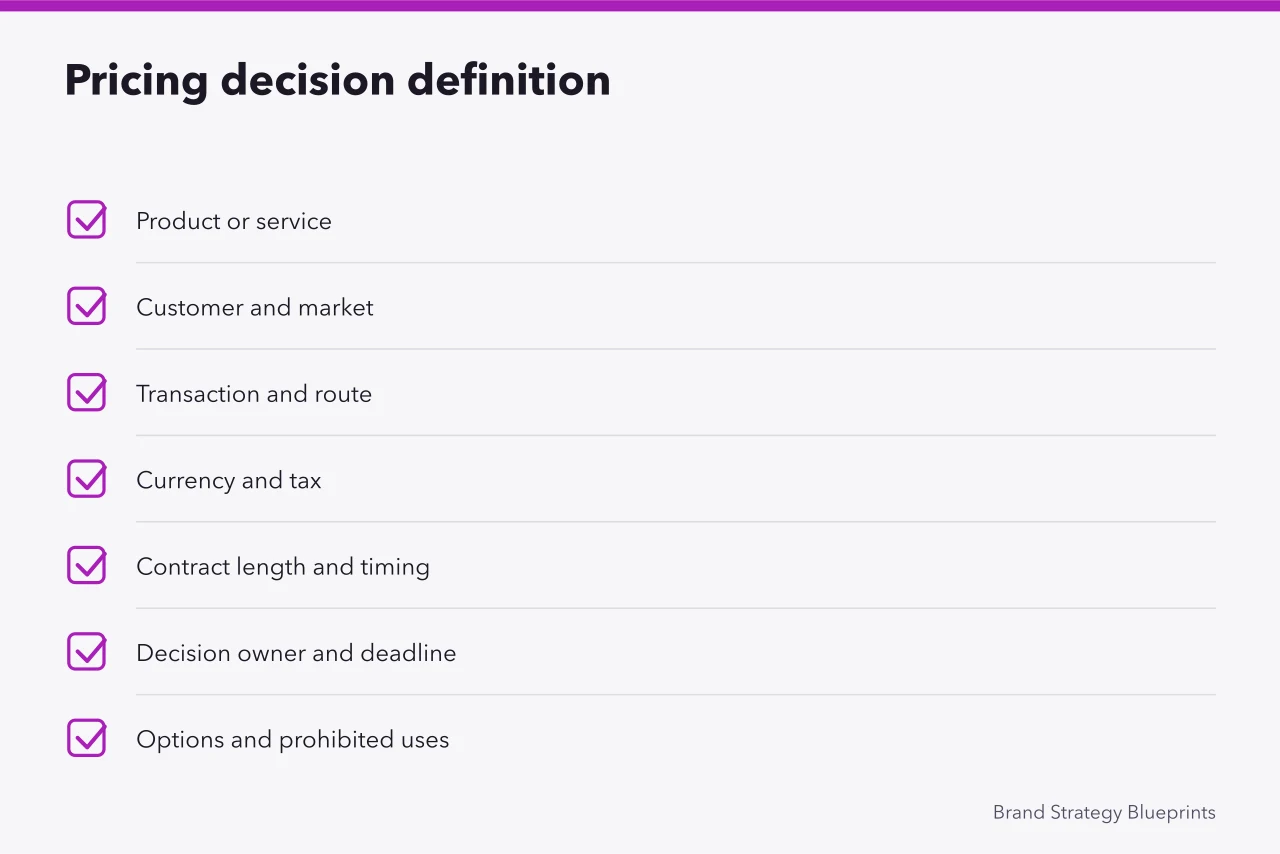
Separate strategy from a one-time quote. Strategy establishes the logic and guardrails; execution applies them to defined cases. Record prohibited uses and escalation, especially where prices affect vulnerable customers, regulated products, essential services, credit, or other high-consequence situations.
Start with customer value and alternatives
Research the customer job, desired outcome, current alternative, switching cost, buying process, budget source, decision authority, risk, proof needed, usage pattern, and total cost of adoption. Include active, prospective, former, lost, assisted, and relevant noncustomers. Do not ask only whether a proposed price sounds acceptable.
The U.S. Small Business Administration recommends combining existing information with direct research. Interviews, observation, surveys, transaction records, sales notes, product behavior, support, returns, and win-loss evidence provide different views. Document sample, method, wording, incentives, missing groups, and limitations.
The current version is at sba.gov in the business guide. Check the page date before quoting it.
Map full economics
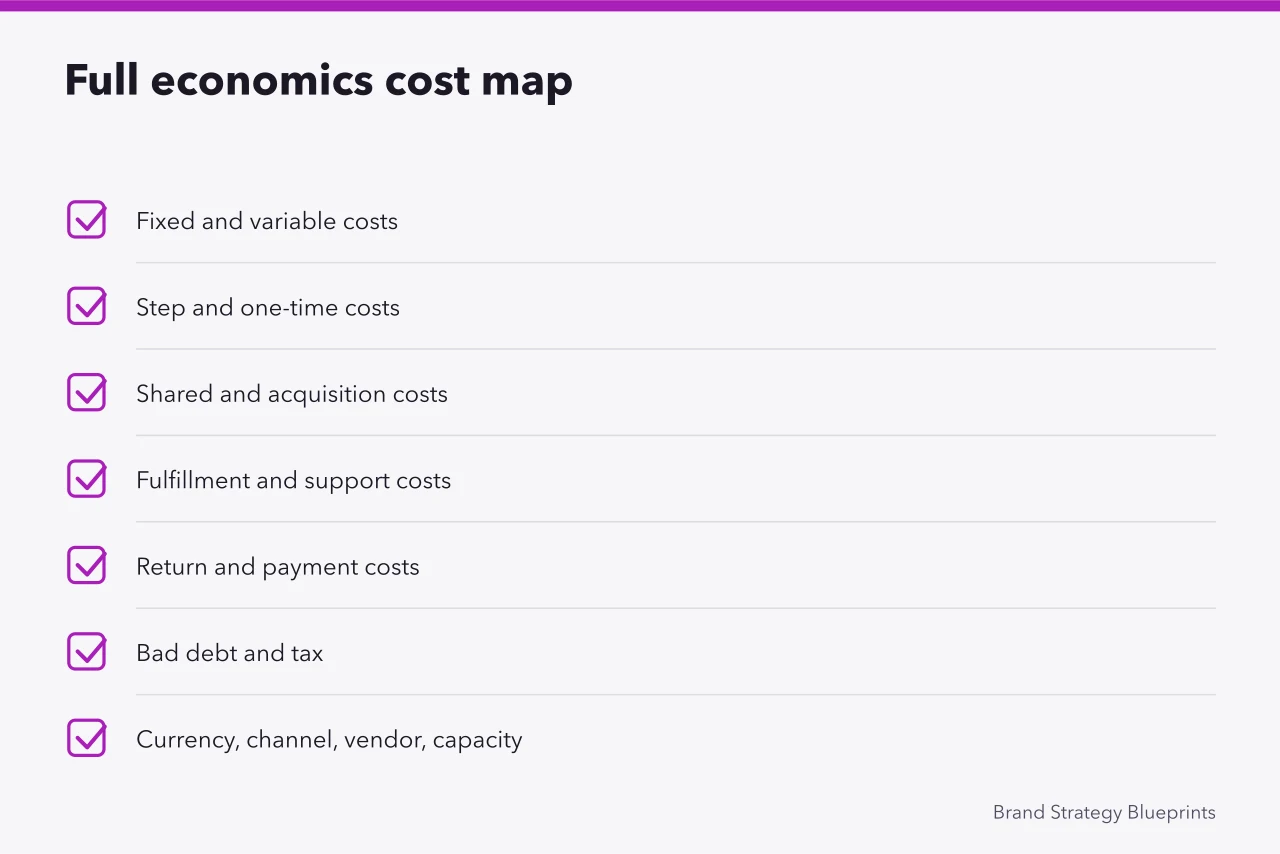
Model fixed, variable, step, one-time, shared, acquisition, fulfillment, support, return, payment, bad debt, tax, currency, channel, vendor, and capacity costs. Include internal labor and cash timing. Marketing budgets draw on the same cost picture from the spending side. Work with finance on accounting and tax treatment instead of assuming marketing conventions.
The SBA explains break-even as the relationship between fixed cost, selling price, and variable cost. That can be a useful base, but real businesses may have multiple products, constrained capacity, subscriptions, changing mix, refunds, and delayed value. Use contribution and cash scenarios that match the actual model.
Illustrative numbers: $42,000 in monthly fixed cost, a $29 price, and $6 per active user in variable cost. That gives a contribution of $23 per user, so break-even is about 1,830 active users a month. Raise variable cost to $9 and break-even moves to about 2,100.
Choose a price metric
The price metric determines what customers pay for: item, user, account, transaction, usage, outcome proxy, time, capacity, project, or another unit. It should align with customer value, be understandable, predictable enough for budgeting, measurable, contractible, difficult to game, and economical to administer.
Cost-plus pricing sets a floor, value-based pricing sets a ceiling, and good-better-best packaging places an offer inside that range. Freemium, seat pricing, and usage tiers are common variants.
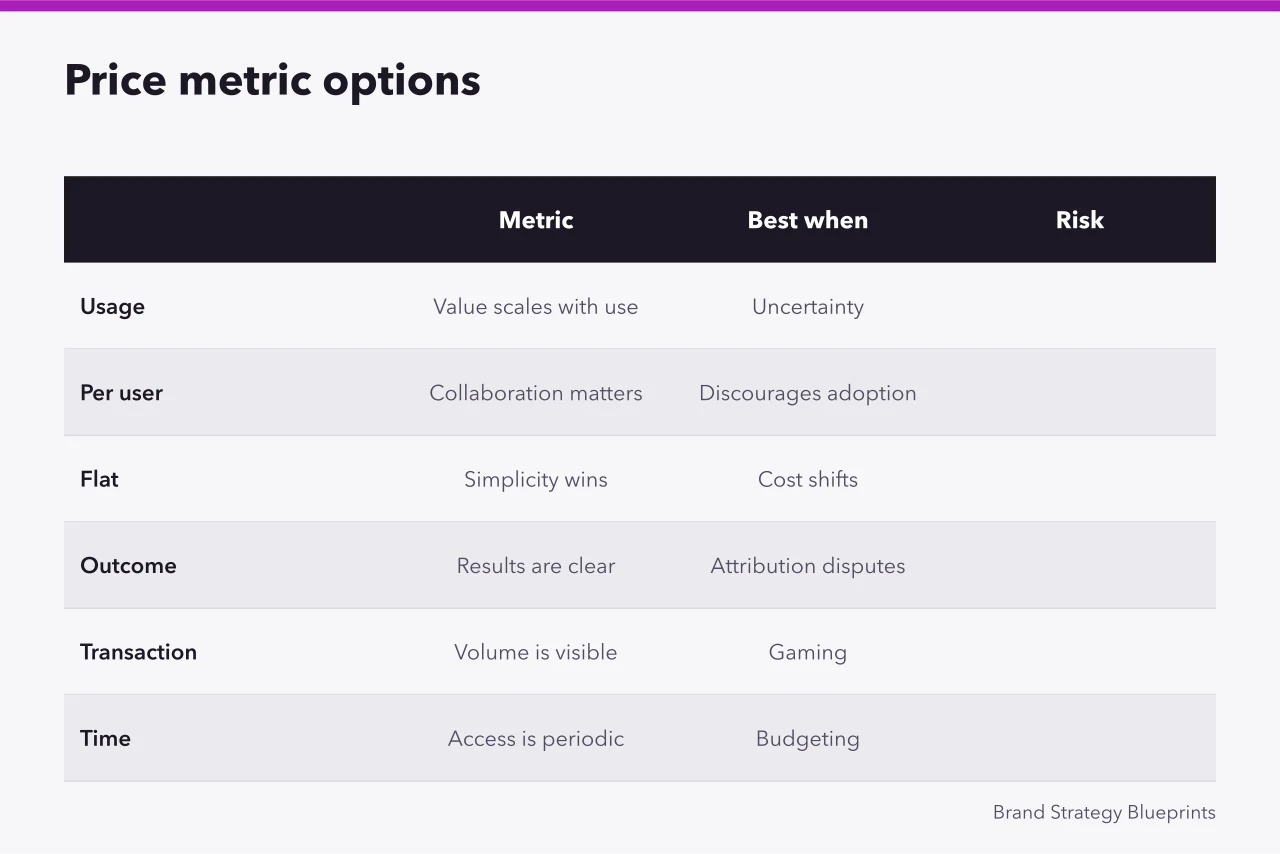
Test edge cases. Usage pricing can create uncertainty; per-user pricing can discourage adoption; flat pricing can shift cost across customers; outcome-linked pricing can create attribution disputes. State included units, overage, minimums, rounding, measurement, corrections, and dispute handling.
Design packages and fences
Packages should create coherent differences in customer outcome, scope, service, access, capacity, risk, or support. Avoid tiers built from arbitrary feature removal. Define eligibility, included units, limits, upgrades, downgrades, add-ons, renewals, migration, and legacy treatment.
Illustrative tiers: Starter at $49 a month for one location and up to 500 transactions. Growth runs $199 for up to 5,000 transactions, and Scale runs $649 for up to 25,000, with overage billed at $0.02 per transaction. Each tier changes scope and support, not just a switched-off feature.
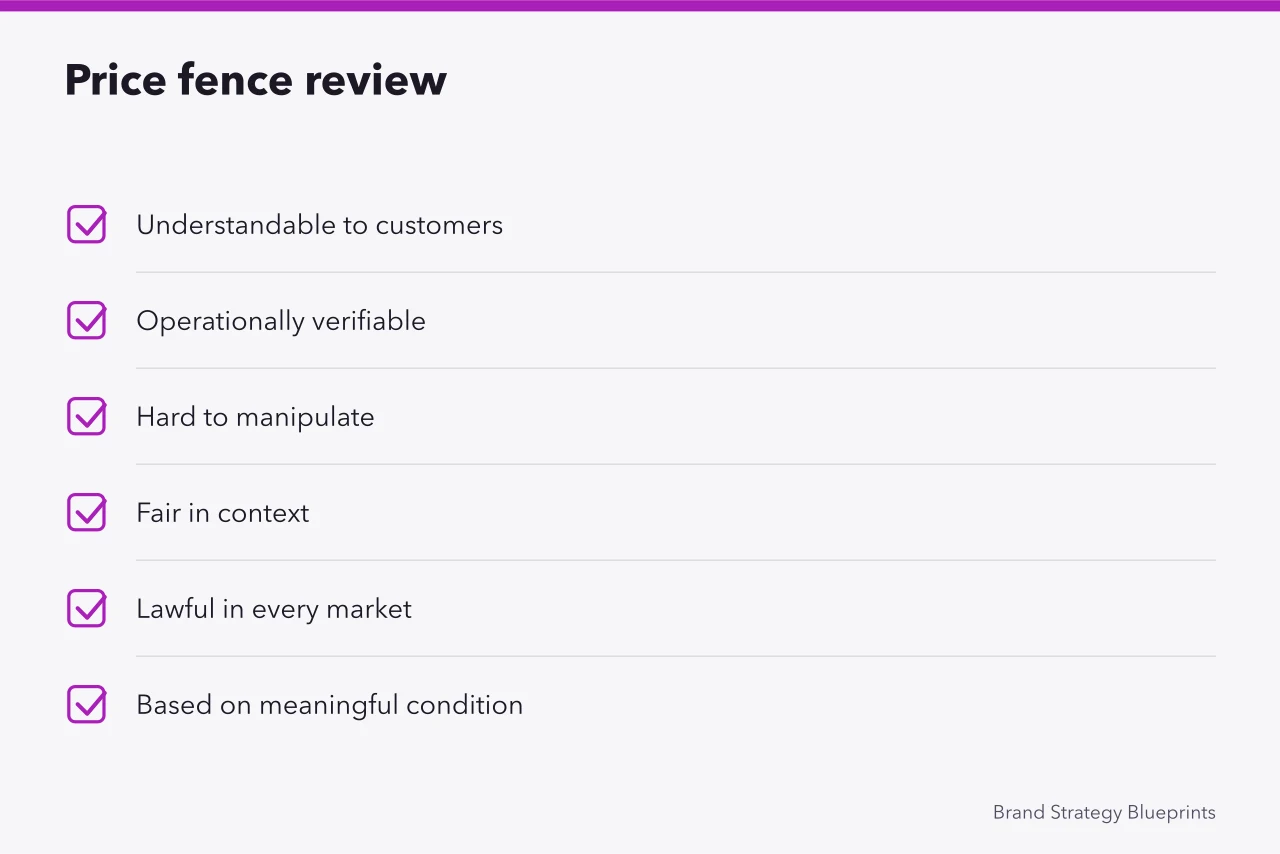
A price fence permits different terms for a meaningful condition such as volume, commitment, time, channel, qualification, geography, or service level. Those conditions are a commercial form of customer segmentation, and they fail in the same ways. Review whether the rule is understandable, operationally verifiable, hard to manipulate, fair in context, and lawful in every affected market.
Use research methods carefully
Qualitative research can reveal value language, tradeoffs, objections, and decision processes. Surveys can compare reactions across larger samples. Conjoint, discrete-choice, monadic tests, and price-sensitivity questions can inform options, but design, sample, realism, analysis, and hypothetical bias affect conclusions.
Named methods include the van Westendorp Price Sensitivity Meter and Gabor-Granger scaling, which return ranges rather than a single correct price.
Do not turn one survey point into a precise willingness-to-pay estimate. Compare methods, use ranges, validate with behavior, and preserve uncertainty. Customers may answer differently when a decision is real, when alternatives change, or when price is presented with taxes, fees, terms, and implementation costs.
Model demand and scenarios
Estimate eligible customers, awareness, consideration, conversion, quantity, mix, retention, upgrades, downgrades, churn, returns, bad debt, service load, and time to outcome under price alternatives. Those stages are the ones marketing funnels describe, priced rather than merely counted.
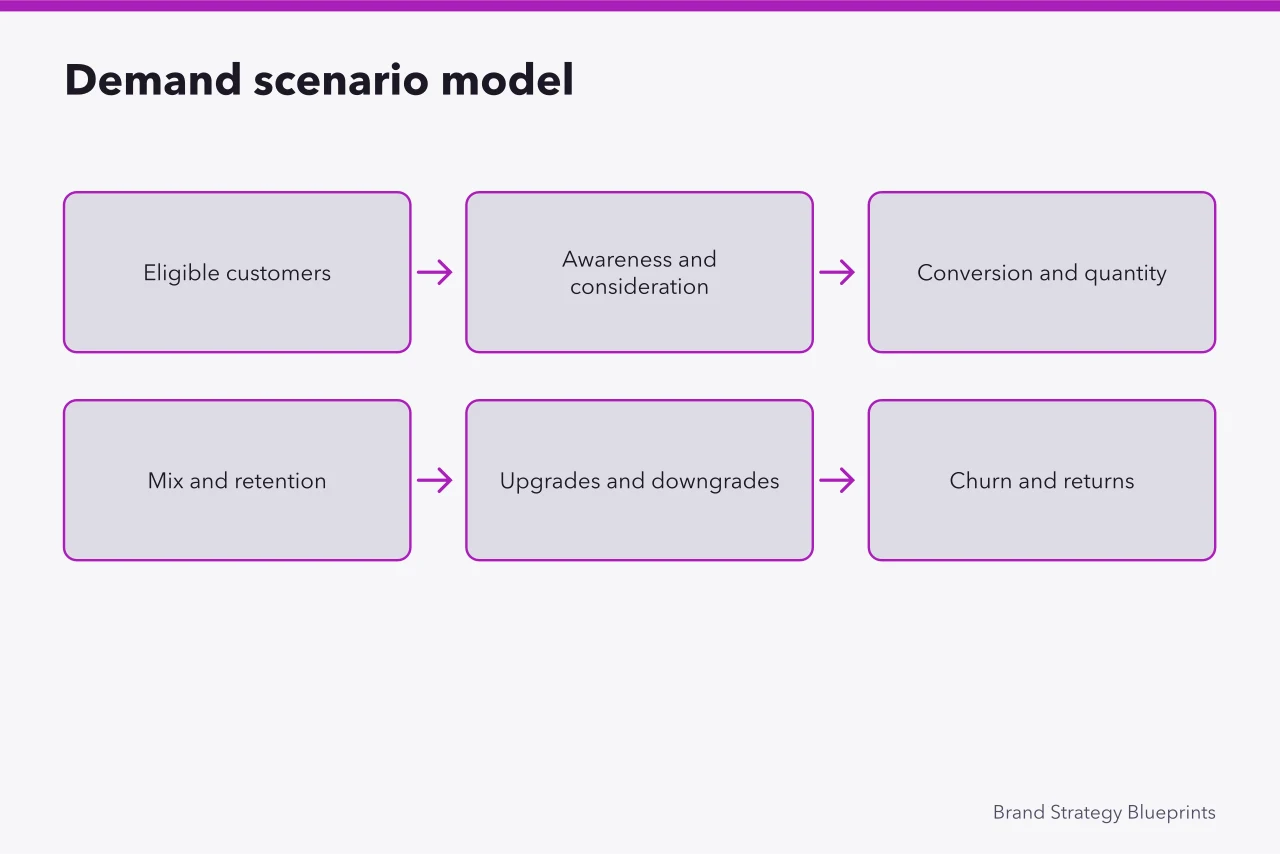
Use conservative, central, and upside scenarios with explicit assumptions. Test sensitivity to price response, competitor action, channel mix, input cost, product readiness, currency, retention, and capacity. A price that maximizes modeled short-term revenue may reduce adoption, trust, or long-term value.
Consider competitive context lawfully
Monitor public prices, packages, terms, promotions, availability, service, and positioning using dated sources. Compare the full offer rather than one headline number. Different cost structures, customer groups, and quality levels make direct copying unreliable.
Do not coordinate prices or sensitive future pricing information with competitors. Competition and pricing laws differ by jurisdiction and circumstance. Use qualified legal counsel for market conduct, channel restrictions, price discrimination, below-cost pricing, resale policies, and other material questions.
Build discount and exception rules
Define permitted discount types, eligibility, evidence, authority, maximum level, exchange received, duration, stacking, channel, customer communication, system entry, and expiry. Require a reason and preserve the undiscounted baseline. Review discount depth, frequency, margin, renewal, service demand, and fairness.
Sample approval thresholds:
| Discount depth | Exchange required | Approval |
|---|---|---|
| Up to 10 percent | Standard terms and a 12 month commitment | Account owner |
| 11 to 20 percent | Two year term or prepayment | Sales manager |
| Above 20 percent | Written reason and executive sponsor | Finance plus pricing owner |
The figures are illustrative thresholds to adapt, not a published standard. Limit each approval to 12 months and return the account to standard terms at renewal.
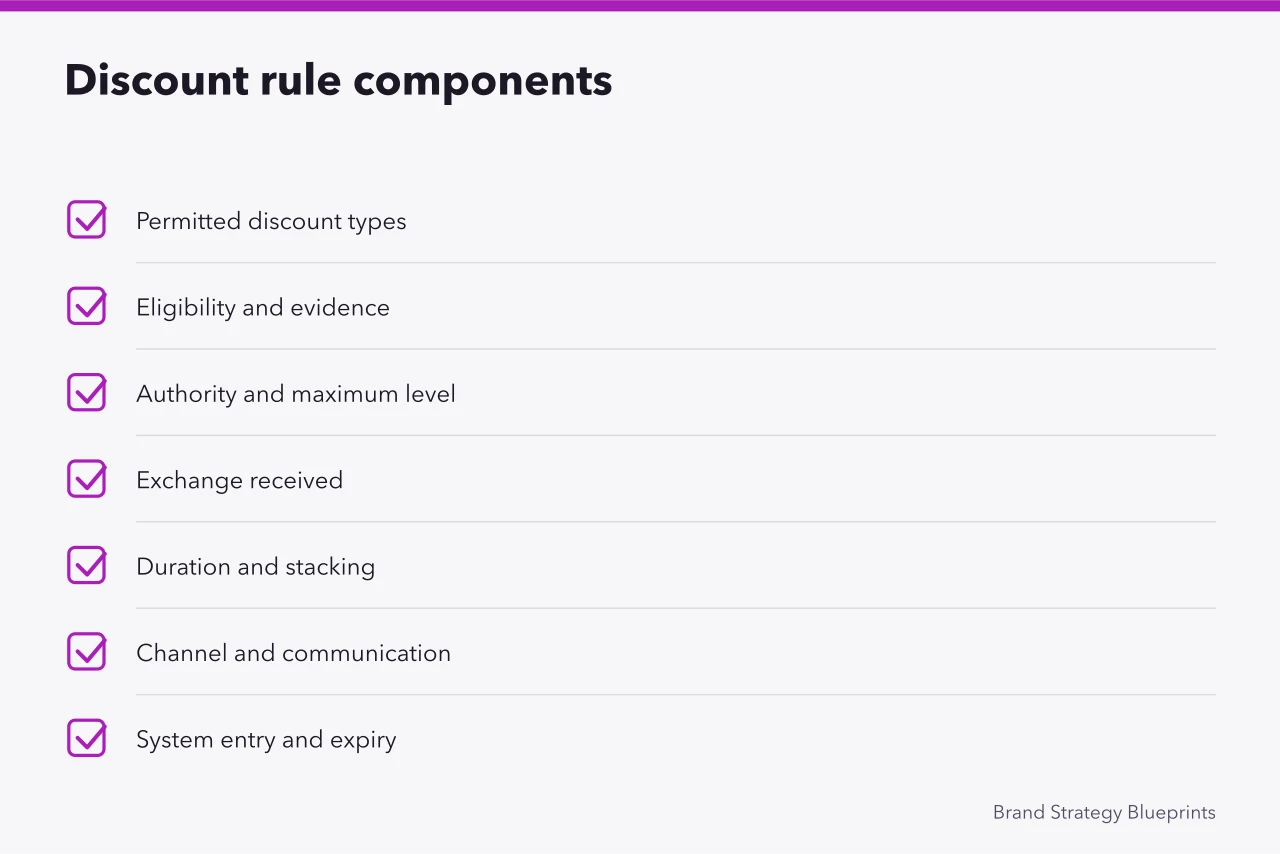
Exceptions can support a strategic account, verified hardship, service failure, volume, or commitment, but uncontrolled exceptions destroy price integrity and forecasting. Set approval thresholds, independent review for conflicts, audit history, and a path back to standard terms.
Design promotions without false references
U.S. reference-price guidance is specific about the evidence behind a claimed bargain. The current eCFR Guides Against Deceptive Pricing explain that a former price should be bona fide, that comparison prices must be factual, and that material conditions on bargain offers should be clear. Review current federal, state, sector, and local rules for the actual offer.
The citation is 16 CFR Part 233. Check the edition date shown on the linked eCFR page before applying it.
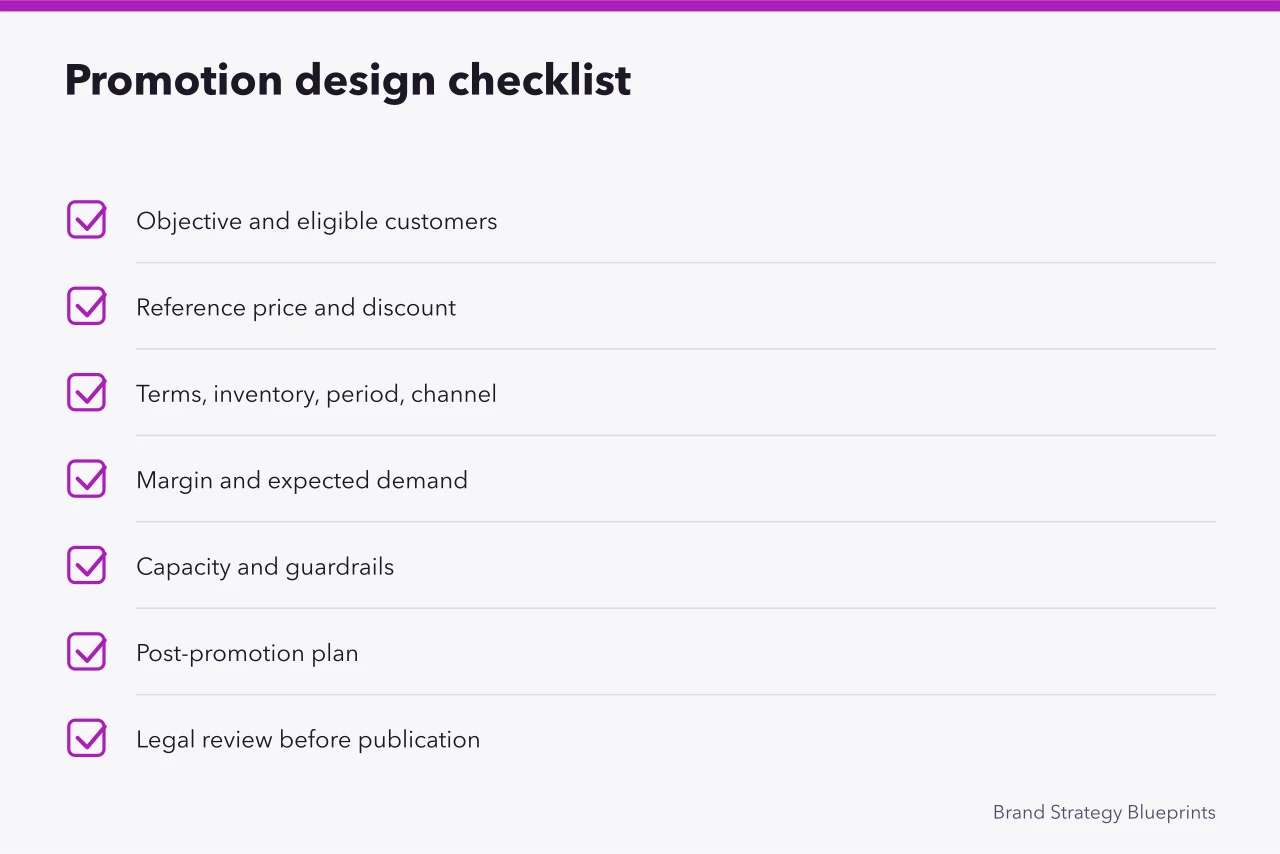
Specify objective, eligible customers, reference price, discount, terms, inventory, period, channel, margin, expected demand, capacity, guardrails, and post-promotion plan. A temporary price should not create a misleading reference or imply availability that the business cannot supply.
The FTC's small-business guidance states that truthfulness standards apply to price comparisons and sale prices. The current version sits at ftc.gov under advertising and marketing basics. Review current rules, including any sector-specific total-price or fee requirements, with qualified counsel before publication.
Communicate the complete offer
Show what is included, excluded, mandatory, optional, recurring, usage-based, refundable, taxable, time-limited, or subject to change. Explain units, billing cadence, renewal, cancellation, overage, delivery, support, discounts, and material conditions near the price in clear language.
Test comprehension with representative customers, including mobile and accessible experiences. Check ads, landing pages, sales materials, quotes, checkout, contracts, invoices, receipts, help content, and service scripts for consistency. A disclosure is ineffective if it arrives after the decision or contradicts the headline.
Prepare systems and operations
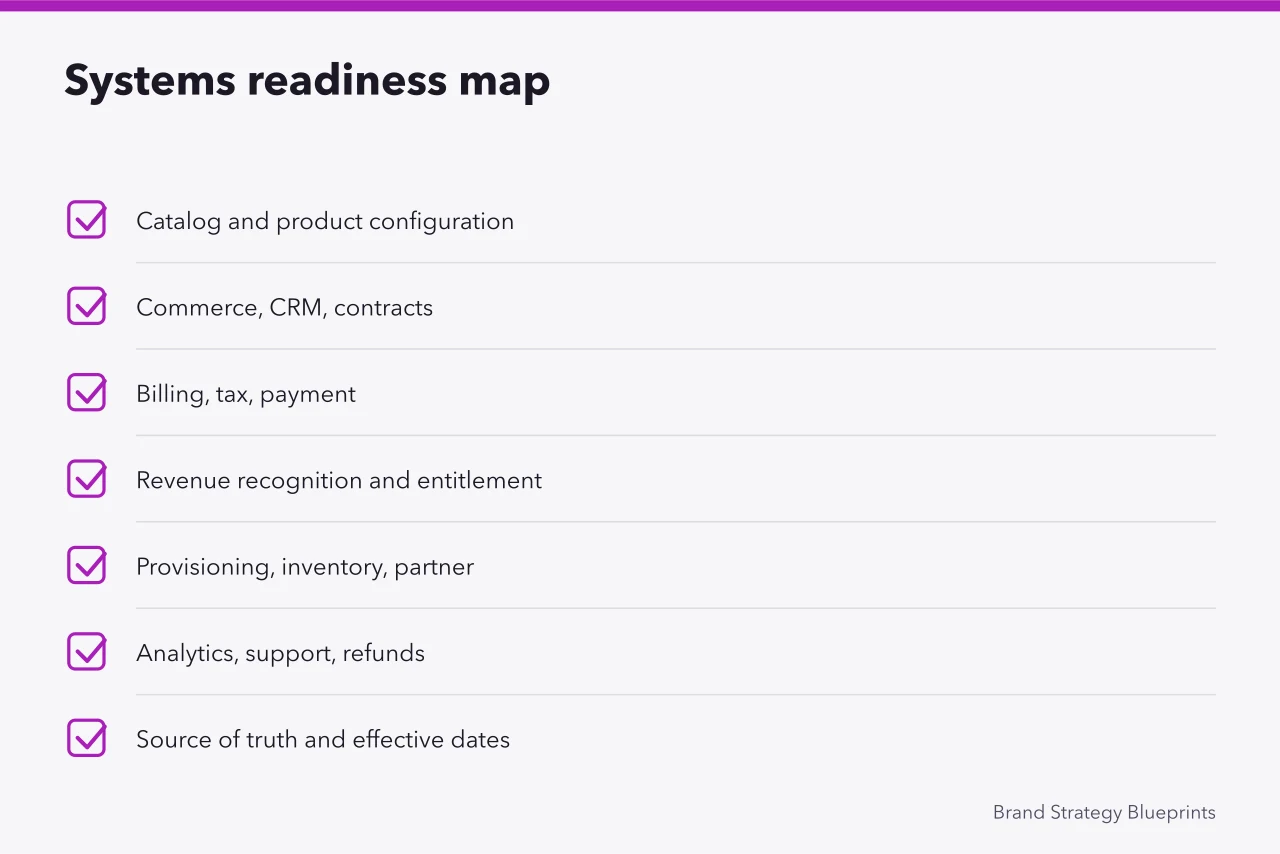
Plan migration for current customers, quotes in progress, channel inventory, regional teams, partners, renewals, and legacy contracts. Set customer notification, consent or acceptance where required, grace periods, dispute handling, and rollback. A pricing change is not ready while one critical system still uses the old rule.
Migration steps: freeze new quotes on the old price book, map each legacy contract to its replacement price, and decide grandfathering, notice period, and proration in writing. Move customers in dated waves with a named owner per wave, then reconcile the moved list against the contract system.
Billing steps: confirm the metric maps to billable units, rounding, minimums, proration, tax treatment, invoice timing, dunning, credit memos, and refunds. Run one cycle of parallel invoicing and compare every line against the approved price list.
Rollback steps: set a trigger before cutover, such as an error rate or a variance above plan, plus the window for reversal and the path back to the previous price book. Keep the old rules runnable for one full billing cycle and rehearse the switch on a test account.
Typical billing platforms include Stripe Billing, Chargebee, Recurly, NetSuite, and Salesforce CPQ. Whichever system is used, test the price book, tax rules, and credit memo path before launch.
Pilot and test proportionately
Use research, simulations, sales pilots, geographic or product phases, or controlled experiments. Predefine the decision, treatment, comparison, assignment, primary outcome, customer guardrails, sample need, duration, contamination, stop rule, and analysis. The primary outcome should trace back to the marketing goals and objectives the business already set.
Pricing tests can affect trust, fairness, and future reference prices. Avoid hidden individual variation that customers would reasonably view as unfair or that creates legal risk. Use clear eligibility and qualified review. When controlled testing is inappropriate, state the limits of alternative evidence.
Monitor beyond immediate conversion
Track exposure, comprehension, conversion, quantity, mix, discount, activation, retention, upgrades, downgrades, churn, returns, complaints, support, sales exceptions, collection, and customer outcomes by mature cohort. Monitor data quality and operational errors.
Separate descriptive differences from incremental effects. A higher-priced group may differ in need, product, market, or channel. Use experiments or qualified causal methods where possible, and explain uncertainty. Do not declare success from revenue alone while customer or margin guardrails fail.
Govern changes and reviews
Create a pricing council or equivalent decision process with accountable business ownership and finance, product, sales, service, operations, analytics, legal, tax, privacy, accessibility, and technology input. Define approval thresholds, conflicts, emergency changes, documentation, and communication.
Review assumptions, competitor evidence, costs, mix, capacity, exceptions, complaints, forecast error, and customer outcomes on a cadence appropriate to the business. Marketing planning is where that cadence meets the rest of the calendar. Preserve original prices, effective dates, models, approvals, and decisions. Retire temporary offers and obsolete system rules.
Use a practical 2027 pricing workflow
- Define the customer, offer, market, transaction, price decision, owner, constraints, and prohibited uses.
- Research value, alternatives, buying process, access, risk, and customer variation with documented methods.
- Map full cost, contribution, cash, capacity, tax, currency, channel, and downside scenarios.
- Choose price metrics, packages, fences, discounts, fees, renewals, and exception rules as one architecture.
- Model demand, mix, retention, operations, and customer effects under conservative, central, and upside cases.
- Review competition, advertising, total price, contracts, fairness, and sector obligations with qualified specialists.
- Test communication, systems, migration, billing, fulfillment, support, reporting, and rollback before launch.
- Pilot where appropriate, monitor mature outcomes and guardrails, preserve decisions, and revise through evidence.
Good pricing strategy connects value, economics, customer understanding, and operating reality. It makes the complete offer clear, supports responsible exceptions, and preserves the evidence behind change. The goal is not the highest possible number; it is a sustainable exchange that the business can explain, deliver, govern, and improve.
Pricing decision record
| Decision layer | Evidence | Release control |
|---|---|---|
| Customer exchange | Value, alternatives, access | Comprehension check |
| Economics | Full cost, demand, cash, capacity | Scenario threshold |
| Architecture | Metric, packages, terms, exceptions | Transaction test |
| Change | Approval, effective date, outcomes | Stop or rollback rule |
Verify pricing strategy before release
The GAO evaluation design guide explains how evaluation questions, evidence needs, and design choices fit together.
The W3C Privacy Principles statement gives system designers a shared vocabulary for privacy and warns against shifting privacy work onto individuals.
The GOV.UK technology selection guidance recommends choices that can change over time, preserve data control, address security risk, and include ownership cost.
Each source covers a neighbouring discipline, not pricing itself, so treat the three as optional reading. Apply these checks to the actual pricing strategy workflow. Record the tested data, roles, product versions, exceptions, and approval date.
Common questions
What is a pricing strategy?
It is the logic and operating system connecting customer value, economics, price structure, terms, communication, execution, exceptions, measurement, and change.
Is cost-plus pricing enough?
Usually not. Full cost sets an economic constraint, while customer value, alternatives, demand, positioning, capacity, access, and risk shape the decision.
How often should pricing be reviewed?
Use a cadence suited to the business plus event-driven reviews when value, costs, demand, competition, regulation, capacity, or customer outcomes change materially.