Rules
Part of Pricing architecture: what the experienced already know for 2027
Pricing architecture checklist from the ground up as of 2027
Pricing architecture checklist: twelve audits run against your own invoices, contracts and approval records, with what each finding should change.
This audit covers what your company actually charges, not what it meant to charge. Each check uses a document you already have: an invoice, a contract, a billing export, or an approval record.
None require an opinion. Several will produce a finding that surprises the person who set the prices.
Set aside a week. Work in order, because the later checks assume you have the list the earlier ones produce.
What to take away
- Your real pricing structure lives in your invoices and contracts, not on your price page. Read those first.
- Most of these checks fail on their own record-keeping rather than on the price, and that is the more useful finding.
- Finish with a named owner and a date. A structure nobody owns drifts back within a year.
What the invoices say
1. List every distinct realized price you are actually charging. Take a defined period, divide collected revenue per account by units of your billing metric, and sort the result. You are looking for the spread, not the average. Two accounts of similar size at very different realized prices is either a segmentation you designed or a discount history you inherited, and you need to know which.
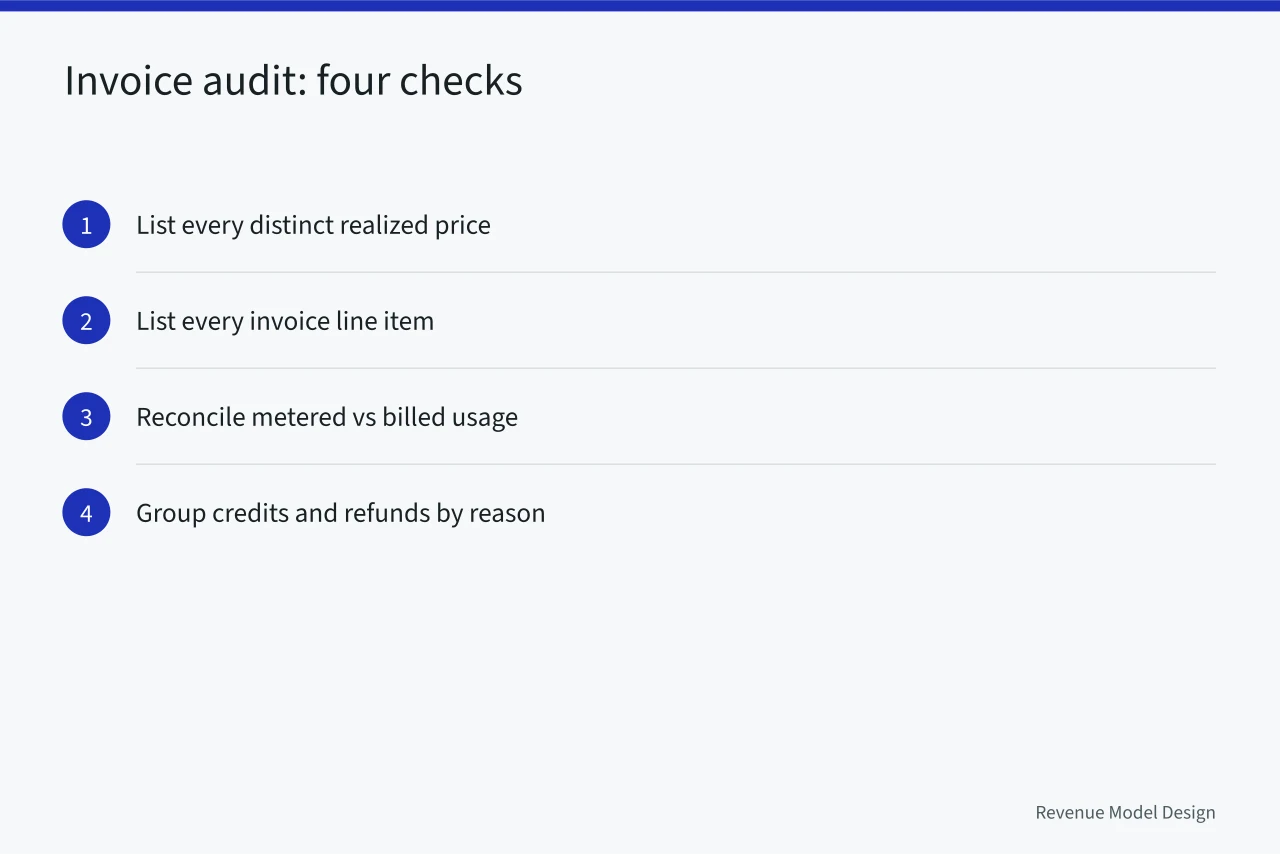
2. List every line item that appears on any invoice, and find someone who can explain each one. Set-up fees nobody charges any more, a support line that duplicates something already included, a legacy charge that survived a product being retired. Anything that cannot be explained in a sentence should not be on a document you send to customers.
3. Reconcile what you metered against what you billed, for one month. Count the events your systems recorded, count what appeared on invoices, and explain the difference. Both directions matter: unbilled usage is money you gave away, and billed usage with no record behind it is a dispute you will lose. If this check takes more than a day, that is the finding, and the definitions it depends on are the ones set out in business model types metrics.
4. Pull every credit and refund issued in the last year and group them by reason. Concentrations here are a map of your structure's weak points. Repeated credits for the same cause mean the price is producing an outcome you keep having to undo by hand.
What the contracts say
5. List every price lock and capped increase, with the account and the expiry date. Then check that the renewal team has that list. A protection nobody tracked is honored forever by accident, and discovered when someone tries to raise a price.
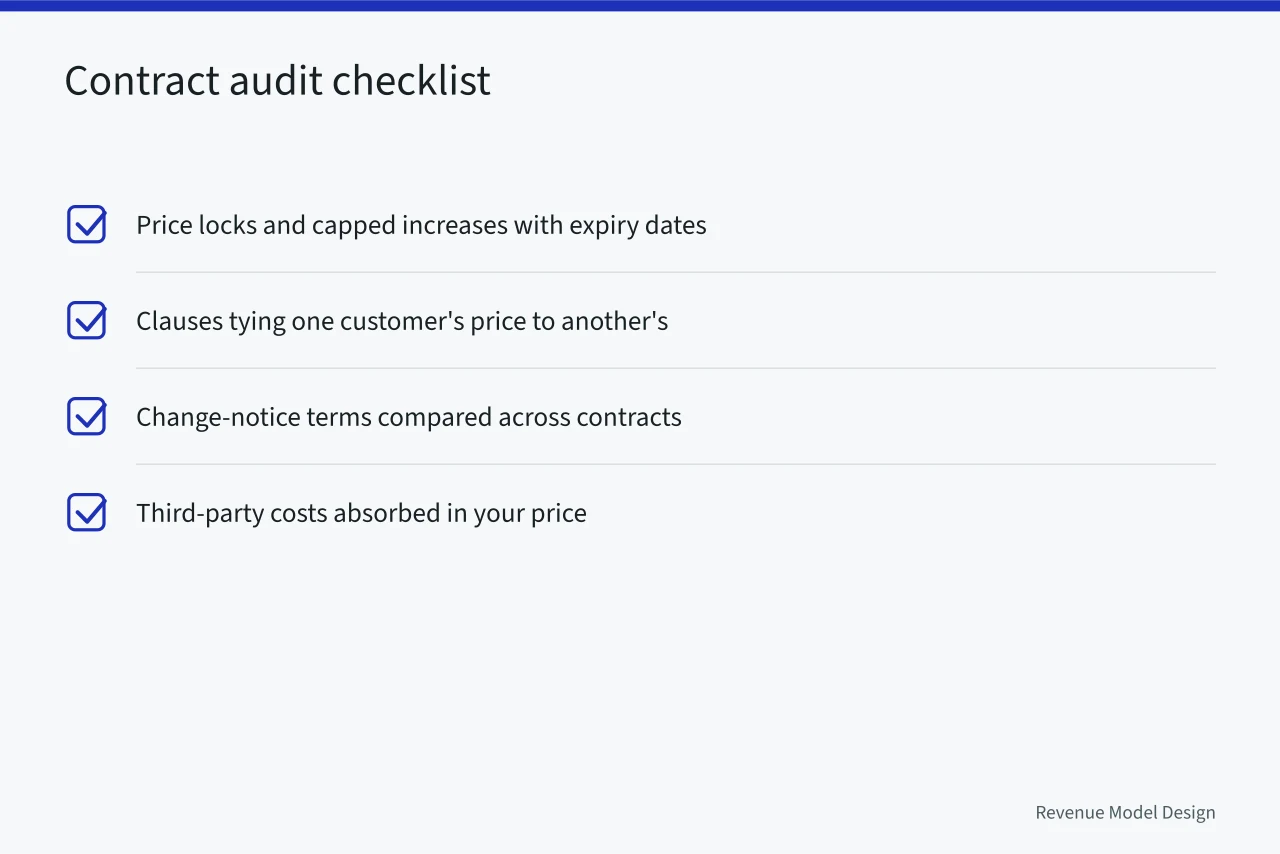
6. Find every clause that ties one customer's price to another's. Most-favored-customer terms, benchmarking rights, and any promise that a discount will be matched later. These clauses turn a single exception into a company-wide constraint, and they are almost never visible from the billing system. Where the customers concerned compete with each other, the differences also carry a legal dimension worth understanding before you write another one, and the doctrine is summarized under price discrimination.
7. Compare the change-notice terms across your contracts. How much notice a price increase requires, whether it can happen mid-term, and what the customer may do in response. If three different answers exist across your book, you have three change rules and no policy, and every future increase will be argued account by account. What each version actually obliges you to do is decided on the wording rather than on the intention, which is the ordinary rule for breach of contract.
8. List every third-party cost you absorb rather than pass through. Payment processing, capacity, shipping, licenses, data. For each, write down who can change it, how much notice you would get, and whether your contracts permit you to pass a change on. Every unpassed cost is a margin exposure you underwrote on somebody else's behalf, and what that does to your economics is the arithmetic in unit economics.
Who can change what
9. Check who is authorized to approve a discount, then check who actually approved the last twenty. The gap between the policy and the record is your real approval process. If the two match, say so in writing and move on. If they do not, fix the record-keeping before you tighten the rule, because a rule you cannot audit is a rule you do not have.
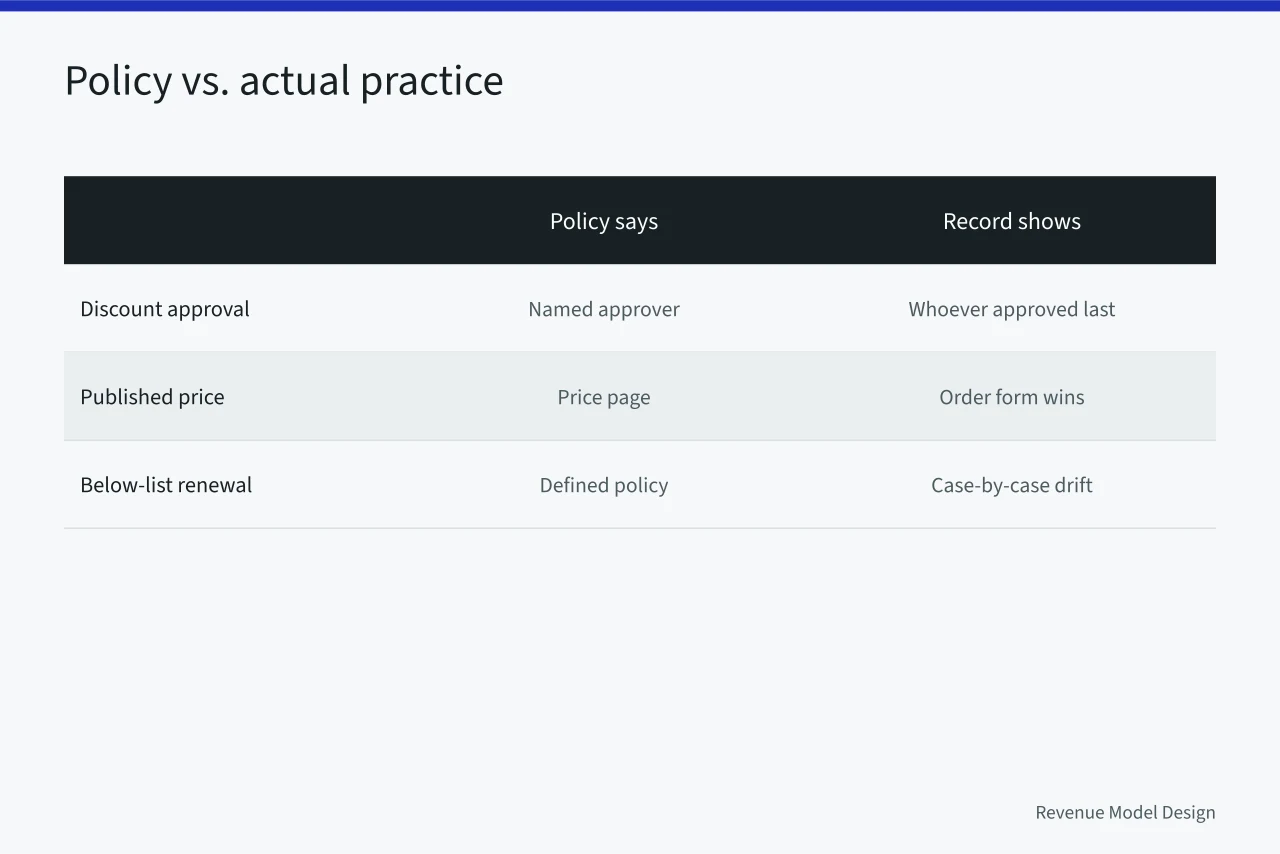
10. Compare your published prices with your standard contract and your actual quotes. All three should describe the same structure. Where the price page says one thing and the order form says another, the order form wins in an argument, and the price page is generating expectations you do not honor.
11. Work out what happens at renewal to a customer whose contract price sits below current list. There are only a few possible policies: hold them, raise them to list, raise them by a fixed step, or decide account by account. Any of those can be defended. Having no answer means the decision is made by whoever handles the renewal, differently each time, which is how a book of subscription models ends up with its oldest accounts paying the least.
Whether anyone owns it
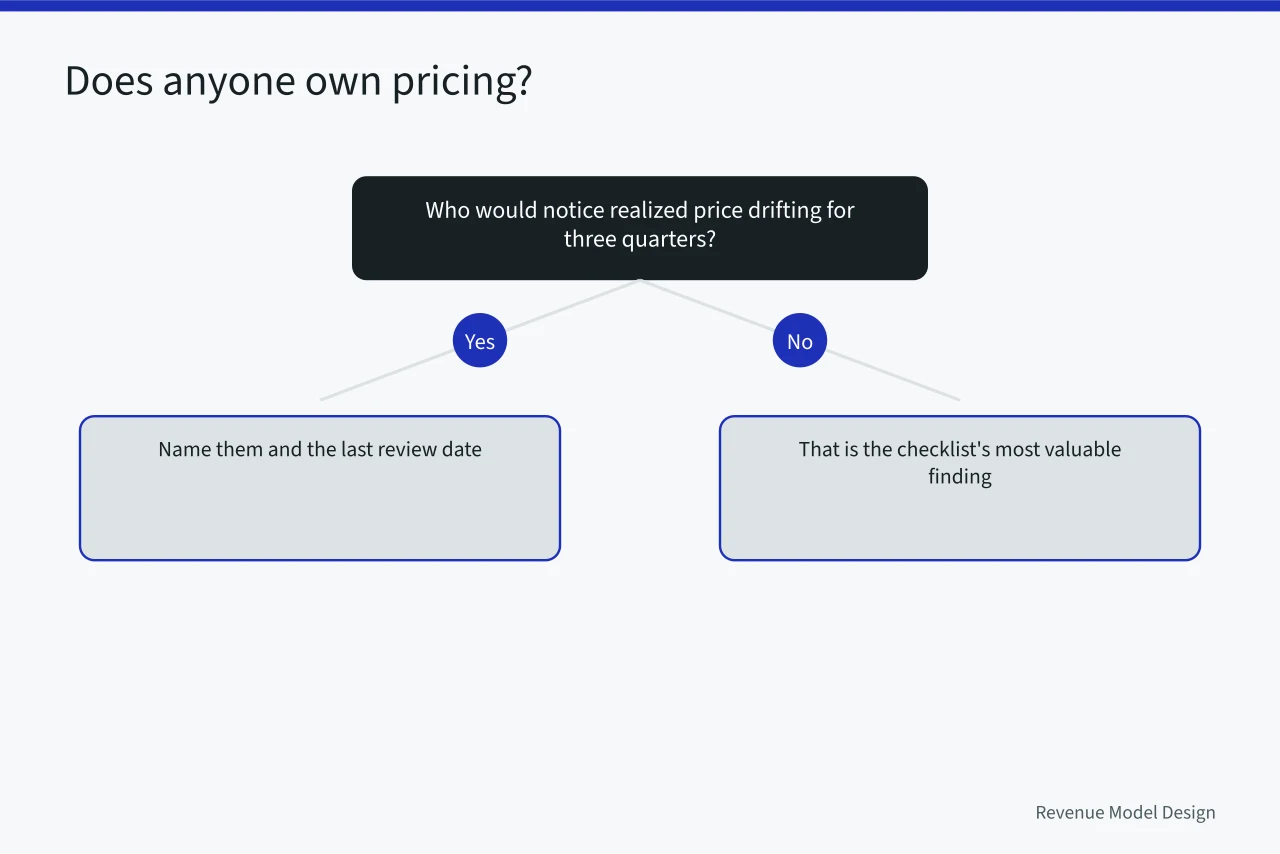
12. Name the person who owns pricing, and the date it was last reviewed deliberately. Not the person who signs off changes: the person who would notice that realized price has been drifting for three quarters. If the honest answer is that nobody owns it, that is the most valuable output of this checklist, and it costs nothing to fix.
What to do with the findings
Sort them into three piles rather than one list.
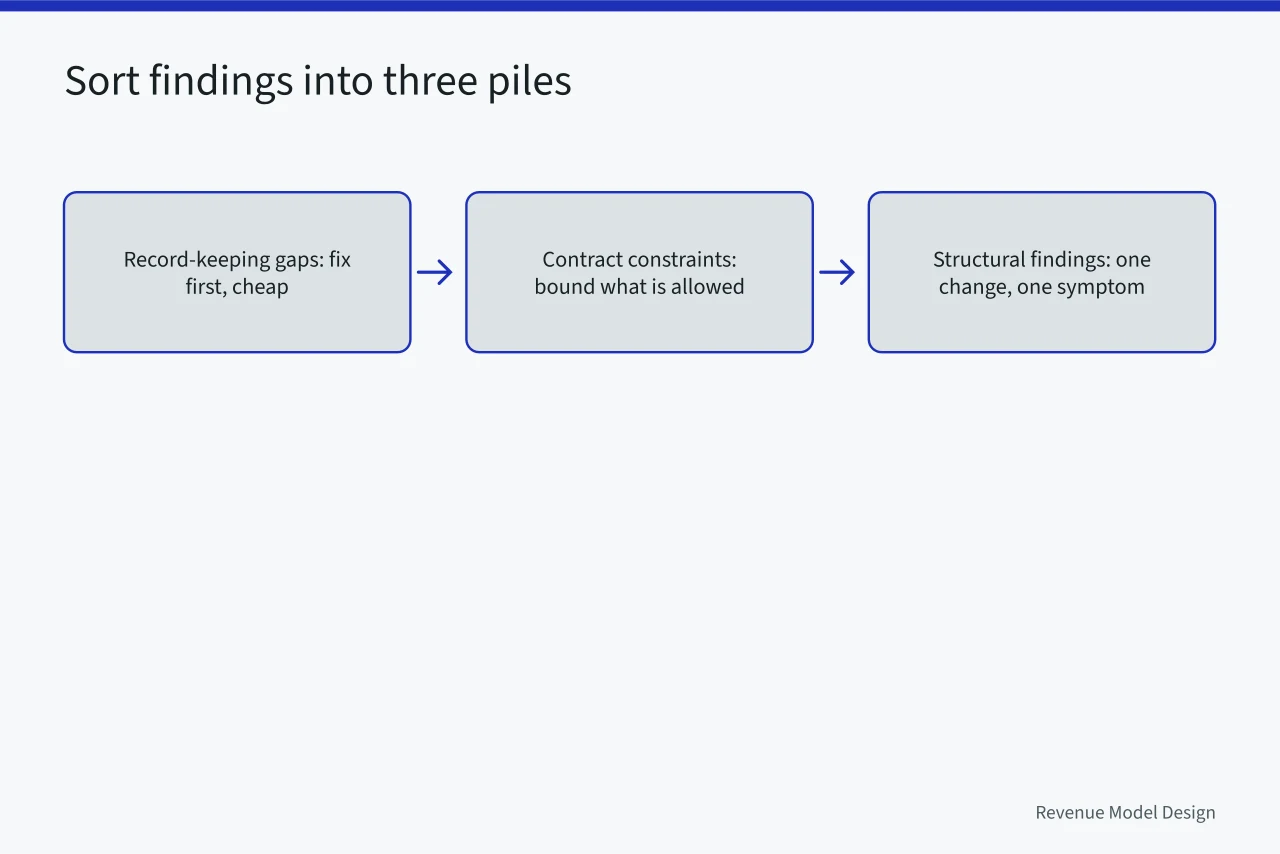
Resist merging the piles. Record-keeping problems dressed up as pricing problems produce a repricing that fixes nothing, and contract constraints discovered halfway through a change turn a plan into an apology.
Common questions
How long should this take?
A week for a company with a few dozen accounts, longer where contracts are individually negotiated. If it takes a month, the length itself is the finding, and it is worth reporting as one.
Can we run it on a sample?
For the invoice checks, yes, provided the sample includes your largest accounts and your oldest ones. For the contract checks, no: the whole point is the unusual clause, and a sample is designed to miss it.
We are pre-revenue. Is any of this useful?
Checks 7, 11 and 12 are, before you sign anything. Deciding your notice terms, your renewal policy, and your owner while you still have negotiating room is far cheaper than discovering them later. The wider set of decisions this sits inside is in the pricing architecture overview.
Should the results be shared internally?
The structural findings, yes. The realized price list, carefully: it is a document that tells any reader exactly what to ask for.