Reviews
Part of Pricing architecture: what the experienced already know for 2027
How to judge pricing architecture tools before you sign a contract
Best pricing architecture tools 2027: the four records a price structure has to leave behind, when a spreadsheet is enough, and the reconstruct test.
Software does not set pricing. It sets who may depart from it and whether anyone can reconstruct what was agreed later. Authority and memory are the two jobs of a pricing toolchain.
Get them right and a company can run a complex structure on modest tools. Get them wrong and it cannot run a simple one.
What to take away
- The question is where pricing authority lives and where it is recorded, not which product you buy.
- Most of what is needed is configuration in systems you already own. Buy something new only when a specific trigger has fired.
- The test that matters: for any account, can you reconstruct what was agreed, by whom, and when, without asking a person?
No products are named here
A shortlist helps. The useful part of this decision is not the product. Nearly every capability below is a setting inside a customer record, document, or billing system you already pay for.
Companies that struggle rarely have the wrong software. They are the ones where nobody decided who may approve an exception.
Choose the policy first. Then buy whatever enforces it, if anything needs to.
The four things that have to be held somewhere
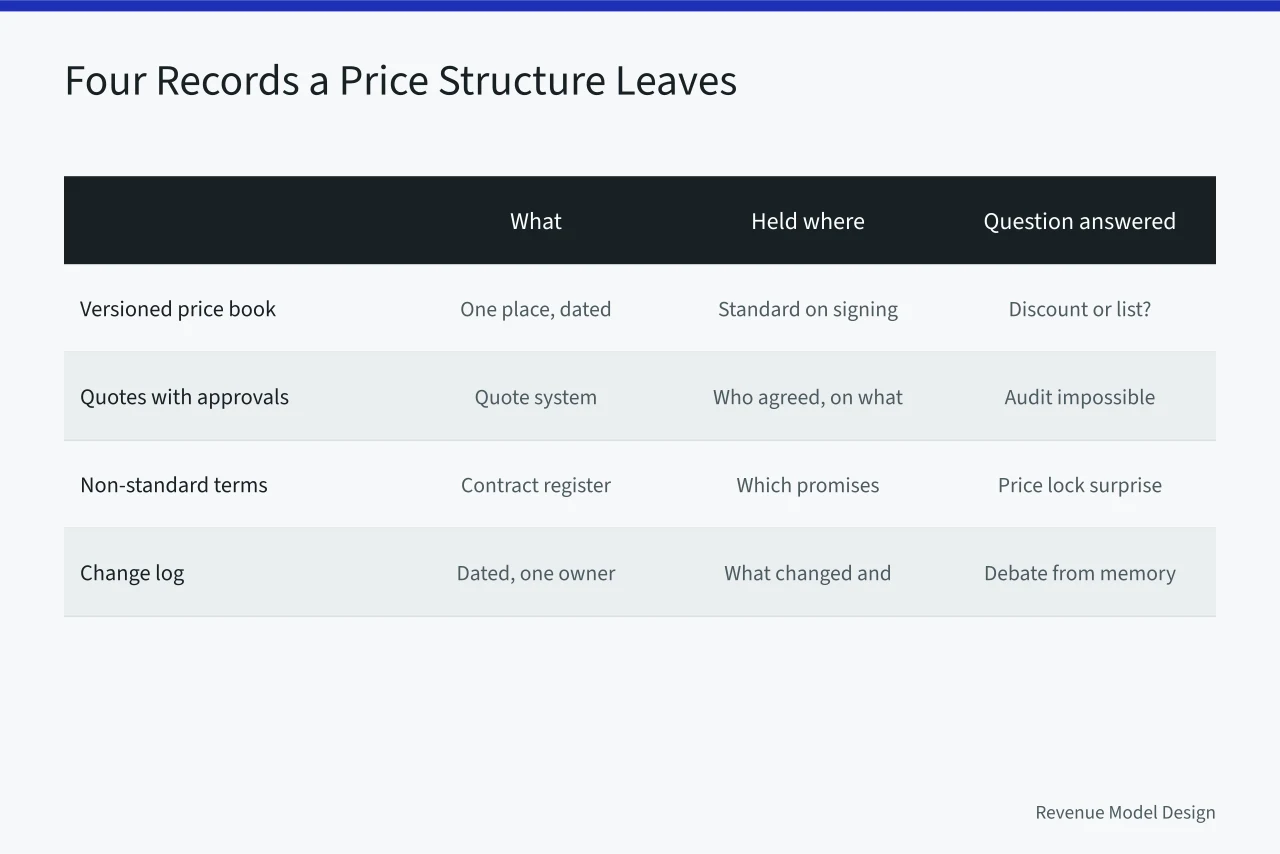
| What | Held where it can be | The question it answers | The symptom when it is missing |
|---|---|---|---|
| A versioned price book | One place, with dated versions kept | What was standard on the day this deal was signed | Nobody can say whether a price was a discount or the list at the time |
| Quotes with an approval record | The system that produces the quote | Who agreed to this departure, and on what basis | Approvals live in message threads and cannot be audited |
| Non-standard contract terms | Extracted from the contract into a register | Which promises constrain what we can change | A price lock discovered when a raise is attempted |
| A change log | A dated document with one owner | What we changed, when, and what we concluded | Every repricing debate restarts from memory |
Keeping old versions of the price book is the item most often skipped and the one that pays back the most. Without it you cannot distinguish a customer who negotiated hard from a customer who bought when the list was lower, and those two accounts deserve completely different renewal conversations.
When a spreadsheet is genuinely enough
For a single structure, a handful of approvers and a book you can read in an afternoon, a maintained spreadsheet plus a document folder does all four jobs. It is not a compromise; it is proportionate.
The triggers that mean you have outgrown it are specific, and each is worth watching for.
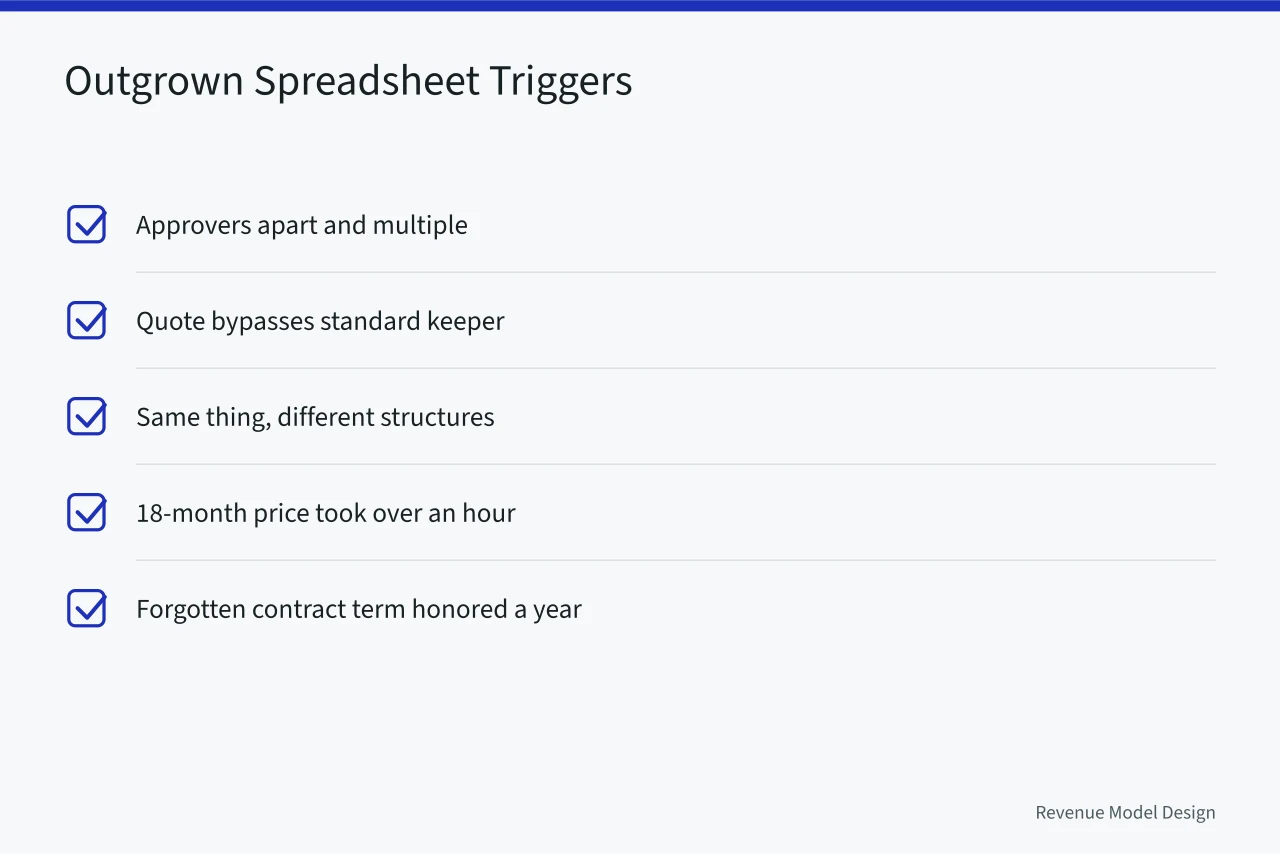
Any two of those firing together is the point at which tooling starts to repay its cost. Before that, the work is writing the policy down, and it belongs with the other standing decisions in the business model types checklist.
Buying criteria that do not go stale
If you are evaluating something, judge it on these rather than on a feature list.
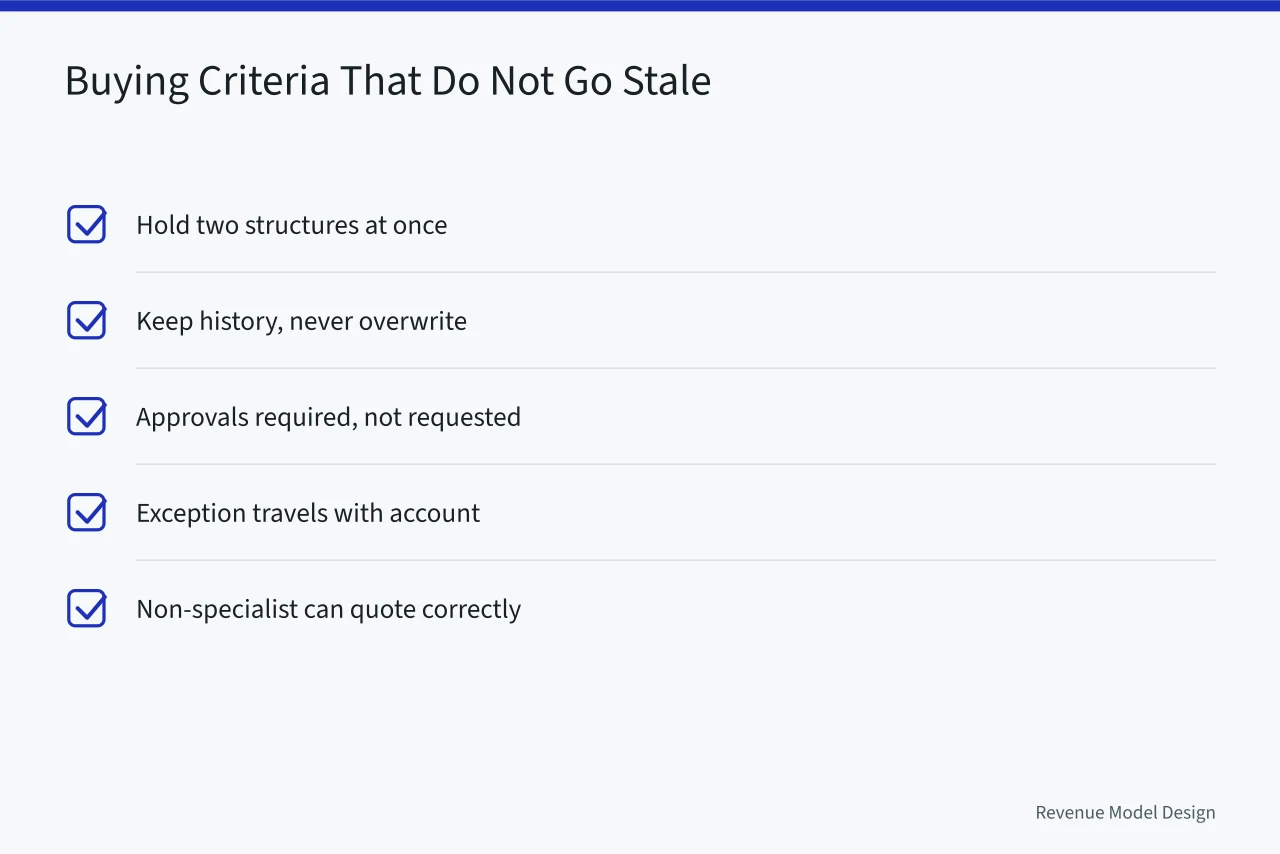
Can it hold two structures at the same time? You will have both the moment you change anything. A system that models only the current price forces you to choose between raising prices and honoring promises.
Does it keep history, or overwrite it? Ask to see what a record looked like before its last change. Systems that overwrite silently destroy exactly the evidence you would need in a dispute. What each side has to be able to show is decided on the wording of the agreement and the record behind it, which is the ordinary rule in a claim for breach of contract.
Can approvals be required, not merely requested? The difference between a workflow that blocks and one that notifies is the difference between a policy and a preference.
Does the exception travel with the account? A term agreed in a contract has to be visible to the person handling the renewal three years later, ideally without them opening the contract.
Can a non-specialist produce a quote correctly? If correct quoting depends on one person's knowledge, that person is your pricing system, and they will eventually be on holiday.
The reconstruct test
Before you commit to anything, run this on your current setup with a real account chosen at random. In fifteen minutes, without asking a colleague, establish: what the standard price was on the day they signed, what they were actually charged, what was non-standard about it, who approved that, and what has changed since.
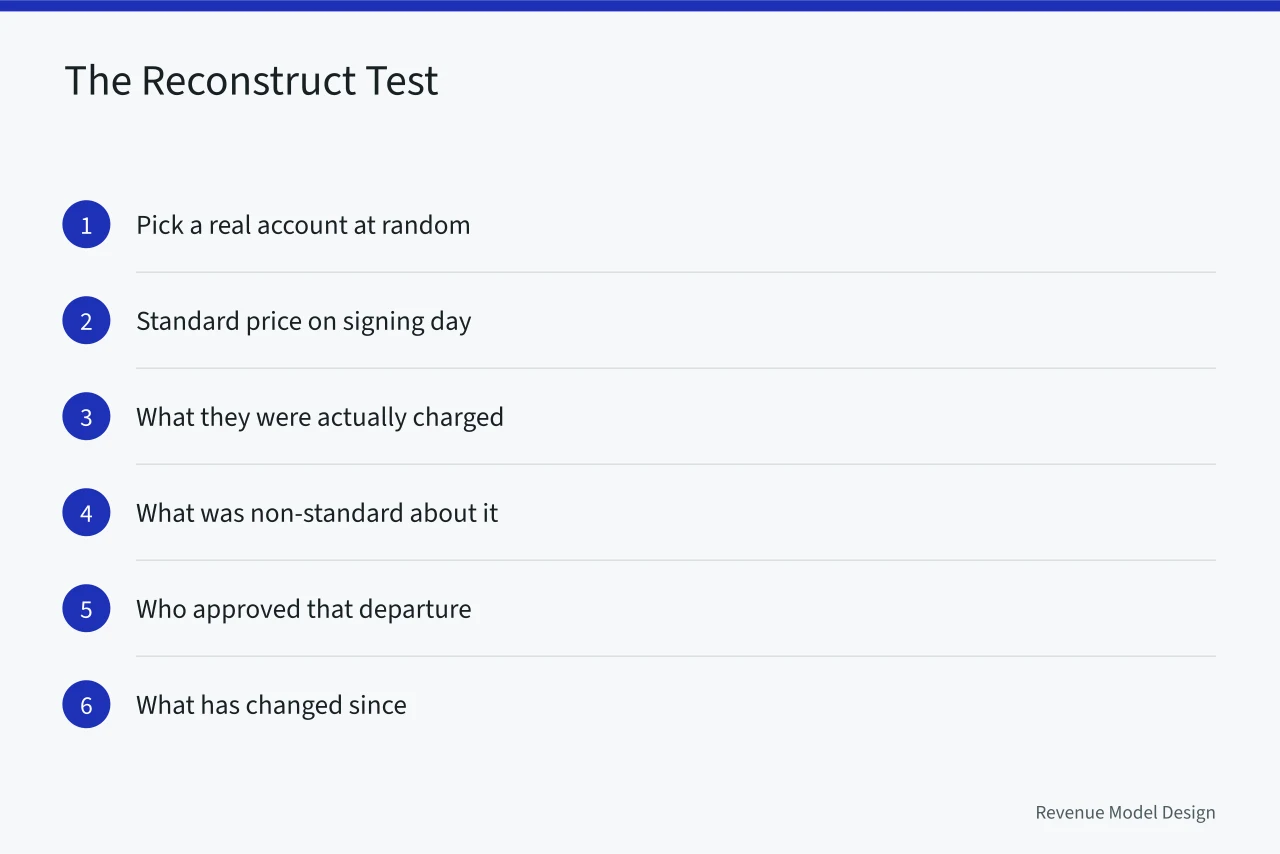
Most companies fail this the first time, and the failure is instructive because it points at which of the four records is missing rather than at a product. Fix that record. If a tool is the cheapest way to fix it, buy the tool; the record is the deliverable, not the software.
The equivalent question on the billing side is what a system can represent rather than what it remembers, and what it has to represent follows from your capture event, which is the subject of the revenue models overview.
What no tool fixes
Three things, worth saying because they get bought at repeatedly.
A tool cannot tell whether a discount was necessary, because the deal not done leaves no record.
A tool cannot settle whether a price is right. That is a judgment about customers, not a calculation, treated as its own subject in MIT's pricing course. Definitional traps make such comparisons unreliable, as set out in business model types metrics.
A tool cannot create authority: if the person with the title is routinely overruled by the person with the deal, workflow software will simply record that happening.
Fix the authority question in a conversation. Then the tooling is straightforward, and often already installed. The structural decisions all of this is protecting are in the pricing architecture overview.
Common questions
What should we set up first?
The versioned price book. It costs nothing, it starts accumulating value immediately, and every other record refers to it.
Do we need a dedicated quoting system?
Only once quoting has left the room where the standard lives. Until then a locked template and a required approver do the same job.
How much history should we keep?
At least as long as your longest contract term plus one renewal cycle, and longer where an agreement caps future increases. That is the period in which somebody can still ask what was agreed.
Our sales team says approvals slow deals down.
Sometimes true, and worth measuring rather than debating. Set the approval threshold so that routine deals pass untouched and only real departures stop, then look at what actually stopped. Approvals that block everything get bypassed, and a bypassed control is one of the business model types mistakes rather than an argument for removing it.