Costs
Part of Getting service models right the first time
Five pressures pushing service models toward fixed fees this year
Service models trends worth watching in 2027: pressure toward fixed fees, senior-hour scarcity, subcontracted delivery, and what each does to the effective rate.
A trend is only useful if it changes a decision. Most trend writing about professional services does not, because it describes a direction without saying what the reader should do differently on Monday.
Below are the five pressures pushing service models toward fixed fees this year. For each one: the named mechanism, what it does to the arithmetic, and what would count as evidence that it reached your own firm. The worked examples use round numbers to show the mechanism, not survey results.
What to take away
- Buyers moving toward fixed fees are moving risk onto you. Price the risk or decline it; do not absorb it silently.
- Scarcity of senior people raises the value of anything that lets work be delivered without them.
- Every one of these pressures shows up first in the effective rate, months before it shows up in revenue.
Pressure one: firm-fixed-price procurement, from FAR 16.202 to SAP Ariba
Approval processes on the buying side need a figure before the work starts. Federal agencies buy under FAR 16.202, the firm-fixed-price contract type that puts cost risk on the contractor.
GSA publishes awarded hourly rates by labor category on GSA eLibrary, so buyers compare numbers before they call you. SAP Ariba and Coupa both require a price on the requisition before the approval route runs.
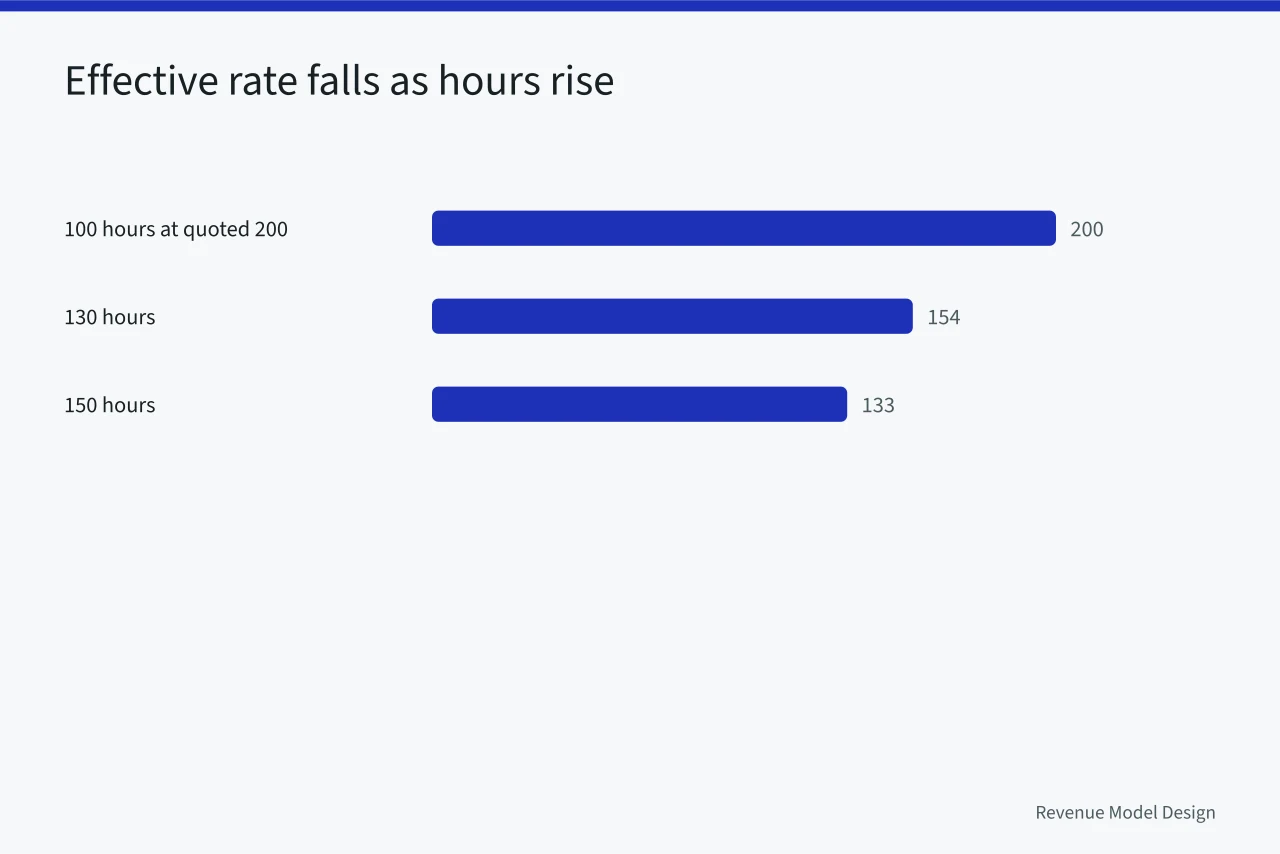
The mechanism is about who absorbs variance. A fee built from 100 hours at a quoted 200 yields an effective rate of 154 at 130 hours and 133 at 150 hours. No discount is agreed anywhere in that.
The response is to charge for certainty instead of pretending it is free, and to keep a phased option for work whose length is unknown. The structural version of that choice is in pricing architecture.
Evidence in your own book: the share of new engagements sold as a fixed fee, and the effective rate on those compared with hourly work over the same period.
Pressure two: the Cravath scale and the shrinking senior bench
When experienced people are hard to hire and expensive to keep, a firm's ceiling tightens. The Cravath scale, the pay ladder large US law firms follow, put first-year base pay near $225,000 after Milbank's raise in late 2024.
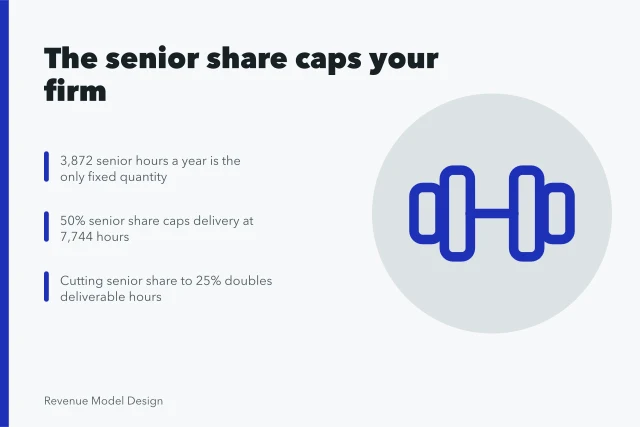
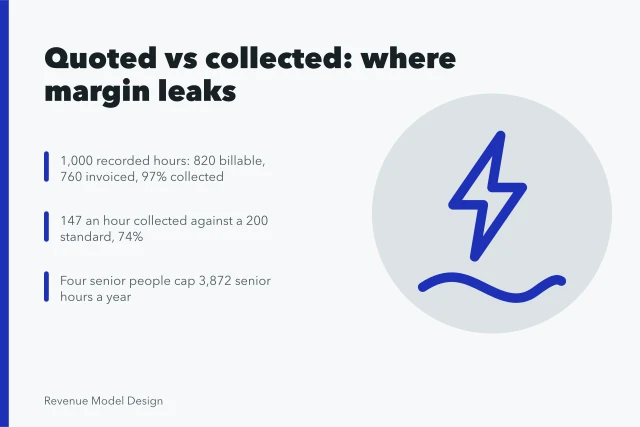
The AICPA's Trends report tracks a thinning pipeline of accounting graduates, and most states require 150 semester hours before the CPA exam. Four senior people working 44 weeks at 22 sellable hours a week hold 3,872 hours.
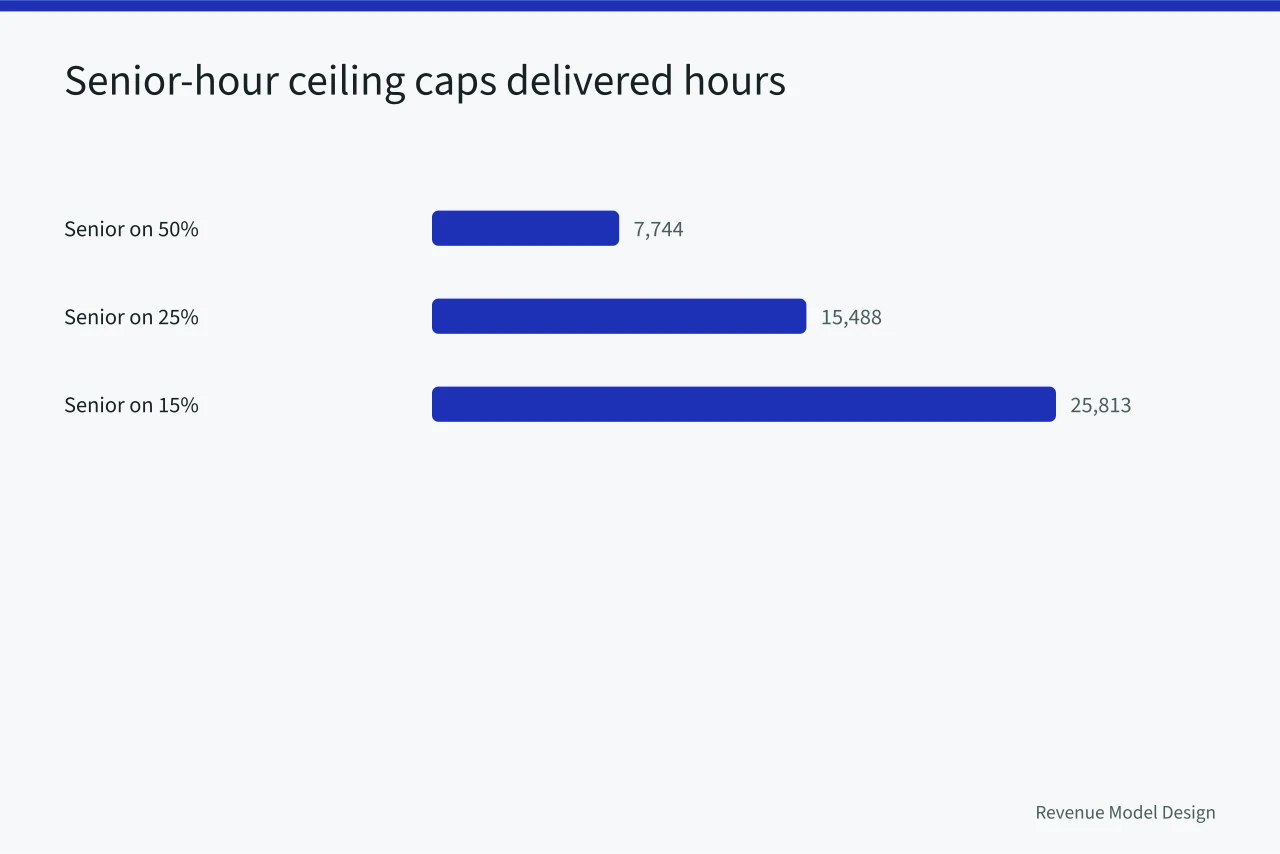
If practice needs a senior on half of everything delivered, the firm is capped at 7,744 delivered hours. At a quarter it is 15,488, and at fifteen percent it is 25,813.
The pressure raises the return on anything that lowers that share: written method, worked examples, a defined review point, and tooling that removes preparation rather than judgment. It also raises the cost of the informal habit where a partner redoes work instead of reviewing it. The capacity argument in full is in service models.
Evidence in your own book: the share of delivered hours in a month that a senior person had to touch, tracked as a single number over four quarters.
Pressure three: Axiom, Integreon and the Big Four delivery centers
Subcontracting and associate networks let a firm take work it cannot staff. What they do not do is move review and client relationship, both of which stay on the same senior calendar. The result is a firm that raised delivery capacity and did not raise its ceiling, which feels like the trend failed.
Axiom staffs and manages legal work with its own lawyers, so a client can buy an outcome instead of a headcount. Integreon runs delivery centers in India and the Philippines for contract review and document work.
EY Global Delivery Services, PwC Acceleration Centers and KPMG Global Services are the Big Four's own captives in India, with additional sites in Poland. Upwork publishes rate benchmarks in its Freelance Forward research, and Toptal screens applicants before listing them.
There is also a margin question. Subcontracted hours arrive with a cost attached, so the gross margin on that work is lower, and blending it into a single firm-wide margin hides which work is which. Keep them as separate books.
Evidence in your own book: gross margin on subcontracted delivery against in-house delivery, computed separately, and the senior hours consumed per subcontracted hour.
Pressure four: subscription cures and outcome payments
Buyers ask for payment tied to a result more often when they cannot judge the work itself. That is not automatically bad for the seller. Carrying a client's risk is a service and can be priced.
Louisiana's 2019 hepatitis C subscription is the clearest example. The state paid Asegua Therapeutics, a Gilead subsidiary, a fixed sum reported at roughly $58 million over five years for unlimited treatment. Washington state signed a similar deal. CMS lets state Medicaid programs sign value-based supplemental rebate agreements that pay only if a drug performs.
Dispute work moves the same way. Burford Capital funds commercial claims and reports its portfolio in public filings. A relator who sues under the False Claims Act usually receives 15 to 30 percent of the recovery.
What makes it dangerous is measurement. Define the outcome loosely, and the disagreement arrives after the work is done and after the money is spent.
Agreeing a remedy for a defined shortfall before work begins is a normal contract question. liquidated damages is the doctrine that judges that agreement. Written after the fact, it is a dispute instead.
Evidence in your own book: how many outcome-linked engagements reached their trigger without a disagreement about whether the trigger had been met.
Pressure five: the ACC Value Challenge and the Mansfield Rule
Clients increasingly ask which named people will deliver, and hold the firm to the answer. The Association of Corporate Counsel launched its Value Challenge in 2008 to push outside counsel off hourly billing.
Diversity Lab's Mansfield Rule asks firms to consider at least 30 percent underrepresented lawyers in candidate pools, and it publishes the certified firms. Cisco's legal department has described paying outside counsel flat fees by matter type.
That converts an informal staffing flexibility into a contractual one, and it makes the senior-hour ceiling bind harder than it did.
The honest response is a delivery model you can describe: who does what, where the review sits, and what a mid-level person is trusted to run alone. Firms that cannot describe it quietly break the promise.
Sometimes this requires a different business, not a tidier one, as argued in model innovation. Put the cost consequences of each option in unit economics.
Evidence in your own book: how often the people named in a proposal were the people who delivered.
What not to do with a trend
Do not restructure on a direction you have only read about. Each pressure above has a measure attached, so check whether it has arrived in your numbers before you act.
A firm that changes its pricing model on a trend piece, and cannot say what would have changed its mind, has made a decision it cannot review later.
Testing a claimed effect against your own data rather than adopting it is the ordinary discipline of measurement. MIT's data mining course shows why a pattern in general is not evidence about a particular case.
Common questions
Which pressure matters most for a small firm?
The first and the second. A firm under ten people lives or dies on whether fixed fees are priced for variance and whether the founders are on every job.
Should we refuse fixed-fee work?
No. Refuse fixed fees on work you have not done before. On work you have done forty times, a fixed fee is where your margin comes from, because your variance is small and the buyer is paying you to remove theirs.
How far ahead can any of this be forecast?
Not far, and this page does not try. What it offers is five measures you can read in your own book, which is a better basis for a decision than any forecast about the sector.
Does tooling change the ceiling?
Only where it removes preparation, formatting, or search. Where the constraint is judgment and review, tooling moves the ceiling very little, and a firm that expects otherwise buys capacity it does not get.