Industry
Subscription models and the promises recurring revenue cannot break
Subscription models and the obligations recurring revenue creates: why retention compounds, the three churns that get one name, and when the shape is wrong.
"Subscription" describes how the invoice arrives. It says nothing about why anyone pays it. Two companies can bill identically every month and have opposite economics. One is delivering something the customer needs again this month; the other is collecting rent on a decision made two years ago that nobody has got round to reversing.
That difference is the whole subject. What follows is about the obligations recurring revenue creates, the arithmetic that makes retention compound, the three separate things people call churn, and the point at which a subscription is the wrong container for the value you provide.
What to take away
- Reporting "churn" as one number merges three problems with three different owners and three different fixes.
- Auto-renewal makes revenue predictable and makes you lazy, because it removes the moment when the customer has to agree that the last period was worth it.
- Longer terms with money up front pull cash forward, cut the frequency at which you are evaluated, and reduce the noise in your forecasts.
- Once a subscription business is any size at all, growth stops being about the number of new customers and starts being about what happens inside the existing base.
What you have actually promised
A one-time sale ends. A subscription is a standing commitment to keep being worth paying for, and it carries obligations that do not appear on the pricing page.
You promised to keep it working. That means support for as long as anyone subscribes, not a warranty period. You promised continuity, so the migrations, deprecations, and rewrites you want are negotiations.
You promised availability in a way a product sale does not. An outage in a subscription business is a breach of the current month's value, not an inconvenience.
There is a balance-sheet version: money collected for a period not yet delivered is a liability, not income.
That is an accounting fact and a useful discipline. Annual prepayment gives you cash you have not yet earned, and treating it as earned is the standard way a growing subscription business runs out of money while reporting growth.
The distinction between when income is earned and when it is received is set out in IRS Publication 538, and what it does to your arithmetic is the subject of unit economics.
Why retention compounds and acquisition does not
Retention is multiplicative. Survival across several periods is the per-period retention rate multiplied by itself once for each period. Acquisition is additive: each campaign delivers its customers and stops.
That structural difference has three consequences worth taking seriously.
A retention difference that looks negligible in a single month is raised to a power over a year, and the gap between two businesses widens every period without either doing anything new.
A gain in retention improves every cohort you have ever acquired and every one you ever will; a gain in acquisition efficiency improves only the cohorts acquired after it. And a retention problem stays invisible as long as your growth rate is high enough to hide it, because new customers have not had time to leave.
The practical version: when acquisition and retention are competing for the same budget, retention wins on any horizon longer than its own payback, and the reason is arithmetic rather than sentiment.
Three churns that get one name
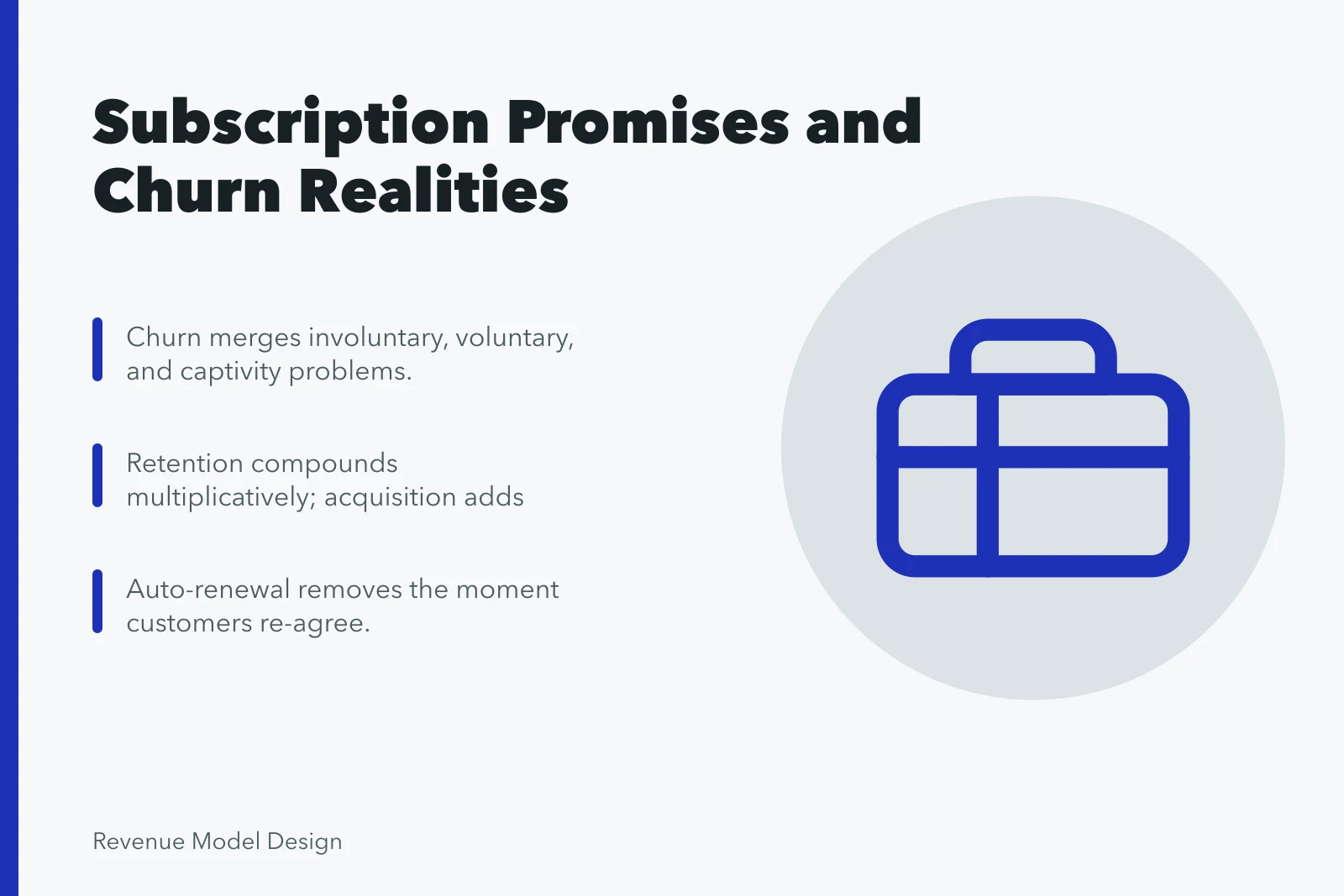
Reporting "churn" as one number merges three problems with three different owners and three different fixes.
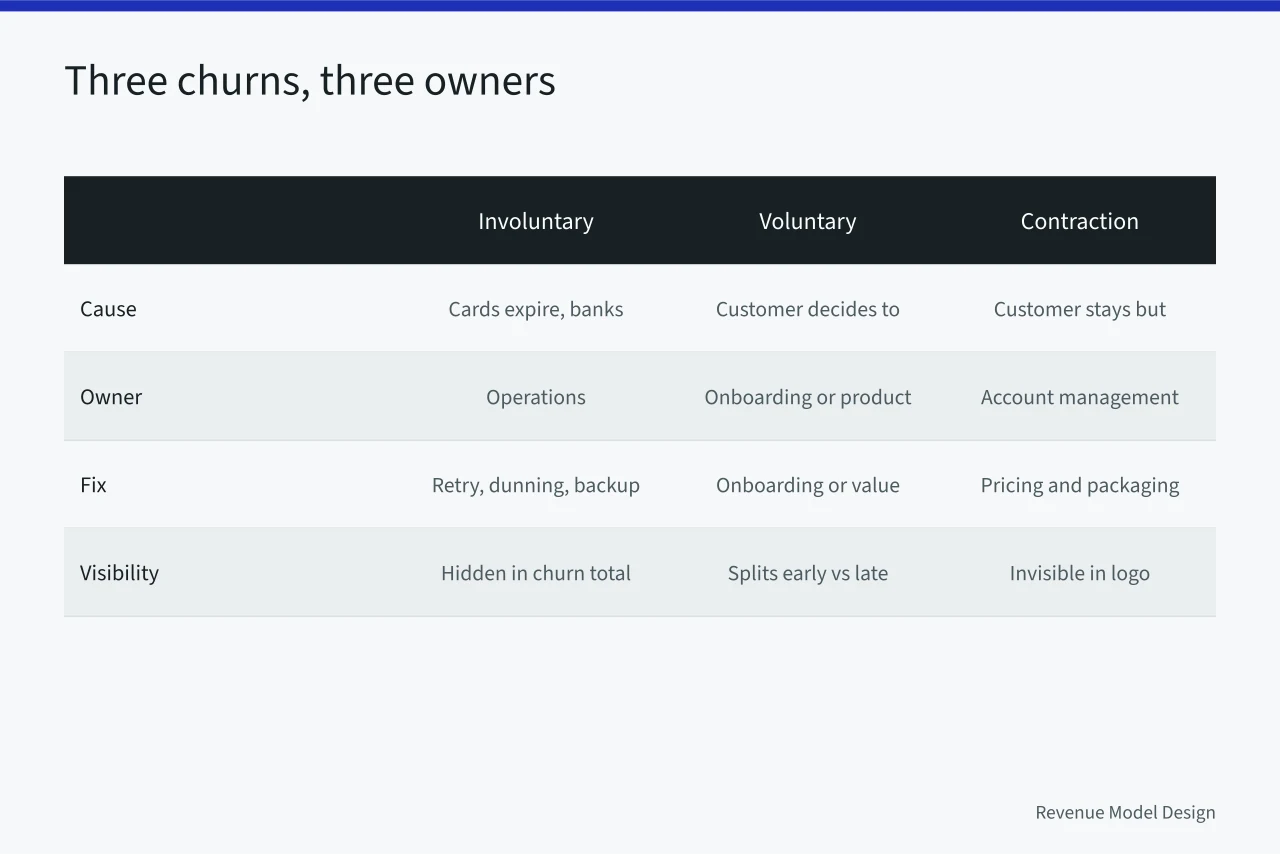
Involuntary churn is customers who did not decide to leave. Cards expire, banks decline, addresses change, a payment method belongs to someone who left the company. This is an operations problem: retry logic, pre-expiry notice, backup payment methods, a dunning sequence that reads like a helpful reminder rather than a debt collection. It is usually the cheapest recoverable revenue in the business and nobody's job, because a dashboard that only shows a total cannot see it.
Voluntary churn is a decision, and it splits again. Customers who left in the first period usually never got started: the failure is in onboarding, and it happened weeks before the cancellation. Customers who left much later usually either stopped needing you or never noticed they were paying. Those are different diseases and the same exit survey question will not distinguish them.
Contraction is customers who stayed and shrank: fewer seats, a lower tier, a narrower scope. This never appears in a count of logos, and a business can hold its customer count flat while its revenue falls for a year.
Split the number three ways before you spend anything on fixing it. Most retention programs are aimed at voluntary late churn, which is the hardest of the three, while involuntary churn sits unaddressed.
The renewal is the sale
Auto-renewal makes revenue predictable and makes you lazy, because it removes the moment when the customer has to agree that the last period was worth it.
Two things are worth separating here. Retention is a customer who would choose you again. Captivity is a customer who has not managed to leave. They look identical in a monthly revenue report and behave completely differently the moment a credible alternative appears, or the moment someone new takes over the budget.
The test is uncomfortable and simple: if canceling took one click and required no conversation, what share of your revenue would still be there next period? You do not have to run the experiment to know that a business whose answer is "considerably less" has a product problem its billing mechanics are concealing.
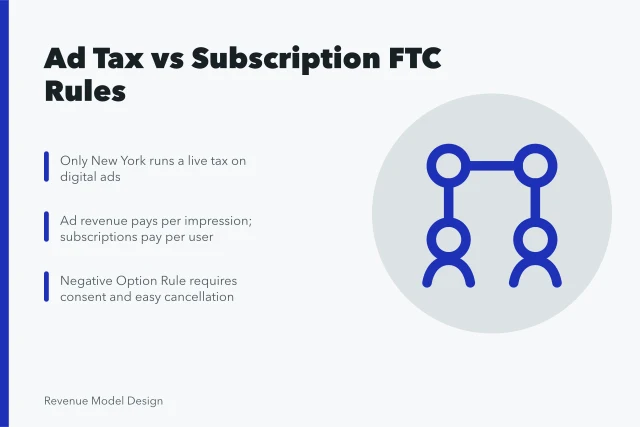
Making cancellation difficult buys revenue in the current period at the cost of your renewal conversations for years, and increasingly at legal risk in jurisdictions that have taken an interest in the practice. In the United States the requirements around disclosure, consent and cancellation for arrangements that renew automatically online are set out in the provision on negative option marketing.
Term and prepayment
Longer terms with money up front pull cash forward, cut the frequency at which you are evaluated, and reduce the noise in your forecasts. They cost you two things people underestimate.
First, a long term locks your product promise. Anything you want to change (the packaging, the metric, a deprecation, a price), is now subject to agreements you signed under different assumptions, and the larger the customer the longer the tail.
Second, a long term hides the truth for the length of the term. Monthly billing tells you every month whether the value is landing. Annual billing tells you once, and by the time it tells you, a year of product decisions has already been made on the assumption that everything was fine.
A defensible policy: sell term length with a discount instead of requiring it, and read the mix.
What a discount is exchanged for, and what it costs when it is exchanged for nothing, belongs in pricing architecture. A rising share of short-term picks is information, arriving earlier than churn.
Expansion is where growth actually comes from
Once a subscription business is any size at all, growth stops being about the number of new customers and starts being about what happens inside the existing base.
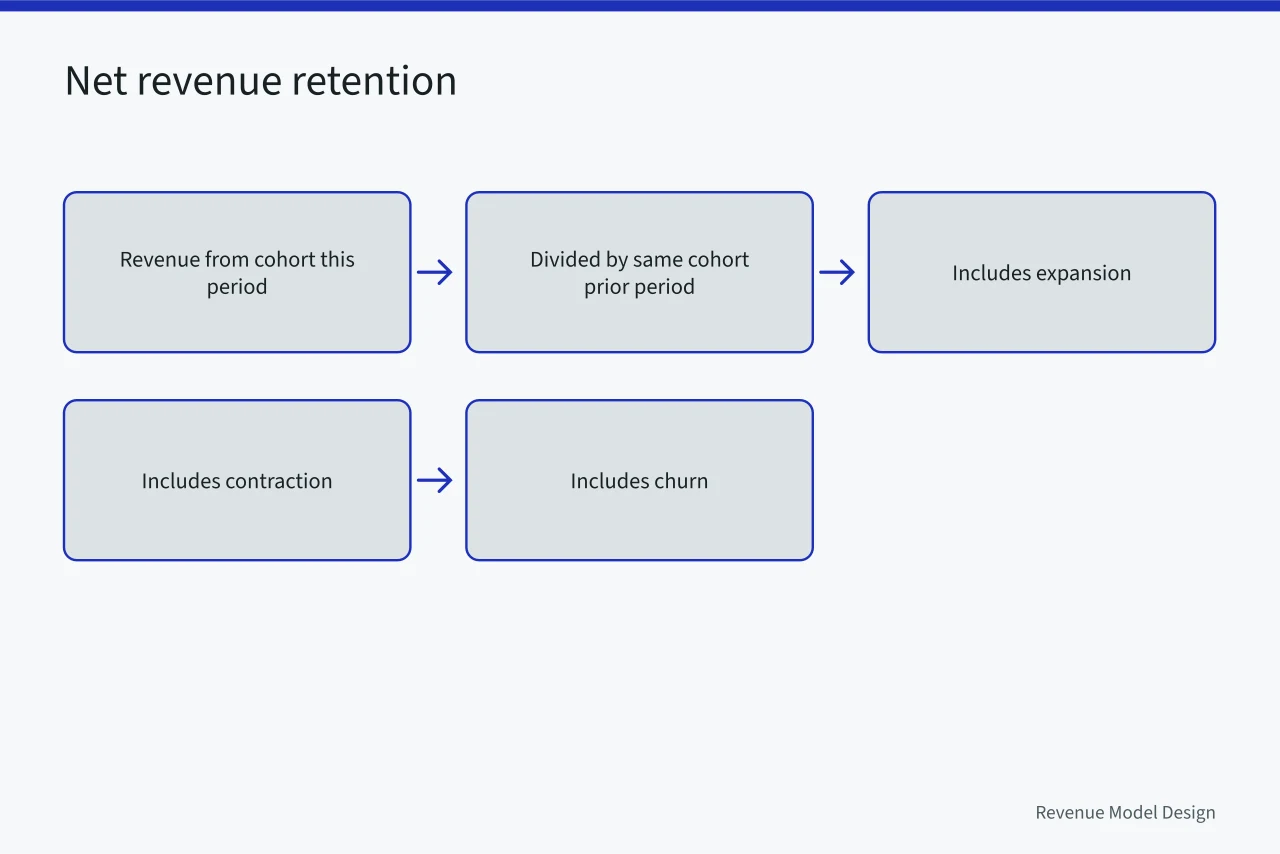
The value is yours and worth computing exactly rather than approximating. Its importance is structural.
When a base grows on its own, new customers add to a rising floor. When it shrinks, every new customer is partly replacing one you already had.
Designing for expansion is mostly about removing friction from growing. An account should be able to add usage, seats, or scope without a renegotiation, a new contract, or a call. If growing requires a conversation with your sales team, most customers who would have grown simply will not, and you will never see the ones who quietly decided against it.
The counterweight: expansion that comes from a customer being forced past a limit they resent is contraction deferred. Expansion revenue that arrives with a complaint attached should be counted differently from expansion that arrives because someone found you more useful.
Free tiers and trials, honestly
A free user is not free. They consume infrastructure, support, and attention, and those are variable costs attached to people who may never pay.
The right question is not what your conversion rate is, since that number without context tells you nothing. It is whether the free tier generates demand or absorbs it.
A free tier generates demand when free users bring paying ones: they invite colleagues, produce something a buyer sees, or need a paid capability at a predictable point.
It absorbs demand when the free tier is quietly sufficient for many people who would otherwise have paid you.
Both are legitimate strategies with different cost structures, and which one you are running is a question about who pays and what triggers the money, settled by the five decisions under every model. What is not legitimate is running an absorbing free tier while reporting it as a demand generator because the sign-up numbers look good.
When subscription is the wrong shape
Recurring billing fits recurring value. Where the value is not recurring, the mismatch shows up as churn that no retention program can fix, and the honest answer is a different structure.
Infrequent need, with months between uses, makes customers notice the charge more than the benefit. A one-time need sold as a subscription brings cancellation once the job is done.
Variable usage under a flat fee leaves light users feeling cheated and heavy users feeling clever. Both are right. Seasonal demand on an annual fee guarantees an off-season argument.
The alternatives are ordinary and often better: pay-per-use, prepaid credits that do not expire aggressively, a membership that carries benefits rather than a service allocation, or a maintenance and support agreement attached to a product sold once.
Choosing one is not a downgrade. It matches the billing shape to the value shape, the entire job. The alternatives are compared family by family in revenue models.
What to measure
Split churn into involuntary, voluntary-early, voluntary-late, and contraction, and report them separately from the first month you have enough customers to do so. Compute net revenue retention on defined cohorts rather than on the whole book. Keep deferred revenue visible beside cash so nobody mistakes the second for the first.
Track the mix of term lengths customers choose when they have a choice. And record what happened after each price change, because you will need it next time and memory will not serve.
For the general structure of a plan built around recurring revenue, the sections an outside reader expects, the U.S. Small Business Administration's business plan guide is a free reference point.
Bottom line
The billing mechanic is the easy part. What makes a subscription work is that the customer needs you again this period, that leaving would be a real loss rather than an administrative chore, and that growing with you costs them nothing in friction. Everything else is invoicing.
Common questions
Should churn be counted by customer or by revenue?
Both, labeled, and never blended. Losing many small accounts and losing one large one are different problems that a single figure reports identically.
Is auto-renewal worth having?
Commercially yes, and it comes with obligations about disclosure and cancellation that vary by jurisdiction. What it must never be is a substitute for the customer wanting to stay, because that substitution is invisible until a credible alternative appears.
How long before a retention improvement shows up in revenue?
Roughly the average life of a customer, because the book has to turn over before the new rate dominates. Expecting it within a quarter is how good changes get abandoned.
Does a free tier belong in the churn number?
No. Trial conversion and paid churn have different causes and different owners, and mixing them produces a figure that moves for reasons nobody can name.
In this guide
- 5 plain facts about subscription models questionsSubscription models questions answered with churn arithmetic: what a monthly loss rate does to a book, what expansion offsets, and what cancellation owes a customer.