Costs
Part of Why growth quietly drains cash in most product models
Product models framework as practitioners see it
A product models framework that separates the four decisions a price actually settles, and shows why cost-plus and value-based answer different questions.
"What should we charge?" is not one question. It is four, and they get answered in the wrong order almost every time, which is why pricing conversations circle.
This is a way to take them in an order that terminates. Every figure below is an invented placeholder.
What to take away
- A price settles four separate things: the floor, the ceiling, the position between them, and the rule for changing it later.
- Cost-plus finds the floor. Value-based finds the ceiling. Neither one is a pricing method on its own.
- Decide the change rule at the same time as the number, because a price with no agreed way to move is a price you will be stuck with.
Decision one: the floor, which cost sets
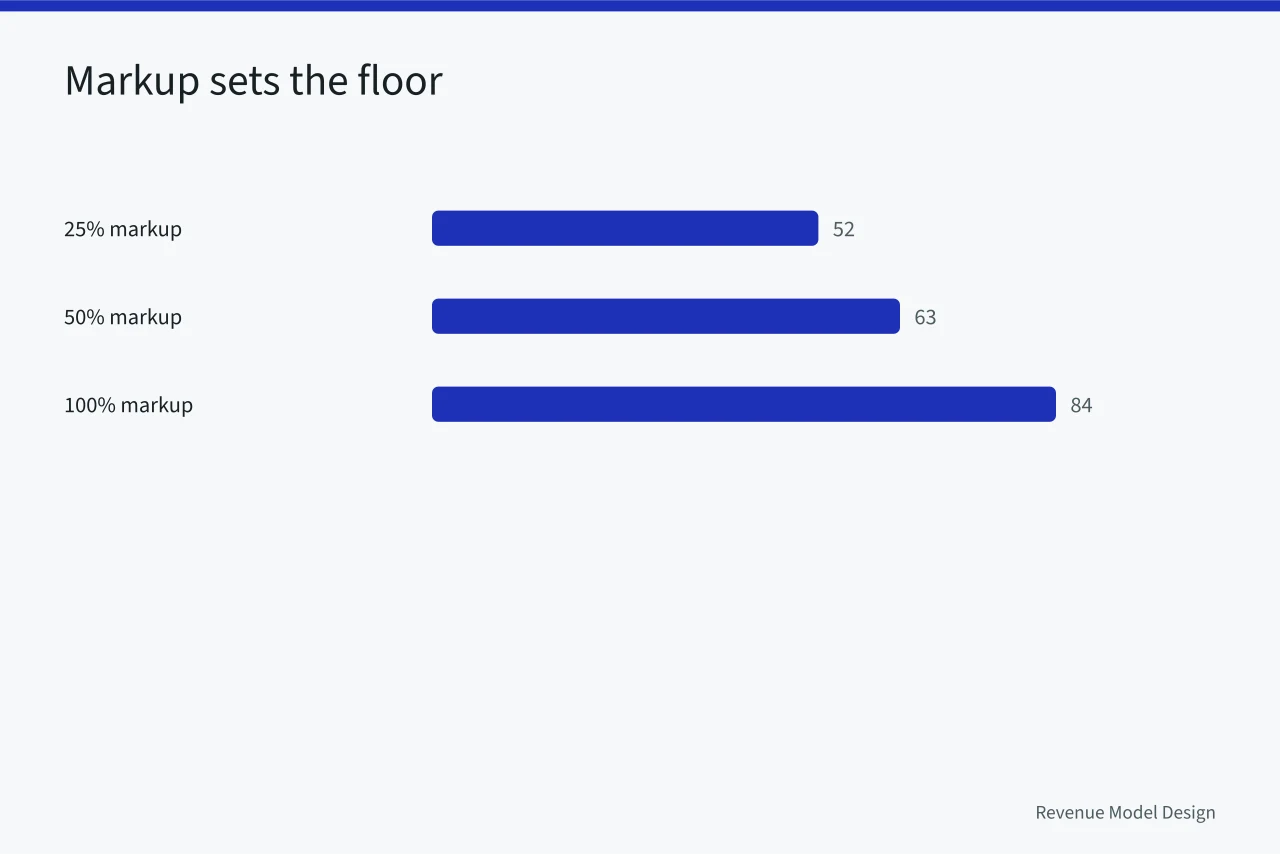
Take a unit cost of 42. A markup of 25% gives 52, 50% gives 63, and 100% gives 84. That calculation is genuinely useful, and what it produces is a floor: below it the unit is not worth making, and the markup is a statement about the fixed costs and risk you need the unit to help carry.
What it cannot do is tell you the right number, because nothing in it refers to the buyer. Two products with identical costs can be worth very different amounts, and cost-plus prices them the same. Which costs belong in the 42 is its own argument, worked through in unit economics.
Decision two: the ceiling, which the buyer's alternative sets
The most a buyer will pay is set by what they would do instead. That alternative is sometimes a competing product, often a worse manual process, and quite often doing nothing.
Finding the ceiling means describing the alternative in the buyer's terms, in units they already track. This slow work is the part firms skip.
The output is a range with a stated basis, and that basis is what you defend in a negotiation. Segmentation matters because different buyers have different alternatives, the standard treatment in MIT's marketing management course.
Decision three: where you sit between them
Now you have a floor and a ceiling and the actual choice is a position. That position encodes a strategy, and it is worth saying which:
| Position | What you are buying | What it costs you |
|---|---|---|
| Near the floor | Volume, and a hard barrier for others | Almost no room for error in cost |
| Middle | Reach across several segments | A price nobody finds remarkable |
| Near the ceiling | Margin, and the ability to serve fewer buyers well | Longer sales, and a permanent case to make |
The mistake is not choosing wrong. It is choosing without saying, then defending the number afterward with whichever argument is nearest. The layer structure that carries this decision into an actual price list sits in pricing architecture.
Decision four: the rule for changing it
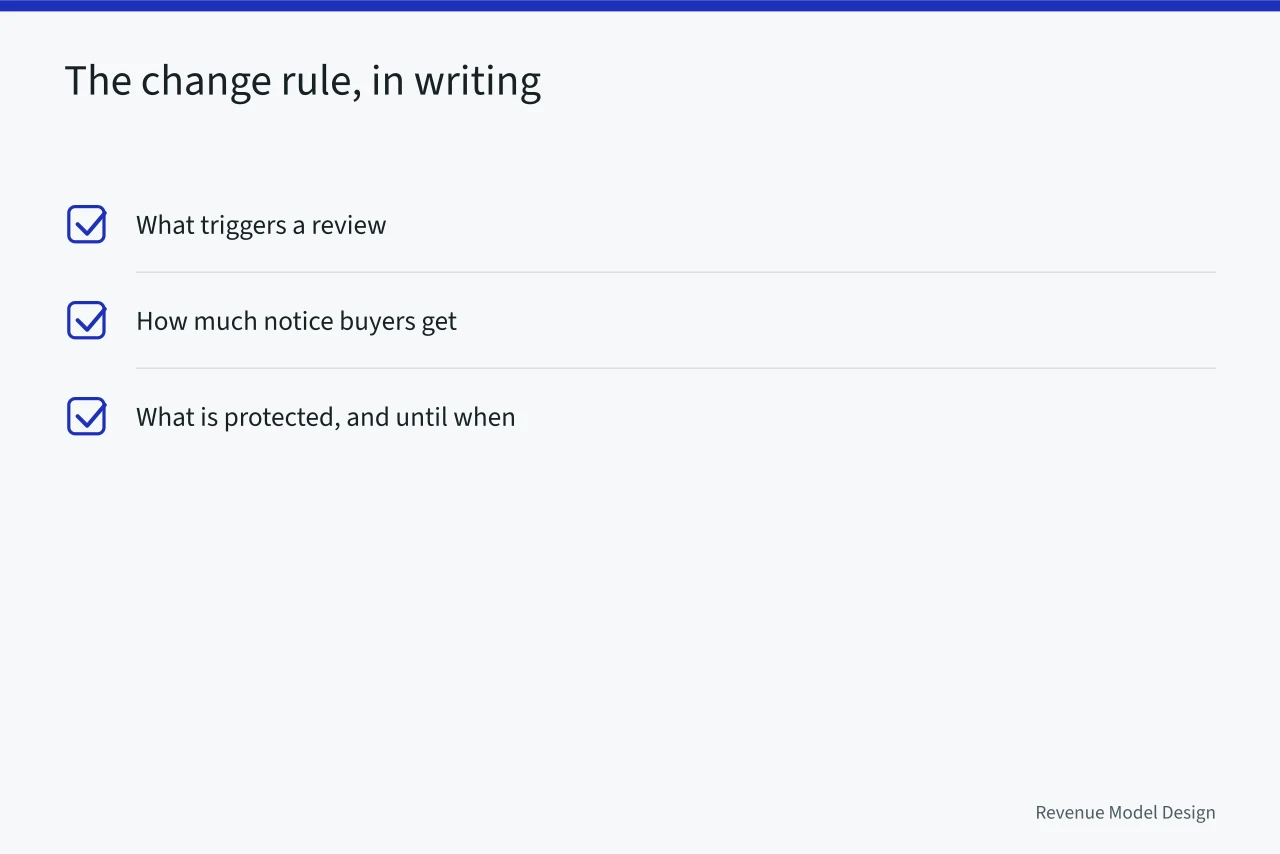
Firms that skip this end up unable to move a price at all, because every increase becomes a fresh negotiation with every customer at once. A change rule agreed at the start is a term. Introduced later, it is a concession you have to buy.
Working the four in order
- Compute the floor honestly, including the costs that only exist because the unit does.
- Describe the buyer's alternative before naming any number.
- Choose the position and write one sentence saying why.
- Write the change rule into the contract or the terms.
- Decide what evidence would tell you the position was wrong, and when you will look at it.
Step five is the one that gets dropped. Without it, every result after the decision can be read as confirmation, and the price never moves again.
Two ways this framework fails
It fails when the ceiling cannot be found because the buyer's alternative is genuinely unknown. In that case, sell a small first version whose purpose is to find out, and price the second one properly.
It also fails when the product is not truly a product: if what you sell varies so much per customer that no two units are alike, you run a service. The constraint is capacity, not price, a different set of decisions covered in service models.
Settle which one you run before any of this; the test is in business model types.
Common questions
Is cost-plus ever the right answer on its own?
Where the buyer's alternative is a near-identical product from someone else, the ceiling collapses onto the floor and cost-plus is close to the whole answer. That is a description of a commodity, and it is worth knowing that is the business you are in.
How do we find the buyer's alternative without asking them?
You mostly cannot. Ask, in the sales conversations you already have, what they would do if you did not exist. The answers are more specific than any research substitute, and they are free.
What if different segments have different ceilings?
Then you have more than one price, and the honest way to hold that is a structure with a defensible reason for the difference rather than a discount granted case by case. Undisclosed differences between competing business buyers also carry legal exposure, which is why the federal price discrimination rule is worth reading with a lawyer before designing tiers.
How often should the four be redone?
The floor when costs move. The ceiling when the buyer's alternative changes, which is usually when a competitor appears or disappears. The position rarely. The change rule never, if it was written properly.