Guides
Which five decisions decide your business model type?
Business model types are outputs of five decisions about buyer, value, delivery, capture and defense: how to tell which type your invoices say you run.
Lists of business model types are the wrong shape for the problem. They present as a menu, and the reader picks the one that sounds most like them, which teaches nothing. The named types are outputs. They are what you get when five underlying decisions have been made a particular way, and the decisions are where the work is.
This page goes at those five decisions, then at the question people actually arrive with: which type am I already running, as opposed to the one I describe in a pitch.
What to take away
- The named types are results of five decisions, not choices in their own right. Change a decision and you change type whether or not you meant to.
- Most companies are running two models at once and reporting them as one. That is the source of most confused numbers.
- The type you are is settled by where the cash comes from and what triggers it, not by what the deck says.
The five decisions underneath every type
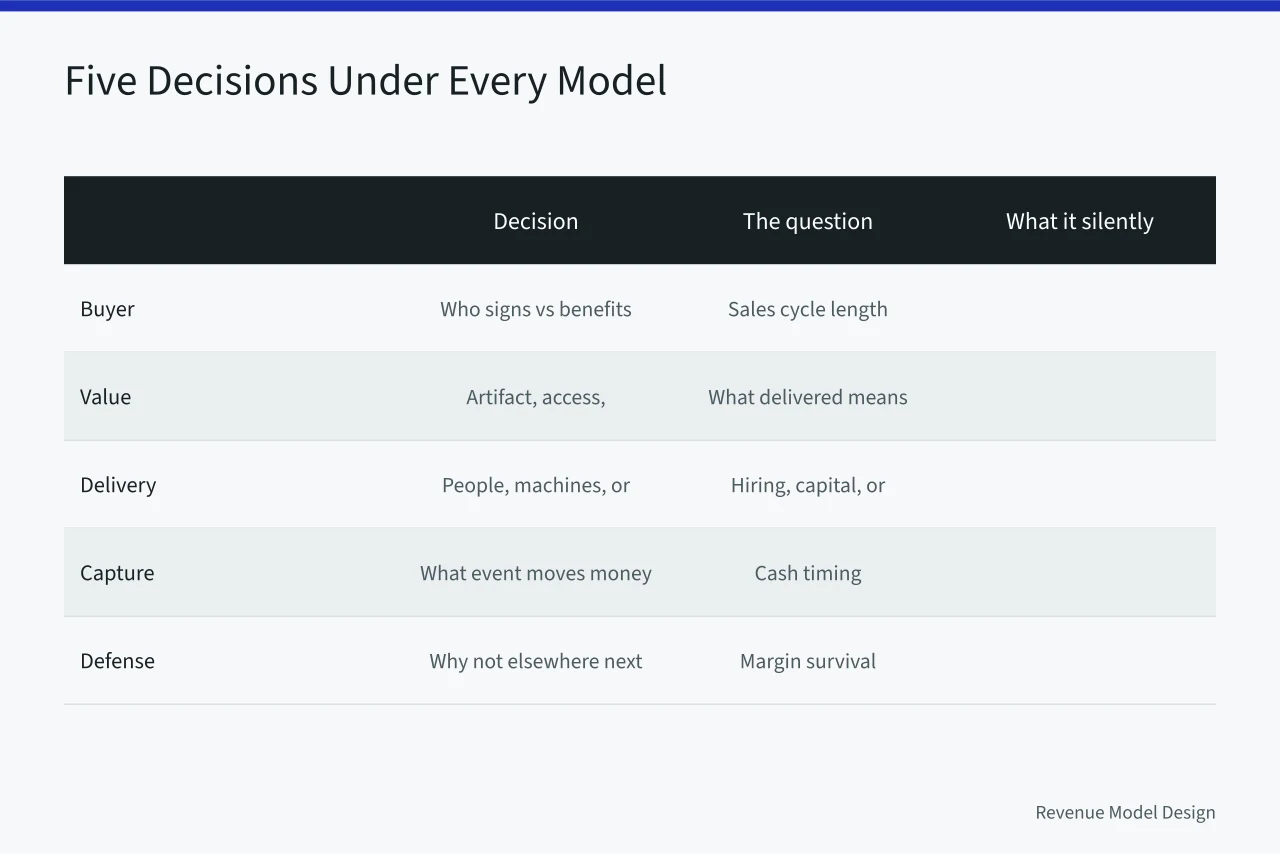
| Decision | The question | What it silently sets |
|---|---|---|
| Buyer | Who signs, and are they the person who benefits? | Length of sales cycle, and who you must convince |
| Value | Are you selling an artifact, access, capacity, an outcome, or an introduction? | What "delivered" means, and when you can stop |
| Delivery | Does serving one more customer consume your people, your machines, or almost nothing? | Whether growth needs hiring, capital, or neither |
| Capture | What event causes money to move? | Cash timing, and how far ahead you can plan |
| Defense | Why can the customer not simply do this elsewhere next year? | Whether today's margin survives contact with a competitor |
Every familiar label is a particular combination of those five. That is why arguments about which type you are go in circles: two people are each holding a different one of the five decisions and calling it the model.
1. Who the buyer is
The single most useful question is whether the person who pays is the person who benefits. When they are the same, the pitch is about value and the cycle is short. When they diverge, you are running two sales at once, and the paying side almost always cares about a different thing from the using side.
The extreme version is a model where the user pays nothing and a third party pays for access to them. That is a legitimate structure and it changes everything downstream: your product decisions get made on behalf of the payer, and your users will eventually notice.
2. What the value actually is
Five answers cover most cases, and each one puts the risk in a different place.
An artifact. Something that exists after you make it and can be sold again. The economics are strong once it is built and the whole risk sits before the first sale.
Access. The customer pays to keep using something you keep running. Risk moves from build to retention: the sale never really finishes.
Capacity. You are selling your people's time, in some wrapper. Honest, immediately saleable, and bounded by headcount forever unless you change something structural.
An outcome. You are paid for a result rather than an effort. This wins deals and imports the customer's risk into your business, including risks you have no control over.
An introduction. You are paid for putting two parties together. You own no inventory and no delivery, and you are permanently exposed to both sides deciding to meet without you.
3. What serving one more customer consumes
This is the decision that determines whether growth is a financing problem, a hiring problem, or neither.
If the next customer consumes hours from a named person, growth is hiring, and quality tracks recruitment. If it consumes a physical unit, growth is working capital, and the constraint is paying suppliers before getting paid. If it consumes almost nothing beyond a small marginal cost, growth is a distribution problem, and the constraint is reaching one more buyer.
Being wrong about which of these you are is common and expensive. Plenty of businesses describe themselves as one thing while their cost structure quietly behaves like another, usually because a "product" is being kept alive by a service team nobody counts.
4. What triggers the money
Capture is where a model becomes real, and it splits into three sub-questions worth answering separately: what the event is, how it repeats, and when the cash actually lands relative to the work.
Those three are independent. A model can be recurring and still starve you if the cash arrives after you have paid to deliver. A one-off sale can fund a company comfortably if it is collected up front.
This is the fastest place to be wrong about your own business, because revenue recognition and cash timing look similar in a summary and behave nothing alike in a bank account. The underlying distinction between when income is earned and when it is received is set out in IRS Publication 538.
5. Why it lasts
If your answer is quality or service, you do not have a defense, you have an intention. Defenses that survive are structural. They come from something that gets better as you get bigger, something that costs the customer real effort to leave, a relationship the customer would have to rebuild, or a cost position built into how you are made.
The same offer with and without a structural defense is two different businesses with two different futures. That difference won't appear in this year's numbers, which is why this sits inside the model, not beside it.
Why a position must come from how a firm is built, not from effort, is the organizing question of MIT's strategic management course.
Which type are you actually running
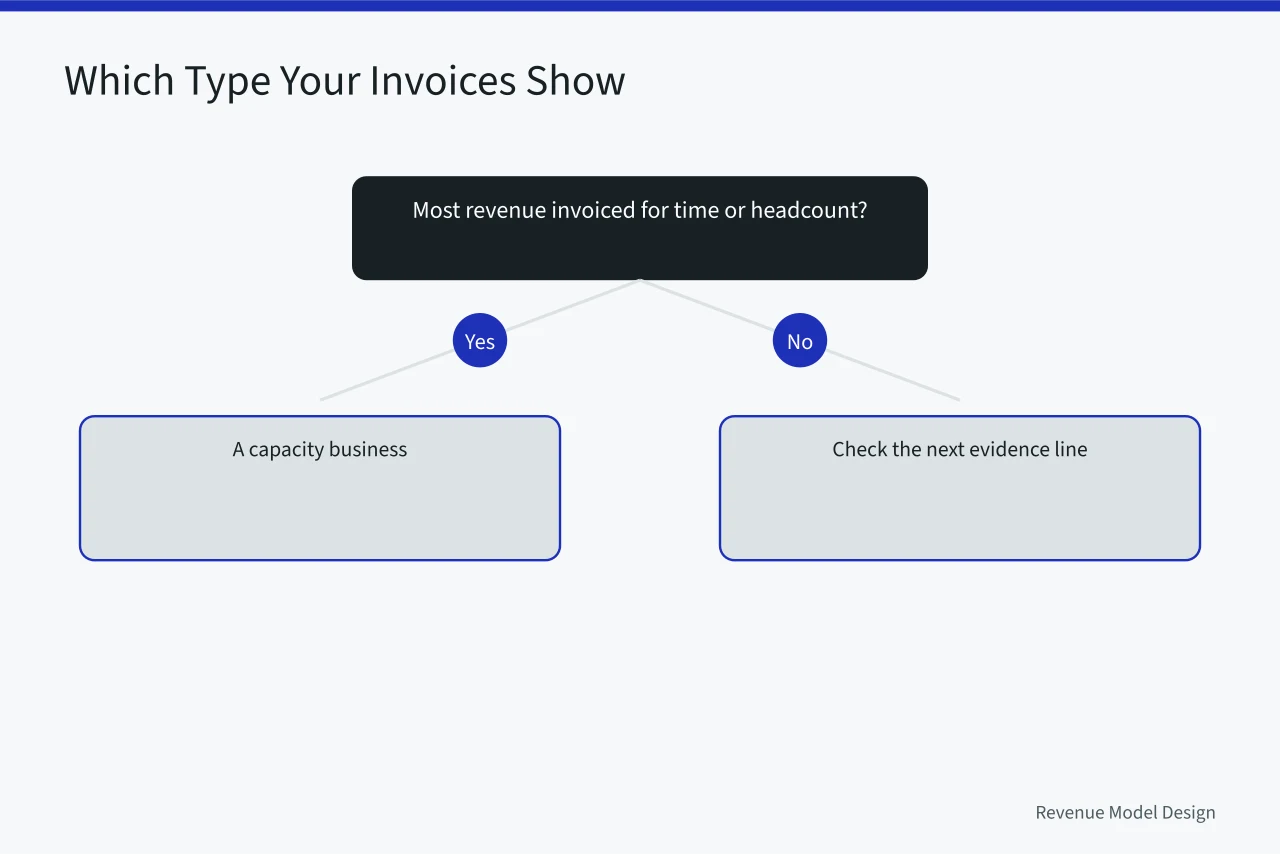
Answer from the invoices rather than the pitch.
| What the evidence shows | What that makes you, whatever you call it |
|---|---|
| Most revenue is invoiced for time or headcount | A capacity business |
| Most revenue arrives on a schedule the customer can cancel | An access business, and retention is your product |
| Most revenue arrives once per customer, per purchase | A transaction business, and acquisition is permanent |
| Revenue arrives as a share of somebody else's transaction | An intermediary, exposed to both sides |
| One customer or channel dominates the revenue | A dependent business, whatever the model diagram says |
The common finding is that a company is two of these at once: a subscription with a services arm that carries the delivery, or a marketplace with one buyer big enough to be a contract. That is not a mistake. Reporting them as one blended thing is.
What to measure in your own business
None of this is answerable from an industry figure. Any margin, retention rate, or acquisition cost you read elsewhere came from someone else's cost structure and customer mix, and importing it hides your own position behind a number that feels authoritative. Measure these instead, from your own records.
- Revenue split by capture event, not by product name. Time, subscription, one-off, share of transaction. The proportions tell you which model you are really running.
- The gap between delivering and being paid, in days, for each of those. This is the number that decides whether growth is safe.
- Cost to serve one more customer, separated into what is caused by that customer and what would have been spent anyway.
- Concentration. How much of the revenue sits with the largest few customers or one channel.
- Where each cost sits on the volume curve. Costs that step up in jumps behave nothing like costs that rise smoothly, and models are usually built as if every cost were smooth.
Write the definitions down next to the values, and put a date on them. In a year the values will be different and the definitions should not be.
When a model has to change
Models are usually changed for the wrong reason: a competitor did something. The reasons that hold up are internal: growth requires hiring you cannot sustain, or a cash gap grows with every new customer.
One relationship carries more revenue than the company could survive losing, or the thing you charge for has stopped being the thing customers value.
Change one decision at a time. Change two and you will not know which one moved the result, and you will have burned the only clean experiment you get.
Common questions
Can one company run more than one model?
Yes, and most do. The requirement is that they are measured separately, with their own costs and their own cash timing. The failure is not the second model, it is the blended report that lets a weak one hide behind a strong one.
Is a recurring model always better than a one-off sale?
No. Recurring revenue is more predictable and it commits you to a permanent cost of keeping customers alive. A one-off sale with strong margin and cash up front can be the stronger business, particularly where repeat purchase was never realistic.
How do we know we picked wrong?
The symptom is usually that growth makes things worse rather than better: more customers, more strain, no improvement in the numbers that matter. That is a model problem, not an execution problem, and working harder inside it will not fix it.
Where do we start if we are designing from scratch?
Start at delivery, decision three. What serving one more customer consumes is the hardest thing to change later, and it constrains every other decision you would rather make first.
In this guide
- The business model types checklist that catches what audits missA business model types checklist of twelve pass-or-fail questions, each with the condition that means it has failed and the record that answers it.
- Business model types mistakes without the filler (2027 update)Nine business model types mistakes, each a reasonable decision with structural consequences, and the visible number that was standing in for a harder one.
- Business model types examples: eight archetypes and what breaks each oneEight business model archetypes with named examples, showing where money enters, what keeps it flowing, and the condition that breaks each one.
- Business model types framework: five axes and where they conflictA business model types framework of five independent axes to place yourself on, plus the position combinations that are reasonable alone and unworkable together.
- Business model types metrics explained for people who act on themBusiness model types metrics do not travel between structures: which family fits which shape of money, and the five definitional traps that break every comparison.