Costs
Part of Which five decisions decide your business model type?
Business model types framework: five axes and where they conflict
A business model types framework of five independent axes to place yourself on, plus the position combinations that are reasonable alone and unworkable together.
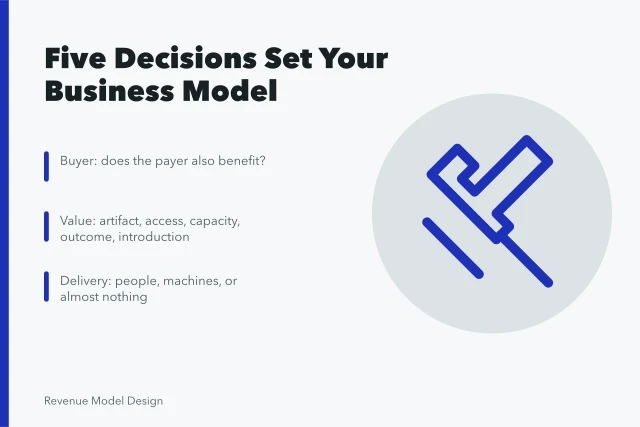
Lists of "the ten business models" are not much use, because real businesses are not one of ten things. They are a position on several independent dimensions at once, and two companies filed under the same label can sit on opposite sides of the dimension that actually determines whether they work.
This is a framework of five axes instead. Placing yourself on each one takes about an hour and produces something a list cannot: an explanation of which combinations are stable and which are quietly fighting themselves.
What to take away
- The user paying is the simplest arrangement and the one where feedback works properly: the person who dislikes the product is the person who can stop the money.
- Position relative to your own spending, not relative to delivery.
- Near-zero marginal cost means an additional customer costs almost nothing to serve.
- The value of the axes is that certain positions are individually reasonable and jointly unworkable.
The five axes
| Axis | The question | The positions |
|---|---|---|
| What is exchanged | What does the customer actually receive? | Ownership, access, an outcome, attention, or risk |
| Who pays | Whose money is it? | The user, a third party, both sides of a market, or a mix |
| When money moves | Relative to when you incur cost? | Before, during, or after |
| How delivery cost scales | What does the next unit cost? | Near-zero, proportional, stepped, or rising |
| Who holds the relationship | Who can reach the customer? | You, a channel, a platform, or shared |
1. What is exchanged
Ownership transfers a thing permanently. The transaction ends, and any future revenue has to be created rather than continued.
Access grants use for a period. The obligation continues, which means the cost continues, and the customer re-decides at every renewal whether or not you make them.
An outcome promises a result rather than an artifact or an interval. It carries the highest willingness to pay and moves risk onto you, including risk arising from decisions the customer makes.
Attention is exchanged when the user pays nothing and their attention is what you actually sell. The user is not your customer, which changes every product decision downstream.
Risk is exchanged when the customer pays to not carry something: a guarantee, an insurance-shaped arrangement, a fixed price on a variable job. Whatever the axis, something has to move in each direction for an agreement to exist at all, which is the doctrine of consideration. Anything in this position is heavily regulated in most jurisdictions, and the structure needs qualified legal advice before the commercial terms are set.
2. Who pays
The user paying is the simplest arrangement and the one where feedback works properly: the person who dislikes the product is the person who can stop the money.
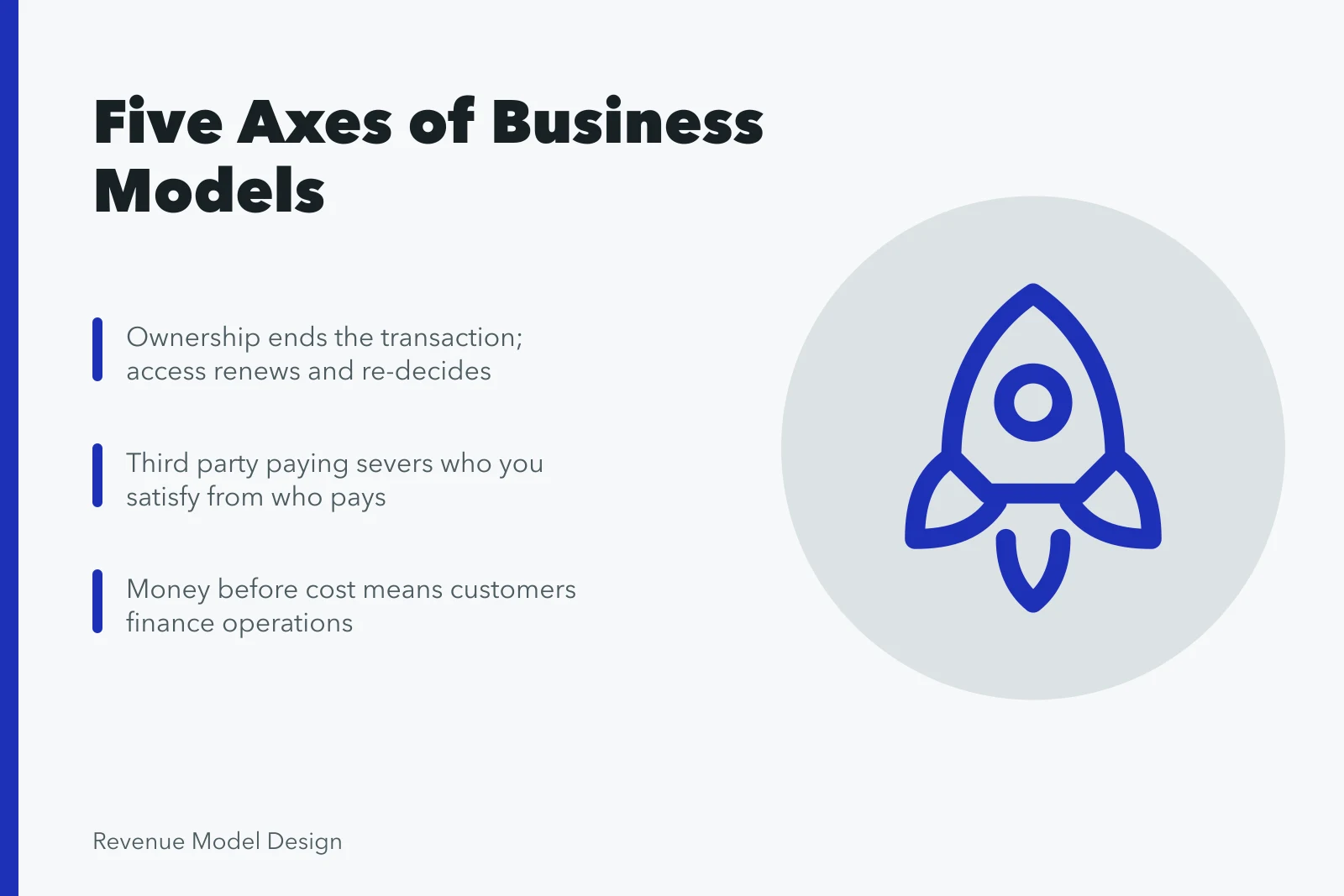
A third party paying (an employer, an advertiser, a manufacturer, an insurer, a government program), unlocks willingness to pay the user never had, and severs the link between the person you must satisfy and the person you must please. That gap needs managing deliberately or it manages you.
Both sides paying happens in markets with two distinct participant groups, and doubles the number of constituencies that can decide your fee is too high.
The axis is worth writing down even when the answer is obvious, because it is the axis most likely to change over a company's life and the change is rarely noticed as a model change.
3. When money moves
Position relative to your own spending, not relative to delivery. Money before you incur cost means customers finance operations, the strongest working-capital position, with an obligation you have already been paid for.
Money during keeps cash roughly in step with cost, while money after means you finance the customer, and each additional sale consumes cash before it produces any.
This axis alone determines whether growth is self-funding or capital-hungry, which is why it deserves equal weight with the more interesting-sounding ones.
4. How delivery cost scales
Near-zero marginal cost means an additional customer costs almost nothing to serve. This allows free tiers, wide distribution, and aggressive pricing, and it invites competitors with the same cost structure to undercut you indefinitely.
Proportional cost means each unit costs roughly the same to deliver. Margin is stable and volume alone will not save a weak one.
Stepped cost means flat across a range then a jump: a hire, a facility, a license band. The danger is pricing just below a step you are about to cross.
Rising cost means each additional unit costs more than the last, usually because you are consuming a scarce resource: senior expertise, a limited supply base, a physical constraint. This is the position most often misdiagnosed, because it looks like proportional cost until you push volume. Telling a cost that moves with output from one that does not is the first division made in MIT's financial and managerial accounting course, and it is the division this axis rests on.
5. Who holds the relationship
Whoever can contact the customer without permission holds the relationship, regardless of who made the product. If a retailer, marketplace, or platform sits in between, you have distribution but not a relationship, and you cannot design a second sale, change a price without an intermediary's agreement, or learn anything directly.
Shared positions exist and are usually unstable: both parties are trying to move it, and one of them will succeed.
Combinations that fight themselves
The value of the axes is that certain positions are individually reasonable and jointly unworkable. Five worth checking for.
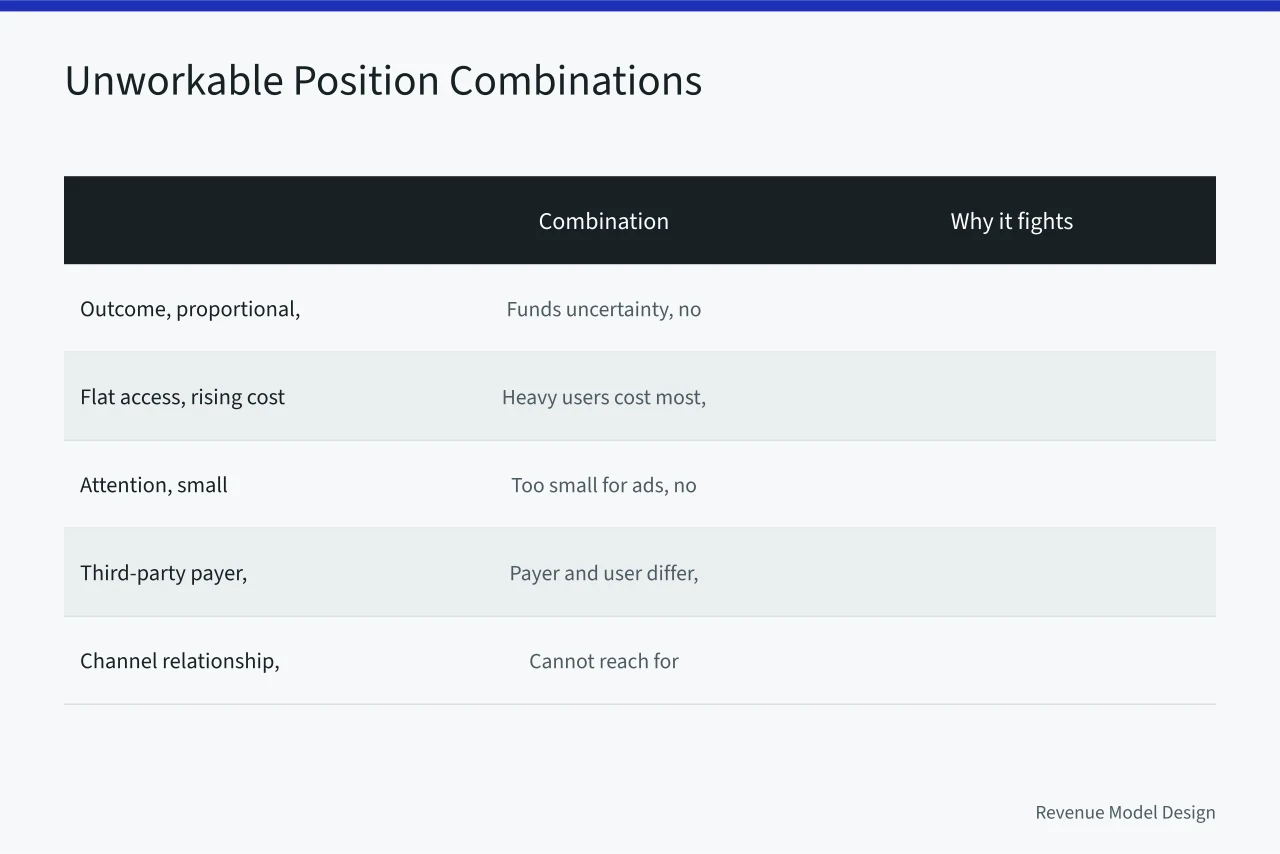
Outcome exchanged, cost proportional, money after. You have taken the customer's risk, you pay for delivery as you go, and you are paid only if it works. Working capital funds someone else's uncertainty. Survivable only with either a large balance sheet or genuine control over the outcome.
Flat access pricing, rising delivery cost. Your heaviest customers cost the most and pay the same. Growth in usage among your best accounts is a loss, and the accounts you are proudest of are the ones doing the damage.
Attention exchanged, small high-value audience. Not enough audience to sell to advertisers, and you have foregone charging the people who value you most. This combination has ended more publications than any competitive pressure.
Third-party payer, user-driven product. The person paying and the person you optimize for are different, and the product will drift toward whoever renews. Not fatal, but it needs an explicit rule about which one wins.
Relationship held by a channel, model requiring repeat purchase. The second sale is the whole plan, and you cannot reach anybody to make it. Either buy the relationship back, or change to a model that pays out on the first transaction.
Placing yourself
Write one line per axis about what you do today. Not what you intend, not what the deck says: what happens this month.
Mark which two are hardest to change. Almost always, they are cost scaling, set by your delivery physics, and relationship ownership, set by earlier distribution decisions.
Those two are your constraint set. Any model change worth planning must work within them or explicitly buy its way out of one.
The cost to buy out of either is the arithmetic in unit economics.
Finally, run the combinations above against your five positions. If one of them fits, you have found the thing that will keep going wrong for reasons that appear unrelated.
The archetypes generated by these axes are cataloged in the business model types examples. The pre-commitment version, phrased as pass-or-fail questions, is the business model types checklist, and the wider comparison sits in the business model types overview.
Common questions
How long does placing ourselves take?
An hour for the five lines, and rather longer to stop arguing about them. The argument is the useful part, because it is usually about what the company actually does rather than what it intends.
Can a position on an axis change without anyone deciding?
Constantly, and axis two is the worst for it. A company that adds a third-party payer has changed its model whether or not anyone called it that.
What if we sit between two positions on an axis?
Write both and say which one describes this month. A position that is genuinely mixed is worth knowing about, because mixed positions are where the fighting combinations come from.
Does a fighting combination mean we should change?
It means you have found the thing that will keep going wrong for reasons that appear unrelated. Whether to change it is a separate decision, and knowing which one it is makes that decision much cheaper.