Features
Part of Why growth quietly drains cash in most product models
Product models examples worth copying, and why
Twelve product models examples where the obvious price is wrong, each named with the buyer's real alternative, hidden cost, or ownership burden behind it.
Twelve product models, twelve pricing decisions. Examples worth copying, such as TurboTax, Slack and Keurig, show the same pattern: what differs is not the item. It is what the buyer compares you against, and which of your costs move with the sale.
What to take away
- The buyer's alternative sets your ceiling. Change the alternative and the right price changes, even when the product does not.
- Costs that do not move with the unit belong in a second layer, never in unit cost.
- Where the first sale is meant to be recovered later, you are betting on a repeat rate. Measure it or the bet is unpriced.
- Name the authority for anything regulated: the FTC for franchise disclosure, the CRA for affiliate reporting, FASB for ASC 606, your state board for licensing.
- Compute collected cash divided by units shipped. That is your realized price, not list.
Twelve product model examples worth copying
Prices are public list figures or labelled typical ranges. Confirm the current number before you quote it.
| # | Product model | Named example | Pricing trap | Buyer's alternative or hidden cost |
|---|---|---|---|---|
| 1 | Replaces an unpleasant manual task | TurboTax from Intuit | Priced against rival tax software, not against the buyer's time | A shoebox of receipts and a lost weekend; DIY federal editions typically run about $40 to $120 |
| 2 | Bought out of obligation | Ecolab warewash sanitation programs | Treated as a discretionary purchase | A failed health inspection and a closed dining room; Ecolab quotes per site on multi-year contracts |
| 3 | Nobody budgeted for it | Notion Plus and Business seats | Discounting to force a decision | No approval route exists inside a large firm; Plus lists at $10 per member per month billed annually |
| 4 | Expensive returns | Zappos | Gross margin quoted as contribution | Free shipping both ways and a 365-day return window; freight, inspection and markdown land on you |
| 5 | Cheap to make, costly to ship | Peloton Bike | Freight left out of unit cost | Delivery and setup move with every unit; the Bike lists near $1,445 before delivery |
| 6 | Cost falls sharply with volume | AWS Reserved Instances | Today's cost or future cost? | A three-year all-upfront reservation discounts up to about 72 percent off on-demand and locks the date |
| 7 | Cheap device, costly consumable | Keurig brewers and K-Cup pods | Device priced as the product | Pods typically run $0.50 to $1.00 each; an unmeasured refill rate is a gamble |
| 8 | Paid upgrade path | Slack free-to-paid | Optimizing the first price | Pro lists at $8.75 per user per month billed annually; upgrade share and time-to-upgrade set the floor |
| 9 | Once-in-a-lifetime purchase | Dignity Memorial funeral homes, run by Service Corporation International | Assuming a lifetime relationship | No repeat rate exists; the National Funeral Directors Association puts the median adult funeral with burial near $8,300 |
| 10 | Reseller sets shelf price | Microsoft 365 through Cloud Solution Provider partners | Modeling only your invoice | The partner buys at a discount and sets the shelf, so partner margin expectation caps your price |
| 11 | Different net prices to competing buyers | Grainger volume price breaks and contract tiers | Ignoring the legal edge | Robinson-Patman, 15 U.S.C. 13, applies once your buyers compete with each other |
| 12 | Channel deductions booked elsewhere | Amazon Vendor Central co-op and promo credits | Reading list price as realized | Deductions sit in another account; net PPM, not list, is the number that pays |
Each row is worth copying for one reason. The price is set against the buyer's real alternative, and every cost that moves with the unit is visible in the model.
Worked example: the returned unit
Take a physical item at a list price of P, with unit cost C, outbound freight F, and a return rate R.
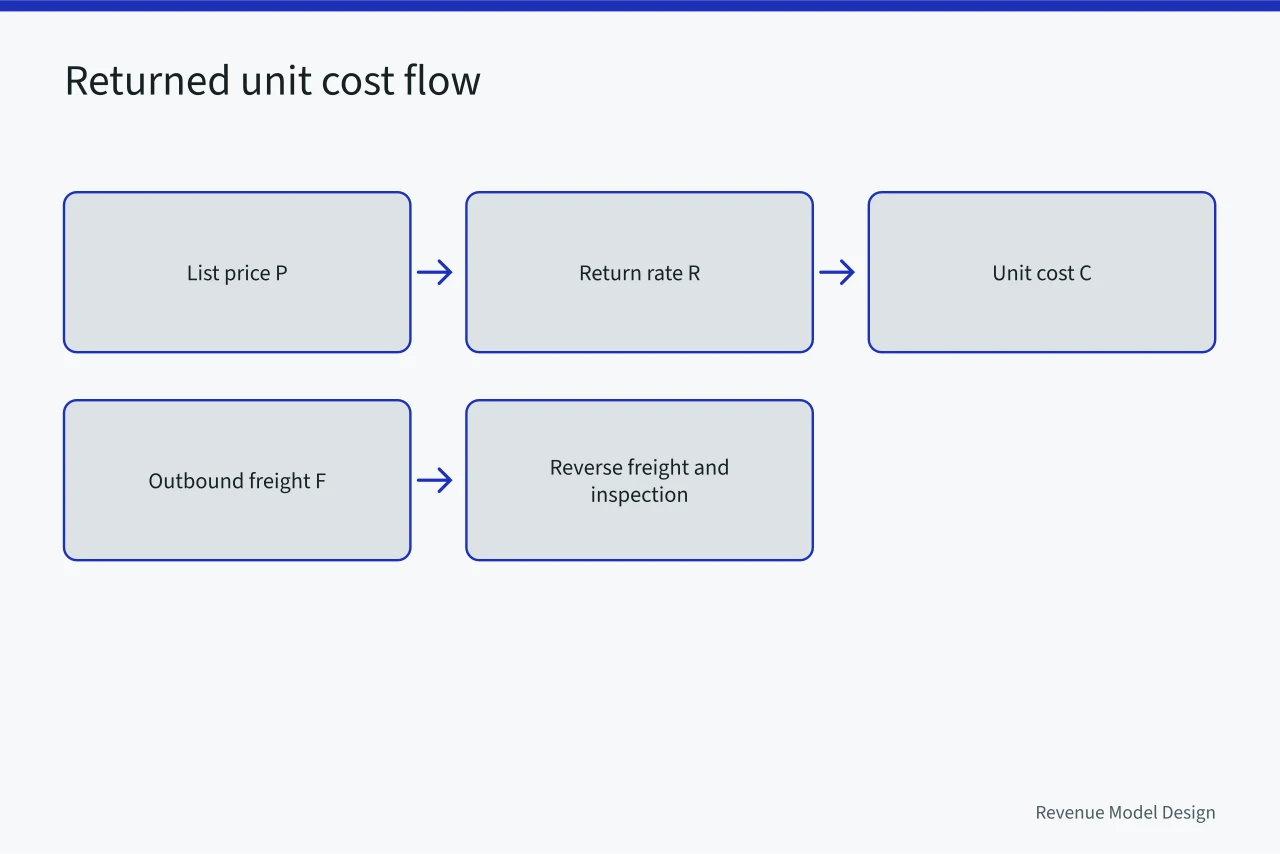
Contribution per unit shipped is P times (1 minus R), minus C, minus F, minus the cost of reverse freight and inspection times R.
At a 20 percent return rate, one in five sales pays for two freight legs and an inspection. A model that omits R reports a contribution the bank balance will not confirm. Handling and reverse flow are ordinary parts of a supply network, which is how MIT's course on supply networks for products and services treats them.
Zappos pays both freight legs and accepts returns for 365 days, so R is a cost line rather than a rounding error.
When the first sale is not the whole relationship
Keurig sells the brewer near cost and earns on pods. A pod typically costs the buyer $0.50 to $1.00. That only works if the refill rate is known. Without it, every brewer sold is an unpriced bet.
Slack gives the product away and charges for history, permissions and admin controls. Pro lists at $8.75 per user per month billed annually. The number that matters is upgrade share and how long it takes. Until you have it, price the free tier at the floor, not below.
Funeral services are bought once. No repeat rate exists to recover anything from, so acquisition cost sits in full against a single transaction. The National Funeral Directors Association puts the median adult funeral with burial near $8,300. Anything assuming a lifetime relationship overstates what you can spend to win the customer.
When someone else stands between you and the buyer
A dealer channel sets the shelf price. You control your net price only. Model the whole chain, because the reseller's margin expectation moves your ceiling.
Microsoft 365 sold through Cloud Solution Provider partners runs this way. The partner buys at a discount and sets the end-customer price, so your list is not the shelf.
Volume tiers and rebates are ordinary. They also carry legal edges once the buyers compete with each other, which is what the price discrimination provision addresses. Read it against your tier structure before a complaint does it for you.
Promotional credits, listing fees and co-op allowances often sit in a different account from sales. On Amazon Vendor Central, those deductions land against net PPM instead of list. Compute collected cash divided by units shipped and compare it with list. On a channel where deductions run several points, that gap is the margin argument.
What each of these shapes demands of the cost model is in unit economics. The wider families are in revenue models.
Reading these onto your own product
Three questions, in order.
- What would this buyer do if you did not exist?
- Which of your costs disappear if this unit is not made?
- Is the money coming from this sale or a later one?
The third changes the most decisions and is the one most often answered by assumption. If the answer is a later sale, write down the repeat rate you are relying on and the date you will have measured it.
See product models for what that answer implies for the business. See pricing architecture for how the price list should carry it.
Common questions
Do these twelve cover every situation?
No. They cover the cases where the obvious price misleads, which is where money is lost. A product with a clear alternative and a clean cost is absent because it needs no help.
How do we learn what a buyer would do instead?
Ask, in conversations you already have. Specific answers beat any substitute, and the question costs nothing to add to a sales call.
Several of these apply to us at once. Then what?
Then you have more than one product and should model them separately. A blended figure across products with different cost structures describes none of them.
Is a low launch price ever right?
Where cost genuinely falls with volume and you can name the volume and the date, yes, as a written bet. Where it is hope, you will raise the price later without having agreed how.