Rules
Part of Which five decisions decide your business model type?
Business model types mistakes without the filler (2027 update)
Nine business model types mistakes, each a reasonable decision with structural consequences, and the visible number that was standing in for a harder one.
None of the nine errors below is stupid. Each one is the result of a reasonable decision, made by someone competent, that turns out to have structural consequences nobody was looking for. That is what makes them worth naming: you cannot avoid them by being careful, only by knowing the mechanism.
What to take away
- None of these is a careless error. Each is a sensible decision whose consequences arrive somewhere other than where it was made.
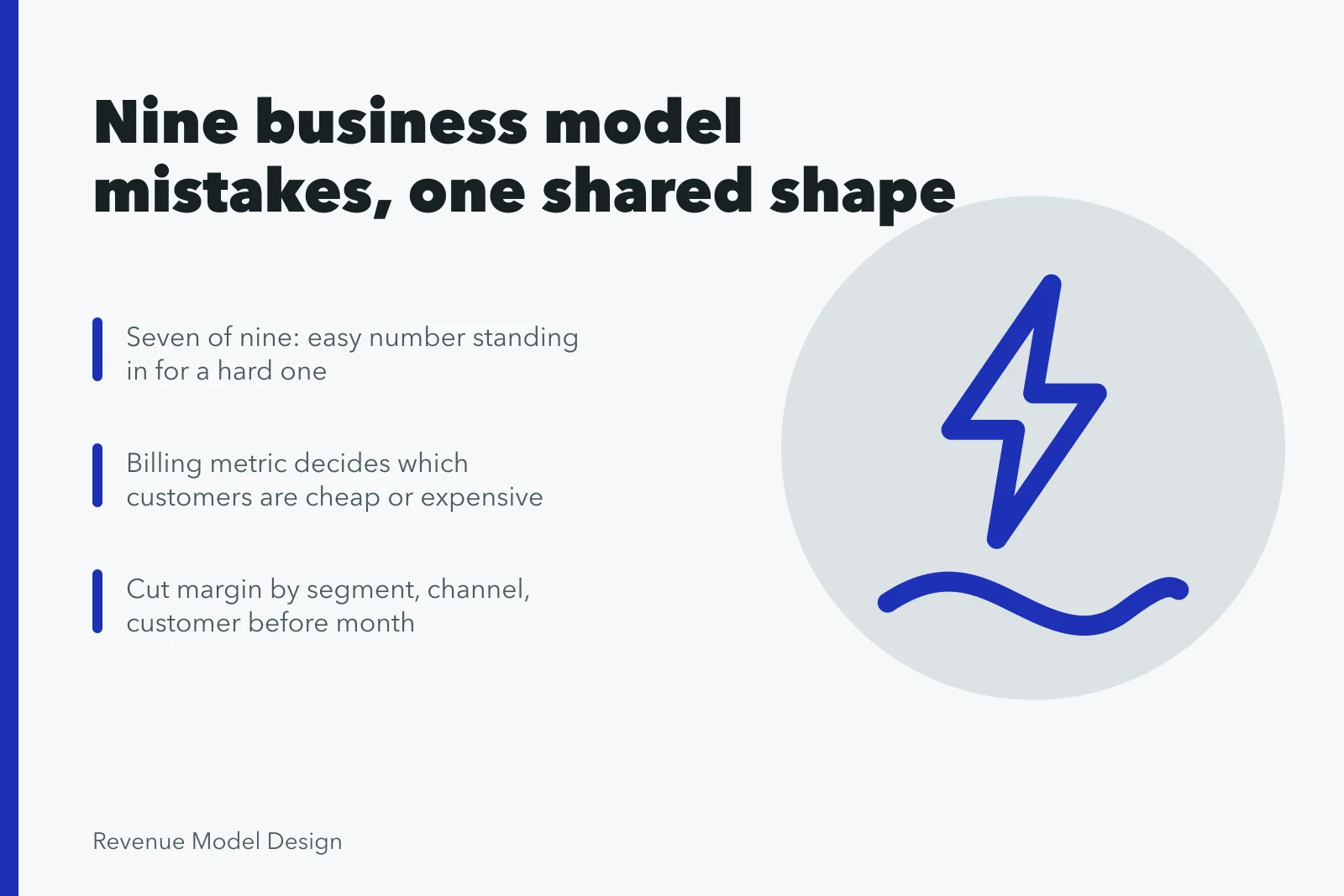
- Seven of the nine share one shape: an easy number standing in for a hard one nobody measured.
- The two cheapest to fix are the billing metric and the segment margin, and both get harder every quarter you wait.
1. Copying a model whose economics you cannot see
You can observe a competitor's list price, their tiers, their packaging, and roughly what they promise. You cannot observe their realized price after discounts, their cost to serve, their contract terms, their capital position, or the subsidy that might be funding the whole arrangement.
Copy the visible half and you inherit a structure built for an invisible half you lack. That is worse than designing badly from scratch, because it arrives with confidence: you have seen it work somewhere.
The fix: reason from your own costs and your own customers first. Then treat the competitor's structure as a hypothesis, not a template.
2. Choosing the billing metric to make the first invoice easy
Early on, someone has to build billing, and the easiest thing to count wins. Users, or months, or projects: whatever the system already knows about.
Years later, that decision constrains everything: the metric decides which customers are cheap and which are expensive, whether usage growth helps you, and whether a customer who gets ten times the value pays anything more.
Changing it later means repapering every contract. The metric deserves a week of thought when it takes an hour. That is the only point when changing it is cheap.
3. Treating gross flows as revenue
Money that passes through you is not money that belongs to you. Value transacted on a marketplace, the full invoice on a mostly subcontracted project, a payment you collect and forward, a channel's cut deducted before settlement: none of it is yours, and all of it feels like scale.
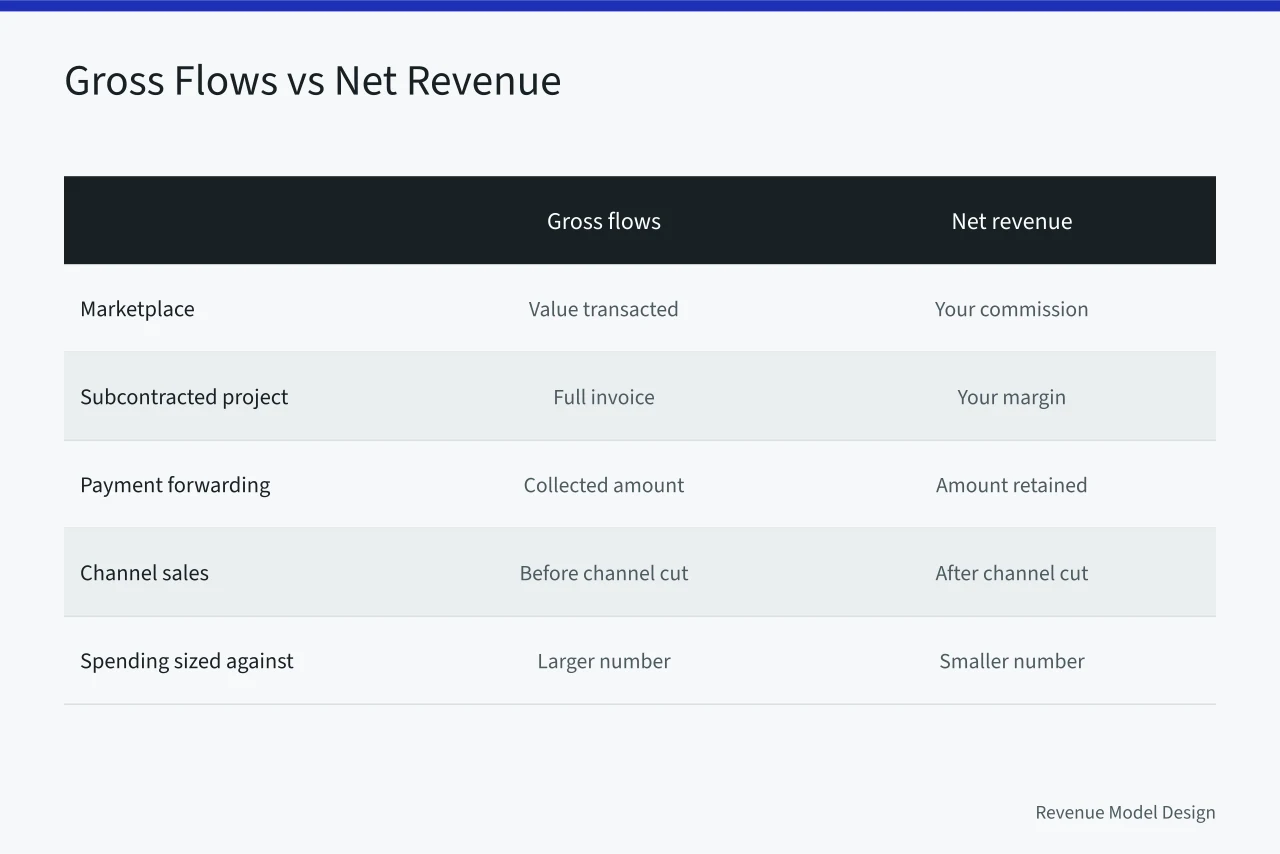
The damage is not vanity. Spending decisions get sized against the larger number, and the smaller number has to pay for them. Keep both figures, label them differently, and run every economic calculation on the amount that actually stays.
What counts as receipts, and what is netted off before they are counted, has rules attached. They are stated plainly for a small business in IRS Publication 334.
4. Averaging away the segment that is losing money
Aggregate margin is a weighted average, and averages conceal exactly the thing you need to see. A strong segment funds a weak one, the total looks acceptable, and nobody is prompted to look further.
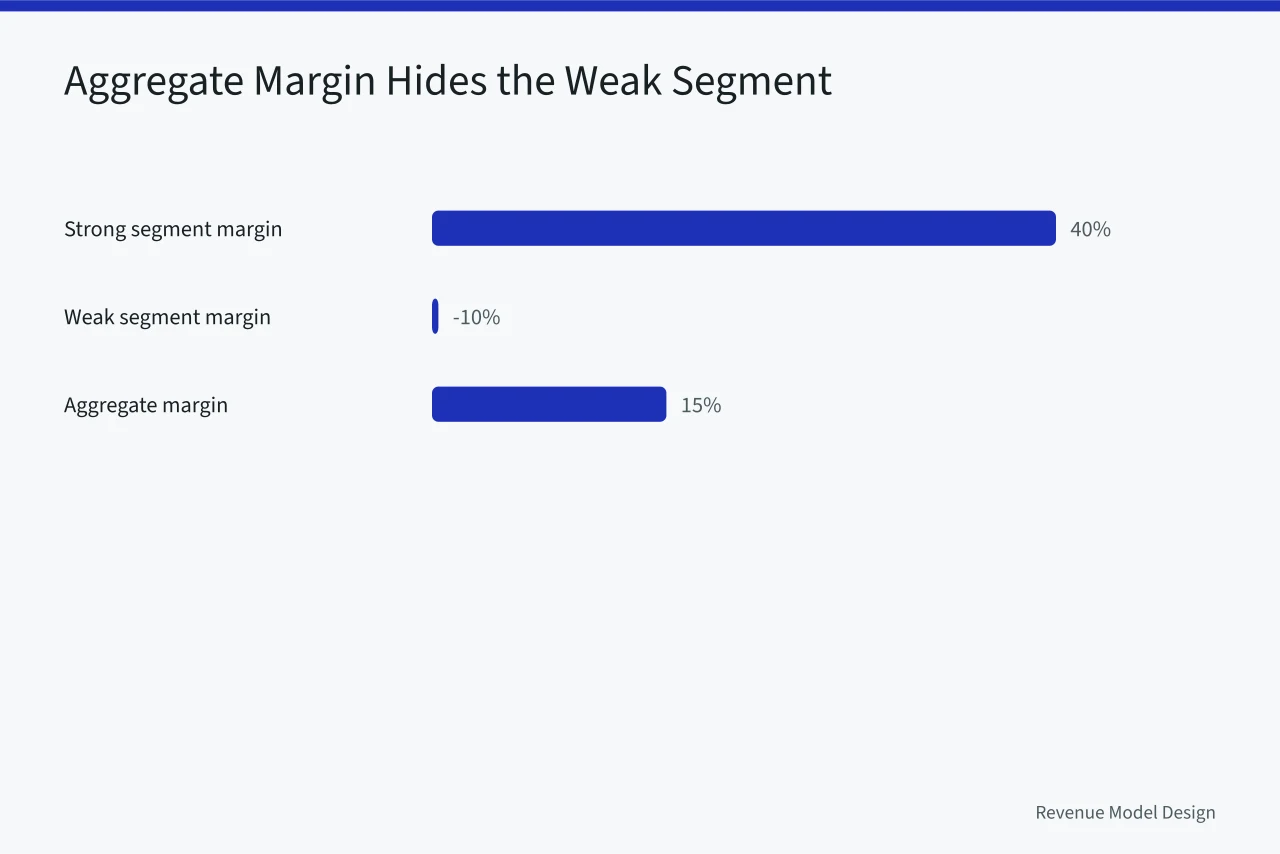
The weak segment gets treated as growth, because it is easy to sell to. It grows, its weight in the average rises, and the aggregate deteriorates for reasons that look mysterious.
Cut margin by segment, channel, and customer before you cut it by month. Do it early, while few enough customers make the answer obvious. The arithmetic, and the choice of unit it rests on, is in unit economics.
5. Confusing a captive customer with a loyal one
Retention counts the people who stayed. It does not distinguish those who would choose you again from those who have not managed to leave: an integration nobody wants to rebuild, data nobody can export, a contract with an awkward exit, a renewal that happens automatically.
Both appear as retained revenue and behave completely differently under pressure. Captivity holds until a credible alternative appears or a new person inherits the budget, and then it does not hold at all. Worse, captivity suppresses the feedback that would have told you the value had eroded, so the loss arrives without warning.
6. Adding a revenue stream instead of fixing the one you have
When the core model underperforms, a second stream is an attractive response. It is new, it is visible, and it does not require admitting the first one is wrong.
It splits one team's attention across two models, so each gets less than it needs. New streams consume management capacity far out of proportion to revenue. The underlying problem, a metric that does not track value and a cost to serve nobody measures, remains, with less attention.
A second stream is a good decision when the first one works and has spare capacity, and rarely otherwise.
7. Setting the price from your costs, or from a competitor's
Cost-plus pricing guarantees you capture none of the value you create beyond your own inefficiency, and it means that every improvement in your cost structure is passed straight to the customer. It also produces a strange result: the better you get at the work, the less you charge.
Pricing against a competitor's list price fails in the opposite way. It anchors you to a number from a company with different costs, different customers, and possibly a different objective.
Both approaches share one root: they use an input that is easy to observe instead of one that is hard, what the customer gains and what it is worth.
Cost and value are treated as answers to two different questions in MIT's pricing course, and the structural layers that carry the answer into a price list are in pricing architecture.
8. Building growth on a channel you do not control, without pricing the dependency
Borrowed distribution is often the right decision. A marketplace, a platform, a large partner, or a single acquisition channel can build a real business faster than anything you could construct yourself.
The error is treating it as free. The channel sets the terms, and the terms will change: a fee, a ranking rule, an algorithm, a decision to compete with you. Any model that only works at the current terms is a position, not a model.
Price the dependency deliberately: know what share of revenue depends on it, keep a route to your customers that does not run through it, and treat a change in terms as a scheduled event rather than a shock.
9. Changing the model without changing the incentives
A model change is announced. The strategy is sound. The compensation plan, the internal targets, and the reporting all still reward the old behavior.
Nothing happens, and it is not resistance. People respond to what they are measured and paid on, and they are right to.
A sales team paid on first-year value will not sell a lower-priced recurring arrangement. A support team measured on tickets closed will not prevent tickets. If incentives were not rewritten before launch, the transition has already failed. Results take a quarter to say so.
The pattern underneath
Seven of the nine share a shape: a number that is easy to see standing in for one that is hard. Visible competitor pricing for invisible economics. Gross flows for net revenue. Aggregate margin for segment margin. Retention for loyalty. Cost for value. Registered channel revenue for controlled revenue.
The counter-habit is cheap and unglamorous. For every important number in your model, ask what it is a proxy for and whether the harder underlying thing has ever been measured directly. It usually can be, from data you already hold, and it usually says something different.
More on how the types differ in the business model types overview, and the pre-commitment version of the same material in the business model types checklist.
Common questions
Which of the nine should we check first?
Number three, then number four. Both take an afternoon with records you already hold, and both change what every other conversation is about.
Is copying a competitor's model ever right?
Copying the question they answered, yes. Copying their structure without their cost base is how a company ends up with someone else's price and its own costs.
We have already built on a borrowed channel. What now?
Price the dependency instead of trying to escape it immediately. Know the share of revenue that runs through it, keep one route to customers that does not, and treat a terms change as a scheduled event.
How do we avoid mistake nine?
Rewrite the compensation plan and the internal targets before the announcement, not after. A team paid on the old basis will sell the old basis, and they are right to.