Maintenance
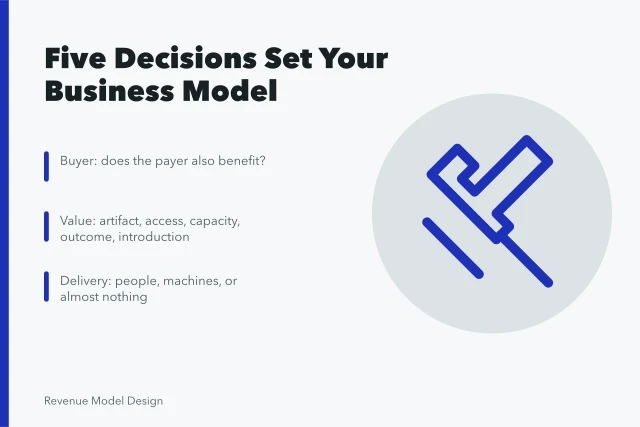
Part of Which five decisions decide your business model type?
The business model types checklist that catches what audits miss
A business model types checklist of twelve pass-or-fail questions, each with the condition that means it has failed and the record that answers it.
Twelve questions to answer in writing before you commit to a model, or before you defend the one you already have. Each is phrased so that a vague answer is obviously vague, and each carries the condition under which it should be treated as failed.
This is a gate, not a scoring exercise.
What to take away
- Answer all twelve before deciding, not after, and date what you wrote.
- Each is phrased so that a vague answer is obviously vague, and each carries the condition under which it should be treated as failed.
- A single hard failure matters more than eleven comfortable passes, because the failures listed here are the ones that do not resolve themselves with effort.
The twelve checks
1. Who pays, and are they the person using the thing?
Name the payer and the user separately, even when they are the same person. Where they differ, you have two constituencies with different definitions of success, and your product decisions will be pulled toward whoever signs.
Fails when you cannot say which of the two you will side with the first time they disagree.
2. Does what you charge for rise when the customer gets more out of you?
Your billing metric should move roughly in step with the value being delivered. When it does not, one of two things happens: the customer grows and you do not, or you grow and the customer feels taxed.
Fails when you can describe a customer doubling the benefit they receive without their invoice changing at all.
3. Does one sale cover the cost of getting it, and if not, what produces the second?
Either the first transaction repays acquisition, or there is a designed mechanism for a second one. Consumption, attachment, replacement, and range are the usual four. Enthusiasm is not one of them. Which of the four applies follows from what actually triggers the money, and the families are compared in revenue models.
Fails when the plan relies on repeat purchase and nobody can name the mechanism that causes it.
4. What does it cost you to serve your most demanding customer?
Not the average customer. The one who consumes the most support, the most exceptions, and the most of your senior people's time. If they pay the same as everyone else, the rest of your customers are funding them.
Fails when cost to serve exists only as a company-wide number.
5. Does money arrive before or after you spend it?
Write the sequence: pay for inputs, deliver, invoice, collect. The gap between the first and the last is what you finance out of your own pocket, every cycle.
The difference between when income is earned and when it is received is in IRS Publication 538. That is why a profitable business can still run short.
Fails when nobody has written the sequence down and the answer is "roughly the same time".
6. Does growth make the cash position better or worse?
In some models a new customer funds the next one. In others, each new customer consumes cash for months. Both are workable; only one of them survives being surprised.
Fails when the growth plan and the cash forecast were prepared by different people and never reconciled.
7. What happens to cost when volume doubles?
Costs rarely scale smoothly. Look for the steps (the next warehouse, the next support hire, the next infrastructure tier, the next license band), and find where the nearest one sits relative to your current volume.
Fails when the model assumes a smooth per-unit cost across a range that contains a step you have already identified.
8. Who owns the customer relationship?
If a channel, a marketplace, or a platform sits between you and the buyer, you do not own the relationship regardless of who manufactured the product. That determines whether you can ever sell again, change a price, or learn anything from your own customers.
Fails when you cannot contact a meaningful share of your customers without someone else's permission.
9. What does the customer do if you disappear?
Answer it from their side. If the honest answer is "call the next supplier", your model has no defensible position and your price is set by whoever is hungriest this quarter.
Fails when the only answer involves the quality of your relationships rather than anything structural.
10. Can you change the price, and by what mechanism?
Every model needs a route to a different price: a renewal, a term end, a new version, a new pack, a contractual index. Decide it while you have negotiating room rather than during the argument.
Fails when there is no written mechanism and the plan is to raise prices when it becomes necessary.
11. How concentrated is the revenue?
Look at the share held by your largest few customers, and separately by your largest channel or platform. Both are dependencies, they are usually different, and the larger of the two is your actual exposure.
Fails when losing a single relationship would make the business unviable and no one has priced that risk into the terms.
12. What would have to happen for this to stop working, and would you notice?
Name the two or three conditions the model depends on: a channel staying cheap, an input staying available, a regulation staying as it is, a behavior staying common. Then name the measurement that would show each one moving.
Start from the conditions a venture depends on, not the idea. That is how model design is taught in MIT's new enterprises course.
Fails when the conditions can be named but none of them is being watched.
Using this
The order matters less than the discipline of writing something specific enough to be wrong later, and dating it.
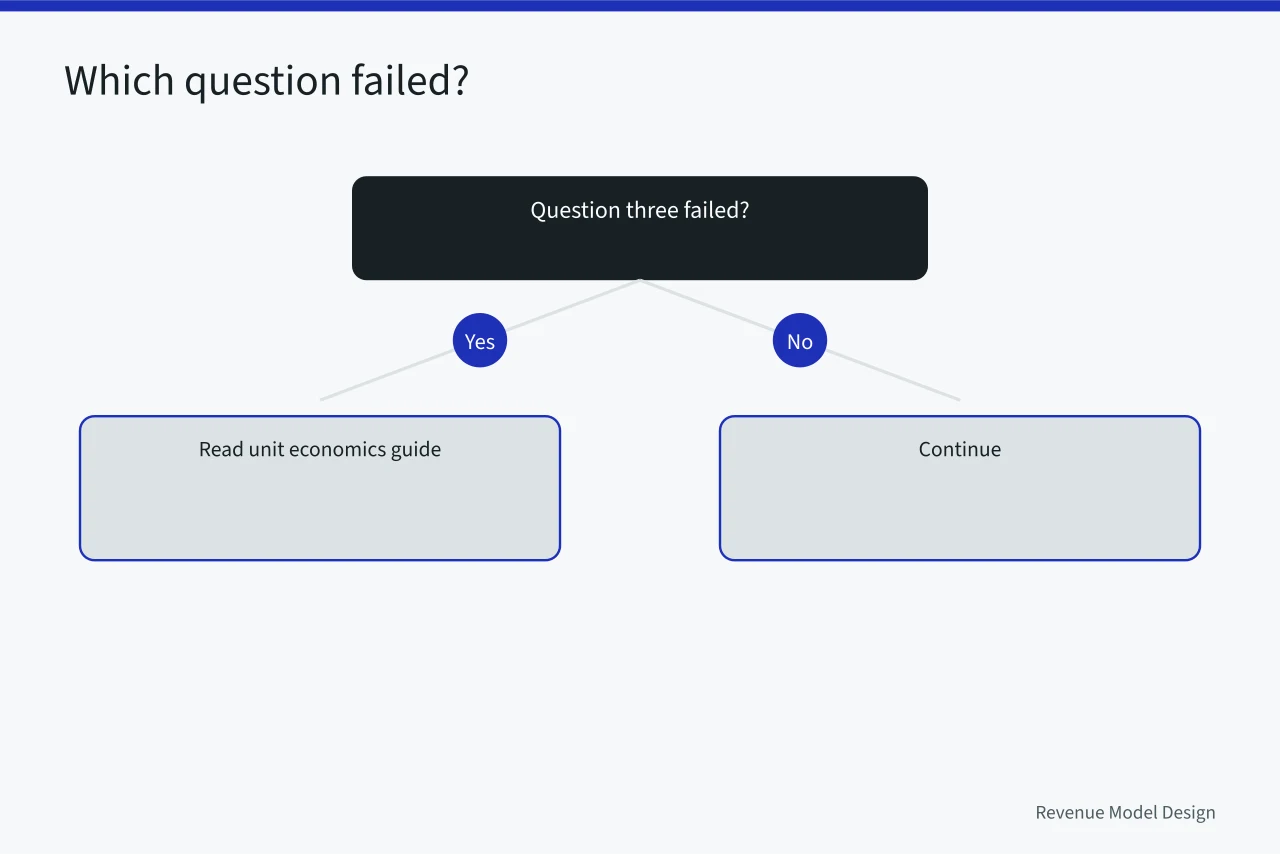
The questions that most often fail on a first pass are three, four, and eleven: the second sale, the cost of the difficult customer, and concentration. All three are invisible in aggregate reporting and all three are answerable from data you already hold.
For the wider view of how the model types differ before you pick one, start with the overview of business model types. For the arithmetic behind questions three through seven, the guide to unit economics works through the definitions. And if question ten is the one that failed, the piece on pricing architecture covers the mechanism in detail.
Common questions
Can a model pass eleven of twelve and still be sound?
Yes, if the failure is one you have priced. A concentration failure that everyone knows about and has terms written against it is a managed risk. The same failure nobody has named is the one that ends the business.
Which three fail most often on a first pass?
Three, four and eleven: the second sale, the cost of your most demanding customer, and concentration. All three are invisible in aggregate reporting and all three are answerable from records you already hold.
How long should this take?
A day of work and a week of waiting, because two or three answers will need somebody to go and count something. The waiting is the useful part.
Should the answers be shared?
Internally yes, with a date and an owner. Externally, the concentration answer and the cost-to-serve answer are both documents that tell a reader exactly where to push.