Features
Revenue model choice: the four questions that actually decide it
Revenue models compared by four answers rather than labels: who pays, what event releases the money, how often it repeats, and when the cash actually lands.
A revenue model is not a name you choose; it answers four questions: who pays, what event releases the money, how often that event recurs, and how long after the work the cash actually lands.
Companies sharing a label often answer those four differently. "we are subscription" predicts little about how a business behaves.
What to take away
- Two revenue models with the same label can behave like opposite businesses. Compare the four answers, not the label.
- Predictability and cash timing are independent. A recurring model that collects late can be more fragile than a one-off model that collects up front.
- Every revenue model has a specific operational demand attached. Choosing the model chooses the work.
Four questions, then the label
Who pays. The user, an intermediary, an employer, an advertiser, a platform. Where the payer and the beneficiary are different people, everything downstream bends toward the payer.
What event releases money. Signature, shipment, access granted, usage metered, a period elapsing, someone else's transaction completing, a result verified. This is the single most informative fact about a revenue model and the one most often left implicit.
How often it repeats. Once per customer, once per purchase, on a schedule, or continuously with volume.
When the cash lands. Before the work, at the moment of the work, or some number of days after an invoice that goes out after the work. This is the question that decides whether growth is safe, and it is not implied by any of the other three.
The wider question of which business you are running, rather than how you charge, is a separate set of decisions covered in the guide to the five decisions underneath every model. Revenue capture is one of them. It is the one people mistake for the whole thing.
The families, and how each one fails
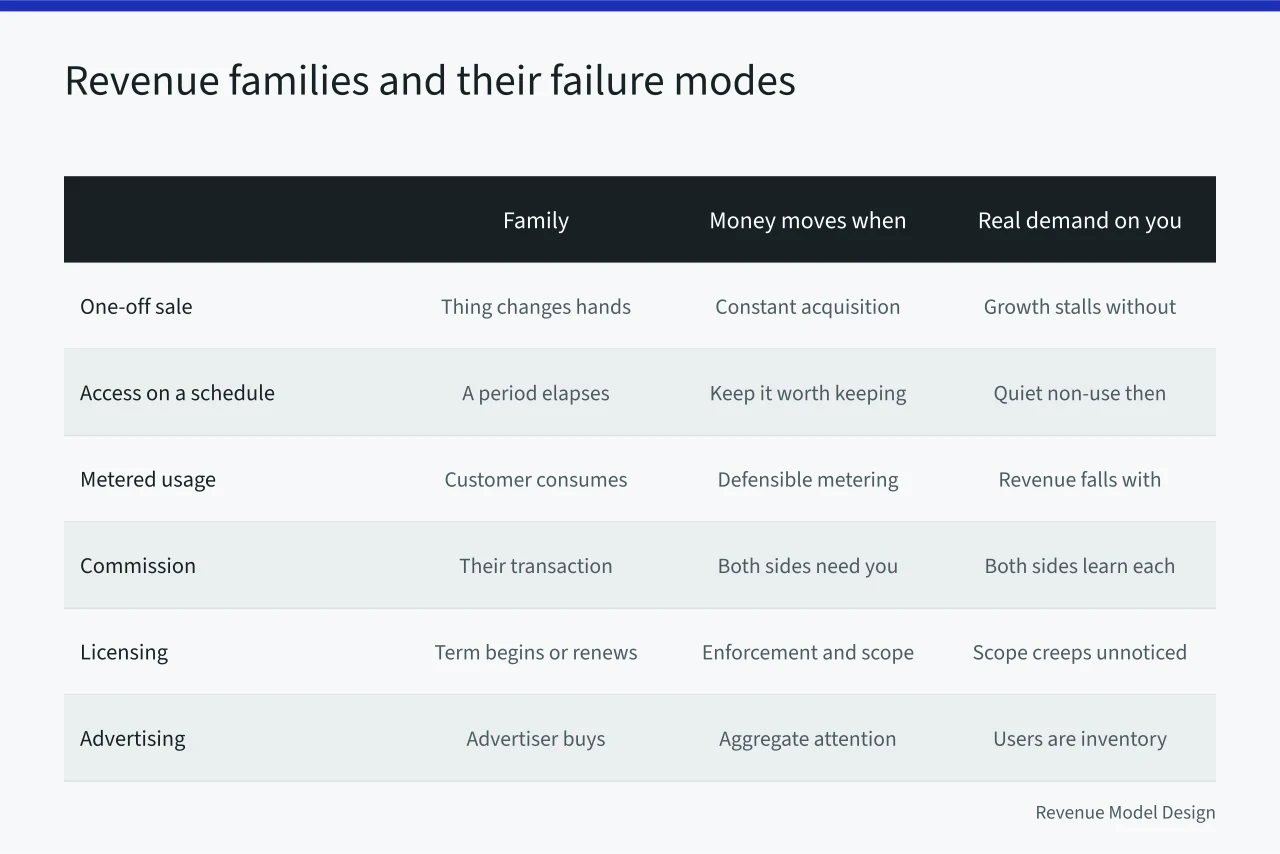
| Family | Money moves when | Its real demand on you | How it fails |
|---|---|---|---|
| One-off sale | The thing changes hands | Constant acquisition, forever | Growth stalls the moment marketing stops |
| Access on a schedule | A period elapses | Keeping the thing worth keeping | Quiet non-use, then a cancellation you never saw coming |
| Metered usage | The customer consumes | Metering you can defend in a dispute | Revenue falls when the customer has a bad quarter |
| Commission on someone else's deal | Their transaction completes | Keeping both sides needing you | Both sides learn each other's names |
| Licensing | A term begins or renews | Enforcement, and defining the scope precisely | Scope creeps, and nobody notices until renewal |
| Advertising or sponsorship | An advertiser buys attention | Aggregating attention worth buying | Your users are the inventory, and they can tell |
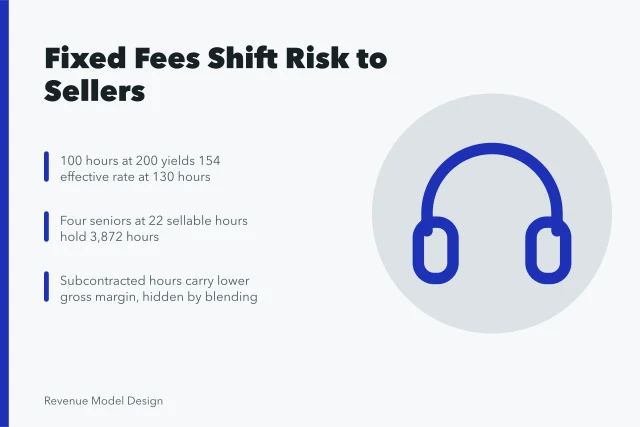
| Service fee for effort | Work is performed and invoiced | Utilization, and people who stay | Capacity is the ceiling and it never moves on its own |
| Outcome or success fee | A result is verified | An attribution argument you can win | The result arrives from something you did not control |
The point of the table is the third column. Choosing a revenue model is choosing which of those jobs your company will be doing every day for years. That is a bigger commitment than the pricing decision it looks like.
Predictability and cash timing are not the same thing
These get merged constantly, and they come apart in both directions.
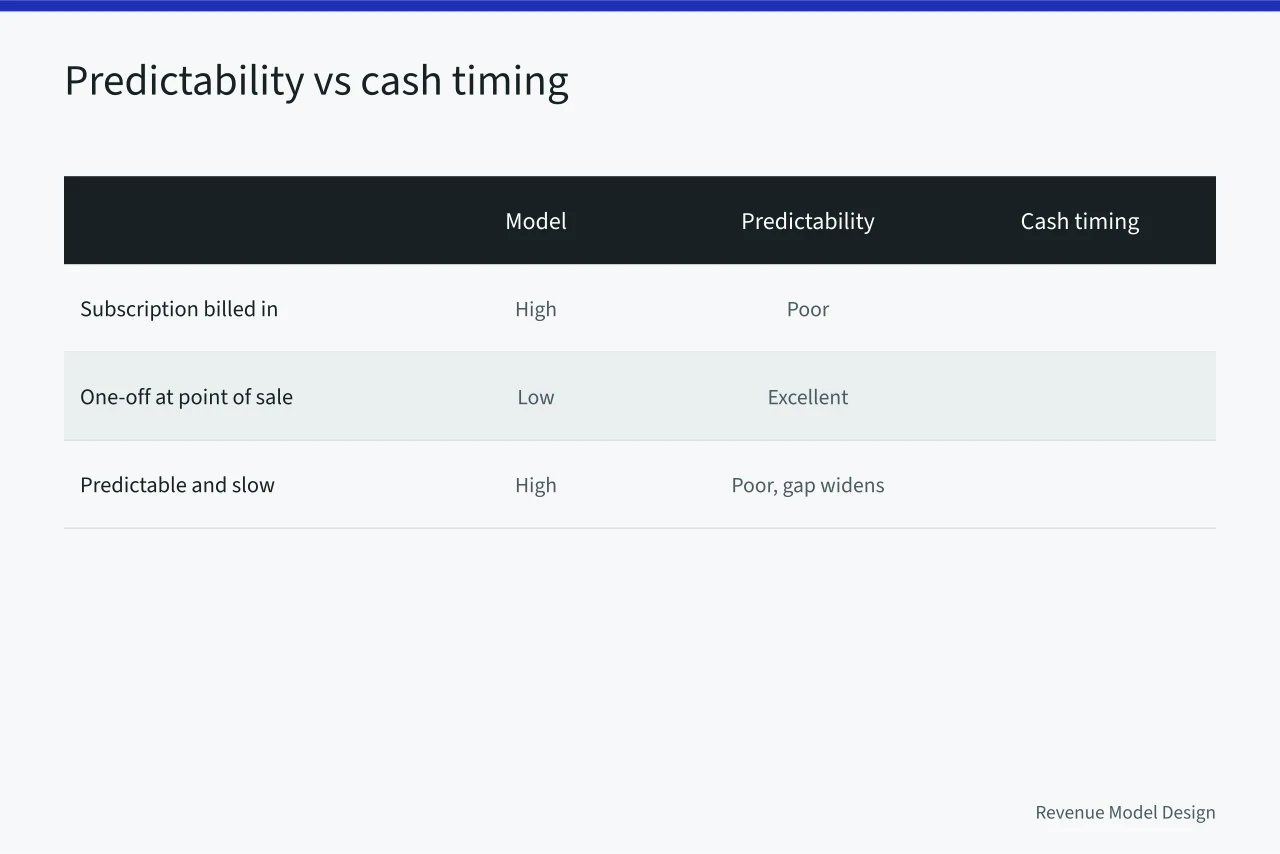
Predictability is whether you can say what next quarter's revenue will be. Cash timing is when the money is available to spend.
A subscription business billing in arrears on long payment terms has high predictability and poor cash timing: you can forecast and still run short. A one-off business collecting in full at the point of sale has low predictability and excellent cash timing: you cannot forecast, and you are never waiting.
Model them separately, because the fixes are different. Weak predictability is fixed with commitments, terms, and a better handle on churn. Weak cash timing is fixed with deposits, milestone billing, shorter terms, or financing, and no amount of forecasting improves it. Comparing those options against each other is the ordinary subject of MIT's entrepreneurial finance course.
The dangerous combination is a model that is predictable and slow. It reports well, it sounds stable, and every new customer widens the gap between money out and money back. Businesses in that position often discover the problem during their best quarter.
What a mixed book does to you
Most companies past the early stage carry more than one revenue model, usually because a large customer wanted something and nobody wanted to say no.
A services arm attached to a subscription has completely different margins, cash timing, and growth behavior. Blending the models into a single line is fine but unmanageable: the result describes neither.
The slow failure is a subscription business whose growth comes from implementation fees, reported as one figure, with nobody asking why growth needs more people every quarter.
Split the reporting by capture event rather than by product name, and look at each one's cash timing separately. If one model is subsidizing another, that can be a deliberate strategy. It just has to be a decision somebody made rather than a fact nobody noticed.
The demand you are signing up for
Each family requires a capability you must actually build, and the mismatch between the model chosen and the capability present is where most revenue model failures live.
Metered usage requires metering that survives a customer disputing the count. If you cannot produce a defensible record of what was consumed and when, you will settle every dispute in the customer's favor. What each side has to be able to show is read off the agreement, which is the ordinary rule in a claim for breach of contract.
Subscriptions require someone whose job is knowing which accounts have stopped using the thing. Usage decay precedes cancellation by a long way, and the entire opportunity to act sits inside that gap.
Commission models require both sides to keep needing you after they have met. Whatever provides that, escrow, dispute resolution, insurance, discovery, is your actual product, and the commission is just how it is billed.
Outcome fees require attribution you can defend when the result is good and someone else wants credit, and when the result is bad and you want distance.
Service fees require utilization tracking and a real answer to what happens in a quiet month.
What to measure in your own book
Industry figures for any of this are worse than useless, because they carry someone else's mix and definitions and arrive sounding like facts. These come from your own records.
- Revenue split by capture event, with each split's own cash timing in days.
- The largest cumulative gap between money paid out and money received back, at your current growth rate. This is the number that tells you how much cash growth costs.
- Concentration by customer and by channel, for each revenue family separately.
- For recurring revenue, usage against billing. Accounts paying and not using are next year's churn, already decided.
- For usage revenue, the distribution across accounts, not the average. Averages hide the two tails that determine whether a bad quarter for one customer is a bad quarter for you.
Changing the model on live customers
Revenue model changes are announced badly more often than they are designed badly.
The mechanics that reduce damage are unglamorous.
Change one thing at a time and hold existing customers on the old terms for a stated period, not an indefinite one. Publish the new structure before anyone is moved onto it. Make sure whoever answers the questions knows the reasoning, not just the new prices.
Never move an existing customer to a model that is worse for them without telling them plainly that it is worse and why.
Decide the change rule before you need it. A company arguing about whether it is allowed to reprice, in the middle of repricing, has already lost the argument.
Common questions
Is recurring revenue always the goal?
No. Recurring revenue is predictable and it obliges you to keep earning it every period, permanently. Where repeat purchase was never natural, converting to a subscription usually produces a worse business wearing a more fashionable label.
Should we offer a free tier?
Only if you can say precisely what it is for: distribution, evaluation, or a network effect that needs volume. Free as a general hope is expensive, since the cost of serving free users is real and arrives long before the revenue does.
Can we charge for outcomes without being able to measure them?
No, and agreeing to try is how firms end up in unwinnable arguments. If the measurement is not agreed in writing before the work starts, including who produces the number and what happens when the parties disagree, the fee is a dispute with a delay on it.
How often should a revenue model be revisited?
Look at it when something structural moves: the cash gap grows with each new customer, growth needs headcount that is not there, or the thing you bill for has drifted away from the thing customers value. Calendar reviews mostly produce changes nobody needed.
In this guide
- Revenue models examples with the reasoning laid bareTwelve revenue models examples built from four ordinary offerings charged three ways each, showing what every capture event obliges you to staff and run.
- Revenue models framework: the 2027 reviewA revenue models framework that eliminates rather than selects: four constraints on the buyer's side that rule out most charging shapes before you choose.
- Reading revenue models metrics without fooling yourselfRevenue models metrics separated into four numbers that get one name, with what each can carry, what it cannot, and the gaps that hold the information.
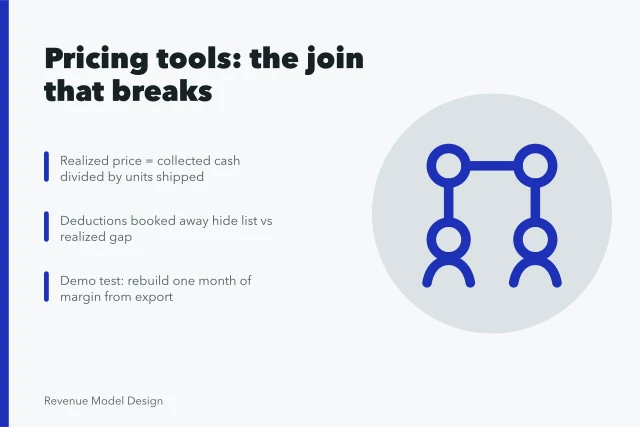
- The export test that separates real revenue models tools from spreadsheetsBest revenue models tools 2027: what a billing system has to represent before it constrains your model, the four jobs, and the export test to run first.
- Revenue models questions, answered without hedgingRevenue models questions that arrive from buyers, partners, lenders and your own sales team, with what a solid answer contains and what gives you away.