Reviews
Model innovation: what to keep and what to drop
Model innovation as a transition problem: the four levers, the cash trough, the incentives that defeat you, and how to sequence the irreversible decisions last.
Model innovation is almost never performed on a blank page. It is performed on a running business, with customers on existing agreements, salespeople on an existing commission plan, partners who built around the old arrangement, and a payroll that has to be met during the change. The idea is the easy part. The transition is the part that kills companies.
This page is about the mechanics of getting from one model to another. What counts as a model change, the four levers available, the specific ways transitions fail, and how to sequence the decisions so the irreversible ones come last.
What to take away
- A useful test, because "innovation" gets applied to anything new.
- Moving the payer works when someone other than the user captures more of the value than the user does, an employer, an insurer, a manufacturer, an advertiser, the other side of a transaction.
- Most model tests prove nothing, because nothing was at stake in them.
- Every decision in a transition is one of three kinds, and the order matters more than the speed.
What counts
A useful test, because "innovation" gets applied to anything new. A change is a business model change if it alters one of four things:
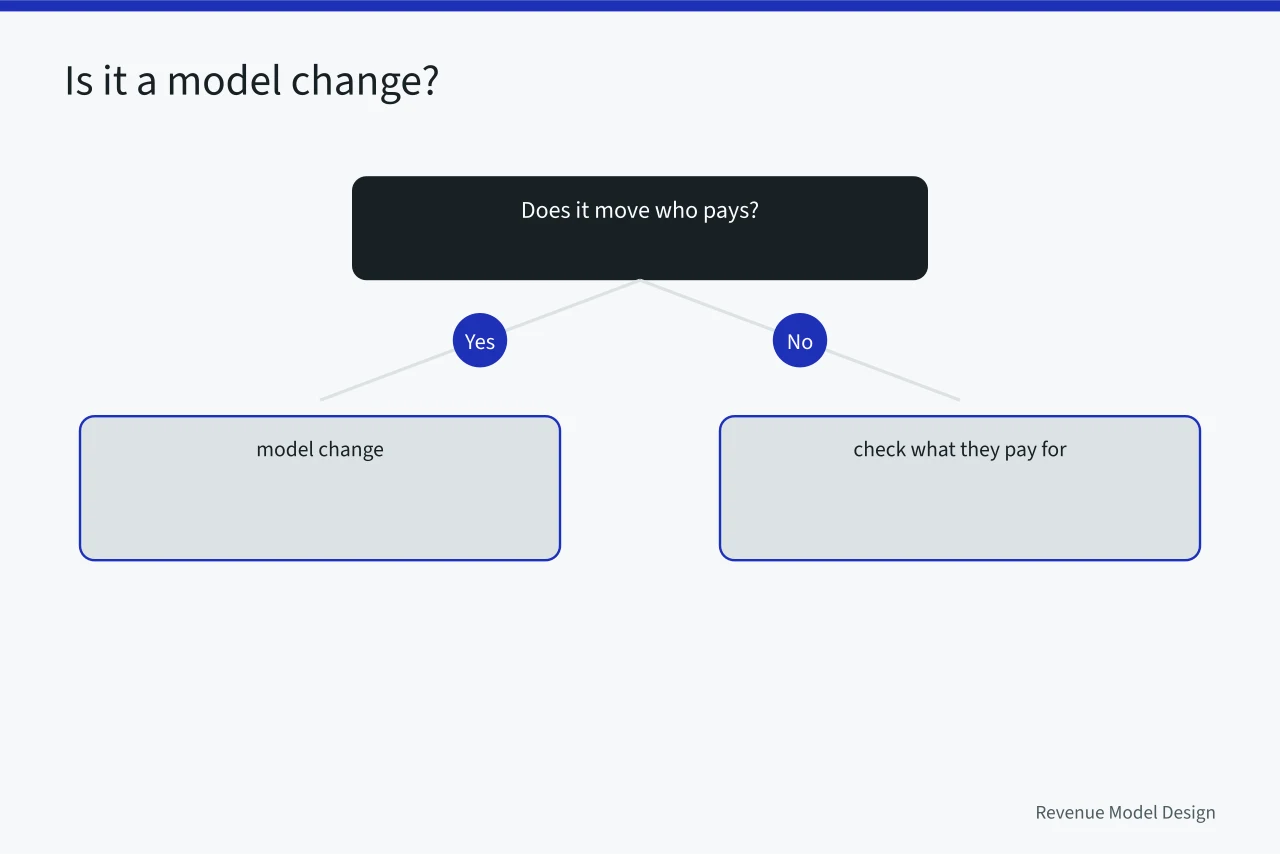
If a proposal does not move one of those, it is a feature, a campaign, a repackaging, or a price change. Those are all worth doing and none of them require the machinery below. Applying transition-scale caution to a price adjustment is as expensive a mistake as treating a model change as a pricing exercise.
The four levers
Moving the payer works when someone other than the user captures more of the value than the user does: an employer, an insurer, a manufacturer, an advertiser, the other side of a transaction. It changes what the buyer is willing to pay in a way the user never would, which is why it is one of the families compared in revenue models.
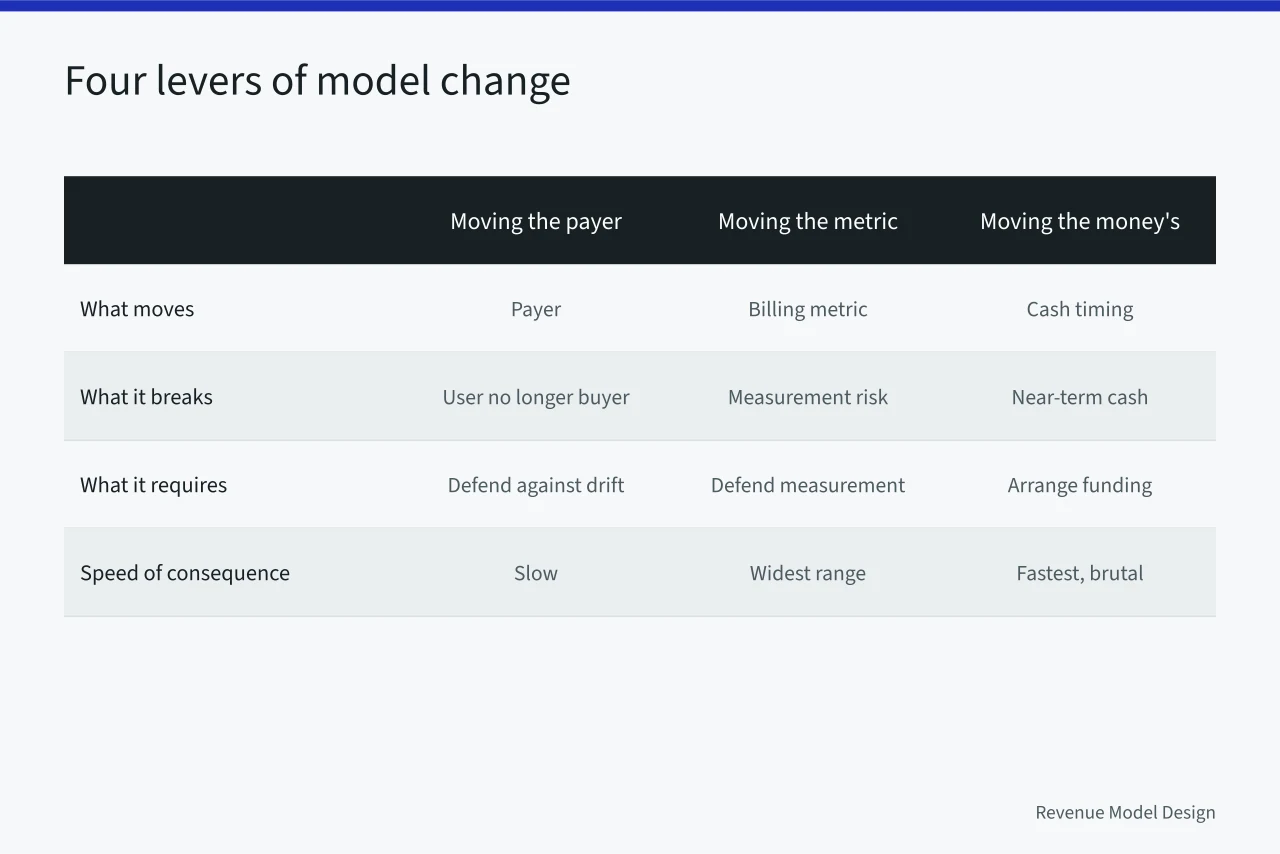
What it breaks: the person using the product is no longer the person you have to satisfy, and product decisions drift toward whoever signs. Every business that has made this move has had to defend against that drift deliberately. The ones that did not ended up with a product their users tolerate.
Moving the metric is the most common model change and the one with the widest range of outcomes, and the layer it sits in is the first one described in pricing architecture. Shifting from charging for effort to charging for output, or from output to outcome, moves risk from the customer to you and raises what you can charge in exchange.
It requires that you can measure the new thing, defend the measurement, and survive the periods when the outcome does not arrive. Shifting the other way, from outcome back to effort, is not a retreat if your outcomes depend on decisions you do not control.
Moving the money's timing is the lever with the fastest and most brutal consequences, which is why it gets its own section below. Prepayment, financing, deferred fees, and usage-after-the-fact all change the amount of working capital the business needs, and they change it immediately while the benefits arrive slowly.
Moving the work changes your cost structure rather than your revenue. Pushing delivery to the customer through self-service lowers cost and raises the quality bar on everything they now do alone. Pushing it to partners buys reach and costs consistency and margin. Pulling it back in-house buys control and consistency and costs capital and flexibility. Each is reversible, but not quickly, because the capability you gave up takes time to rebuild.
The transition problem
This is where model changes actually fail, and every item below is predictable in advance.
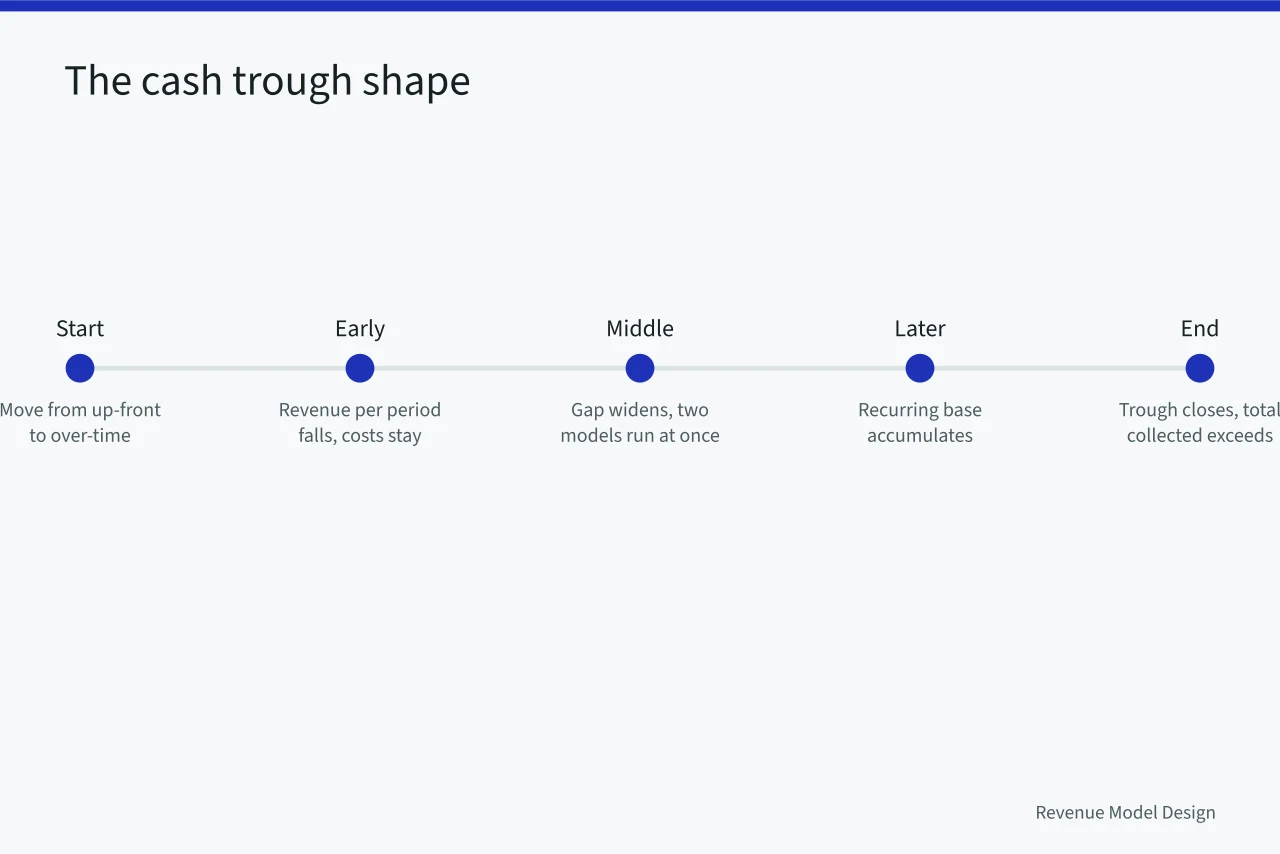
You will run two models at once, and it will cost more than either. For a period always longer than planned, you support the old arrangement for existing customers and the new one for arriving ones. Two price books, two contracts, two support paths, two sets of reporting, and a team explaining the difference to everyone. Budget the overlap as its own project with an end date, or it will be funded out of whatever else was planned that year.
The cash trough is a shape, not a risk. Moving from money-up-front to money-over-time reduces near-term cash even when it increases the total eventually collected. Revenue recognized per period falls while costs stay where they were, and the gap widens until the accumulating base of recurring customers catches up. This is arithmetic, not pessimism.
What varies is only how deep the trough goes and how long it lasts. Both are computable from your own numbers before you start, using the definitions in unit economics.
Financing a change before it pays is the standing subject of MIT's entrepreneurial finance course. Businesses that survive computed the trough and arranged funding first. Those that did not discover its shape midway and reverse at the worst point.
Your compensation plan will defeat you. A sales team paid on first-year contract value will not sell a lower-priced recurring arrangement, no matter what the strategy deck says, and they are behaving rationally. Whatever the plan pays for is what you will get. Rewrite compensation before the launch, not after the first disappointing quarter, and accept that a transition period usually requires paying people for behavior that is temporarily uneconomic.
Existing contracts do not move. Customers on agreements written under the old model stay there until those agreements end. Grandfathering is not a courtesy you extend informally: it is a decision with a duration, a defined population, and a cost, and it should be written down at the start. Otherwise it becomes permanent by accident, and years later a meaningful share of revenue sits on terms nobody can explain.
Partners built a business on your old model. Resellers, implementers, and referral partners have their own economics attached to how you used to charge. A change that improves your margins can eliminate theirs, and they will find out from a customer before they find out from you if you let that happen.
The new model may need capabilities you do not have. Moving from project delivery to a product needs people who maintain rather than deliver, which is the last rung of the ladder described in service models. Moving from direct sales to self-service needs demand generation and onboarding rather than relationships. These are hiring and learning timelines, and they run in parallel with the cash trough rather than after it.
What a real test looks like
Most model tests prove nothing, because nothing was at stake in them.
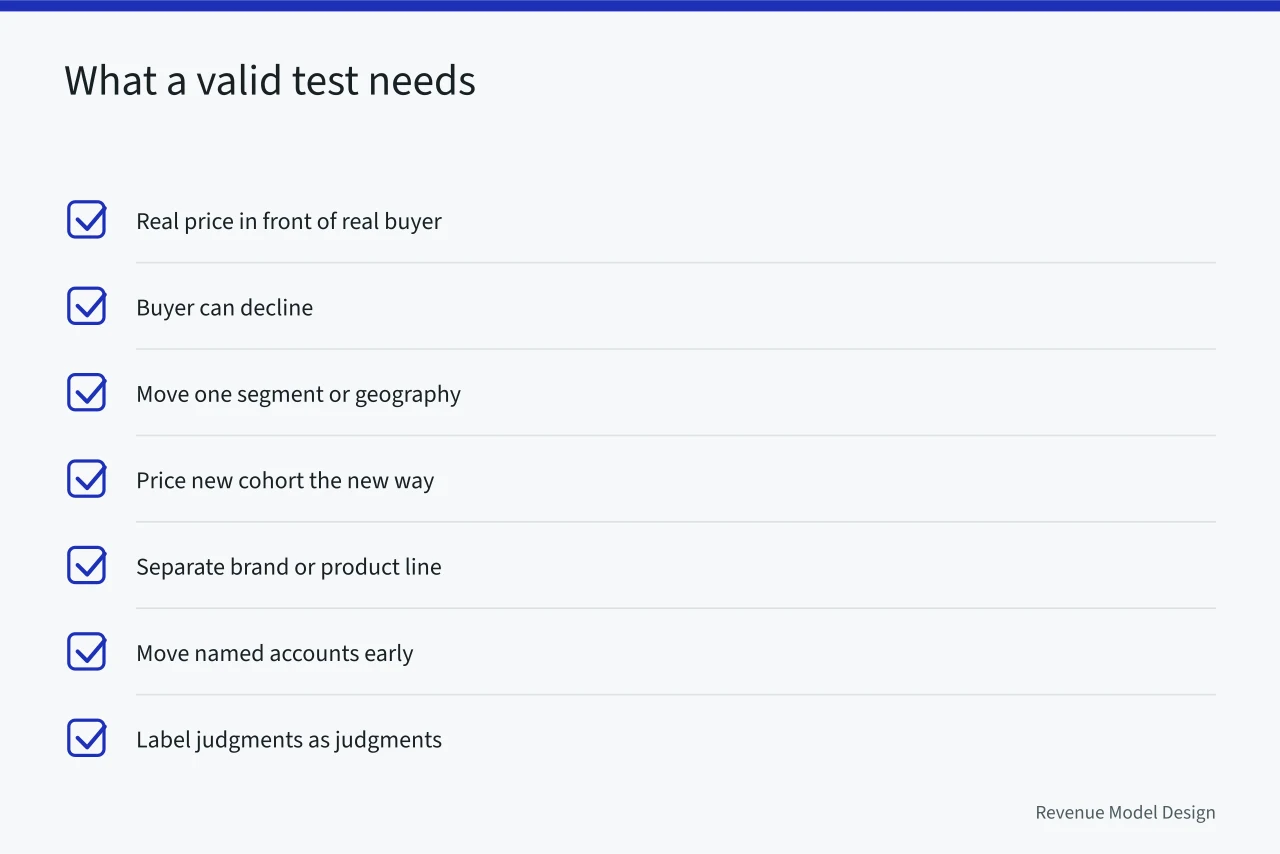
A valid test puts a real price in front of a real buyer who can decline. Everything softer (survey questions about willingness to pay, enthusiasm in a discovery call, a show of hands) measures politeness.
The cheapest honest tests are four: move a single segment or geography onto the new model, rest unchanged, and price a new customer cohort the new way from day one.
Carry the new arrangement on a separate brand or product line, existing base untouched. Or move a few named accounts early for a term you would not offer generally.
Be clear about what a test cannot tell you. It cannot tell you retention under the new model, because that takes as long as it takes. It cannot tell you cost to serve at scale, since early cohorts are over-served. Nor can it tell you how competitors will respond.
Those three enter the decision as judgments, labeled as judgments, not smuggled in as findings.
Sort the doors before you open them
Every decision in a transition is one of three kinds, and the order matters more than the speed.
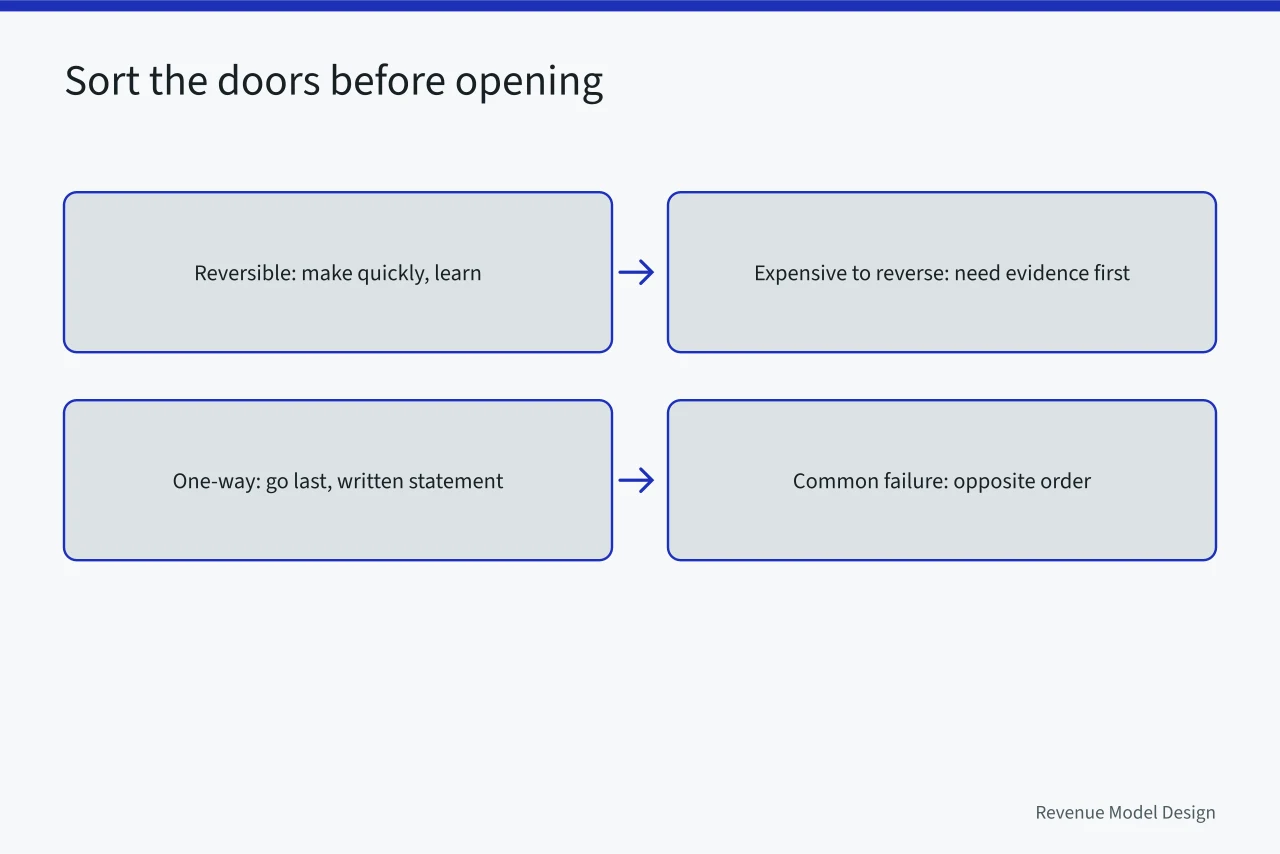
Reversible decisions can be undone within a period at modest cost: a price on a new cohort, a packaging change for new customers, a pilot in one region. Make these quickly and learn from them.
Expensive to reverse decisions can be undone but you will pay in money and credibility: a public price change, a new tier structure, a partner program. These need evidence from the reversible ones first.
One-way decisions cannot practically be undone: terminating a channel, dismantling a delivery capability, migrating your entire base onto new agreements, a public commitment you would have to break. These go last, after the other two have produced evidence, and they deserve a written statement of what would have to be true for them to be right.
The common failure is doing them in the opposite order because the one-way decision is the one that feels decisive.
Signals that it is the model and not the execution
Model changes are expensive, so it is worth being sure the problem is structural.
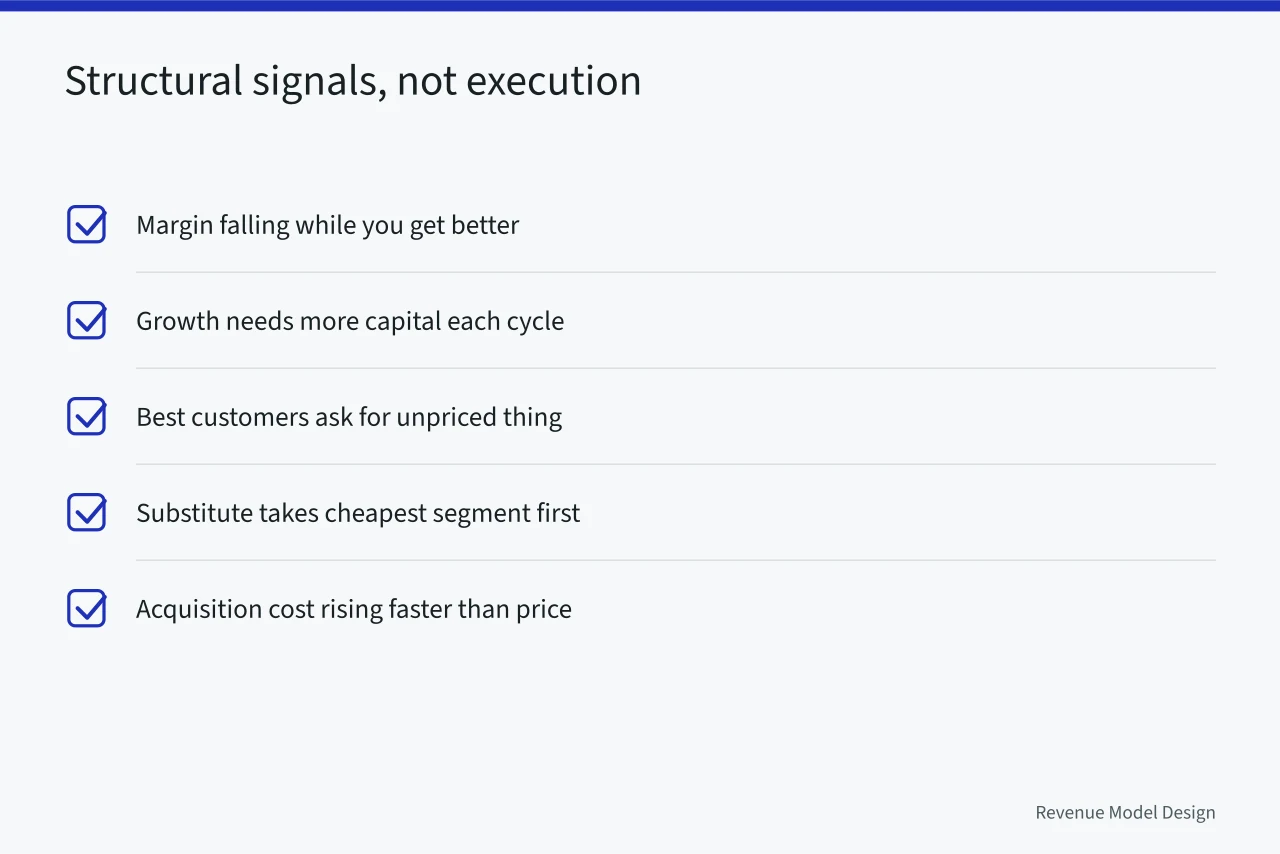
Margin falling while you get better at the work suggests the price is captured by the customer or the channel rather than by you. Growth requiring proportionally more capital each cycle suggests the model finances itself badly however well it is run. Your best customers repeatedly asking for something you cannot price suggests the metric is wrong.
A substitute taking your cheapest segment first suggests the low end is being redefined and will not stay there. And acquisition cost rising faster than what you can charge suggests the value per customer no longer supports the way you reach them.
Each of these is a structural signal. None is fixed by working harder inside the current arrangement, which is why they are worth distinguishing from ordinary underperformance before anyone commits to a transition.
A sequence that tends to hold
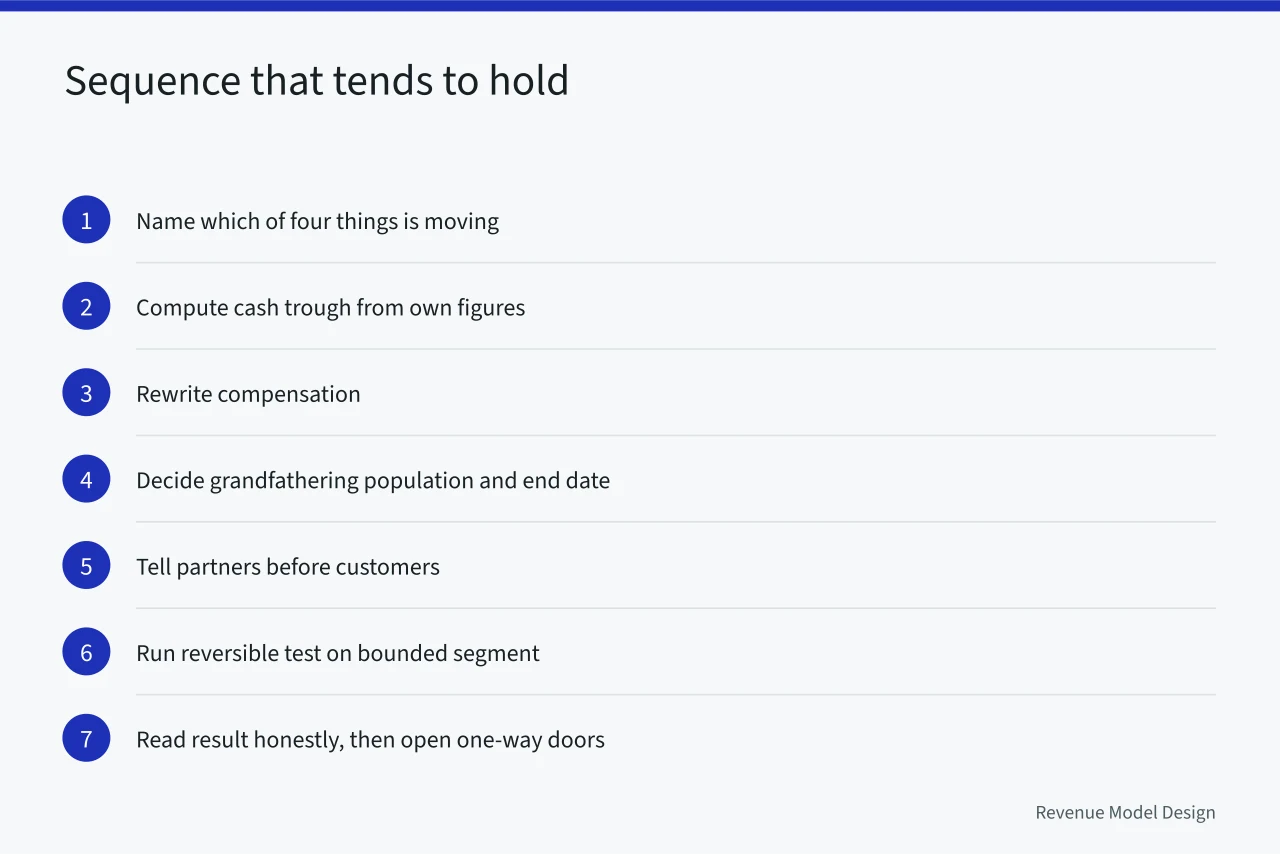
Name which of the four things is moving. Compute the cash trough from your own figures. Rewrite compensation. Decide the grandfathering population and its end date. Tell partners before customers. Run a reversible test on a bounded segment. Read the result honestly, including the part that is judgment. Then, and only then, open the one-way doors.
For the general planning frame, the sections a lender or partner will want to see when the model itself is changing, the U.S. Small Business Administration's business plan guide sets out a reasonable structure.
Bottom line
Business model innovation fails at the transition more often than at the idea. Work out the cash shape, fix the incentives, and decide what happens to customers you cannot move. Keep irreversible decisions until last.
The new model is usually fine. The stretch in the middle, where you are paying for both, is what has to be survived.
Common questions
How do we tell a model change from a price change?
Ask whether it moves who pays, what they pay for, when the money arrives, or who does the work. If it moves none of those, it is a price change, and applying transition-scale caution to it is its own expensive mistake.
How long should we expect to run two models?
Longer than planned. The useful discipline is naming an end date in advance, so that overrunning it triggers a decision rather than a shrug.
What if the sales team resists?
Check the compensation plan before calling it resistance. People sell what they are paid to sell, and a plan that still rewards the old behavior is doing exactly what it was designed to do.
Can we skip the reversible tests if we are confident?
You can, and then the one-way decision carries all the risk on its own. Confidence is not evidence, and the reversible tests are cheap precisely because they can be undone.