Reviews
Pricing architecture: what the experienced already know for 2027
Pricing architecture in six layers, from the billing metric to the change rule, with a table for working out which layer is causing the symptom you can see.
A price is a number. A pricing architecture is the structure that produces that number: for every customer, in every situation, for as long as the offer exists. Most teams argue about the number. The number is rarely what is broken.
This page walks through the six structural decisions underneath any price, what each one does to your buyer and to your economics, and how to work out which one is causing the symptom you are actually seeing.
What to take away
- The billing metric is the most consequential decision in the whole structure, and it is usually made in an afternoon, early, by whoever was building the invoice.
- Commitment trades three things against each other: when cash arrives, how certain future revenue is, and how much freedom you keep to change the offer.
- When a deal is lost on price, one of three quite different things happened.
The six layers
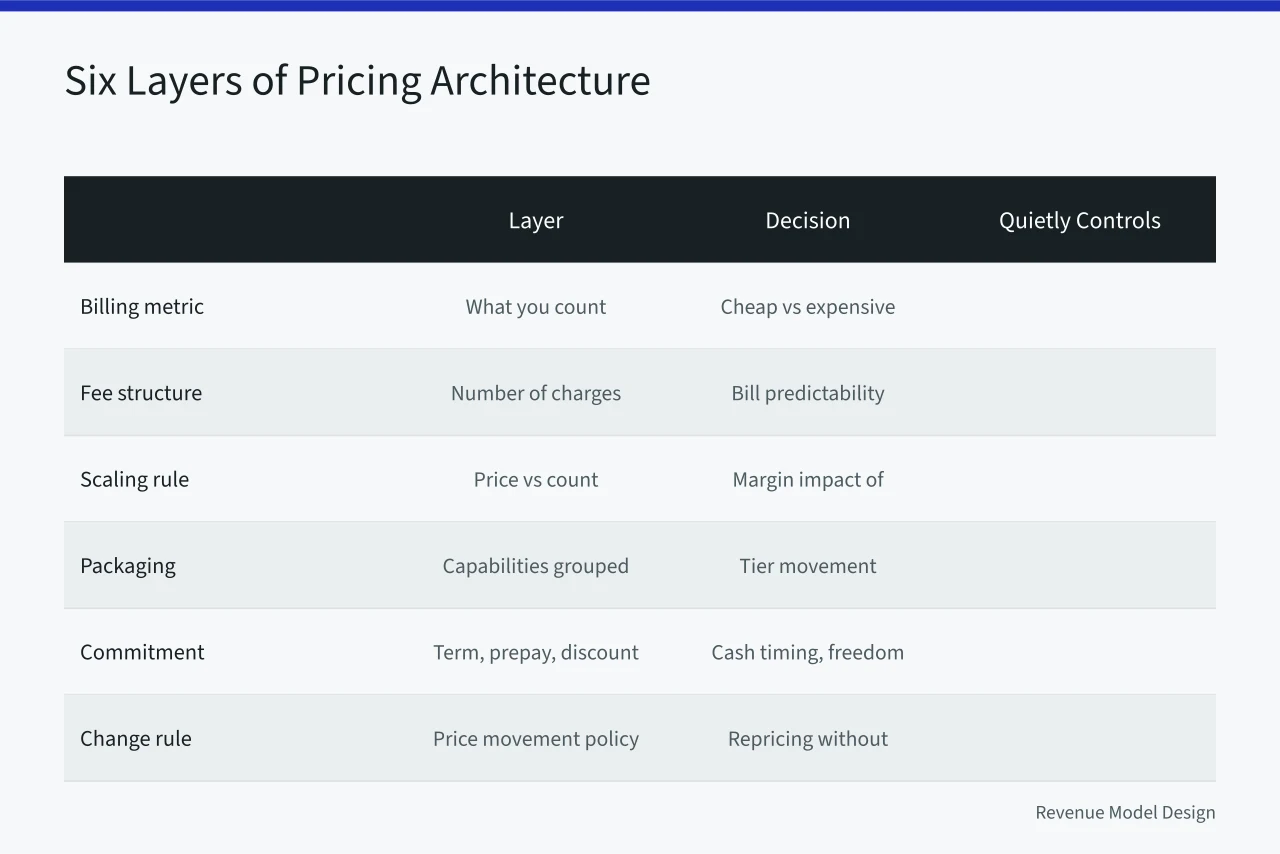
| Layer | The decision | What it quietly controls |
|---|---|---|
| Billing metric | What you count | Which customers are cheap to serve and which are expensive |
| Fee structure | How many separate charges appear on the invoice | How predictable the bill feels before it arrives |
| Scaling rule | How the price moves as the count rises | Whether growth in usage helps or hurts your margin |
| Packaging | Which capabilities travel together | Who is pushed up a tier and who is stranded below one |
| Commitment | Term, prepayment, and discount policy | When cash arrives and how much freedom you keep |
| Change rule | How and when a price is allowed to move | Whether you can ever reprice without a fight |
You can change any layer. You cannot change several at once and still know which change did what.
1. What you count
The billing metric is the most consequential decision in the whole structure, and it is usually made in an afternoon, early, by whoever was building the invoice.
A metric worth keeping has to do five jobs at once:
- It rises when the customer gets more out of you.
- The customer can estimate it before the invoice arrives.
- You can meter it cheaply and defend the count when it is disputed.
- It is hard to reduce without also giving up the value.
- It moves roughly in step with what it costs you to serve.
No metric does all five. Every real choice is a trade among them, and knowing which one you gave up tells you where the pain will show up later. Which metric a business can even consider follows from what triggers the money, which is the argument in revenue models.
Counting people is predictable and trivial to meter. It fails whenever a few operators use your product on behalf of many beneficiaries: the customer's value grows, your revenue does not. Counting consumption tracks value and cost closely, and produces bills nobody can forecast.
That invites procurement to cap spending exactly when adoption is working. Counting outcomes tracks value best of all. It forces you into an attribution argument you may not win, and into a revenue line that moves with the customer's fortunes rather than your own.
A cheap diagnostic: take your ten largest accounts and ten smallest. Compare three ratios: what they pay, what they appear to get, and what they cost you to serve.
Where those three ratios move together, the metric is doing its job. Where they diverge sharply, you have found either your most profitable customers or the ones subsidized by everyone else.
2. How many charges
Invoices carry five kinds of line: one-time (onboarding, migration, implementation), recurring (access, platform, seat), variable (usage above or instead of a base), contingent (overage, success fee, penalty), and pass-through (a third-party cost you collect and forward).
Each additional line buys accuracy and spends comprehensibility. A single flat charge is easy to sell and quietly cross-subsidizes heavy users with light ones. A five-line invoice matches revenue to cost and creates a quoting problem, a billing-system problem, and a monthly conversation with the customer's finance team.
The line to think hardest about is pass-through. Payment processing, cloud capacity, shipping, third-party licenses, and data fees move without your permission. Decide deliberately whether each one sits inside your price or outside it. Everything you fold inside is a margin exposure you have underwritten on someone else's behalf, and it will be repriced by them, not by you.
3. How the price scales
There are only a few shapes: strictly linear, blocks with a fixed price per block, declining rates at higher volume, a committed minimum with overage above it, and a floor-and-ceiling band.
The question that decides between them is not what competitors do. It is whether your cost of serving actually falls as volume rises. Structure and level are treated as separate problems in MIT's pricing course, which is a reasonable place to see why the scaling rule deserves its own decision.
If serving twice the volume costs you close to twice as much, a volume discount converts growth into margin erosion, and the effect is largest in exactly the accounts you are most proud of.
That is worth stating plainly: with a declining scaling rule and no offsetting cost curve, your biggest customer is structurally your least profitable one. Nobody notices, because margin is reported in aggregate and the big account is reported as a win.
4. What travels together
Packaging is fence-building. You are deciding which capability a customer must move up a tier to reach.
A good fence sits on a capability whose need genuinely appears at a certain scale: more environments, more granular permissions, higher throughput, longer retention. The customer grows into it and the upgrade feels earned.
A bad fence sits on something everyone needs regardless of size. Single sign-on, audit logs, basic access control, and the ability to get help when something breaks all fall here. Gating them looks like clever tier design and reads to the buyer as a hostage arrangement, and it will be described that way to other buyers.
Two tests worth running on your tier list. For each tier, name the specific customer it exists for and the one reason they cannot use the tier below. If you cannot say it in a sentence, that tier is decoration.
Then look at what customers actually use after they buy the top tier. If most bought it for a single feature, that feature is in the wrong package. You are collecting the rest as an accident.
5. Term, prepayment, and discount
Commitment trades three things: when cash arrives, certainty of future revenue, and freedom to change the offer.
Longer terms with money up front pull cash forward, locking your price and product promise for the term. That trade works when costs are stable, but fails when your inputs move.
Discounting deserves a written rule rather than a mood. Every discount is either bought or given. A bought discount exchanges price for something specific: a longer term, payment up front, a narrowed scope, a reference you can name, a shorter sales cycle. A given discount buys nothing, and it teaches every subsequent buyer that waiting is profitable.
The practical constraint is that the discount you grant your first customer becomes the ceiling for your tenth. Prices leak between buyers far more than sellers expect, especially inside an industry, inside a procurement network, and inside any market where the same handful of consultants advise everybody.
6. How the price is allowed to move
Almost nobody designs this layer, and it is the one that traps you.
Before signing, decide if prices change only at renewal or can move mid-term. Set how much notice a change requires. State if existing customers keep their original price, and for how long.
Check if any charge is indexed to an external cost you do not control. Put it in the agreement while you still have negotiating room.
If you skip this, you do not avoid having a policy. You discover your policy in the middle of an argument, with a customer who has every reason to insist it says something else.
Which layer is actually broken
| What you are seeing | Where to look first |
|---|---|
| Sales discounts on almost every deal | Packaging, or a scaling rule that prices small buyers out |
| Customers are surprised by their invoice | Billing metric, or too many variable lines |
| Your largest accounts have the thinnest margin | Scaling rule and discount policy |
| Two customers pay the same and cost wildly different amounts to serve | The metric does not track your cost |
| Everybody buys the top tier and uses one feature of it | The fence is on the wrong capability |
| Nobody buys the top tier | The tier has no named customer |
| You cannot raise a price without losing the account | No change rule, and probably a metric the customer does not connect to value |
Three problems that all sound like "too expensive"
When a deal is lost on price, one of three quite different things happened.
A pricing problem means the right buyer wanted the right package and the number was wrong. This is the rarest of the three and the only one a discount fixes.
A packaging problem means the right buyer was asked to pay for a bundle containing things they do not want. The number is not the objection; the shape is. Discounting here trains a buyer to expect the same bundle for less, and you will still be carrying the unwanted parts.
A positioning problem means you were talking to a buyer for whom no number works, because the outcome you sell is not the outcome they are budgeted for. No pricing change reaches this. It is fixed upstream or not at all.
Loss reasons recorded as "price" collapse all three into one useless category. If every lost deal in your records says price, the field is being used as a polite exit, and you are missing the two problems that matter more.
What to measure in your own book
None of this is answerable from an industry figure. Your architecture is judged against your costs, your customers, and your discount history, so the measurements have to come from your own invoices.
Start with realized price: invoiced revenue divided by units of your billing metric, for a defined period. That is a definition, not a benchmark, the useful thing is its trend. A realized price falling while volume rises means your scaling rule and your discount practice are doing something nobody decided.
Then look at margin by customer rather than in aggregate. The same price against different service costs is not one business, it is several, and only a per-customer view separates them.
Look at the distribution of your billing metric across accounts, not its average. Averages hide the two tails that determine whether your structure works.
Track concentration: what share of revenue sits with your largest handful of customers, and what discount those customers hold. Concentration plus a declining scaling rule is the combination that quietly caps a company's profitability.
Finally, keep a price change log. What changed, when, who was exempted, what happened to renewals in the following period. Without it, every future repricing debate is argued from memory, and memory favors whoever is most worried.
One thing not to copy
You can see a competitor's list price, their tier names, and their fences. You cannot see their realized price, their discount policy, their contract terms, or what it costs them to serve anybody.
What kind of business you are running underneath the price list is a separate question, settled by the five decisions under every model. Copying the visible half of a structure while inheriting none of the hidden economics is the most reliable way to break a model that was working.
If the wider question is how a price fits into a written plan you can hand to a lender or a partner, the U.S. Small Business Administration's guide to writing a business plan is a free place to start, and it will tell you which sections a reader outside your company will expect to find.
Bottom line
Fix the layer, not the number.
Work out what you count, how many things you charge for, and how the price scales. Then decide where the fences sit, what commitment buys, and how a price is allowed to change.
Most blame on the price comes from one of those six layers, made quickly years ago by someone solving a different problem.
Common questions
Which layer should we look at first?
The billing metric, because every other layer is built on it and it is the one most often chosen in an afternoon by whoever was building the first invoice.
Can we change two layers at once if we are in a hurry?
You can, and you will not know which change produced the result. That costs you the only clean reading you get, and the second change is usually the one you would have wanted to reverse.
How do we know whether a lost deal was really about price?
Separate the three cases in your loss records: a number objection, a package objection, and a buyer who was never budgeted for this at all. If every lost deal says price, the field is a polite exit and you have no data.
Should the structure be published even if the number is not?
Usually yes. Most of the benefit of publishing is comprehension: what you charge for, how it scales, and how a price is allowed to move. Buyers who cannot find those assume the worst case.
In this guide
- A realistic take on pricing architecture: the 2027 viewA pricing architecture guide to changing a live price structure: the two documents to build first, which layer to move, and how to plan the handover.
- Pricing architecture checklist from the ground up as of 2027Pricing architecture checklist: twelve audits run against your own invoices, contracts and approval records, with what each finding should change.
- 4 things to understand about pricing architecture mistakesFour things to understand about pricing architecture mistakes: who decides, what the contract fixes, what billing can capture, and how a change reaches the customer.
- 5 details of pricing architecture examples people missFive pricing architecture examples named by the companies that run them reveal the approval problem each structure creates on the buyer's desk.
- What your own pricing records can prove, and the limit metrics hitPricing architecture metrics and their limits: which questions your own price history can answer, which it can only bound, and the one it cannot answer at all.
- How to judge pricing architecture tools before you sign a contractBest pricing architecture tools 2027: the four records a price structure has to leave behind, when a spreadsheet is enough, and the reconstruct test.
- Understanding pricing architecture questions properly as of 2027Pricing architecture questions that recur in every company, with what is actually being disputed in each and the cheapest way to settle it for good.
- Pricing architecture trends worth taking seriouslyPricing architecture trends for 2027 as five structural pressures, each with a check you can run on your own contracts to see whether it applies to you.