Rules
Part of Pricing architecture: what the experienced already know for 2027
Pricing architecture trends worth taking seriously
Pricing architecture trends for 2027 as five structural pressures, each with a check you can run on your own contracts to see whether it applies to you.
This page contains no market forecasts, no adoption figures and no claims about what buyers in general are doing. Those numbers exist, they conflict with each other, and none of them are about your book.
What it does contain is five structural pressures that show up in the contracts companies actually sign, and for each, a check you can run on your own records to find out whether it applies to you. A pressure that is not visible in your own quotes and renewals is somebody else's news.
What to take away
- A trend matters to you only if it is already visible in your own contracts, losses or renewals. Check there first.
- Every pressure below is a question about who carries a risk. The structures that survive are the ones that name the answer.
- The response to a pressure is a clause more often than a price.
Pressure one: costs that move without your permission
Third-party inputs sit inside most prices: payment processing, capacity, shipping, licenses, data. When one of those moves, the question is who absorbs it, and the answer is decided by a clause you either wrote or did not.
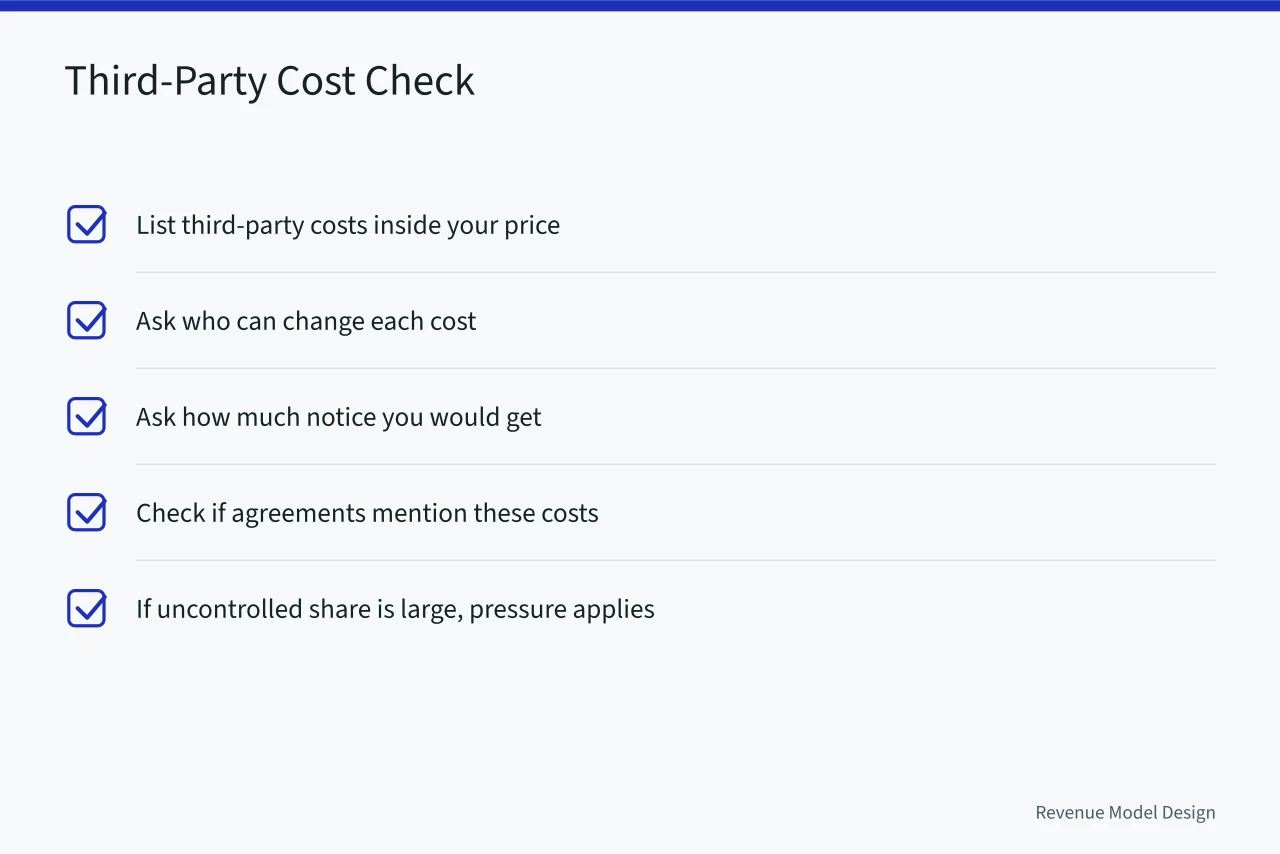
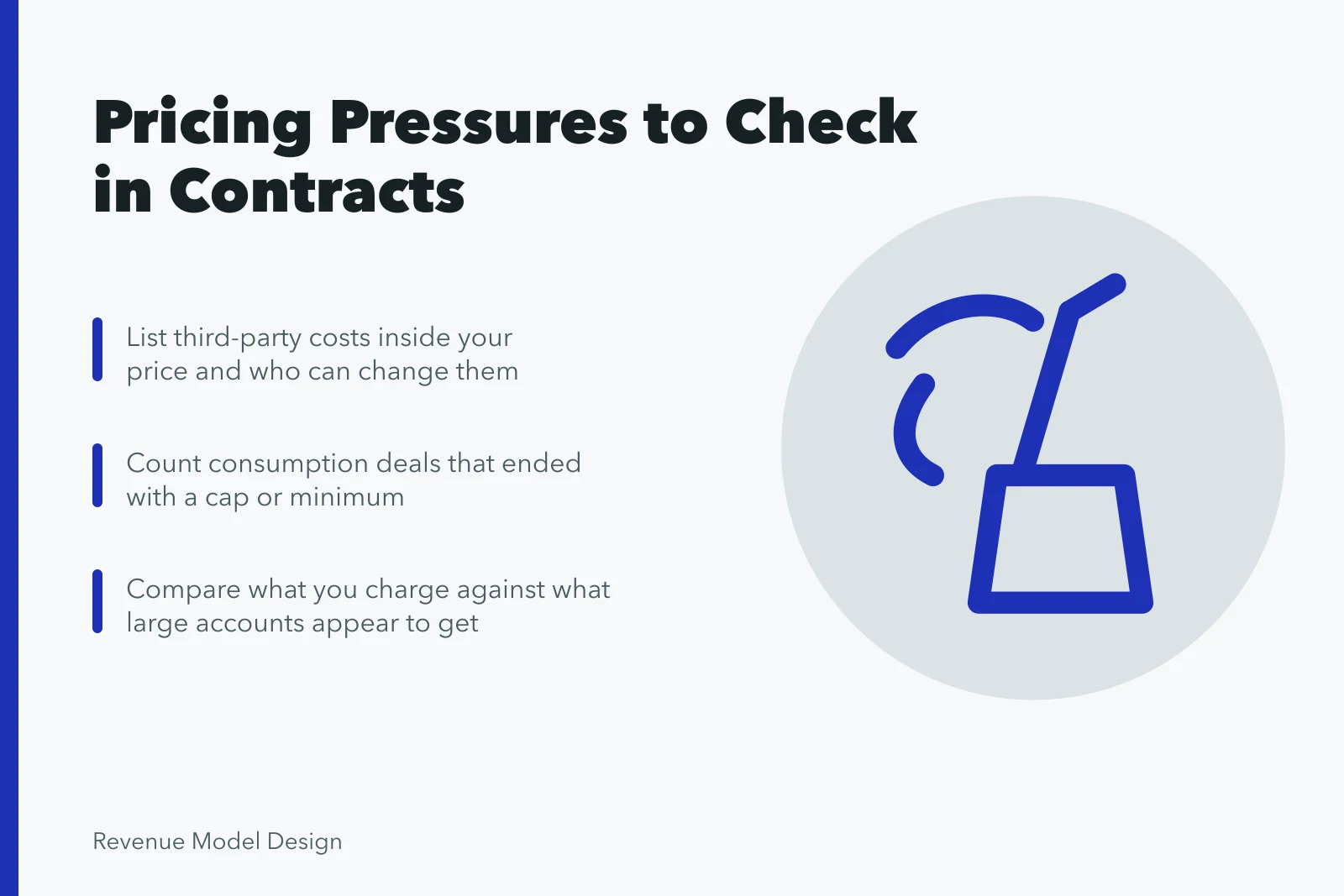
How to tell if it applies to you. List the third-party costs inside your price and, for each, ask who can change it and how much notice you would get. If more than a small share of your price is made of costs you do not control and your agreements do not mention them, this pressure is on you regardless of what any market report says.
What it does to the structure. It pushes toward explicit pass-through, stated separately on the invoice, with the treatment of an increase written into the agreement. Folding a volatile cost into your own line is a decision to underwrite it.
Pressure two: buyers who cannot approve an unknown number
Approval processes are getting no more relaxed, and an unbounded variable charge is difficult to raise a purchase order against. This is not a price objection and it is regularly mistaken for one.
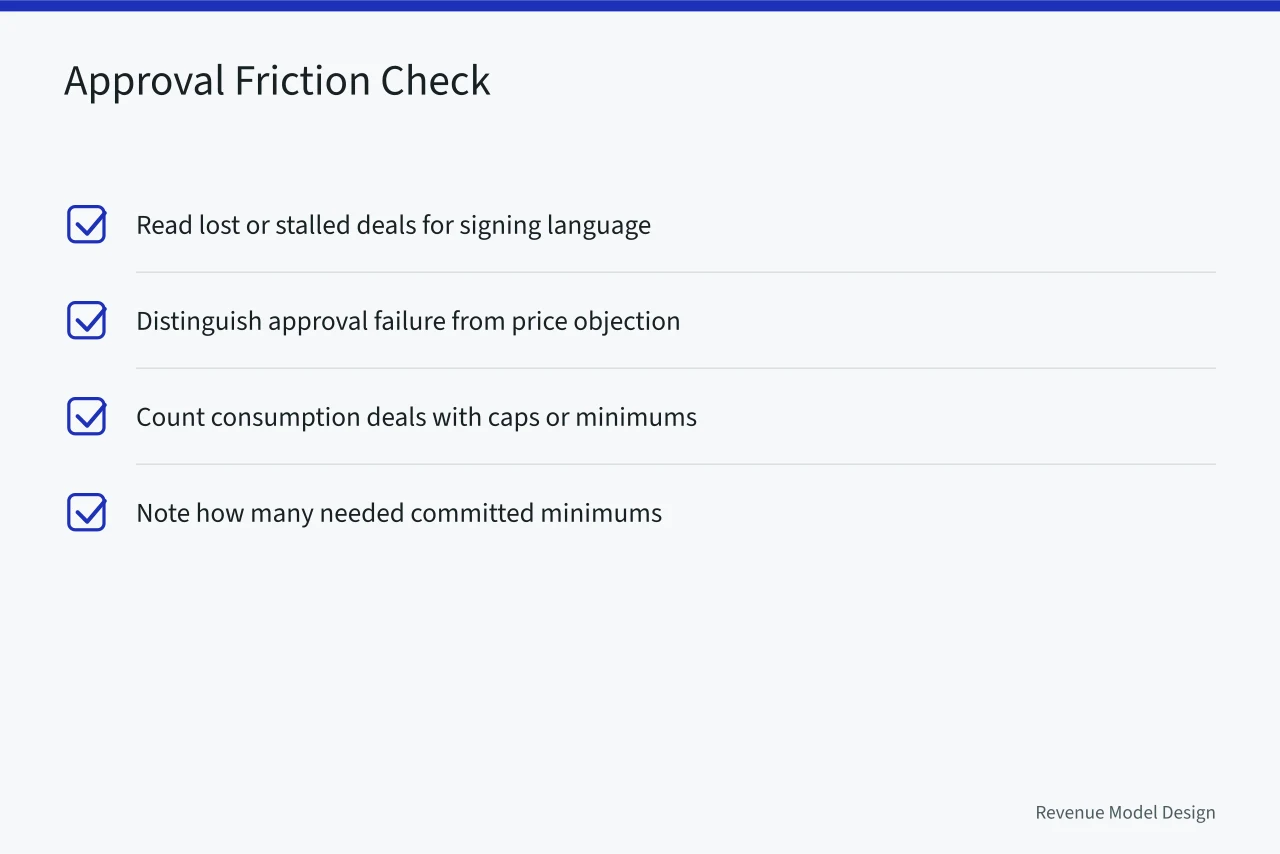
How to tell if it applies to you. Read your last set of lost or stalled deals for the phrase that means "we could not get this signed", not "it was too expensive". Also count how many of your consumption-based deals ended up with a cap or a committed minimum attached before signature.
What it does to the structure. It pushes consumption models toward caps, floors and committed minimums, which is to say toward the structures a buyer can approve once. That is part of why subscription models hold up well in organizations with annual budget cycles, whatever their other merits.
Pressure three: scrutiny of renewal and increase clauses
The parts of an agreement that used to pass unread are now read: automatic renewal, notice periods, indexation, and what a supplier may change unilaterally.
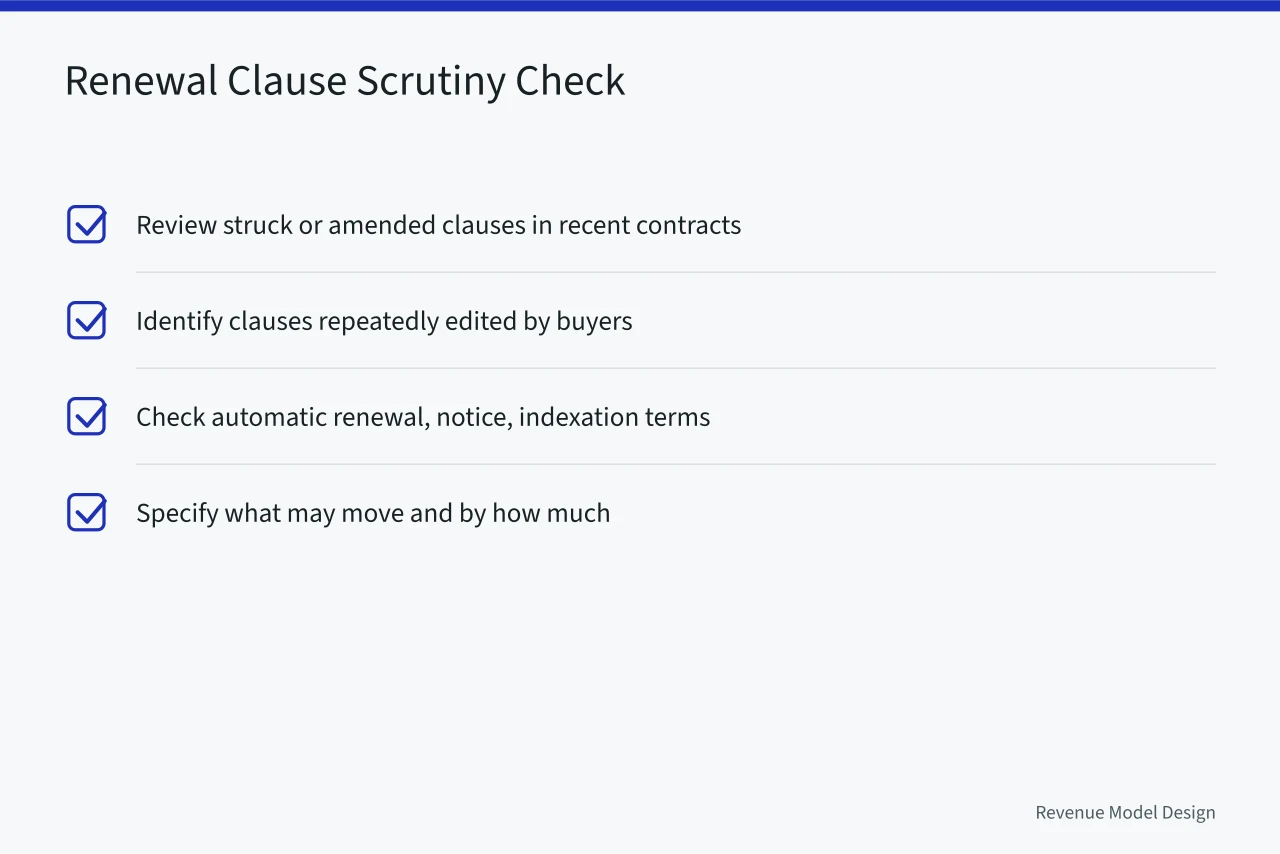
How to tell if it applies to you. Look at what has been struck out or amended in your last several contracts. If the same clause keeps being edited, that is the pressure, measured on your own book, and it is more reliable than anything published about the market. Automatic renewal is one of the clauses under the most scrutiny, and the requirements around disclosure, consent and cancellation are set out in the rule on prenotification negative option plans.
What it does to the structure. It makes a vague change rule expensive. "Prices may change on reasonable notice" gets removed or renegotiated, and what replaces it is whatever you can specify: what may move, by how much, how often, and what the customer may do in response. Writing that before you need it is the cheapest version of this conversation, and it belongs with the standing decisions on the business model types checklist.
Pressure four: metrics that assume headcount
Many billing metrics count people because people were once a good proxy for how much of a thing was used. Where a customer's work is increasingly done by automation, that proxy loosens: their output grows, their headcount does not, and your revenue tracks the wrong one.
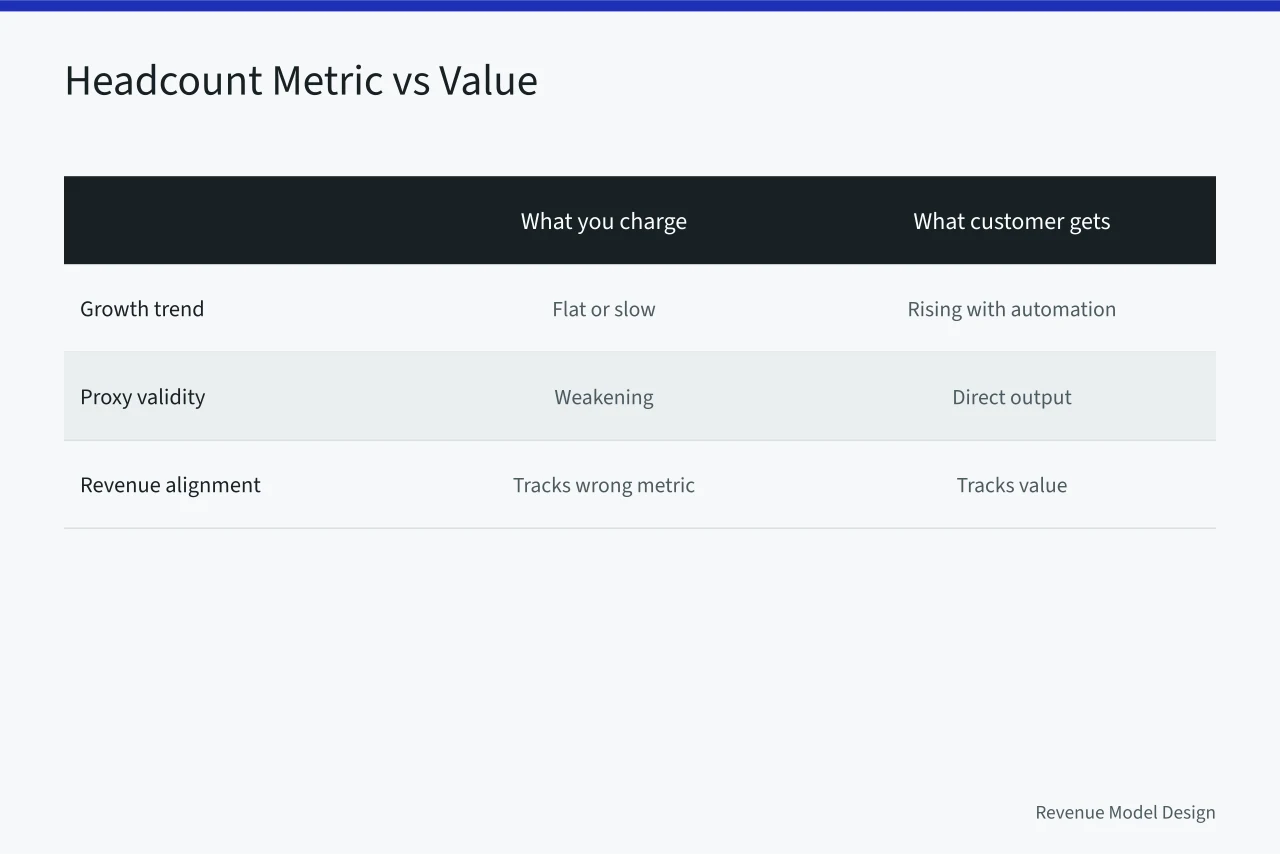
How to tell if it applies to you. Take your largest accounts and compare the growth of what you charge for against the growth of what they appear to get. Diverging lines mean your metric has detached from value. That check needs no external data and takes an hour.
What it does to the structure. It pushes toward metering something closer to output, which then runs straight into pressure two, since output-based charges are harder to forecast. Most companies land on a hybrid: a stable base with an output-linked component, which is a compromise between value tracking and approvability rather than a clever design.
Pressure five: risk moving toward the seller
Pilots, phased commitments, break clauses, and fees tied to a verified result all move the risk of the thing not working from the buyer to you.
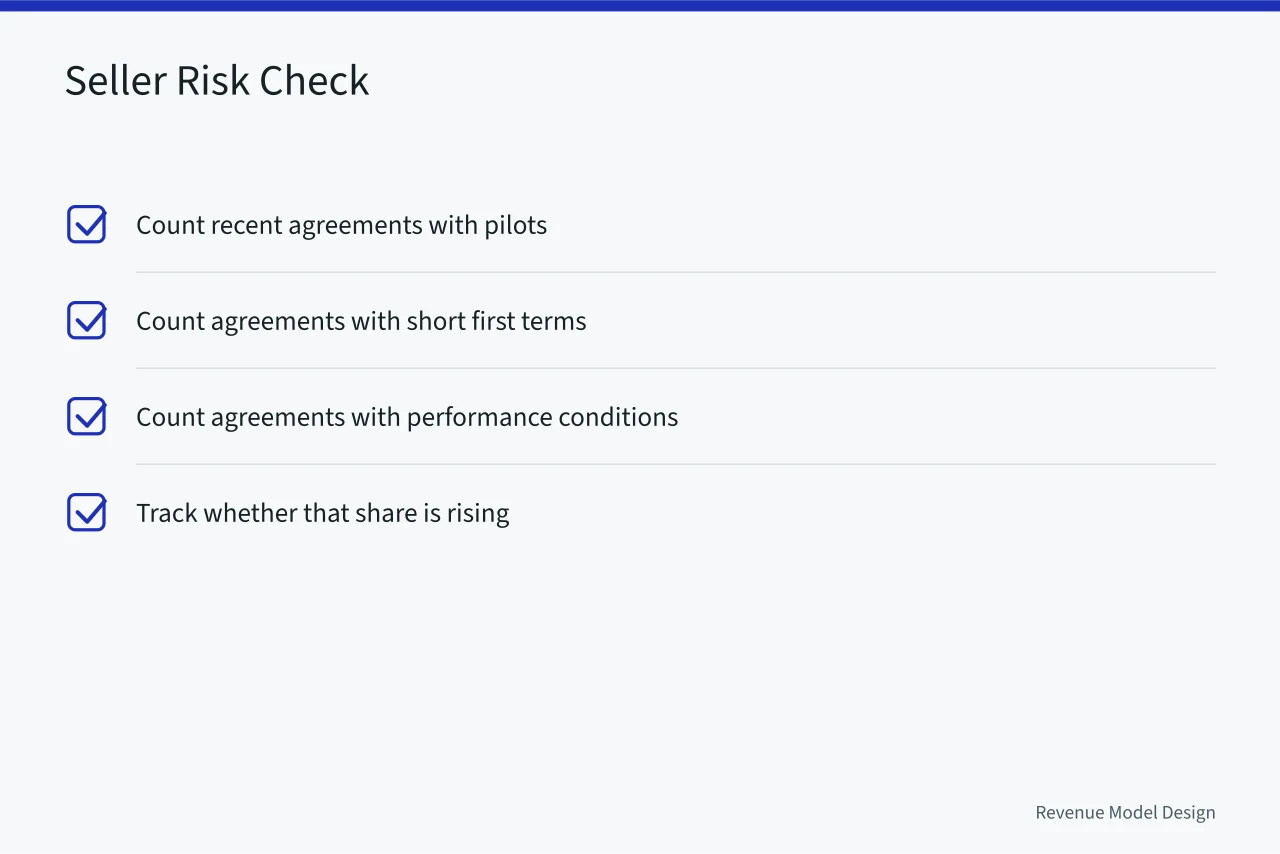
How to tell if it applies to you. Count how many of your recent agreements contain a pilot, a short first term, or a performance condition. If that share is rising in your own book, this is real for you.
What it does to the structure. Carrying risk is legitimate and it has to be priced or bounded. A performance condition without a written definition of the measure, who produces it, and what happens when the parties disagree is not a pricing structure, it is a scheduled dispute. Agreeing the remedy for a defined shortfall in advance is the normal way to bound it, and such terms are judged under the rules on liquidated damages. Where this leads to a genuinely different model rather than a different clause, that is model change, and the ground is covered in business model innovation.
What would count as evidence in your own book
Five signals, all internal, all cheap to produce.
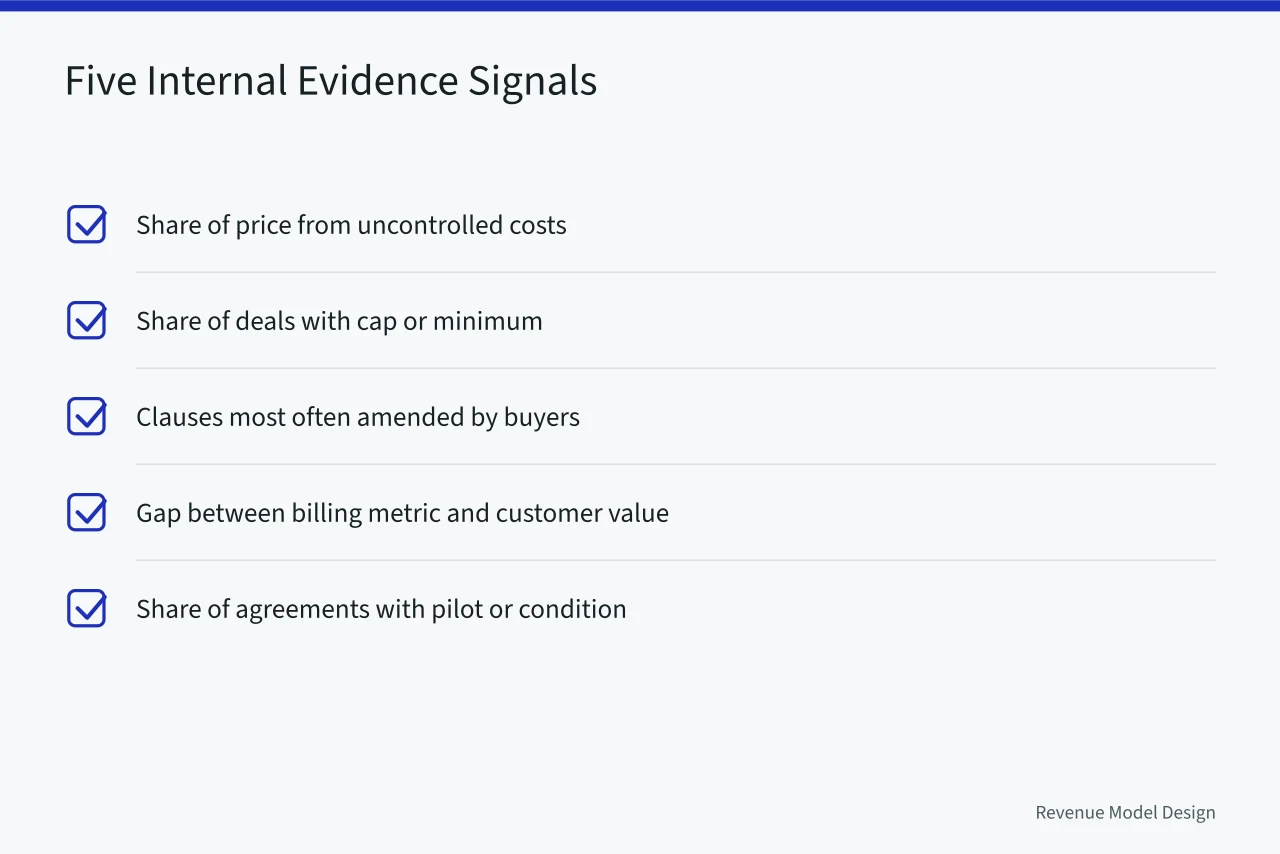
Watch those five over a year and you will know which pressures are yours. That is a better basis for a structural change than any published trend, because it is measured on the customers you actually have.
What not to do with a trend
Do not restructure because a pressure exists somewhere. Restructure because it is visible in your own records, and then change one layer at a time so you can tell what happened. The layers, and how to tell which one a symptom belongs to, are in the pricing architecture overview.
And do not confuse a pressure with a deadline. None of these arrive on a date. They show up as a slow change in what buyers will sign, which is why reading your own contracts is a better early-warning system than reading anybody's prediction.
Common questions
Why are there no market figures on this page?
Because a figure about companies in general is not evidence about your customers, and treating it as one replaces a judgment you can make with one you cannot check.
Which of the five should we look at first?
Whichever is cheapest to check for you, which is usually the contract-amendment one. It requires reading five documents and it tells you what your buyers are actually resisting.
Do these pressures ever reverse?
The clause-level ones do, in either direction, as bargaining power moves. That is a reason to keep the change rule flexible rather than to ignore the pressure.
How does this connect to the revenue model itself?
Pressures four and five can outgrow pricing entirely and become a question about what you charge for rather than how, which is the subject of the revenue models overview.