Guides
Part of Pricing architecture: what the experienced already know for 2027
What your own pricing records can prove, and the limit metrics hit
Pricing architecture metrics and their limits: which questions your own price history can answer, which it can only bound, and the one it cannot answer at all.
Pricing questions arrive sounding like measurement questions: Would we sell more at a lower price? Is our discounting getting worse? Did the new packaging work?
Your records can answer some, bound some, and cannot answer one at all. Knowing which is which saves you from a confident conclusion built on a number that could not carry it.
No reference figures appear here. The point of this page is the load-bearing capacity of each measure, not what a value should be.
What to take away
- Your pricing history can tell you what happened. It can very rarely tell you what would have happened at a different price.
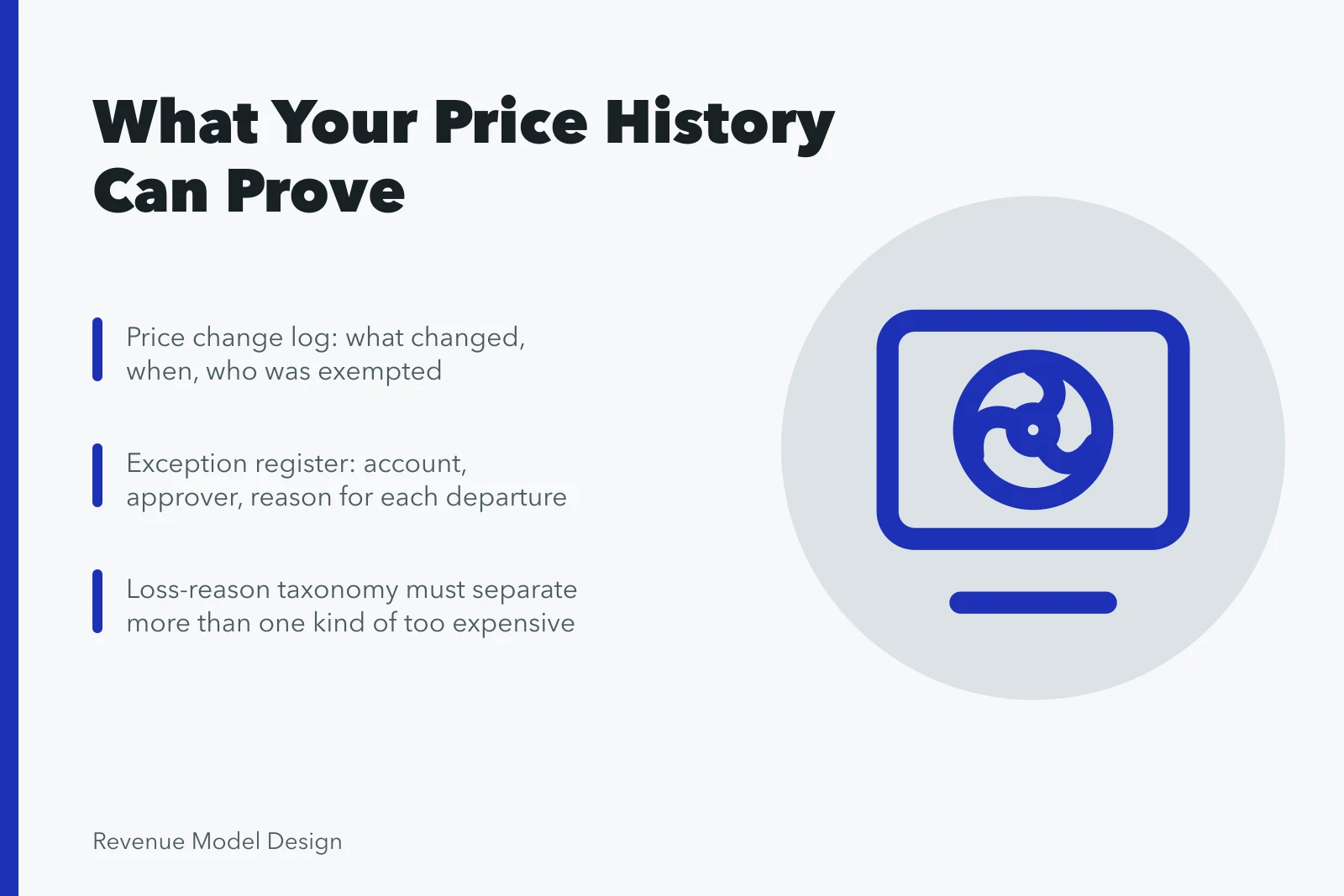
- Three records carry most of the answerable questions: a price change log, an exception register, and a loss-reason taxonomy that distinguishes more than one kind of "too expensive".
- Distributions answer pricing questions. Averages hide exactly the accounts the question is about.
The three records worth keeping
A price change log. What changed, when, who was exempted, and what you concluded afterwards. It supports one thing very well: reconstructing why the book looks the way it does. Without it, every repricing debate is argued from memory, and memory favors whoever is most worried. What it cannot support is a causal claim, because each entry is a single event in a moving business.
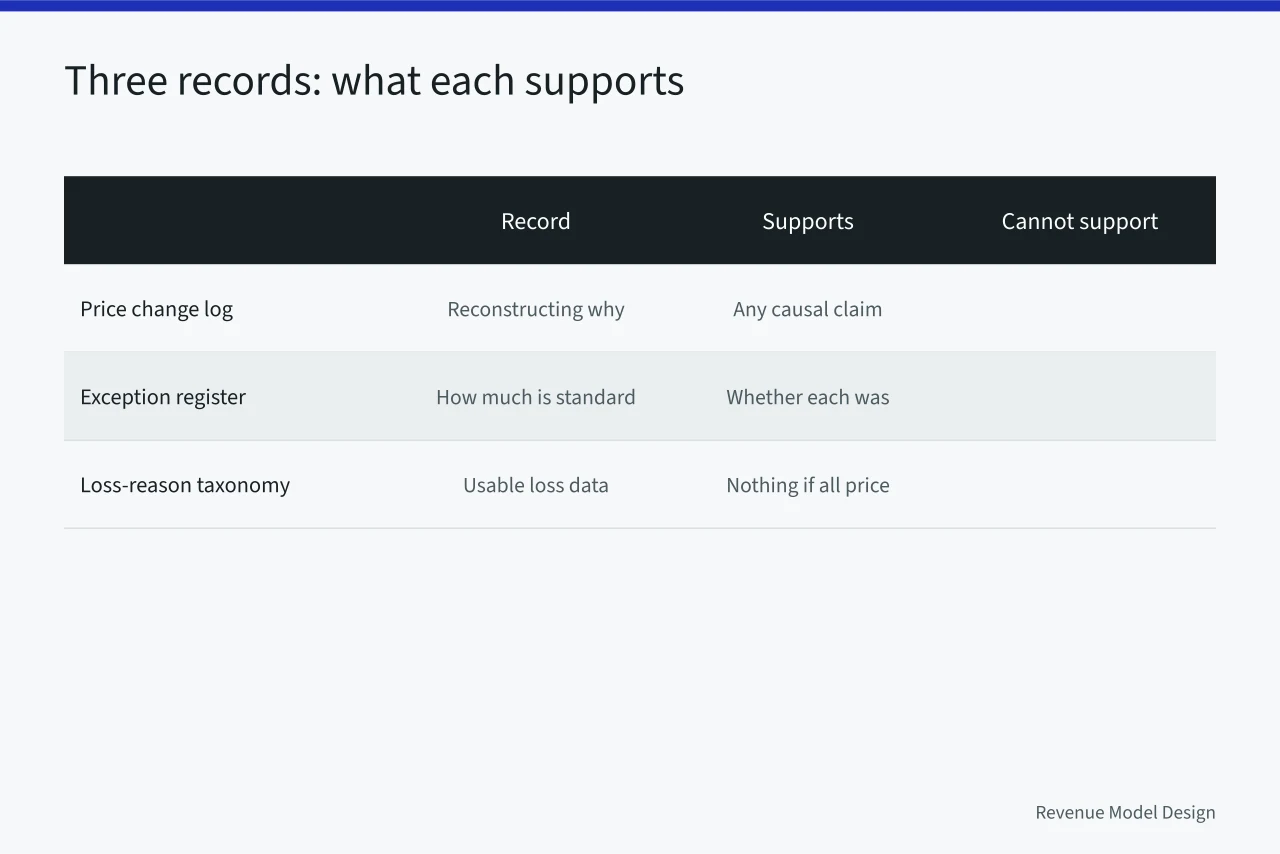
An exception register. Every departure from the standard structure, with the account, the approver and the reason. It supports two questions: how much of your book is actually standard, and whether exceptions cluster around one segment, one salesperson or one competitor. It cannot tell you whether each exception was necessary, since you never observed the deal that was not done.
A loss-reason taxonomy with more than one price category. If every lost deal is recorded as price, the field is being used as a polite exit and you have no data at all. Separating a number objection from a packaging objection from a buyer who was never budgeted for this at all is what makes the field usable. Recording it requires asking, and asking has to happen before the relationship goes cold.
The question your own book cannot answer
Would you sell more at a different price? Almost every company tries to answer this from its own history, and almost none can.
Price never moved on its own; it moved with your customer mix, sales team effort, season, product maturity, and competitors' actions that quarter. So comparing two periods compares two different worlds.
Worse, buyers select themselves: customers who accepted a higher price differ from those who did not, in ways related to whether they would have bought anyway.
You almost never hold two prices at once for comparable buyers. When you do, the cheaper price usually went to the harder deals, the opposite of a controlled comparison.
The formal treatment of how demand responds to price, and what it takes to identify that response, sits in MIT's microeconomic theory and public policy course.
This is not an argument for guessing. It is an argument for stating conclusions at the strength the evidence supports: prices moved, this happened afterwards, here are the three other things that also moved. That sentence is honest and useful. "Demand is inelastic at this level" is neither.
Measures that describe the structure
These describe what your architecture is doing rather than proving what it caused. Each is worth watching, and each has a boundary.
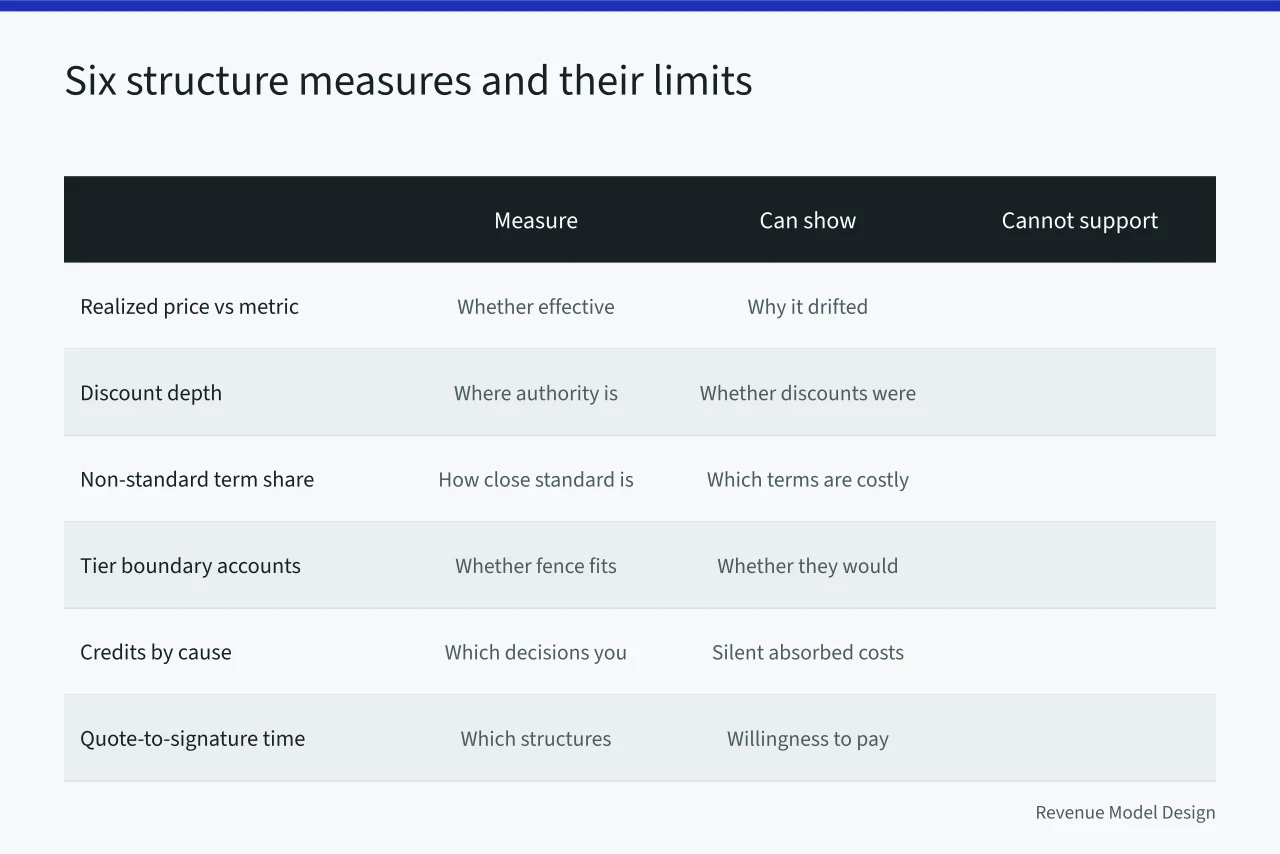
Two rules make all six more useful. Look at the distribution, not the average, because pricing questions usually concern the tails. Cut by segment before concluding anything. A mix change moves every one of these with no decision made.
The definitional traps that break comparisons of this kind are set out in business model types metrics.
None of the six say anything about what an account costs you to serve, so none of them can settle whether a price is high enough. That subtraction is the arithmetic in unit economics.
The comparisons you can legitimately run
New business only. Change the structure for new customers and leave existing ones alone. The comparison is still confounded by time, but it removes the largest confounder of all, which is that existing customers were bought under a different regime.
One bounded segment, with the rest as a rough control. Not a clean experiment, since segments differ, but it lets you see whether something moved much more in one place than everywhere else.
Quote-level records rather than account-level ones. What was asked for, what was offered, what was agreed, and what was refused. That is the only place your pricing decisions are visible before they become outcomes, and most companies do not keep it.
In all three, write down before you start what you expect to see and what would change your mind. Afterwards, everything looks like confirmation.
What to do with a number you cannot trust
Say what it is: a description, not a finding. Then decide whether the decision in front of you actually needs the missing certainty. Many pricing decisions survive being wrong about elasticity, because the downside is a reversible change and the upside is a structure that matches your costs. Those you should simply make.
Evidence matters most for irreversible decisions: a metric change, a fence you cannot un-build, a price locked for years.
For those, the honest answer is often that no evidence exists, and the fix is a smaller first step, not a better report. The layers those decisions sit in are set out in the pricing architecture overview.
Common questions
Is a published industry benchmark useful for any of these?
Only as a prompt to ask why yours differs. Two sources reporting the same measure are usually computing different things, and a target imported from elsewhere replaces a judgment about your business with a judgment about someone else's.
Can we A/B test a price?
Sometimes, for self-serve purchases where buyers do not talk to each other and nothing is negotiated. Where deals are negotiated, prices leak between buyers inside an industry, and a discovered test costs more than it teaches. What can and cannot be learned from a price experiment is one of the standing questions in MIT's pricing course.
What single number should we watch?
Realized price by segment, as a distribution, alongside the share of deals carrying an exception. Those two together catch most drift early, and neither requires a claim about causation.
Where should the records live?
Somewhere that is not the deal file, because deal files are read once. A single dated document, owned by one person, is enough, and it belongs beside the other standing decisions in the business model types checklist.