Industry
Part of Getting service models right the first time
Service models mistakes: where estimating, staffing and pricing go wrong
Nine service models mistakes in estimating, staffing, and pricing, each with the arithmetic that shows what it costs and the change that fixes it.
Service firms rarely fail on one bad decision. They lose margin a fraction at a time, through nine or ten habits that each look reasonable in the moment and are collectively expensive.
Here they are, with the arithmetic where arithmetic makes the point. All figures are invented placeholders.
What to take away
- An estimate that omits review, rework, and meetings is not conservative. It is wrong by a repeatable amount you could measure and never do.
- Discounting a rate costs far more volume than most people assume. Work the number before you offer it.
- Adding people to a firm where seniors must touch everything adds supervision demand at the same time it adds capacity.
Mistakes made before the work starts
1. Quoting a fee against a deliverable nobody has defined. The fee is fixed and the promise is not, so every ambiguity resolves in the client's favor at your expense. The fix is a paragraph, not a policy: what is included, what is excluded, and what triggers a change order.
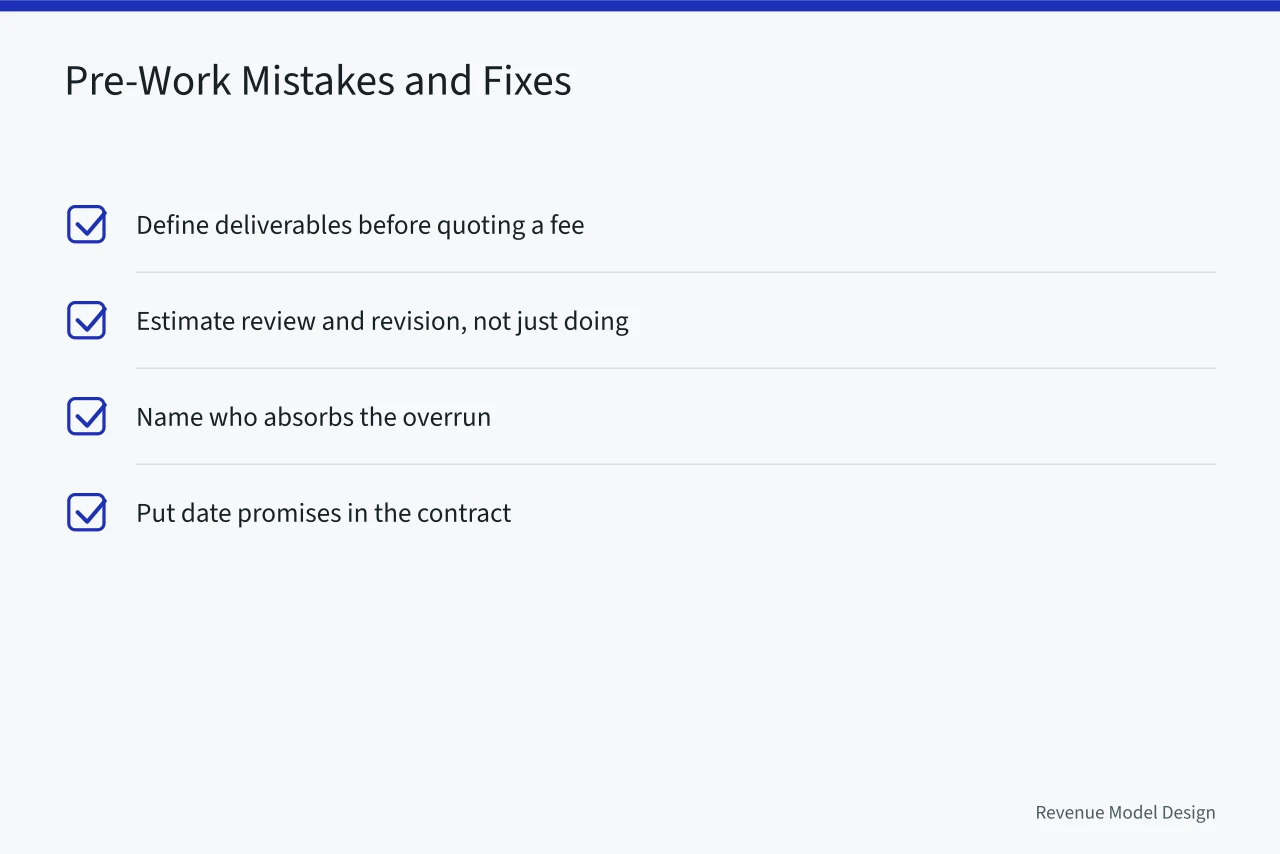
2. Estimating the doing and not the checking. Most estimates cover the visible work and omit review, revision, and the meetings that decide anything. The gap is stable enough to measure. Compare estimated against actual on the last ten jobs and add the average as a line, openly, rather than as private padding.
3. Not naming who absorbs the overrun. Every engagement assigns that risk to someone. If the contract does not say, it lands on the seller. Where a deal depends on the promise being performed by a date, the language belongs in the agreement, because breach of contract is decided on what the document says rather than on what both sides remember intending.
Mistakes made in pricing
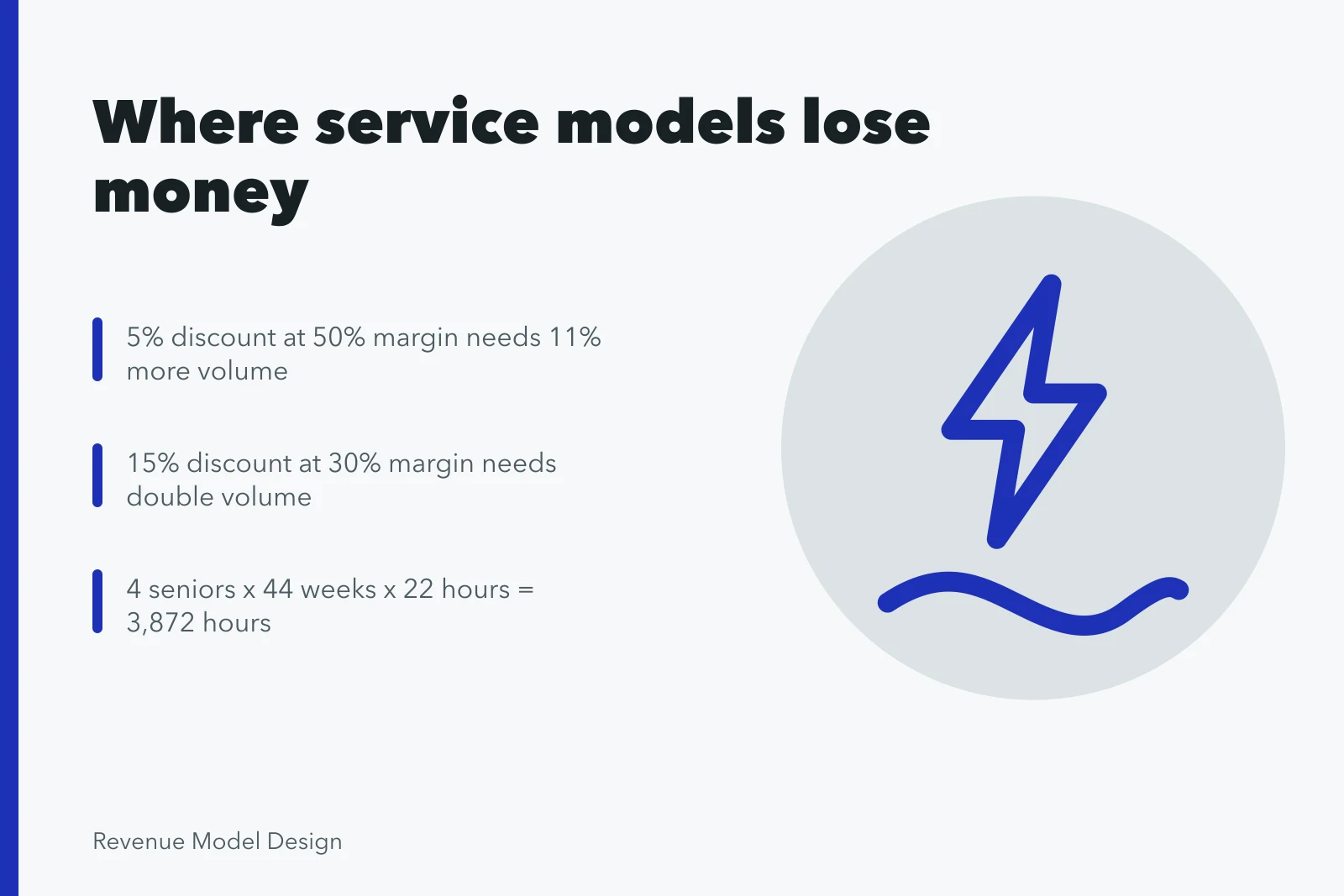
4. Discounting without computing what it costs. Take a fifty percent gross margin. A five percent discount needs eleven percent more volume to hold the same gross profit. Ten percent needs twenty-five percent more. Twenty percent needs sixty-seven percent more. At a thirty percent margin, a fifteen percent discount needs double the volume. Sales teams offer these numbers in seconds and almost nobody runs the arithmetic first, which is why it belongs on a card in the room rather than in a spreadsheet nobody opens. The structural version of this problem sits in pricing architecture.

5. Setting the rate from cost. Cost-plus tells you the floor below which the work is not worth doing. It says nothing about what the work is worth to the buyer, which is set by their alternative. Both calculations are useful and they answer different questions; using one where the other belongs is the most common pricing error in professional services. Price theory treats this as two different problems, and MIT's pricing course is organized around the difference.
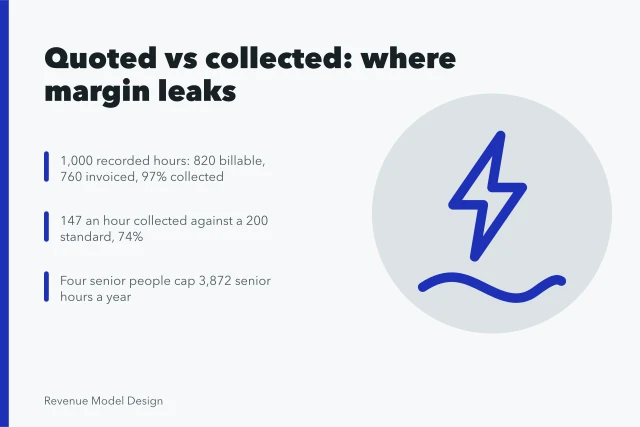
6. Letting the discount happen after the work. A partner writes down an invoice to avoid an awkward conversation. It never appears as a discount, so it never appears in any pricing review, and the same client gets the same write-down next year. Track invoiced hours against billable hours as a separate step. On an invented month, 820 billable hours becoming 760 invoiced is a seven percent write-down that no rate card records.
Mistakes made in staffing
7. Hiring to relieve overload without changing who reviews. New people need supervision from exactly the people who were already the constraint. Capacity rises slowly, margin falls fast, and the firm concludes that hiring does not work. What did not work was hiring without moving review off the senior calendar.
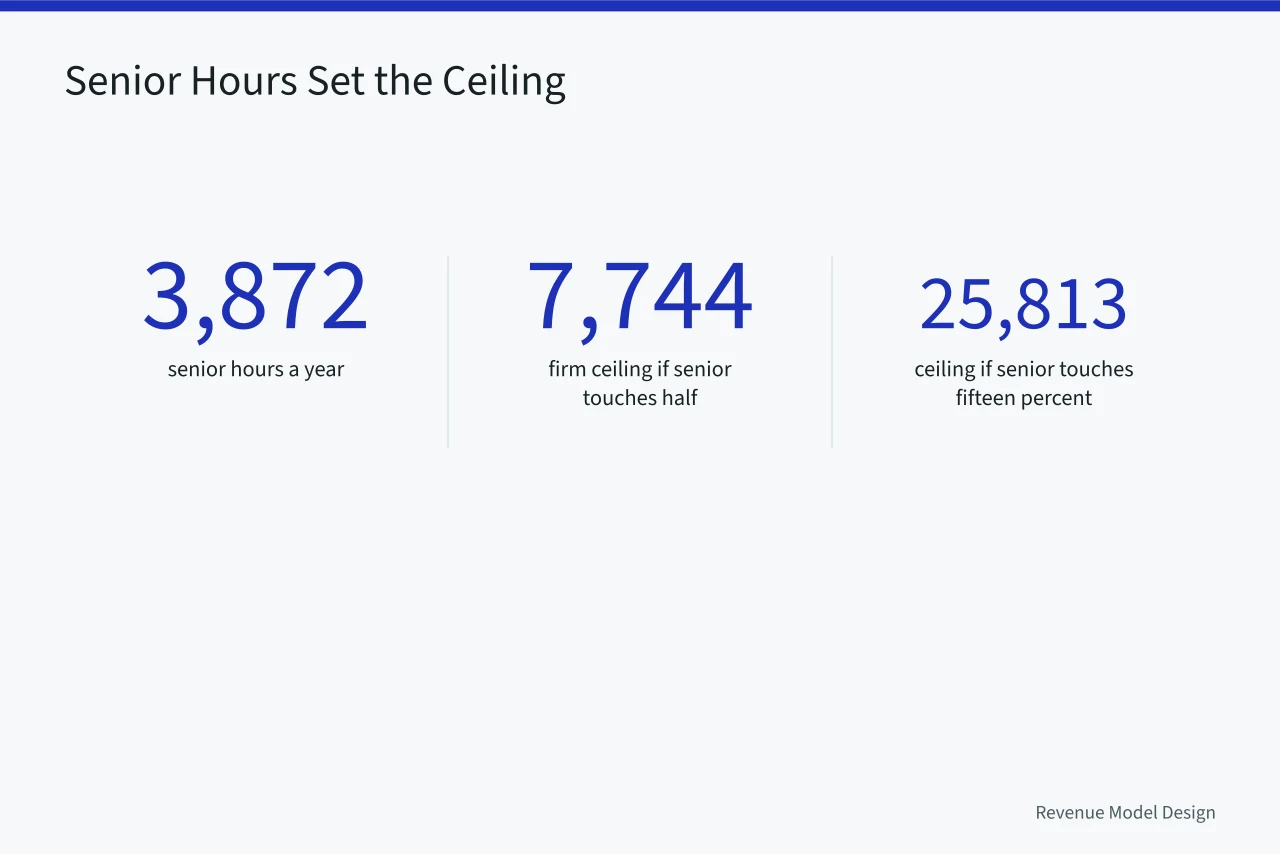
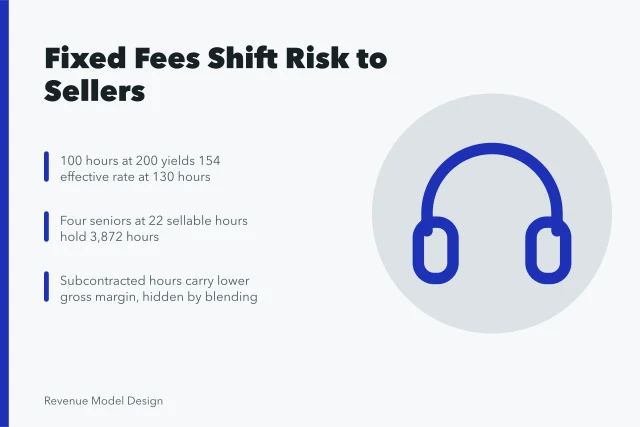
8. Never scheduling the work that lowers the senior share. With four senior people at 44 weeks and 22 sellable hours each, the firm has 3,872 senior hours a year. If a senior must touch half of everything delivered, the firm's ceiling is 7,744 hours. At fifteen percent it is 25,813. Writing down the method is the only thing that moves that number, and no client is ever waiting for it, so it never reaches a calendar. The cost behavior underneath this is the subject of unit economics.
9. Growing concentration without noticing. A book of ten clients at 30, 18, 12, 10, 8, 7, 5, 4, 3 and 3 percent looks healthy. The top three are 60% of revenue. Lose the largest and everyone else must grow 43% to get back to level. Revenue growth on its own will never tell you this is happening; the top-one and top-three shares will, and they cost nothing to compute. The same reading applies across every shape in revenue models.
What the nine have in common
Eight of them are invisible in the profit and loss until a year has passed. That is the actual pattern: the profit and loss is a lagging record of decisions made in an estimate, a contract clause, and a staffing call, and none of those three appear in it.
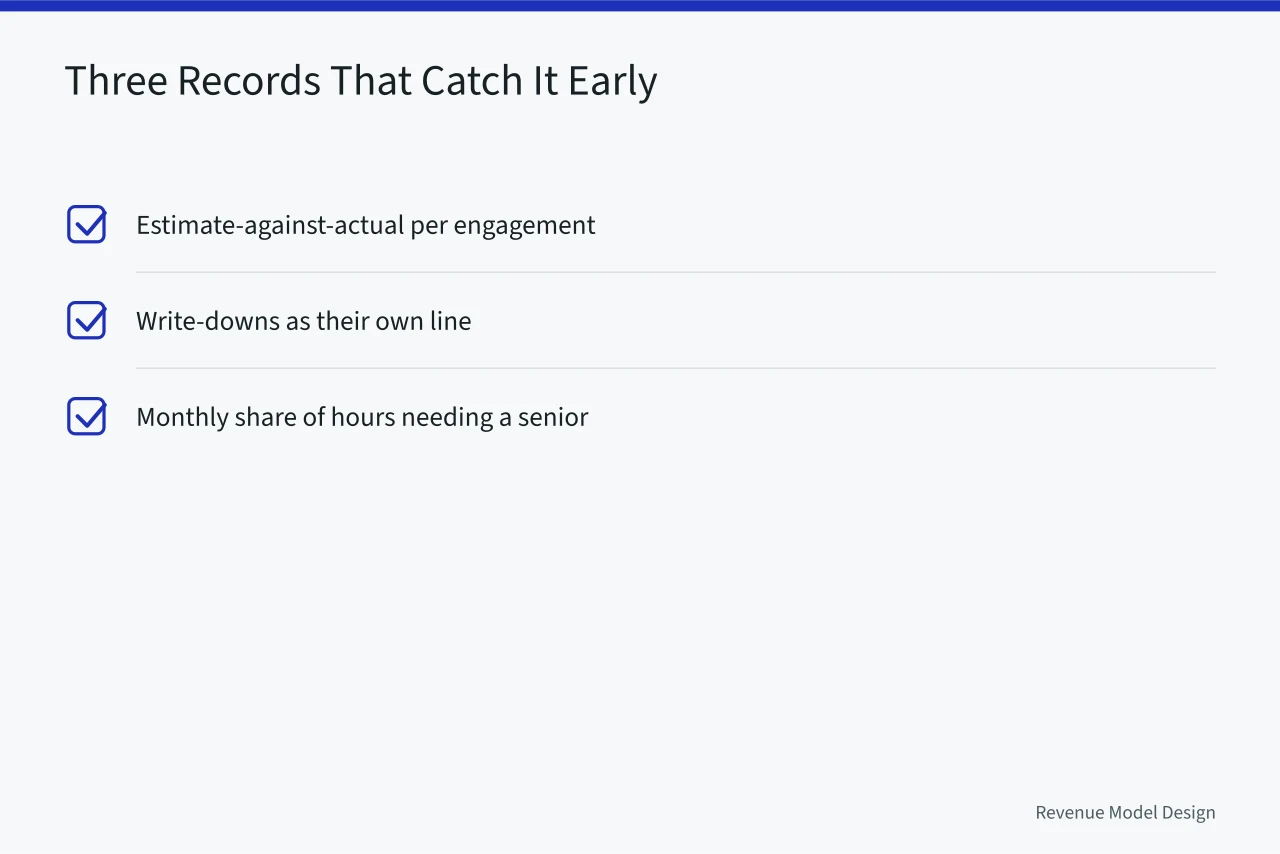
The counter is unglamorous. Keep an estimate-against-actual record per engagement. Keep write-downs as their own line. Keep a monthly number for the share of delivered hours that needed a senior person. Three records, none of them hard, and together they catch most of this list before it costs a year.
How the shape of the firm itself has to change once those records say the ceiling is real is a service models question, and when the answer is a different business entirely it becomes a model innovation one.
Common questions
We are busy and profitable. Do these matter?
Busy and profitable is exactly when they are cheap to fix. Every one of them costs more to correct on a shrinking firm, because a rate change and a scope change both read as panic when revenue is falling.
Is a fixed fee always worse than hourly for the seller?
No. A fixed fee on work you have done forty times is highly profitable, because your variance is small and the client is paying to remove theirs. A fixed fee on work you have never done transfers a risk you cannot price.
How do we start tracking write-downs without accusing anyone?
Record it as a field on the invoice with a reason code and no name attached, for two quarters, before anyone discusses it. The pattern will be obvious and the conversation will be about the pattern.
Which one of the nine should we fix first?
Number four, because it takes an afternoon and changes what happens in the next negotiation. Number eight matters more and takes a year.