
Features
Part of Pricing architecture: what the experienced already know for 2027
4 things to understand about pricing architecture mistakes
Four things to understand about pricing architecture mistakes: who decides, what the contract fixes, what billing can capture, and how a change reaches the customer.
A badly designed price structure is a solvable problem. A reasonable structure wrecked by how it was decided, written and administered leaves signed contracts behind it.
Those failures cluster into four pricing architecture mistakes worth understanding. Each is a process failure rather than a design failure, and each is cheap to avoid and expensive to reverse.
What to take away
- The four are: who was in the room, what the contract fixes, what billing can capture, and how a change reaches the customer.
- The contract ones cost the most, because they are the only ones you cannot quietly correct next quarter.
- Fix the change clause on new business first. It costs nothing and compounds with every signature.
- A concession made under pressure becomes your standard terms the moment someone copies the last order form.
- An unexpected invoice goes into dispute, and dispute delays payment longer than the increase was worth.
1. Who was in the room when the price was set
The people who set prices usually sit in sales, finance or the founder's office. The people who know what an account costs to serve sit in support, operations and implementation.
Price set without the second group produces tiers that promise things the company cannot fund. The gap does not appear until the first demanding customer arrives.
One test: invite someone who will personally carry the consequence of the number. If nobody in the room will, the number is a guess with a signature on it.
2. What the contract fixes, and what it leaves open
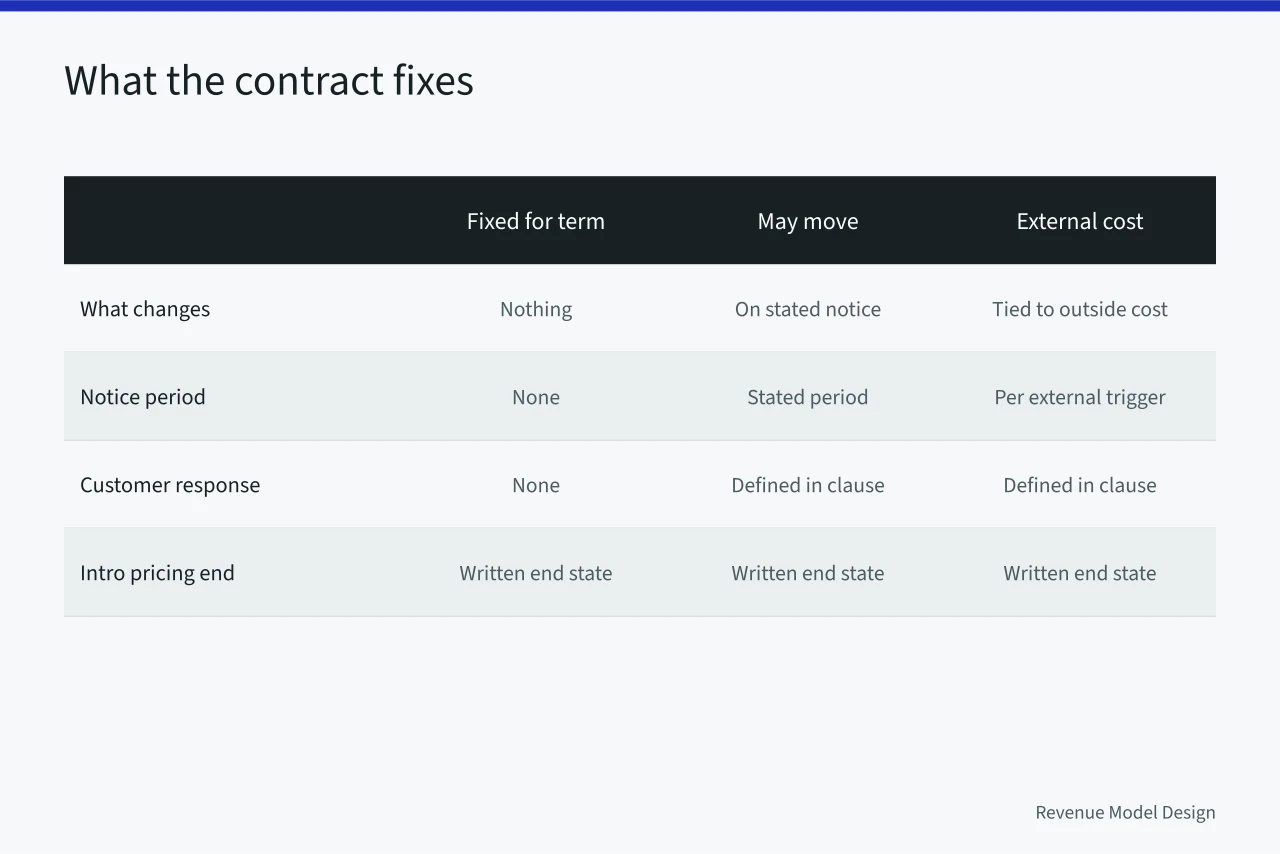
Three clauses decide whether you can change a price later. Get them wrong and every future increase becomes a negotiation.
The change clause needs a mechanism
"Prices may be amended on reasonable notice" is not a change rule. It does not say what may change, by how much, how often, or what the customer may do in response.
Buyers read it as an unpriced risk. They either strike it out or discount your credibility.
Specify three cases separately: what is fixed for the term, what may move on a stated notice period, and what is tied to an external cost you do not control.
What the clause obliges each side to do is read off the wording, which is the ordinary rule in a claim for breach of contract.
Introductory pricing needs a written end state
A launch discount, a first-year rate, a founding-customer arrangement: all defensible, provided the agreement says what happens when the period ends and both sides have seen that sentence.
Without it you have created a permanent discount you will one day try to end, in a conversation where the customer is entirely justified in being annoyed.
Where the arrangement rolls into a paid term automatically, disclosure and consent are also regulated, and the provision on negative option marketing sets out those requirements.
The free-to-paid boundary belongs in writing
Four items belong in writing: what a trial includes, how long it runs, what happens to access and to the customer's data when it ends, and who decides whether it is extended.
Handled by convention, this becomes an argument at exactly the moment you were hoping to be paid.
The first large contract is not the template
One negotiation with a determined buyer produces compromises: an unusual metric, a cap, a bundled extra, a payment term. Those were concessions made under pressure for one deal.
When the next order form is built by copying the last one, they silently become your standard terms. You then negotiate down from them for years.
Write the standard separately from any deal, and record deviations as deviations. Reviewing what you have already agreed to belongs on the business model types checklist, because by then it is a structural fact rather than a sales one.
3. What your billing system can actually capture
Sales agrees to a shape that seems reasonable. Finance then hand-builds that customer's invoice every month, forever, and the arrangement is invisible to every report.
Two or three of these are survivable. A dozen means your revenue reporting is partly manual and nobody can say by how much.
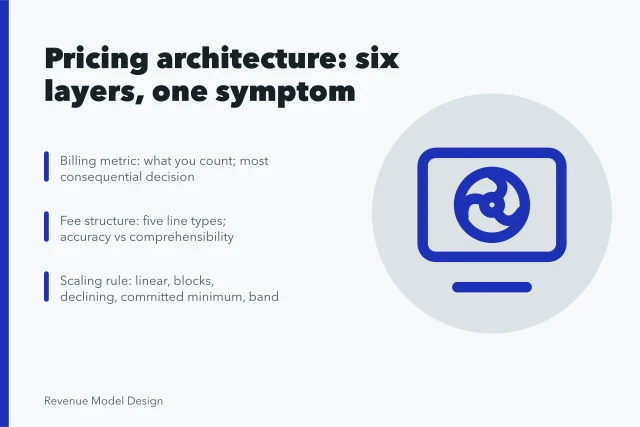
Check what your systems can represent before you agree to it. You are agreeing to a capture event as much as to a number. The six structural layers behind that shape are set out in the pricing architecture overview.
The same test applies to tiers. If the lower package can be made to do the higher package's job, the fence exists only in your marketing. Customers discover this, tell each other, and your tier design becomes a test of who reads carefully.
Either enforce the boundary in the product or stop charging for it. Prefer the second where enforcement would make the product worse.
4. How a change reaches the customer
The first time a customer learns their price has changed should never be a bill. The cost of that mistake is a collections cost.
An unexpected invoice goes into dispute. Dispute delays payment, and the delay costs more than the increase brought in.
Tell them first, in a message that explains the reasoning rather than only the number. Make sure whoever answers the reply knows the reasoning too.
Worked example: the same figure under two metrics
A vendor charges a flat annual fee of A dollars. Under a per-seat metric with B seats, the effective rate is A divided by B. Under a usage metric with C units, it is A divided by C.
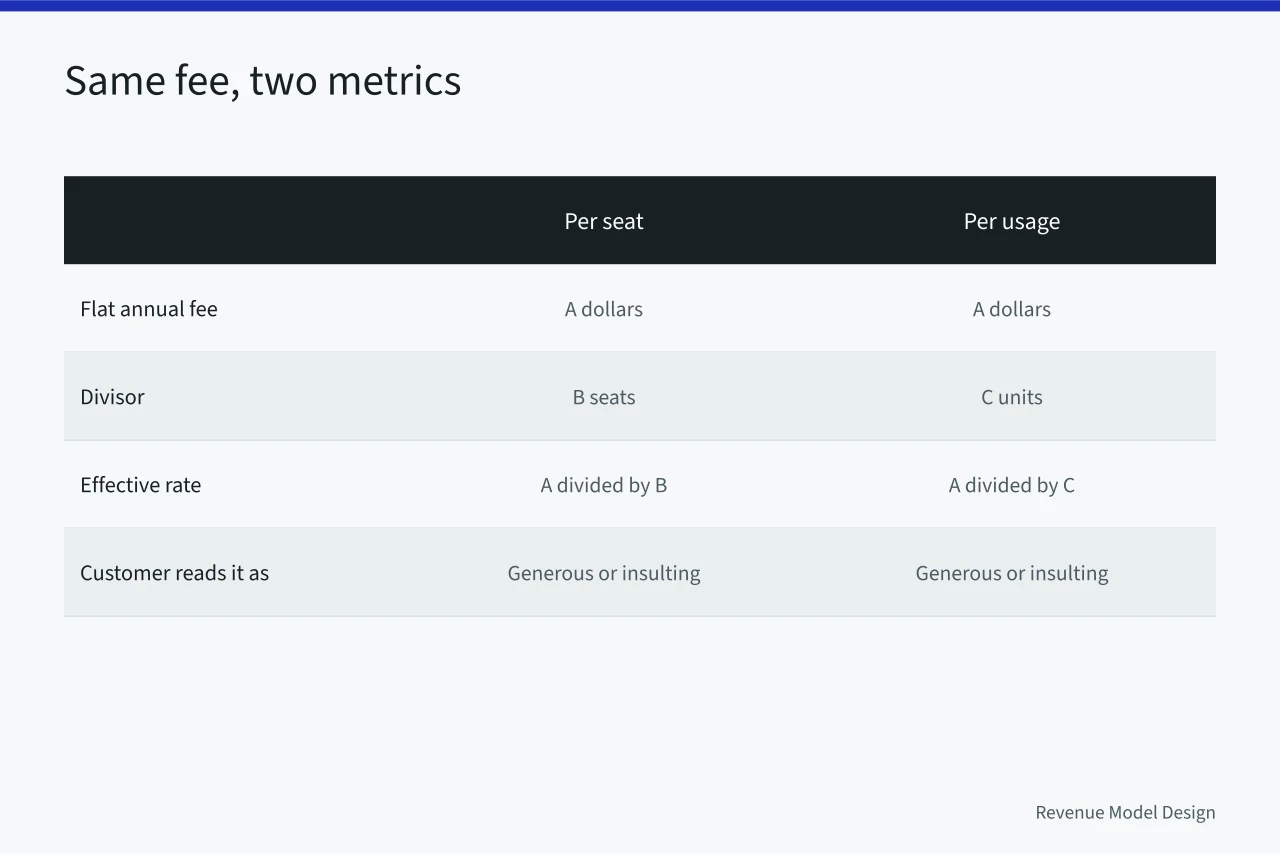
The number never moved. The metric decided whether the customer called it generous or insulting. Teams argue for weeks about A while B and C are still undecided, which is why the shape has to be settled before the amount.
What the four have in common
Each one is a decision that was made without being recorded as a decision. The concession that became a standard, the promotion with no end, the tier nobody enforces, the invoice that arrived unexplained.
Somebody made a reasonable choice in the moment and nothing wrote it down as a choice. That is why the fix is the same and unglamorous: keep a document stating the standard structure, what was deviated from and for whom, and what changed when. It costs an hour a month.
The wider set of model errors this belongs to is in business model types mistakes, and the capture events your systems have to represent are in the revenue models overview.
Common questions
We have already made several of these. What do we fix first?
The change clause, on new contracts only, starting now. It costs nothing, it compounds with every signature, and it determines whether you can fix any of the others later.
Is any of this ever acceptable deliberately?
Introductory pricing is, when the end state is written down. A hand-built invoice is, for one strategic account, when someone owns it and it is visible in reporting. The difference in both cases is that it was chosen rather than allowed.
How do we stop concessions becoming standards?
Keep the standard order form somewhere the person negotiating cannot edit it. Require deviations to be recorded against a named approver. The approval is not the point; the record is.
Does any of this touch franchise or affiliate rules?
It can. Royalty structures, franchise disclosure and affiliate reporting each carry their own requirements, set by the FTC, state franchise regulators and the CRA. Confirm your position with a qualified attorney or accountant before you rely on any of it.