Rules
Part of Revenue model choice: the four questions that actually decide it
Reading revenue models metrics without fooling yourself
Revenue models metrics separated into four numbers that get one name, with what each can carry, what it cannot, and the gaps that hold the information.
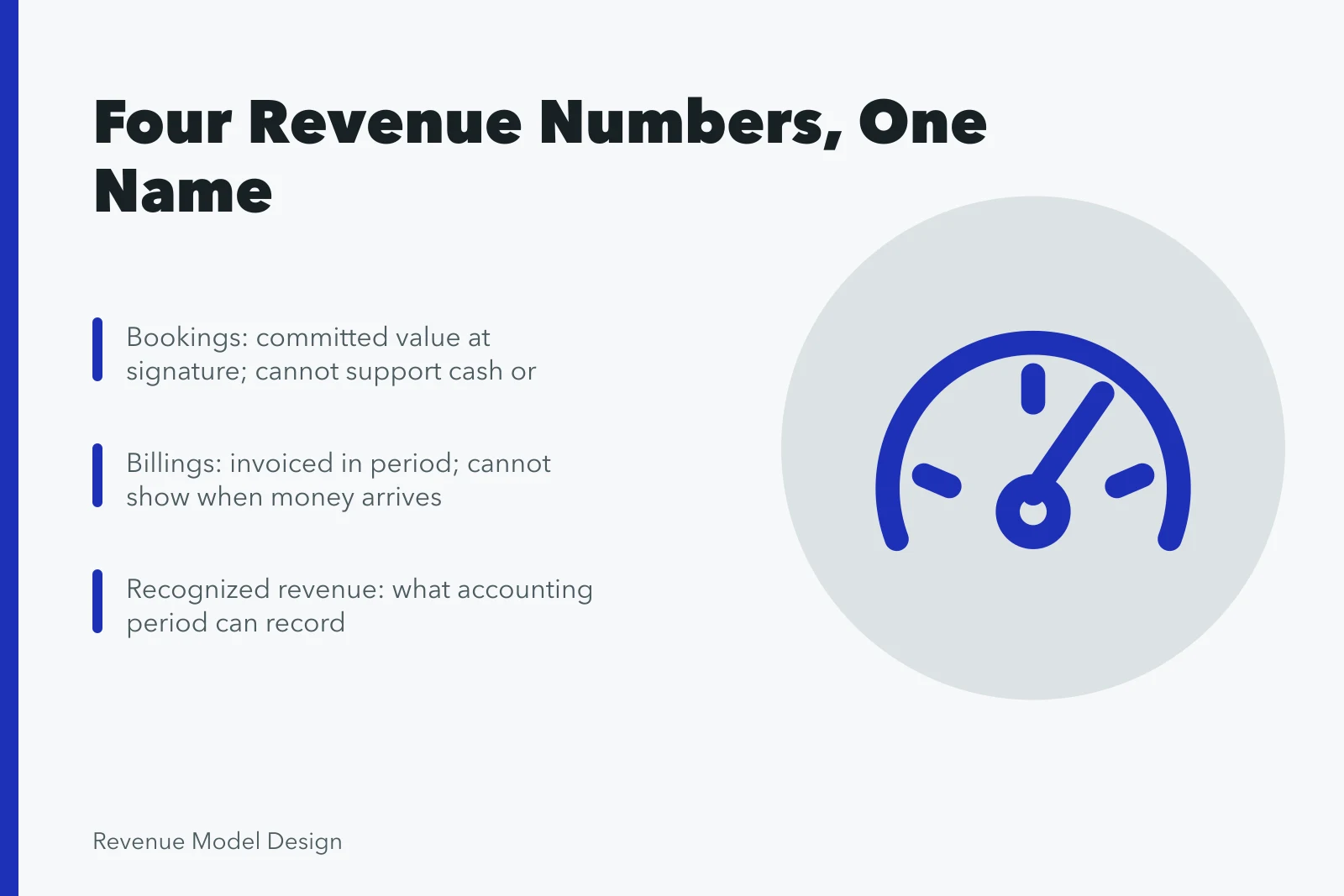
In one meeting, four numbers get called revenue: what customers agreed to buy, what was invoiced, what the accounts recognize for the period, and what arrived in the bank. All four are correct.
Each answers a different question. Using one for another is the most common measurement failure in a revenue model.
This page is about what each revenue measure can carry and what it cannot. There are no reference figures here and none are needed: every value belongs to your own book.
What to take away
- Bookings, billings, recognized revenue and cash collected are four separate numbers. Say which one you mean, every time.
- A growth rate is only meaningful once you name which of the four it was computed on, because the same quarter can grow on one and shrink on another.
- No revenue measure tells you whether a customer is worth having. That question is answered on the cost side.
The four numbers
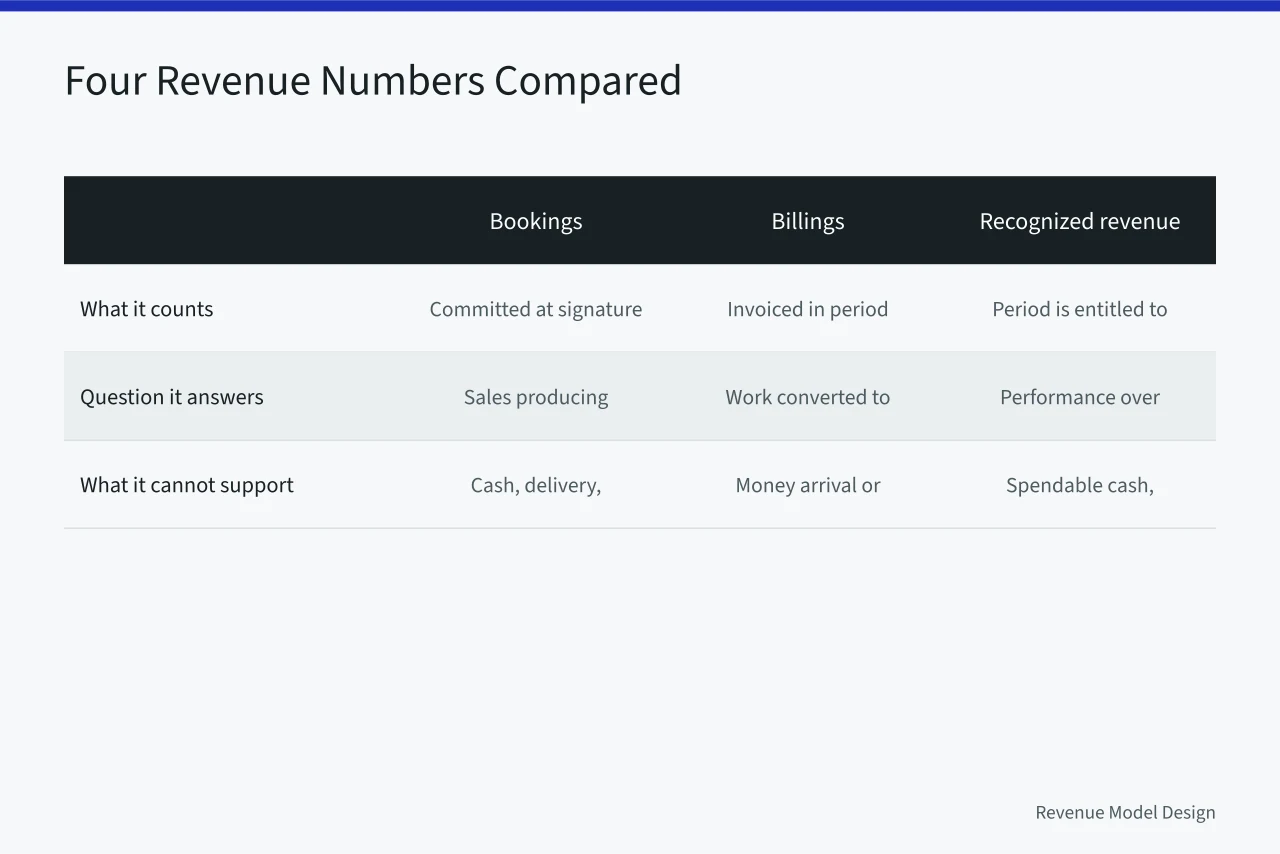
| The number | What it counts | The question it answers | What it cannot support |
|---|---|---|---|
| Bookings | Value customers have committed to, at signature | Is the sales effort producing commitments | Anything about cash, delivery, or whether the commitment survives |
| Billings | What you have invoiced in the period | Is the work being converted into demands for payment | Whether the money will arrive, or when |
| Recognized revenue | What the accounting period is entitled to record | How the business performed over a defined period | What you can spend, and whether the customer is still active |
| Cash collected | What arrived and cleared | What you can actually spend | Performance, since a large collection can be last quarter's work |
The gaps between them are where the information is. A booking that never becomes a billing is a commitment that failed. A billing that never becomes cash is a collection problem or a dispute. Recognized revenue far ahead of cash means you are financing your customers, whatever the growth chart says.
Track the gaps as gaps. A single blended revenue line hides all three, and each one fails differently. Keeping the recording of a transaction separate from the movement of cash is the point of an accounting method, and the two are set out plainly in IRS Publication 538.
Growth, and which number it was computed on
A growth rate is a ratio of two values of the same measure. Change the measure and you change the answer, sometimes in direction.
A quarter with a long contract signed late grows sharply in bookings and barely at all in cash. A quarter that collects on last year's invoices grows in cash while bookings fall. Neither is dishonest; a report that does not say which is being used is.
Two further rules keep growth figures honest. State the population: new customers, existing customers, or both together, since growth carried entirely by existing accounts and growth carried entirely by new ones are different businesses with the same headline. And keep any one-off inside its own line, because an unusual item annualized into a trend produces a forecast nobody can hit.
What retention measures can and cannot carry
Retention is a revenue measure in disguise, and it comes in two forms that answer different questions.
Counted in customers, it tells you whether people stay; counted in revenue, whether money stays. The two come apart in both directions, and the divergence is the informative part.
Strong customer retention with weak revenue retention means the accounts leaving are your large ones; the reverse means you are losing many small accounts while the important ones expand.
What neither form can support is a claim about the future of a population it does not describe. Retention computed across all customers, of all ages, acquired through all channels, is dominated by whichever group is largest.
While you are growing that is the newest group, who have had the least time to leave. The only version worth acting on is cut by arrival period, and the definitional traps that break that cut are set out in business model types metrics.
Retention also cannot tell you why. A cancellation reason recorded by the person who lost the account is a description of a conversation, not a cause.
Measures that fit one revenue shape only
Some measures transfer between revenue models and some do not, and importing one because you read it somewhere produces a number that moves for reasons you cannot act on.
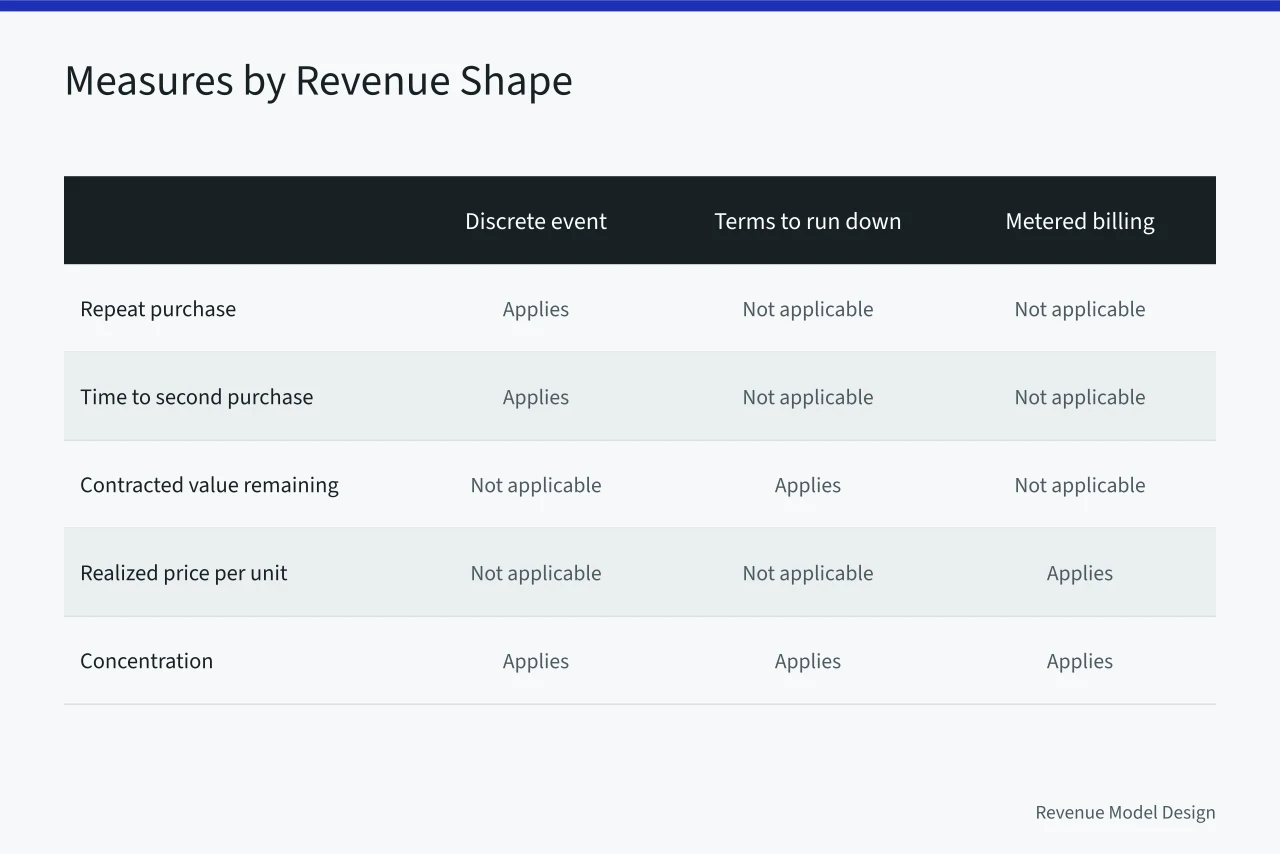
- Repeat purchase and time to second purchase belong where buying is a discrete event. They say nothing in a model where a period elapsing releases the money.
- Contracted value remaining belongs where there are terms to run down. It is meaningless where every purchase is independent.
- Realized price per unit of the billing metric belongs anywhere you meter something. It is the measure that catches discounting drift, and it needs the metric to be defined before it means anything.
- Concentration belongs everywhere: what share of revenue depends on your largest customers, your largest channel, and your largest intermediary. Three separate numbers, and the largest is your real exposure. Which measure belongs to which decision, and why a management figure and a reported figure are not the same thing, is the subject of MIT's financial and managerial accounting course.
Which of these apply to you follows from how your money arrives, which is the argument in revenue models.
Three questions no revenue measure answers
Is this customer worth having? Revenue is one half of a subtraction. The other half is what it costs to serve them, and a customer can be your largest by revenue and your worst by contribution. That arithmetic is in unit economics.
Can we afford this growth? Revenue arriving later than costs is a financing question, and the number that answers it is the largest cumulative gap between money out and money back, not any revenue figure.
Why did the number move? Revenue is an outcome of price, volume, mix and timing at once. Any explanation of a change that does not separate those four is a story. Separating them is arithmetic you can do in an afternoon and it settles most disputes about what happened.
Two lines beside every number
Whatever you report, write two things next to it. Which of the four numbers it is, and which population it covers, including who was excluded. Trials, internal accounts, one enormous customer, and refunded orders each move a headline figure enough to change a decision.
That is a small discipline and it removes most of the arguments. It also survives a handover, unlike a number whose definition lives in the head of whoever built the report.
Which measures are available to you follows from the shape of the business, the argument in the business model types framework.
Common questions
Which of the four should the board see?
All four, in one table, with the gaps visible. Picking one for the board is how a company ends up managing to bookings while running out of cash.
Is there a published benchmark for any of this?
There are published figures, and they carry someone else's definitions, populations and moment in time. The only sound use is as a prompt to ask why yours differs, and the answer is usually that the definition differs rather than the business.
How do we handle revenue recognition timing?
That is an accounting question with rules attached, and the rules depend on your jurisdiction and the shape of your contracts. Ask your accountant before you design a report around it, not afterwards.
What if two systems disagree about the same number?
Name one of them as the source of record for that measure and reconcile to it on a schedule. Two authoritative systems means no authoritative number, and the disagreement will be discovered during a due diligence rather than by you.