Features
Part of Revenue model choice: the four questions that actually decide it
The export test that separates real revenue models tools from spreadsheets
Best revenue models tools 2027: what a billing system has to represent before it constrains your model, the four jobs, and the export test to run first.
The tooling question is narrower than it looks. Your revenue model is limited to what your billing system can represent.
Once real customers are on it, changing what it can represent is a migration, not a setting. Most companies find their revenue model was chosen by a software decision made in a hurry years earlier by someone building an invoice.
So this is not a product list. It is what the software has to be able to do, how the pieces fit together, and the questions that separate a tool that fits your model from one that will quietly reshape it.
What to take away
- Ask what a system can represent, not what it can display. Representation is what limits you.
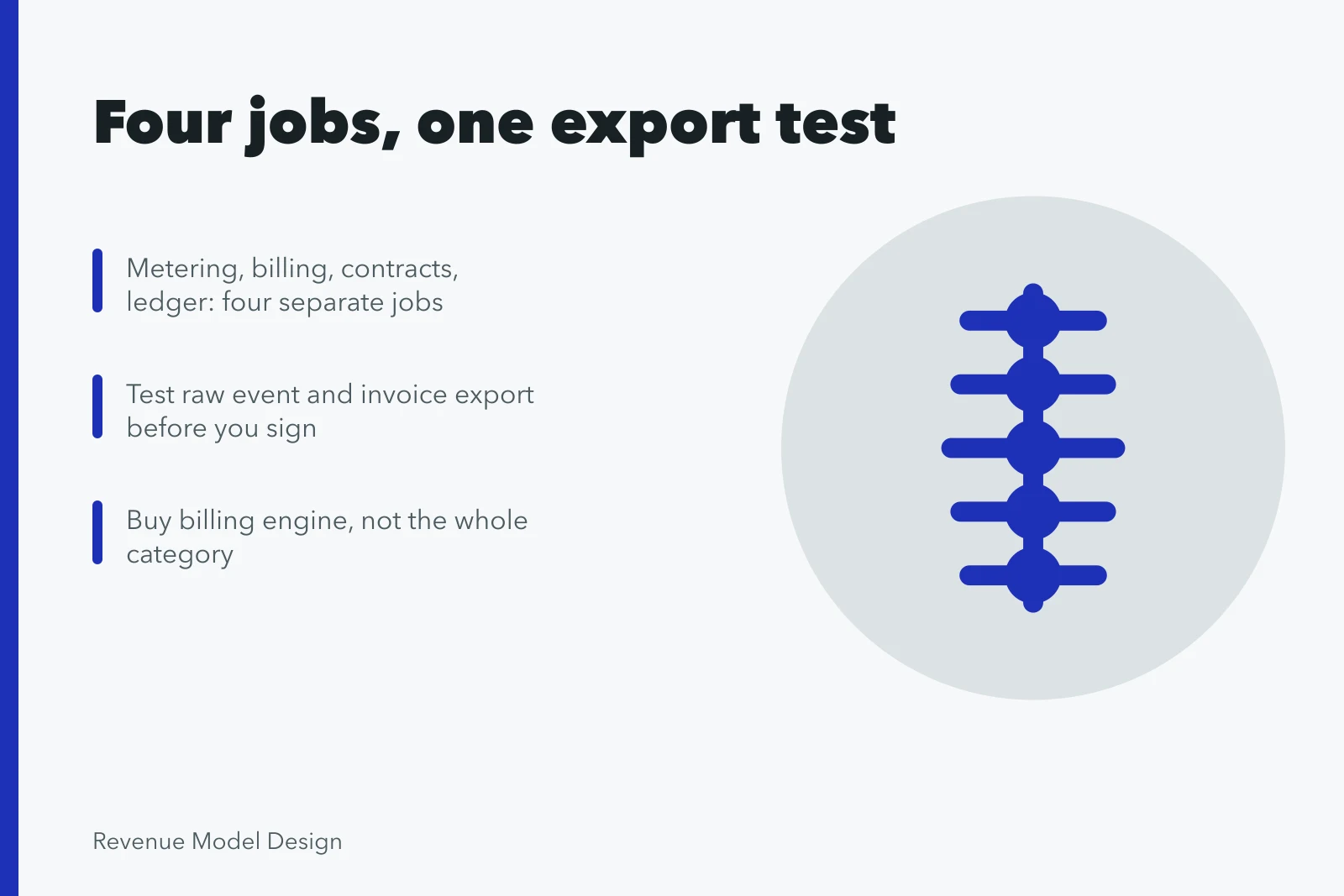
- Metering, billing, contracts and the ledger are four jobs. One product doing all four is a convenience, not a category.
- Whatever you buy, you must be able to get your raw events and your invoice history out of it. Test that before you sign, not when you leave.
No products are named here
Two practical reasons: feature lists and prices change faster than an article, so a named recommendation is stale before useful.
Fit depends entirely on your capture events, which no reviewer knows, and a tool right for a business billing on a schedule can be wrong for one billing on consumption. That difference has nothing to do with quality.
What follows is the part that does not go stale: the questions.
The four jobs
| Job | What it holds | Ask it to answer | What it cannot do |
|---|---|---|---|
| Metering | Timestamped events, attributed to an account | What did this customer consume, and when | Decide whether the event was billable |
| Billing | Prices, terms, schedules, invoices | What does this customer owe for this period | Tell you whether the money arrived |
| Contracts | The agreement, its term, and its exceptions | What did we actually promise this account | Enforce itself |
| Ledger | The accounting record | What does the period look like in the accounts | Track anything before an invoice exists |
Failures sit in the seams, not in a box; three are most common: events metered but not billed, invoices raised without a contract, and contract exceptions in a signed document never wired into billing engine.
The third surfaces during a dispute.
What the system has to represent
Write this list against your own capture events before you look at any product. Each line is something you either need on day one or will need within two years, and each is expensive to retrofit.
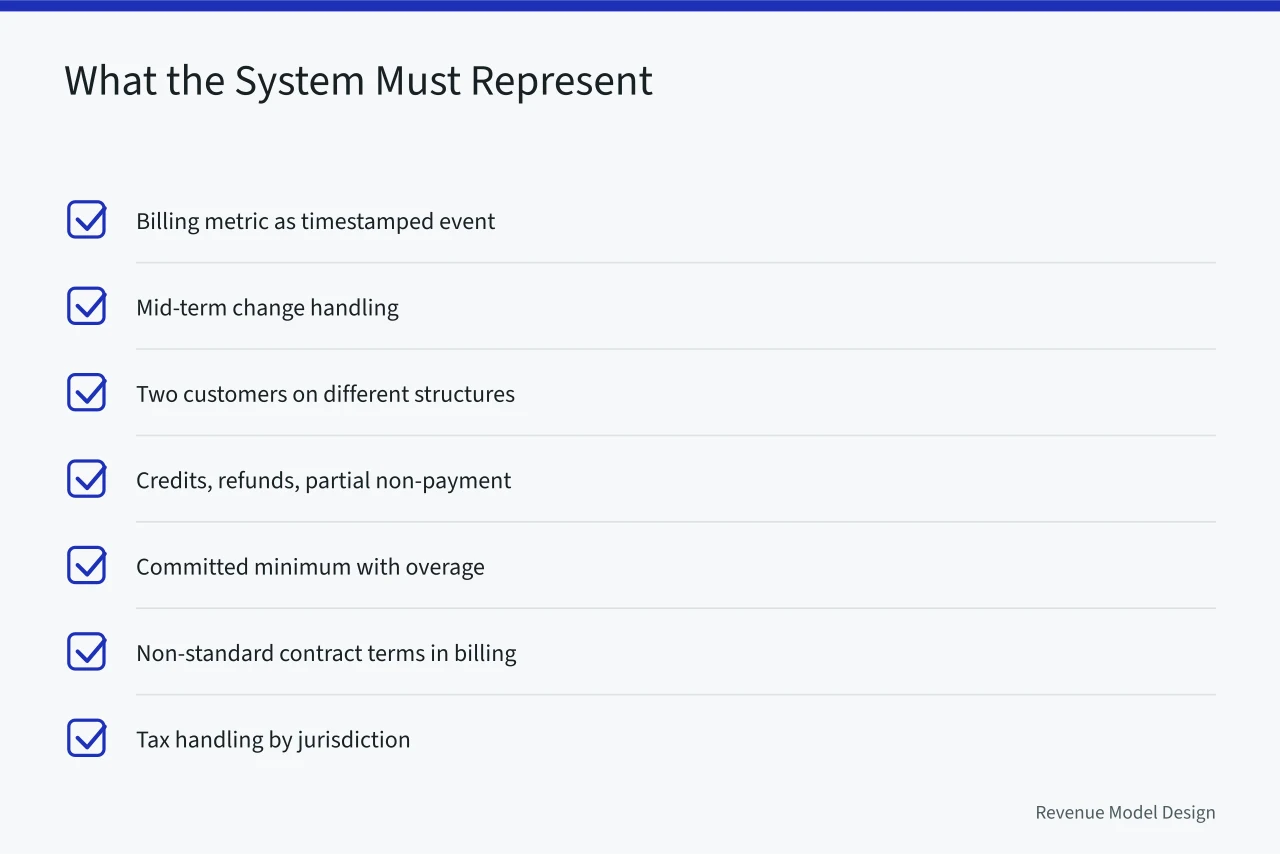
If a required line is missing, that is not a small gap. It is a constraint on which revenue models you can operate, and the options it removes are described in the revenue models overview.
Build or buy
Building is attractive because your first model is simple. The cost is not the first version, it is every subsequent one: proration, tax, dunning, refunds, currency, and the audit trail arrive later and each is more intricate than it looks from outside.
Buying is attractive because those problems are solved. The cost is that the product's assumptions become your assumptions, and the ones you notice last are the ones about how a price is allowed to change.
The honest middle: buy the billing engine, own the metering. Your events are the part nobody else can reconstruct, and keeping them in a store you control means a billing migration is a reconfiguration rather than an archaeology project.
The export test
Before you commit, ask for a full export of a test account: raw events, invoice history, credits, and attached contract terms. Then look at what came out.
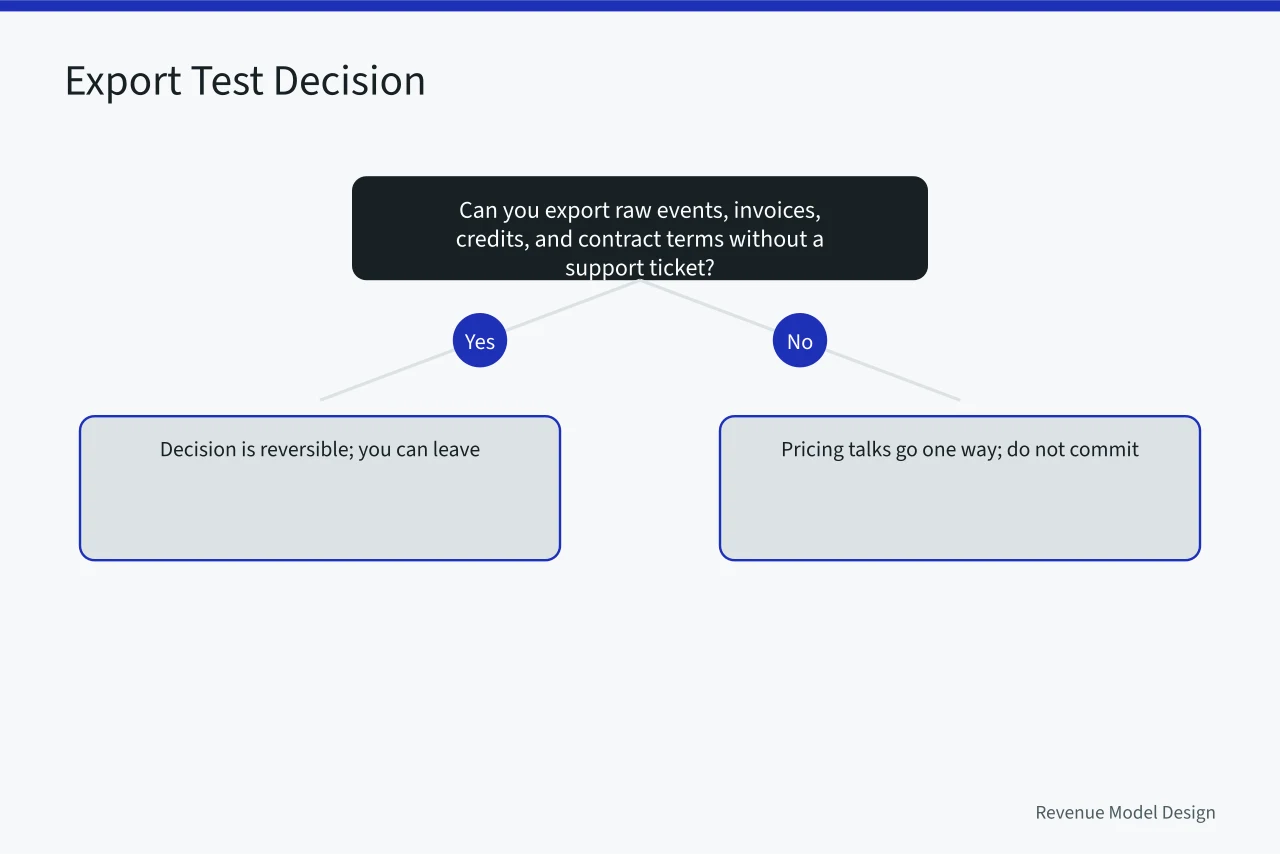
If events arrive without timestamps, invoices arrive as rendered documents rather than data, or the export needs a support ticket each time, you cannot leave. Pricing talks with a vendor you cannot leave go one way.
This matters more than any feature comparison, because it is the thing that decides whether the decision is reversible.
Questions worth asking in a demo
Ask for these to be shown rather than answered, in the product, on a test account.
- Change a customer's plan halfway through a period and show me the resulting invoice.
- Put two customers on different prices for the same thing and show both invoices.
- Show me the record you would produce if this customer disputed last quarter's usage. What that record has to establish is read off the agreement, which is the ordinary rule in a claim for breach of contract.
- Refund part of an invoice and show what the ledger sees.
- Export everything for this account, now, without help.
The answers are more informative than any capability list and take an hour. What each invoice tells you depends on definitions you have written down, the subject of business model types metrics.
The structural choices the system is asked to carry come from the pricing architecture guide.
Common questions
We are small. Is a spreadsheet acceptable?
For a handful of customers on one structure, yes, and it is often the right answer. It stops being acceptable when someone other than you has to produce an invoice, when two customers are on different terms, or when a mistake would be invisible. Those are the triggers, not a customer count.
What breaks first as we grow?
Usually the seam between what was metered and what was billed, because nobody owns it. Assign that reconciliation to a person and give them a monthly report showing events recorded against events invoiced.
Should the billing system be the source of truth for revenue?
For what was invoiced, yes. For what the accounts recognize, that belongs in the ledger, and the two answer different questions. Naming one system per measure prevents an argument you will otherwise have during an audit. The wider set of choices this supports sits in the business model types overview.
How much should tooling cost?
Compare it against the cost of the constraint it removes rather than against a budget line. A cheaper system that cannot represent your model is not cheaper.