Reviews
Part of Revenue model choice: the four questions that actually decide it
Revenue models examples with the reasoning laid bare
Twelve revenue models examples built from four ordinary offerings charged three ways each, showing what every capture event obliges you to staff and run.
The useful exercise is not "which model should we pick." It is "what happens to this exact thing under each model." The twelve revenue models examples below are four ordinary offerings, each shown three ways.
The offering never changes. Everything around it does: who the customer becomes, which department you have to staff, and what must stay true for the money to keep arriving. Each entry names a real product or company carrying public prices so the reasoning lands on something you can check.
What to take away
- The same offering charged differently is a different company. Compare the consequences, not the labels.
- Every capture event you choose hands you a job you will be doing for years. Read the "what you now have to run" line in each entry as the real price of the choice.
- Two of the twelve can be run at once. Most combinations quietly compete for the same customer.
How to read each entry
Three lines per entry: what event releases the money, who your customer effectively becomes, and what you now have to run. The failure mode is the last sentence. Public prices and labeled typical ranges appear as anchors. The arithmetic of your own book still belongs to you, and the revenue models overview sets out where each number comes from.
Software: Microsoft Office, Adobe Creative Cloud, AWS
Sold once, per installation. Microsoft sells Office Home & Business 2021 as a one-time license for $249.99. Money arrives at signature. Your customer is a buyer with a budget cycle, and you will meet them again only when they need a new version.
You now have to run a permanent sales function, because last year's sale is finished and this year starts at zero. It fails quietly: revenue looks fine while the installed base ages out of support and nobody has budgeted for the rebuild.
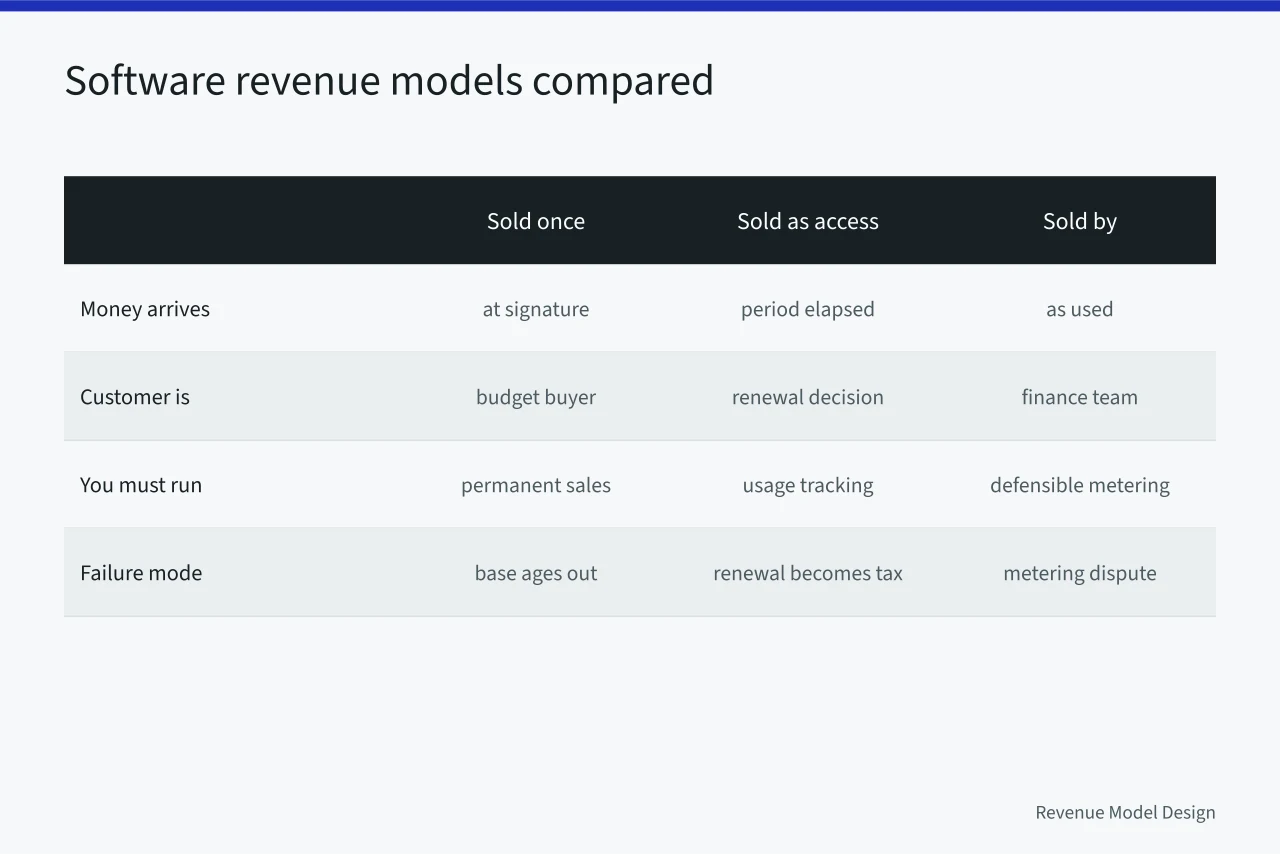
Sold as access, renewed each period. Adobe sells Creative Cloud All Apps for $59.99 a month. Money arrives because a period elapsed. Your customer is a renewal decision that arrives on a schedule whether or not anyone at your end has thought about it.
You now have to run a function whose job is knowing which accounts have stopped using the thing, which is a different job from support and rarely staffed as one. It fails when the product stops changing and the renewal becomes a tax on a decision made three years ago. The version of this trade is in subscription models.
Sold by consumption. Amazon Web Services bills EC2 on-demand instances per second, with a 60-second minimum. Money arrives as the customer uses it. Your customer is now partly a finance team watching a variable line.
You have to run metering you can defend in a dispute, which means records, not dashboards. What either side has to be able to show is decided on the wording of the agreement. That is the ordinary rule in a claim for breach of contract.
It fails when the customer has a bad quarter, because your revenue falls for reasons that have nothing to do with your product.
Physical devices: Apple iPhone, HP printer, Hertz rental
Sold outright. Apple sells the iPhone 15 unlocked starting at $799. Money arrives on shipment. Your customer is a purchaser who owes you nothing afterwards.
You have to run manufacturing, inventory and a returns process, and the cash cycle is the whole business: you pay for stock long before you are paid for it.
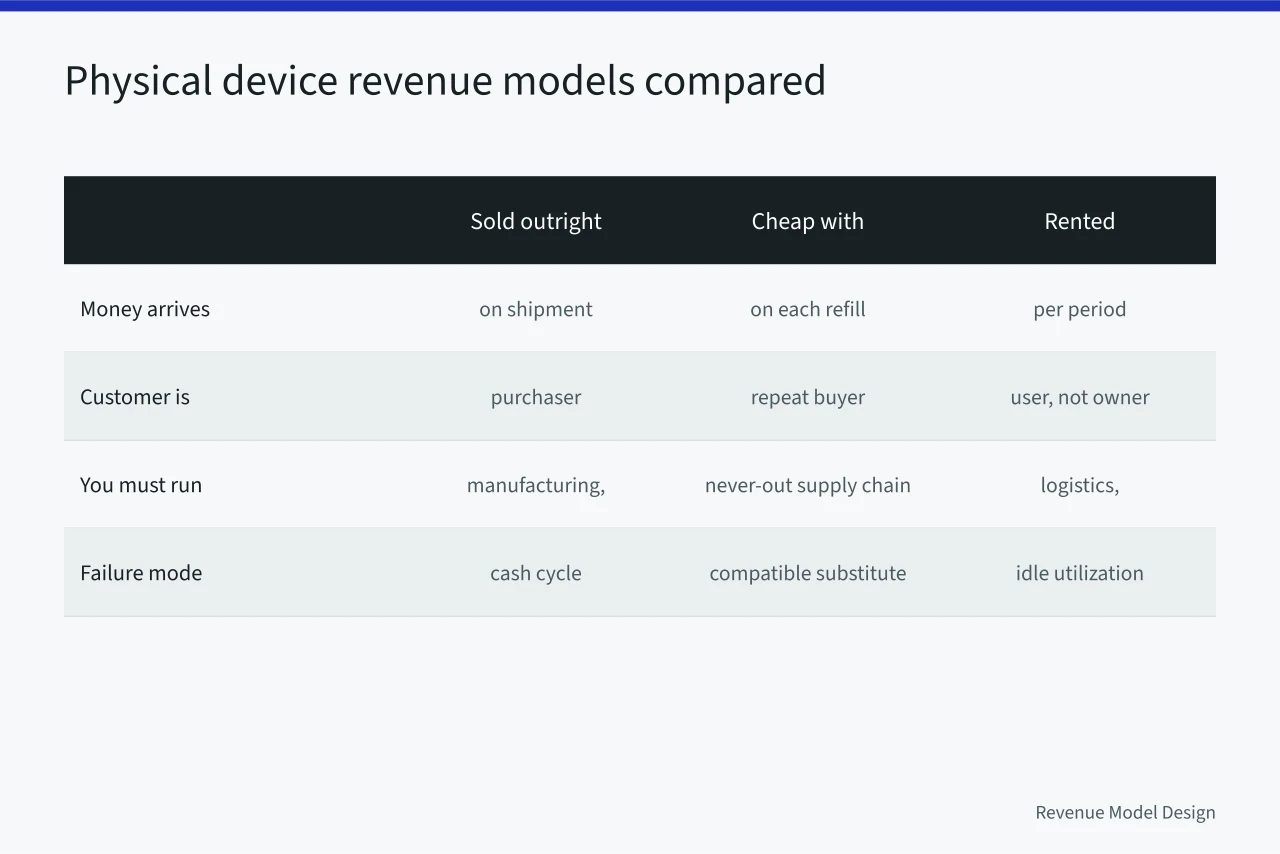
Sold cheap with a consumable attached. HP sells the DeskJet 2755e printer for about $59 and makes its margin on ink cartridges that commonly cost $20 to $40 each. Money arrives on each refill. Your customer is now a repeat buyer whose loyalty is structural rather than emotional.
You have to run a supply chain that never runs out, because a stockout of the consumable is a stockout of your revenue. It fails the day a compatible substitute appears, and every defense against that costs goodwill. The pattern in general form sits in business model types examples.
Rented, with the device staying yours. Hertz rents compact cars for typically $50 to $100 a day depending on market and season. Money arrives per period of possession. Your customer is a user, not an owner, and every fault is your problem forever.
You have to run logistics, refurbishment, and a balance sheet that finances a fleet you own. It fails on utilization: idle units cost exactly as much as working ones. The broader question of who should own the asset belongs with product models.
Expert time: law firm hourly rates, LegalZoom, Rocket Lawyer
Billed for hours worked. Large law firms such as Kirkland & Ellis bill partner time in a range that commonly runs from $500 to $1,500 an hour. Money arrives after an invoice that follows the work. Your customer is buying attention and will count it.
You have to run utilization tracking and a quiet-month answer. It fails at the ceiling: the only growth available is more people or a higher rate, and both have limits you did not set.
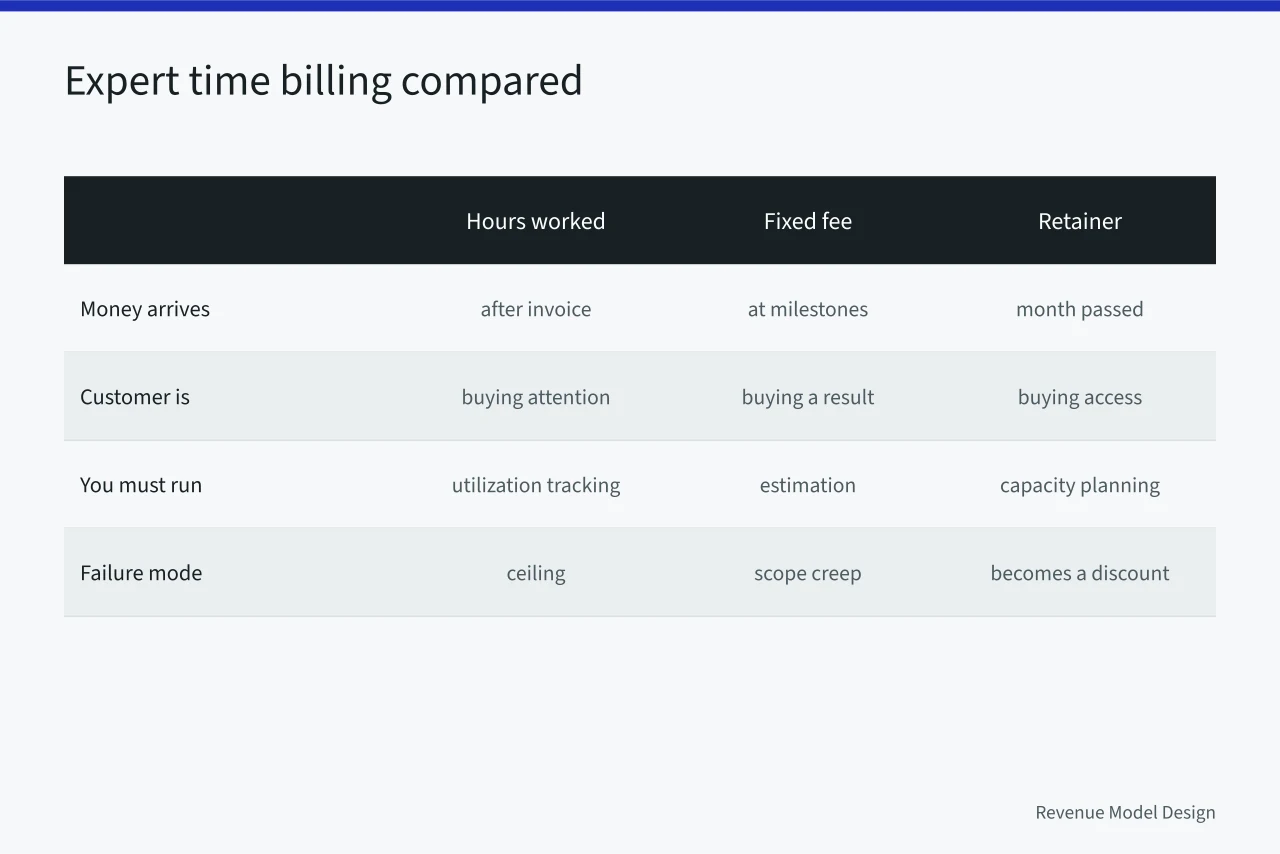
Billed as a fixed fee for a defined outcome. LegalZoom forms an LLC for a flat fee starting at $0 plus state filing fees, or $249 plus state fees for its Express Gold package. Money arrives at agreed milestones. Your customer is buying a result and has stopped caring how long it takes.
You now have to run estimation, and estimation is a skill with a learning curve paid for in losses. It fails on scope, which moves in small friendly increments that nobody logs.
Billed as a retainer for availability. Rocket Lawyer sells a Monthly Legal Plan for $39.99 a month, covering attorney consultations and document reviews. Money arrives because a month passed. Your customer is buying access to you, including the months they do not use.
You have to run capacity planning against demand you cannot see, and a conversation about what happens in a heavy month. It fails when the retainer becomes a discount on hours, at which point you are back in the first entry with worse margins. The trade-offs across all three sit in service models.
Places with capacity: Delta seats, Planet Fitness, airport concessions
Sold by the slot. Delta Air Lines sells seats by the slot, and a one-way fare from Atlanta to New York can run from about $89 to more than $600 depending on demand and booking time. Money arrives per booking. Your customer is whoever showed up, and demand is a curve you inherit rather than one you set.
You have to run yield: the same slot is worth different amounts at different times, and the whole business lives in that spread. Charging different amounts for the same perishable capacity is a standard topic in MIT's pricing course. It fails when a competitor with lower fixed costs can survive a quiet season you cannot.
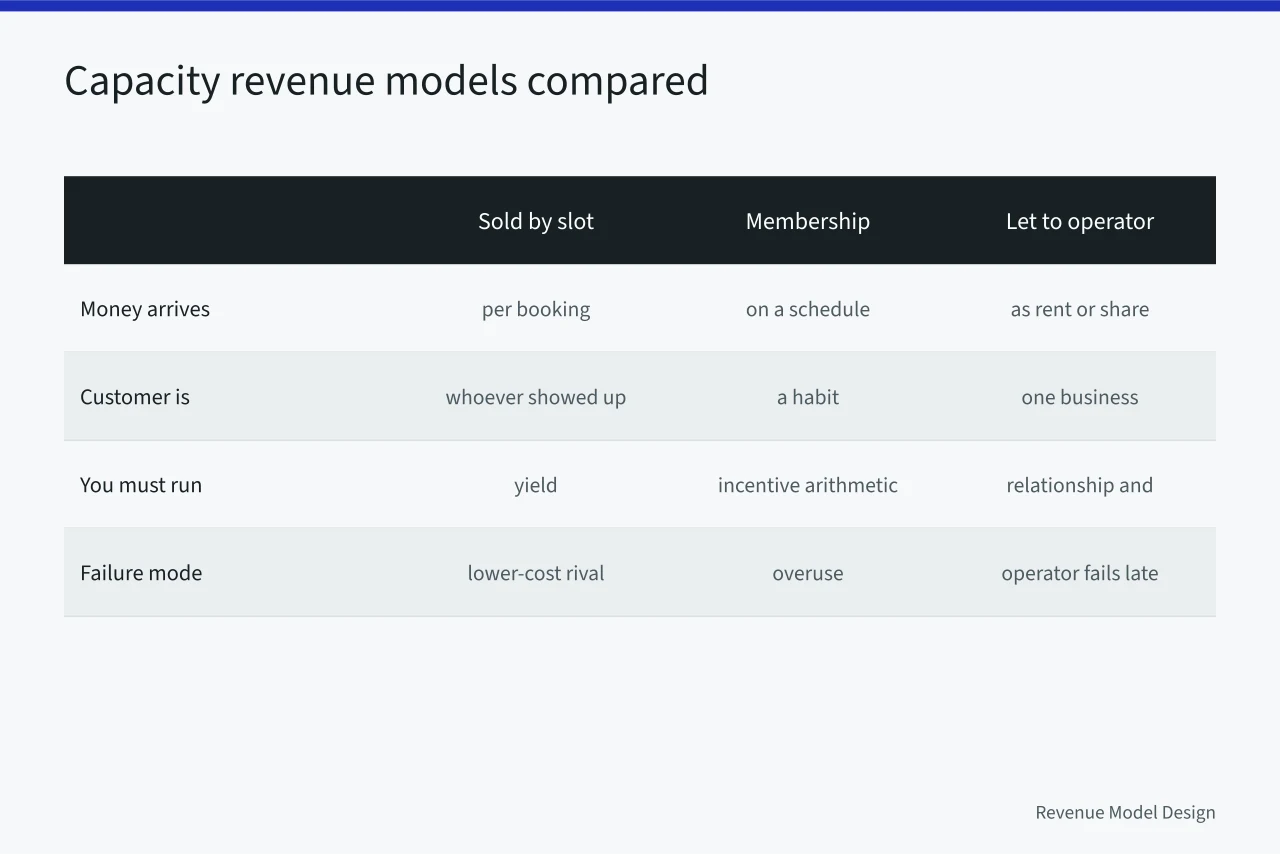
Sold as a membership. Planet Fitness sells a Classic membership for $10 a month and a PF Black Card for $24.99 a month. Money arrives on a schedule regardless of attendance. Your customer is a habit, and you are being paid for the option to come rather than the coming.
You have to run the uncomfortable arithmetic that too many members using their access makes the model worse, which is a permanent incentive problem to manage honestly rather than exploit.
Let to an operator who takes the revenue. Airports charge rental car companies like Hertz a concession fee that commonly runs around 10 percent of gross revenue. Money arrives as rent or as a share of what they take. Your customer is one business rather than many people, so your concentration risk goes from spread to single.
You have to run a relationship and an agreement, and almost nothing else. It fails when the operator's business fails, which you will learn about late.
Reading the twelve back onto your own
Take what you sell today and write three lines for it. The event that releases the money, who your customer effectively is, and the function you must staff because of it. Then write the same three lines for the model you have been considering.
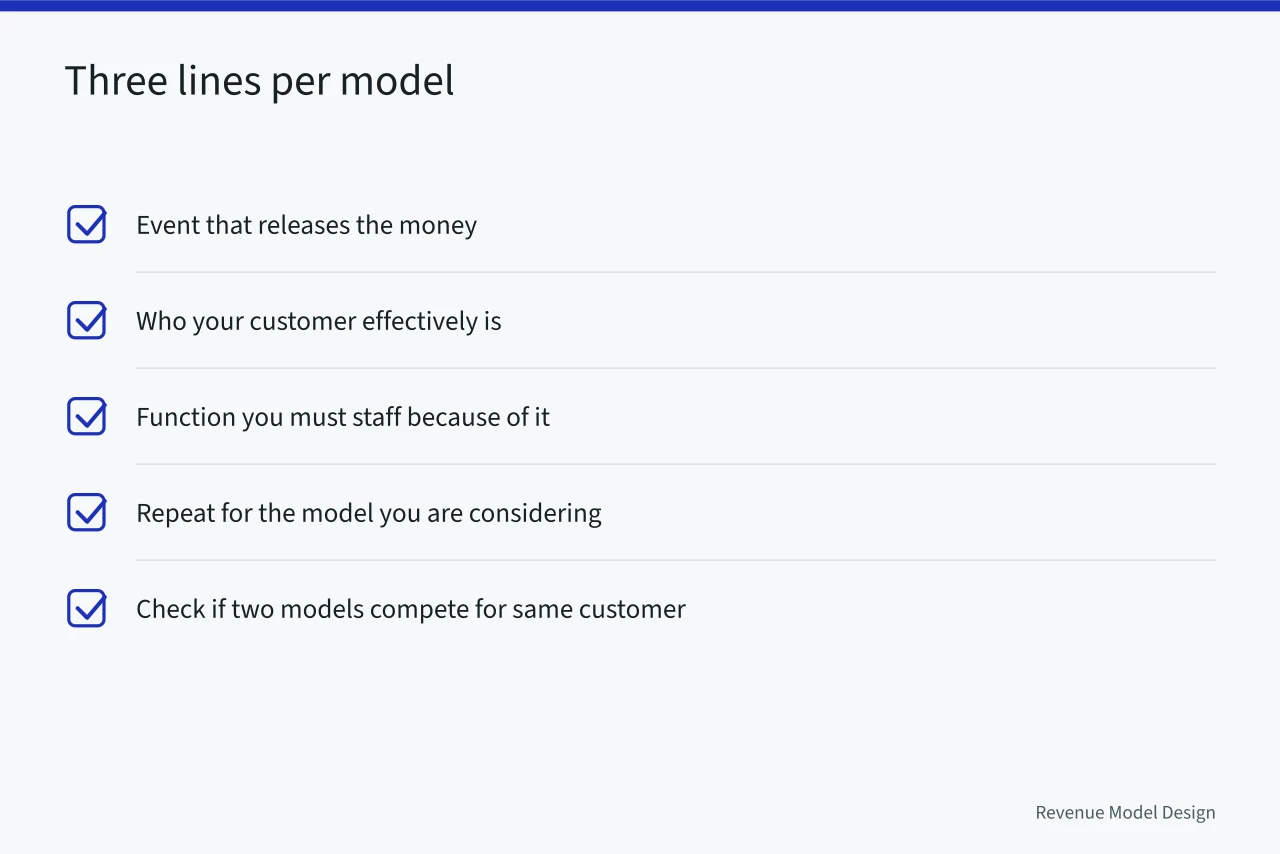
The interesting part is never the revenue comparison but the third line, because that is the change you would actually make to the company.
If two of the twelve look attractive at once, check whether they compete for the same customer at the same moment.
Selling a device outright and renting the same device works because the customer chooses once. Selling access by period and by consumption at once is a decision nobody made. It shows up later as a book you cannot forecast.
Common questions
Can one company run several of these?
Yes, and most do past the early stage. The condition is that each capture event is reported separately, with its own cash timing. Blended into a single revenue line they produce a number that describes neither.
Which of the twelve is safest for a company with no money?
The ones where money arrives before or at the moment of the work. That is not the same as the ones with the best economics, and confusing those two is how a well-funded competitor beats a better business.
How do I test a model before committing to it?
Sell it that way to a small number of customers under a written agreement with an end date, and count what it costs you to serve them. Test the operational half, not just the willingness to pay, because the operational half is the part that does not show up in a survey.