Costs
Part of Revenue model choice: the four questions that actually decide it
Revenue models questions, answered without hedging
Revenue models questions that arrive from buyers, partners, lenders and your own sales team, with what a solid answer contains and what gives you away.
The hard questions about a revenue model are not asked internally. They arrive from a customer's procurement team, a prospective partner, a lender, an auditor, or your own salespeople, and they arrive at the worst moment, in writing, with a deadline.
Each one below is a question you will eventually be asked. For each: why it is being asked, what a solid answer contains, and the answer that tells the person opposite you that nobody has thought about it.
What to take away
- Every outside question about a revenue model is really a question about who carries which risk.
- Write the answers once, keep them in one document, and update the document rather than improvising each time.
- "We would have to check" is a fine answer. Inventing a policy in the moment is not, because you will be held to it.
The buyer's side
"What happens to what we pay if we double in size?"
They ask whether your model turns their success into their problem.
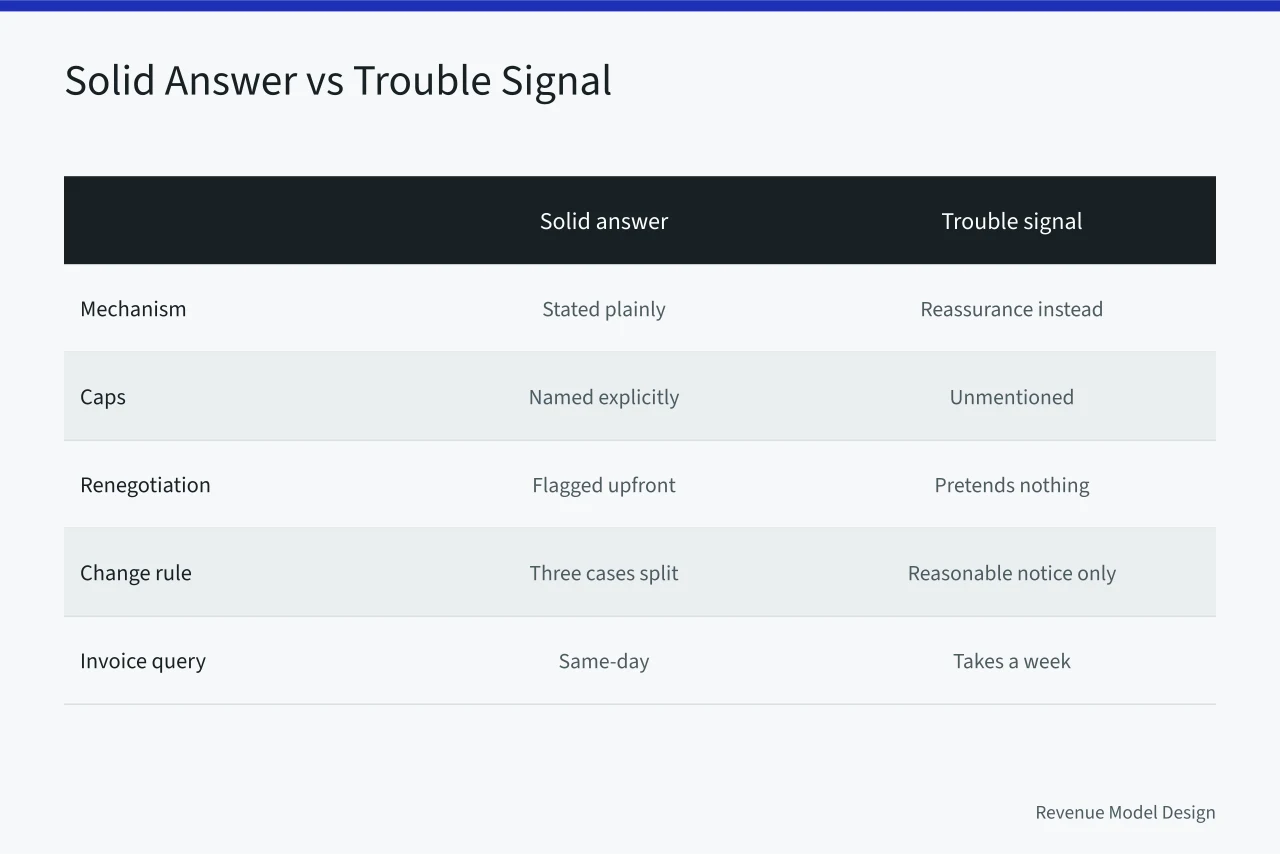
A solid answer states the mechanism plainly, names what is capped and what isn't, and says what would need renegotiating rather than pretending nothing would.
Trouble signal is reassurance instead of mechanism, and buyer's finance team will model worst case anyway and use their number, not yours.
"What are we committed to, and what can you change without our agreement?"
This is a question about your change rule, asked by people who have been surprised before. A solid answer separates three cases: what is fixed for the term, what can move with notice, and what is tied to a cost you do not control.
The trouble signal is a contract that says prices may change with reasonable notice and nothing else, which an experienced buyer reads as an unpriced risk. What the clause permits is decided on its wording, not the intention behind it, which is the ordinary rule in a claim for breach of contract.
"Why is this invoice different from last month's?"
Asked by the person who has to approve it, usually annoyed. A solid answer is a line-by-line reconciliation produced from your own records within a day. The trouble signal is a reconciliation that takes a week, because it means your billing does not reproduce its own arithmetic, and every future dispute will be settled by whoever loses patience last.
A partner or a channel
"Who owns the customer, and how is the money split?"
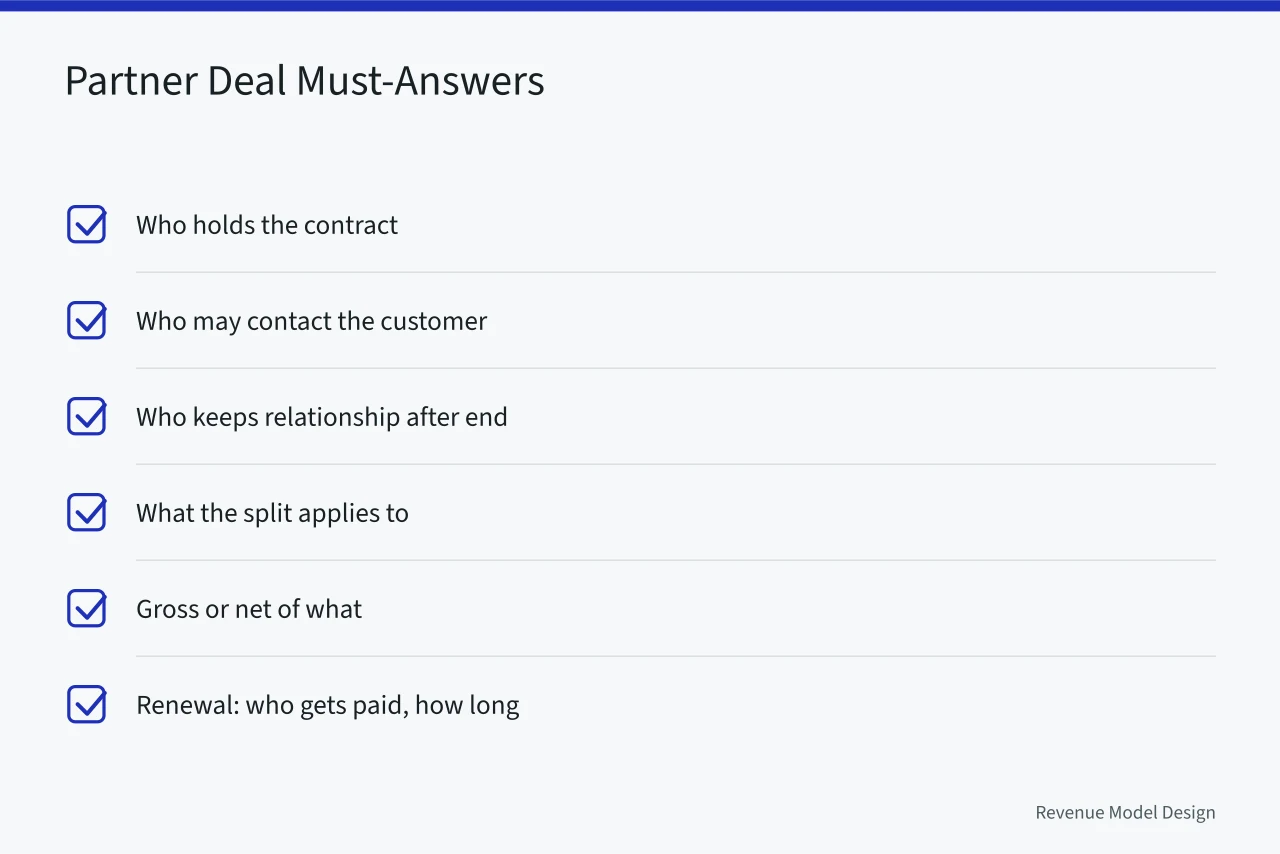
Ownership is three separate things people merge: who holds the contract, who may contact the customer, and who keeps the relationship if the partnership ends. A solid answer treats them separately and writes down each.
It also states what the split applies to, whether gross or net of what. A share of a number nobody defined is an argument with a delay.
The trouble signal is enthusiasm about the split with no answer on renewal: who gets paid, and for how long, on money that arrives after the partner stopped working. Settle that before the first deal, because it is unsettleable afterwards.
A lender or an investor
"How much of next year's revenue is already there without new sales?"
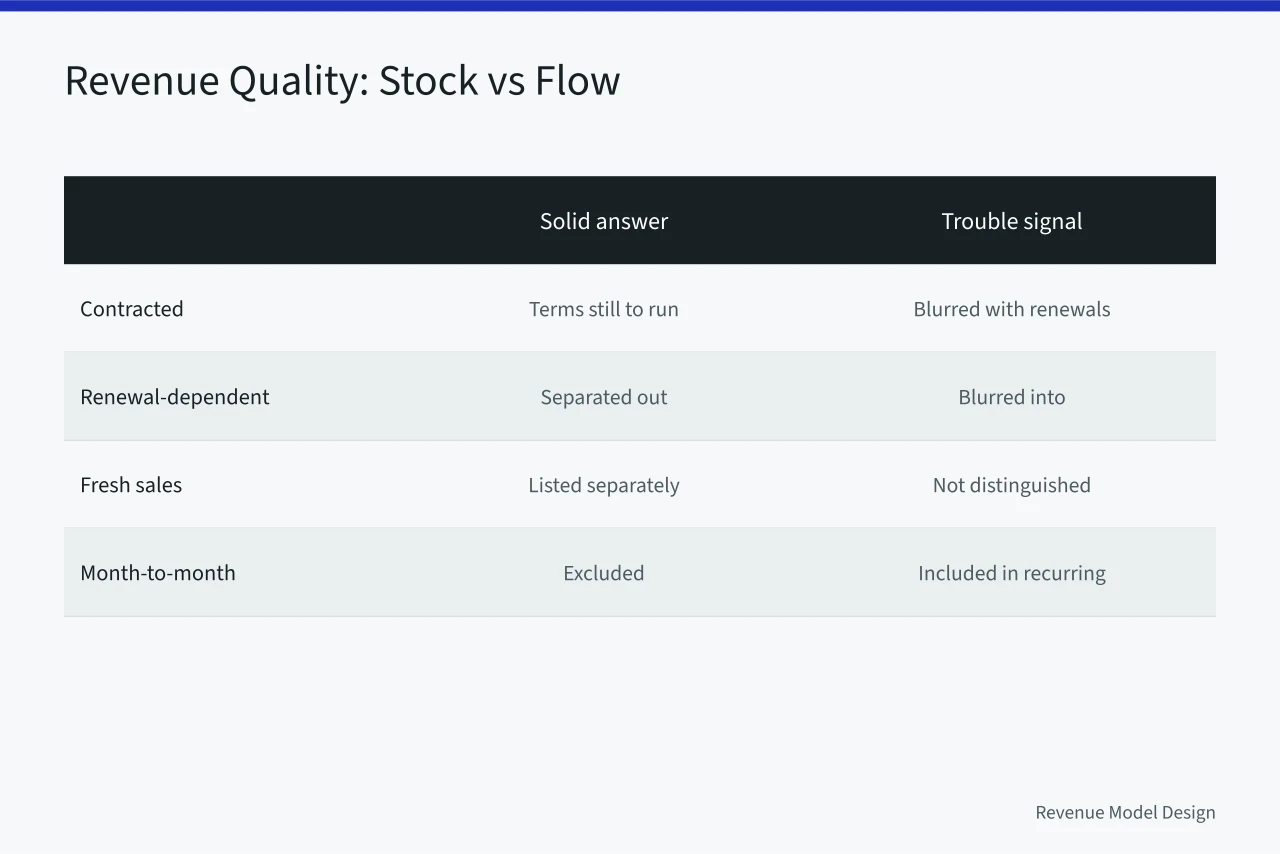
They are testing whether your revenue is a stock or a flow. A solid answer separates contracted revenue with terms still to run, revenue that depends on a renewal decision, and revenue that requires a fresh sale. It does not blur the second into the first.
The trouble signal is one recurring figure that includes month-to-month arrangements anyone can end; that is the distinction subscription models live or die on.
"Why this model and not the obvious alternative?"
A reasonable question, and a chance to sound deliberate or accidental.
A solid answer names the constraint that ruled out the alternative: the budget your buyer approves from, the proof lag, what you can meter, or who sits in the middle taking a share. A market-practice answer signals trouble. It says you inherited the model instead of choosing it.
Your accountant
"When is this recognized, and what is sitting deferred or unbilled?"
Recognition timing depends on your jurisdiction and contract shape. Ask them; don't answer yourself.
Give a clear description of the arrangement: what triggers the money, what obligation remains afterward, and what you promised but have not delivered.
Discovering during an audit that an unflagged contract term changes when revenue can be recognized is a trouble signal. Bring unusual terms to your accountant when signed, not at year end.
IRS Publication 538 explains when income is earned versus received, plus accounting methods and rules for changing one.
Your own sales team
"Can I do it differently for this one deal?"
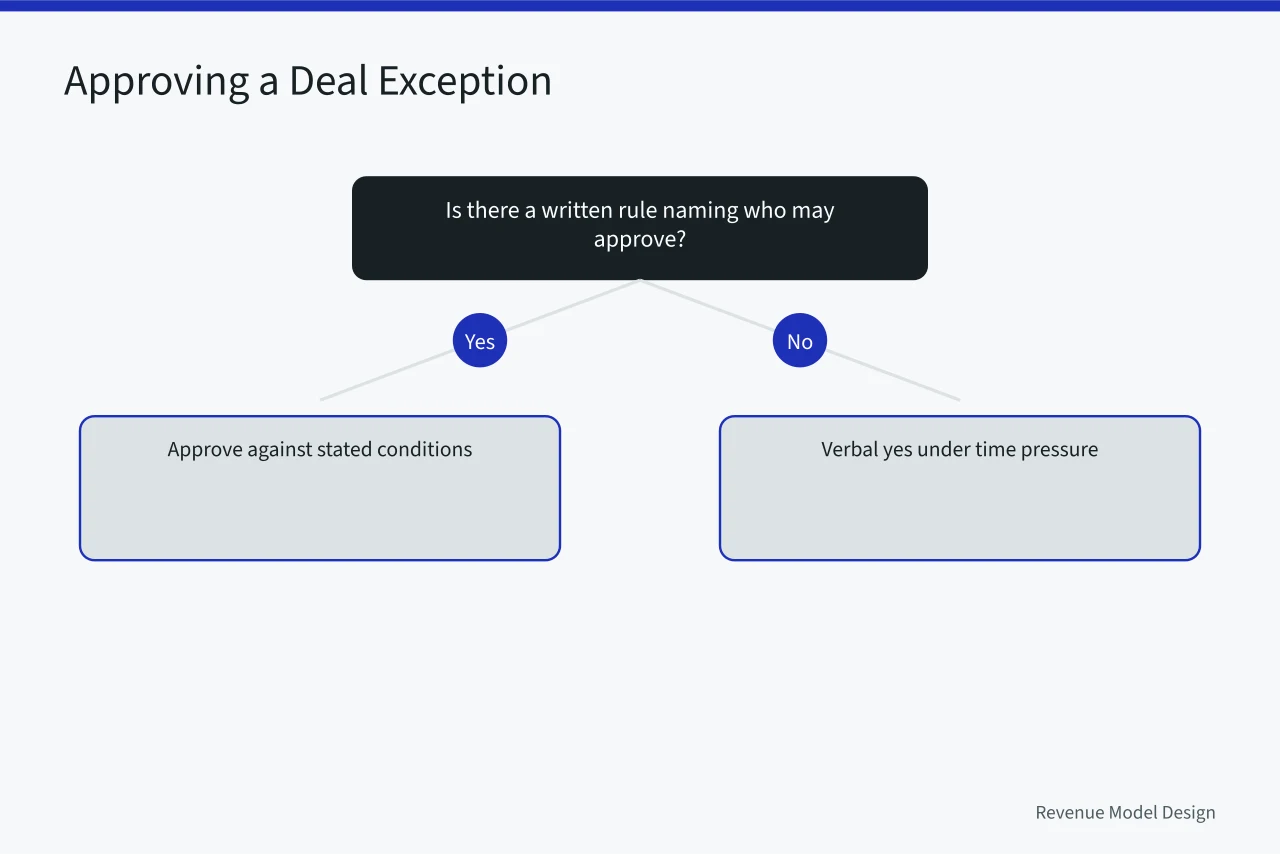
The most consequential question on this page, because it is asked repeatedly and answered informally. A solid answer is a written rule: who may approve a departure from the standard model, and what has to be true for approval. It also says where the exception is recorded, so it exists somewhere other than a signed contract nobody reads again.
The trouble signal is a yes given verbally under time pressure. One exception is a decision. Twenty undocumented exceptions is a second revenue model you did not design and cannot report on, which is exactly the condition that makes the definitions in business model types metrics impossible to apply.
What the questions have in common
Every one asks who carries the risk: growth, change, a partnership ending, a customer not renewing, an exception nobody logged. A revenue model answers those questions.
The answers exist whether or not you write them down. Writing them down means answering from a document, not from a mood.
Keep them in one place, dated, with an owner. When the answer changes, change the document, and note what changed. The business model types checklist covers the wider set of decisions this document sits inside, and the money side of each answer follows from revenue models.
Common questions
What if we genuinely do not know the answer yet?
Say so, say when you will know, and say what would decide it. That is a credible answer. A confident invention is not, and it becomes the policy you are held to.
Should any of these answers be public?
The change rule and the scaling behavior usually should be, because a buyer who cannot find them assumes the worst. Your exception policy should not, since publishing it turns it into an opening offer.
Who should own the document?
One named person, not a committee. The test is whether a new salesperson could read it and answer a customer correctly without asking anyone.