Maintenance
Part of Unit economics and the choice of unit: why the wrong pick lies to you
Unit economics examples: when the obvious unit is the wrong one
Twelve unit economics examples where the obvious unit is the wrong one, with the unit that works and the cost that has to follow it for the answer to mean anything.
Unit economics goes wrong at the first step far more often than at the arithmetic. Someone picks a unit that seems obvious, the sums are done correctly on it, and the answer describes a business nobody runs.
Below are twelve situations where the obvious unit is the wrong one. For each: the trap, the unit that actually works, and the one cost that has to follow the unit for the answer to mean anything. None of these need a figure to be useful, because the mistake is structural.
What to take away
- The unit has to be something you can decide to make one more of. If you cannot buy another one, it is a category, not a unit.
- Where the payer and the user are different people, revenue follows one and cost follows the other. The unit has to hold both.
- Most businesses need two units, not one. Keeping them labeled is the whole discipline.
When the payer and the user are different people
1. One organization buys, many of its staff use it. The trap is measuring per user, because that is how you bill. Revenue is set by a contract; cost is set by however many people turn up and how heavily they lean on you. The workable unit is the account, with the per-user cost curve visible inside it. The cost that must follow: support, which arrives per person, not per contract.
2. A free population creates the demand and a different party pays. The trap is excluding the free users because they generate no revenue. They generate cost, and they are the reason the payer is paying. The unit is the paying entity, with the delivery cost of the free population attached to it. The cost that must follow: everything spent serving people who will never pay.
3. One account shared by a household or a team. The trap is assuming the account is one user. Revenue follows the payer and cost follows consumption, and the gap between them widens as sharing increases. The unit is the paying account, measured with a distribution of consumption behind it rather than an average.
When the purchase is not the relationship
4. A durable item sold cheaply with a consumable behind it. The trap is treating the item sale as the unit, which makes every sale look like a loss. The unit is the customer across the replacement cycle. The cost that must follow: the subsidy inside the first sale, carried explicitly rather than written off, because the whole model depends on how many refills follow it. That pattern in general form is one of the business model types examples.
5. A long free period before anyone pays. The trap is starting the clock at first payment, which parks the entire cost of the free period in a place nobody attributes. The unit is the customer from first delivered value, not from first invoice. The cost that must follow: everything spent serving them before they paid, including the ones who never did.
6. A purchase made once a year, or once in a lifetime. The trap is a customer-lifetime unit, which invites you to invent a relationship that will not happen. Where repeat purchase is not natural, the unit is the transaction, and the honest statement is that you do not know whether they will return. The cost that must follow: acquisition in full, against that single transaction.
When what you sell is capacity
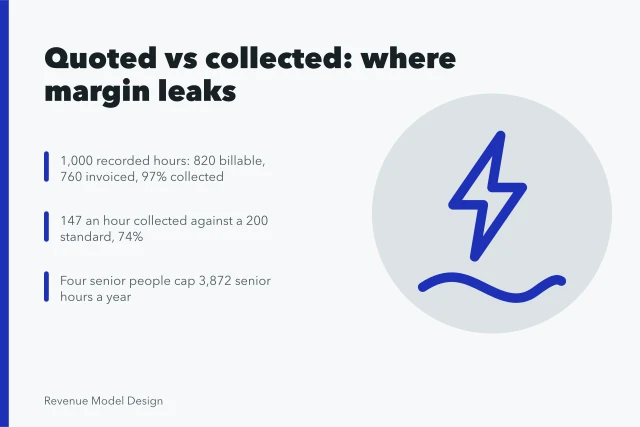
7. A firm with clients, each with several engagements. The trap is the client as the unit, which averages a loss-making engagement into a profitable one and hides both. The unit is the engagement. The cost that must follow: the time of everyone who touched it, including the people whose hours are not billed. The wider version of this sits in service models.
8. A business organized around sites, routes or vehicles. The trap is the customer, when the economics are set by the location. A site carries its own fixed cost whether or not anybody arrives, so per-customer arithmetic tells you nothing about whether to open another one. The unit is the site, and the customer unit is a second, separate model.
9. Perishable capacity sold in slots. The trap is treating an unsold slot as a neutral event. It is a cost that has already been incurred. The unit is the slot-period, and the interesting number is what share of capacity was sold and at what effective price rather than what a single sale earned.
When somebody else is in the middle
10. Customers arriving through a channel or a marketplace. The trap is one blended customer unit across all sources. The intermediary's cut, the acquisition cost and the retention behavior all differ by channel, and blending them produces a number that describes no channel. The unit is the customer within a channel. The cost that must follow: the cut taken before the money reaches you, which never belonged to you and should never appear as revenue. What counts as your gross receipts in the first place is a question with rules attached, and IRS Publication 334 is the plainest statement of them for a small business. The structural version of that relationship is in marketplace models.
11. An audience given something free, with attention sold to a third party. The trap is trying to compute economics per audience member, which mixes a cost you control with a revenue you do not. The unit is a period of audience sold. The cost that must follow: the full delivery cost of the free audience, in that same period.
12. An operator running under your name and system. The trap is modeling the end customer, whose costs you cannot see and should not guess. Your unit is the operator relationship: what it took to recruit and support them, against what they pay you. The cost that must follow: support of the operator, which grows with their number and is usually understated at the start.
Testing a candidate unit
Three questions settle it quickly.
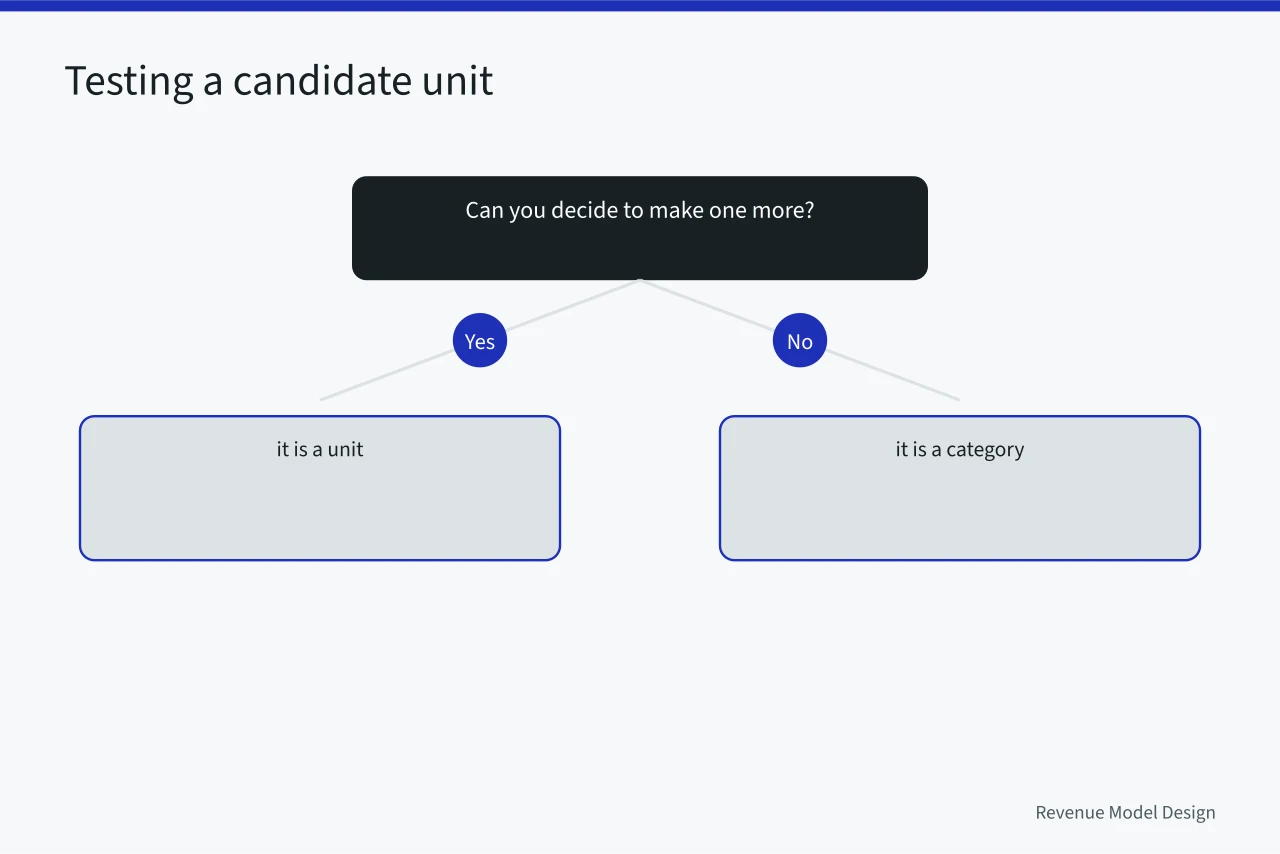
- Can you decide to make one more? If not, it is a category.
- Does revenue attach to it cleanly? If revenue arrives for a group and you are dividing it, note that the division is an assumption and write it down.
- Do the costs you care about move with it? If your biggest cost is per site and your unit is per customer, the unit will not answer the question you are asking. Separating a cost that moves with output from one that does not is the first division made in MIT's financial and managerial accounting course.
Where two units both pass, use both, label them, and never compare a number computed on one against a number computed on the other. Half of all confused reporting is exactly that comparison. The definitions that sit on top of whichever unit you choose are set out in unit economics.
Common questions
Can the unit change over time?
Yes, and it should when the business changes shape. Keep the old model as it was rather than restating history, and date both, so a comparison across the change is at least visible as a comparison across a change.
We sell two very different things. One model or two?
Two, always. A blended model across products with different cost structures produces a figure that is right about nothing, and the moment you want to decide anything you will separate them anyway.
Which unit do investors expect?
They will ask for the one their other holdings use, which is a reason to explain yours rather than adopt theirs. A well-defined unit specific to your business and clearly stated is more persuasive than a familiar one that does not fit. What you sell decides it, and the range of shapes is in product models.
Is a per-order unit ever enough on its own?
Where purchases are genuinely independent, yes. The moment today's order exists because of a relationship you paid for two years ago, you need a second unit that spans the relationship.