Guides
Part of Getting service models right the first time
Where twelve service models examples hit their ceiling, and why
Twelve service models examples tied to real firms show where each hits its ceiling and which party absorbs the resulting cost overruns and delays.
A service business hits a wall in one of a few places. Which wall you are against decides what you do next, and the answer is almost never "sell more".
Below are twelve service model examples, each tied to a named firm. For every one you get where growth stops, who pays when the work runs long, and the single change that raises the ceiling.
What to take away
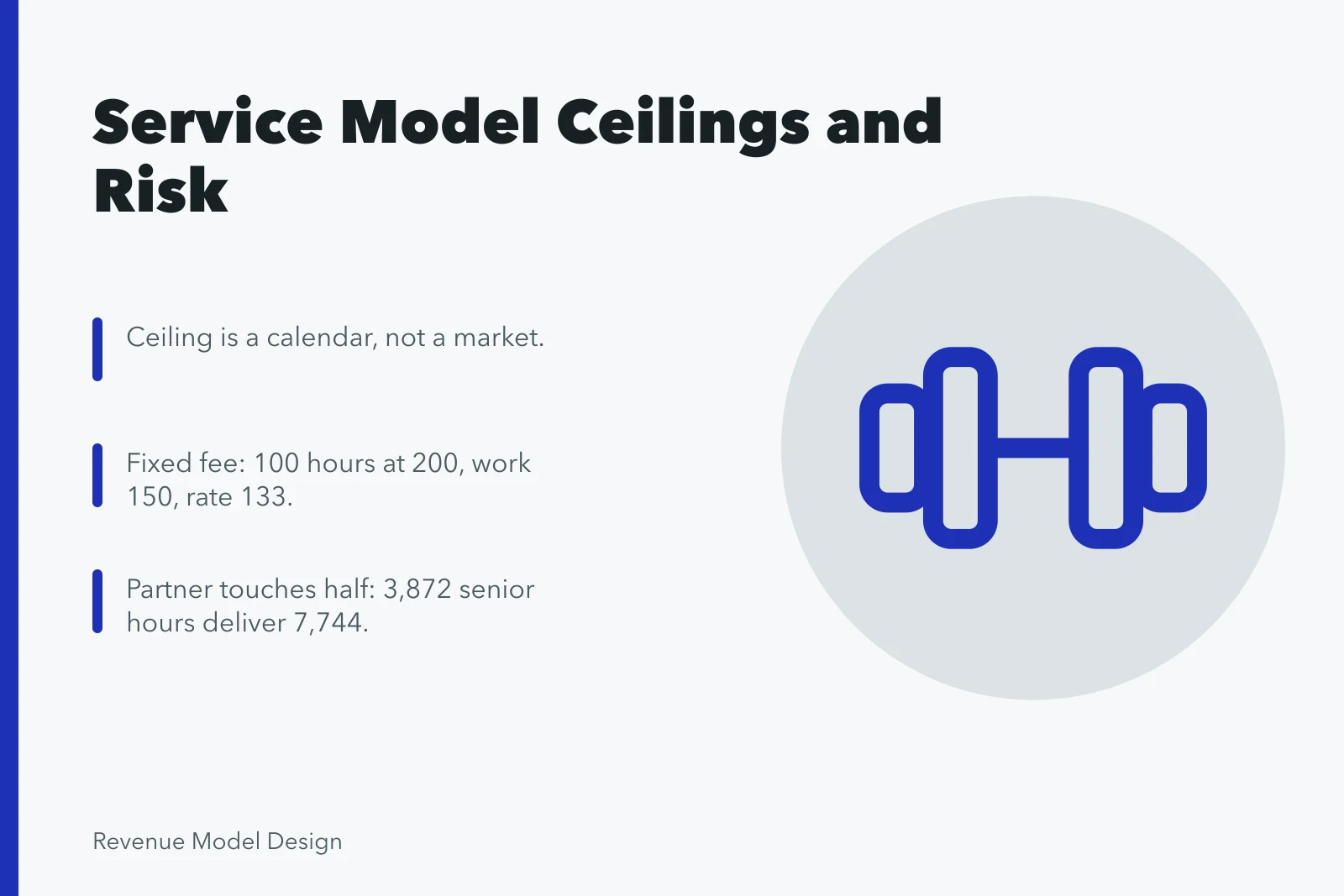
- The ceiling in a service firm is a calendar, not a market. Find whose calendar runs out first.
- Growth that does not change who can deliver the work makes the same senior people later.
- Fixed fee and hourly are two products sold to buyers who want different risks.
- Hiring to fix an overload adds supervision demand at the same time as delivery hours.
- Documenting the method is the highest-return work most firms never schedule.
When one person is the product
1. A solo advisor, the Alan Weiss shape. Weiss runs Summit Consulting Group and wrote Million Dollar Consulting and Value-Based Fees. He built the practice on one person's calendar and published the rate logic behind it.
The ceiling is hours times rate, and demand does not move it. Only two changes help: a higher rate, or an offer that is not his time.
2. An expert with a preparer, the David C. Baker shape. Baker advises marketing and design firms through ReCourses, wrote The Business of Expertise, and co-hosts the 2Bobs podcast with Blair Enns. An associate does the preparation, which takes work off the expensive calendar.
Review stays on it. If the principal still reads every line, review becomes the constraint, and it hides because each item is short.
3. A reputation-led practice, the Blair Enns shape. Enns runs Win Without Pitching and wrote The Win Without Pitching Manifesto. He sells through a named principal who also delivers.
The ceiling is sales, not delivery. One person cannot sell and deliver at full stretch, so the firm grows to a point and then oscillates, busy one quarter and empty the next.
When a team delivers and seniors supervise
4. A partner-touched firm, the McKinsey & Company shape. Suppose four senior people have 44 working weeks and 22 sellable hours a week, so 3,872 senior hours a year. If they must be on half of all delivered hours, the firm delivers 7,744 hours.
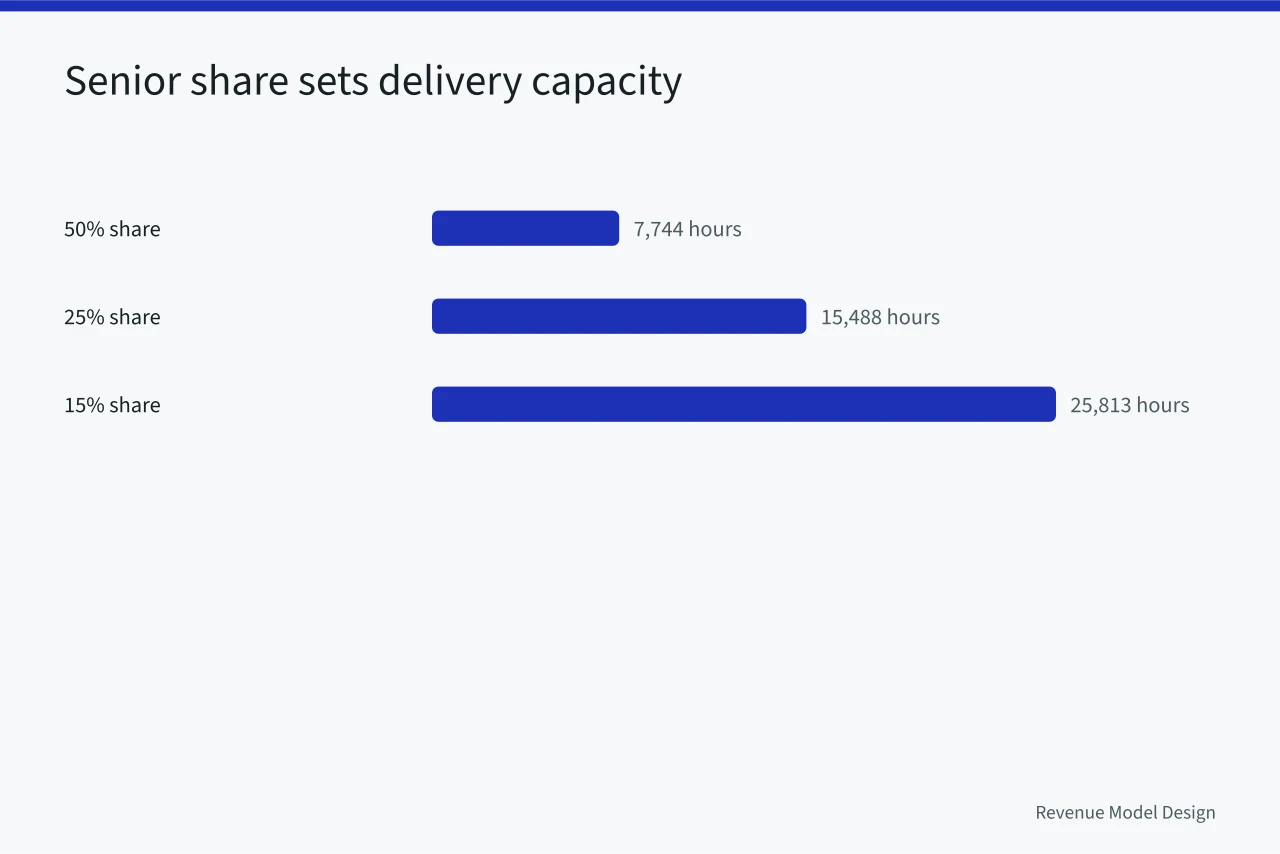
At a quarter, 15,488. At fifteen percent, 25,813. The lever is the share, not the headcount. McKinsey's up-or-out promotion model keeps that share by moving people out, and MIT's introduction to operations management sets out why the binding resource decides throughput.
5. Hiring to fix an overload, the S4 Capital pattern. Martin Sorrell built S4 Capital from MediaMonks and MightyHive and then bought more agencies. Payroll rose, and net capacity rose less, because new staff also consume supervision. S4 reported falling like-for-like revenue in 2023 and cut its profit outlook.
Margin can fall for two quarters before it recovers. This is the most common reason a growing firm's margin drops.
6. A documented method, the EOS Worldwide shape. Gino Wickman's 2007 book Traction lays out the Entrepreneurial Operating System, and EOS Worldwide licenses implementers to run it. A mid-level person can run the method with a review point, so the senior share falls without quality falling.
Implementers typically bill a flat monthly retainer, often in the low thousands of dollars, on a two-year engagement. This work never has a client waiting, so it never gets scheduled.
When the pricing shape sets the risk
7. Fixed fee against a vague deliverable, the Pilot shape. Pilot sells bookkeeping as a flat monthly subscription, with tiers set by transaction volume and catch-up work quoted separately. Plans typically run a few hundred dollars a month.
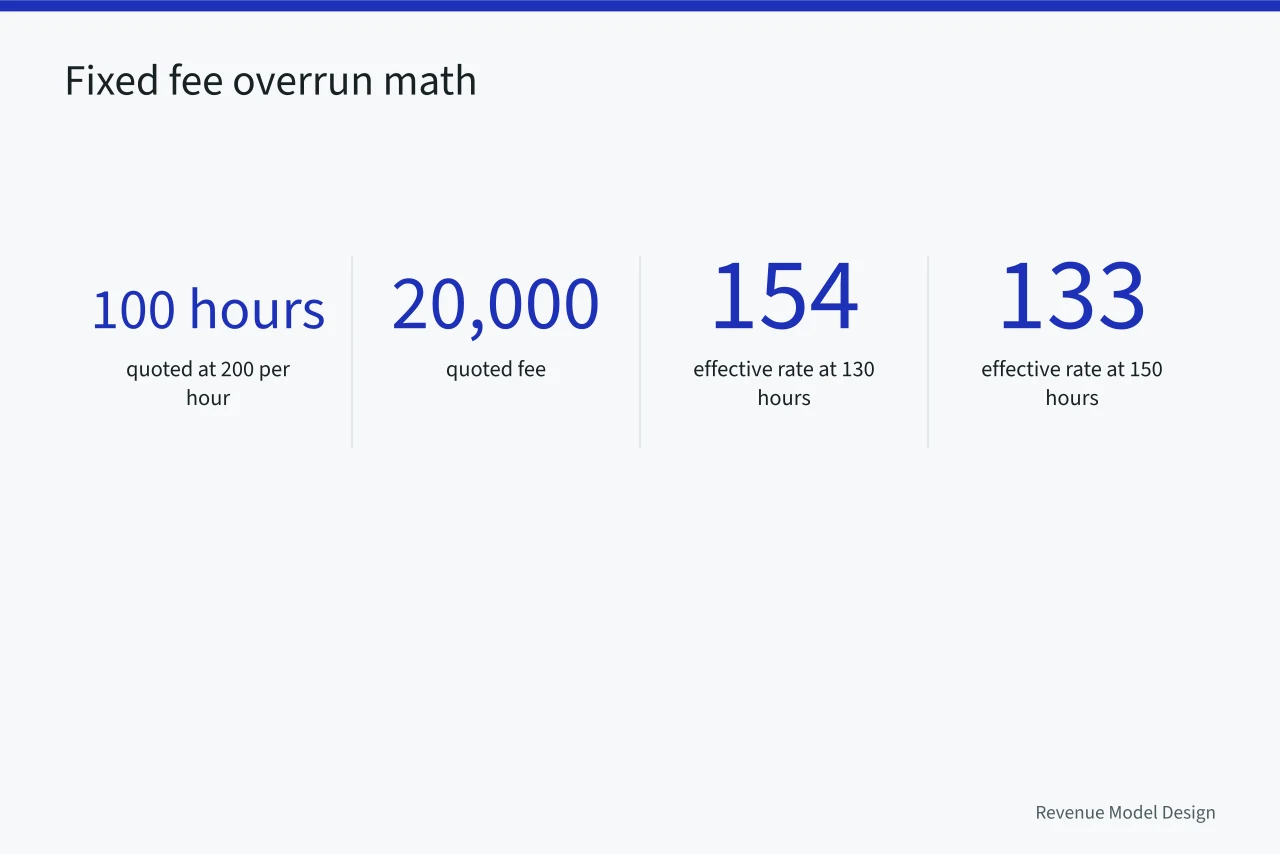
Transaction volume is the vague part, so the firm eats every overrun hour. Build a fee on a hundred hours at 200 and you have 20,000. Work 130 hours and the effective rate is 154. Work 150 and it is 133, two thirds of the quote, with no discount ever agreed.
8. Time and materials with a cap, the Booz Allen Hamilton shape. Booz Allen Hamilton earns the great majority of its revenue from U.S. government work, on a mix of fixed-price, cost-plus and time-and-materials contracts. The client gets the fixed-fee ceiling and the firm loses the hourly floor.
Read carefully, this is usually the worst of both for the seller. It is fair only when the cap sits above the realistic estimate rather than at it.
9. Retainer for availability, the Rackspace Technology shape. Rackspace Technology sells managed hosting and cloud services on AWS, Microsoft Azure and Google Cloud, billed monthly with 24/7 support. You sell an option on your time. The risk is that it gets exercised in bursts you cannot staff.
Price the peak, not the average, and write what happens when the month's demand exceeds the retainer.
10. Contingency pricing, the Morgan & Morgan and contingency search shape. Morgan & Morgan advertises personal injury cases on contingency, with no fee unless the firm wins. Contingency fees in that market typically run about a third of the recovery, and 40 percent if the case goes to trial.
Executive search splits the same way. Contingency recruiters typically bill 20 to 25 percent of first-year salary and only on a placement. Retained firms such as Korn Ferry typically bill about a third of first-year cash compensation, invoiced up front.
The firm carries the client's risk and should be paid for carrying it. The danger is the measurement: a loosely defined outcome produces the argument after the work is done.
A pre-agreed remedy for a defined shortfall, which contract law treats under liquidated damages, is easier to write before the money is at stake.
When the work is really a product wearing a service
11. The same engagement forty times a year, the LegalZoom and Designjoy shape. LegalZoom sells LLC formation as a flat package, advertised at $0 plus the state filing fee, with paid upgrades. Designjoy sells design requests one at a time for a flat monthly fee.
Once variance between instances is small, the honest description is a product with a person attached, priced and packaged as one. The move across that line is the ladder set out in service models, and the shift in cost behavior is why the arithmetic changes with it, as unit economics shows.
12. Implementation attached to a licensed system, the Salesforce partner shape. Salesforce publishes license prices as subscriptions on its price list. The partners who install it, from Accenture to Slalom, run a different business, with different margins and different growth rules. Implementation typically costs about as much as the first year of license fees, and often more.
Blending the two produces a number that describes neither. Keep two models, labeled, and expect them to want different things from the same calendar.
Worked example: reading the twelve onto your own firm
Ask three questions in this order.
- Whose calendar runs out first?
- Who pays when an engagement overruns?
- What would have to be written down for someone cheaper to do the work well?
Question three has the largest answer and the longest lead time. Firms that start it in a busy quarter never start it.
The broader question of when to stop improving the current shape and change it instead belongs with model innovation. What triggers the money is a revenue models question, not a delivery one.
Common questions
Which of these twelve is the best shape?
None of them. They are answers to different constraints. The mistake is running the McKinsey shape while telling yourself you run the EOS shape, then wondering why margin falls every time you win work.
Can a firm raise rates instead of raising capacity?
Yes, and it is usually faster and undercharged for. A rate rise with no volume loss is close to pure profit. It also does nothing about the calendar, so it buys time rather than removing the ceiling.
How do we know if our method is documented well enough?
Give it to someone who has not done that work and watch what they ask. Every question is a gap in the document. Two rounds of that usually gets you further than a year of intending to write it up.
Is subcontracting a way around the ceiling?
It moves delivery hours off your payroll but leaves review and client relationship on the same senior calendar. It helps the overload shape and does almost nothing for the partner-touched shape.