Guides
Why growth quietly drains cash in most product models
Product models and the cash round trip: the cost stack most firms never finish, the mechanism that produces a second order, and why growth consumes cash.
A product business converts cash into goods and goods back into cash. How well it works depends on two things that rarely get equal attention: how much you keep from each conversion, and how long the round trip takes. Companies obsess over the first and go out of business because of the second.
There is also a structural fact that shapes everything else. A one-time purchase has to repay the cost of acquiring the buyer out of a single order: unless you have designed a reason for a second one. Most of what follows is downstream of that sentence.
What to take away
- Ask what a product costs and you will get the factory price.
- Selling the same product through a different channel produces a different business, with different margins, a different cash cycle, and a different owner of the customer relationship.
- Ordering too much and ordering too little are different mistakes with different costs, and which one to fear depends on the product.
- A return reverses the revenue and adds costs on top: outbound shipping already spent, return shipping, inspection labor, repackaging, and a unit that may be sellable only at a discount or not at all.
The cost stack nobody finishes
Ask what a product costs and you will get the factory price. That is the first line of four groups, and the groups below it are where margin quietly disappears.
Before it is yours. The manufactured or wholesale cost. Tooling, molds, or setup charges, spread across the units they will actually produce rather than the units you hope to sell. Minimum order quantities, which are a cash commitment even when they are a good price. Inbound freight, duties, and customs handling. Inspection, and the units that fail it.
While it is yours. Storage, whether you pay for a warehouse or your own space is unavailable for anything else. Insurance. Capital tied up in stock and not doing anything else. Shrinkage, damage, and obsolescence: the units that will never sell at full price and are currently sitting in your inventory value as if they will.
As it leaves. Primary packaging and shipping packaging, which are different costs. Pick, pack, and labor. Outbound shipping, including the portion you absorb to offer free delivery. Payment processing. Any marketplace or channel fee taken before the money reaches you.
After it leaves. Returns, and the labor to receive, inspect, restock or discard them. Warranty claims and replacements. Customer service attached to physical problems. Chargebacks.
Handling, storage and reverse flow are ordinary parts of a supply network rather than exceptions to it, which is how MIT's course on supply networks for products and services treats them.
Landed cost is all four groups. A gross margin computed on the first group alone is not conservative or approximate: it is a different number about a different business, and it is the number most commonly used to justify a price.
The first order has to pay, or the second one must
Write the honest version: contribution from one order is the price collected, minus the full landed cost above. Compare that to what it cost to acquire the buyer who placed it. The definitions behind both halves of that subtraction are in unit economics.
If contribution on the first order does not cover acquisition, the model is not broken. It is incomplete: it requires a second order, and that second order has to be designed rather than hoped for. There are only four common mechanisms.
Consumption. The product is used up and replaced on a rhythm, refills, cartridges, blades, food, anything with a predictable empty. This is the strongest mechanism because the timing is inherent rather than persuaded, and its whole risk is substitution: whether the refill can be bought from someone else.
Attachment. The first purchase creates a need for compatible accessories, parts, or add-ons. Strong when the ecosystem genuinely adds value, weak and increasingly resented when compatibility is artificially enforced.
Replacement. The product wears out or is superseded on a cycle. The cycle length is the model, and it is usually far longer than the acquisition spend can wait for. Businesses in this position generally need the first order to pay for itself.
Range. The customer returns for a different product. This is the hardest of the four, because it depends on brand and category breadth rather than on any mechanism inside the product, and it is the one most often assumed without evidence.
Before spending on acquisition, name which mechanism you are relying on. If the answer is "customers will love it and come back", the plan is a first-order-pays plan and should be priced as one. Which family of money-triggering arrangement each mechanism belongs to is set out in revenue models.
Channel is not a distribution decision
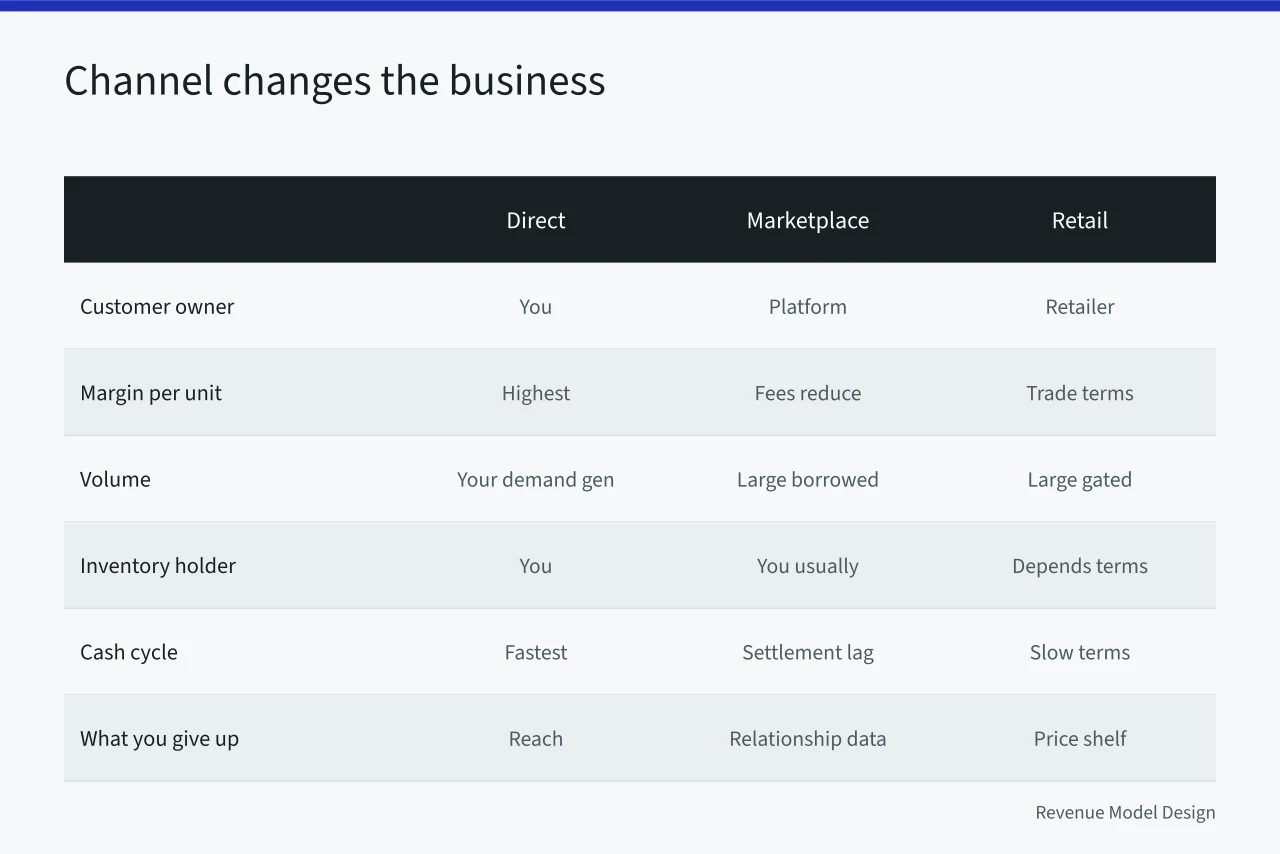
Selling the same product through a different channel produces a different business, with different margins, a different cash cycle, and a different owner of the customer relationship.
| Direct | Marketplace | Retail | Wholesale / distribution | |
|---|---|---|---|---|
| Who owns the customer | You | The platform | The retailer | The retailer, at two removes |
| Margin per unit | Highest | Reduced by fees | Reduced by trade terms | Reduced twice |
| Volume available | Limited by your demand generation | Large, borrowed | Large, but gated | Largest, least controlled |
| Who holds the inventory | You | You, usually | Depends on terms | The distributor, after they pay |
| Cash cycle | Fastest | Fast, with a settlement lag | Slow, on their terms | Slow, on their terms |
| What you give up | Reach | The relationship and the data | Price control and shelf decisions | Both, plus visibility |
Two things follow. First, you cannot compare channel margins without also comparing the demand generation cost, because the higher direct margin is partly the money you now spend to create demand yourself. Each channel is a different business, not a distribution preference, which is what the five decisions under every model are for.
Second, mixing channels creates a price-consistency problem that is more consequential than it looks. A retail partner who finds you undercutting them online will respond in ways that cost more than the margin you gained.
Inventory is a cash machine running backwards
The cash conversion cycle is a definition worth writing on a wall. It is the days your money spends sitting in inventory, plus the days it sits in customer receivables, minus the days you are permitted to sit on your suppliers' money.
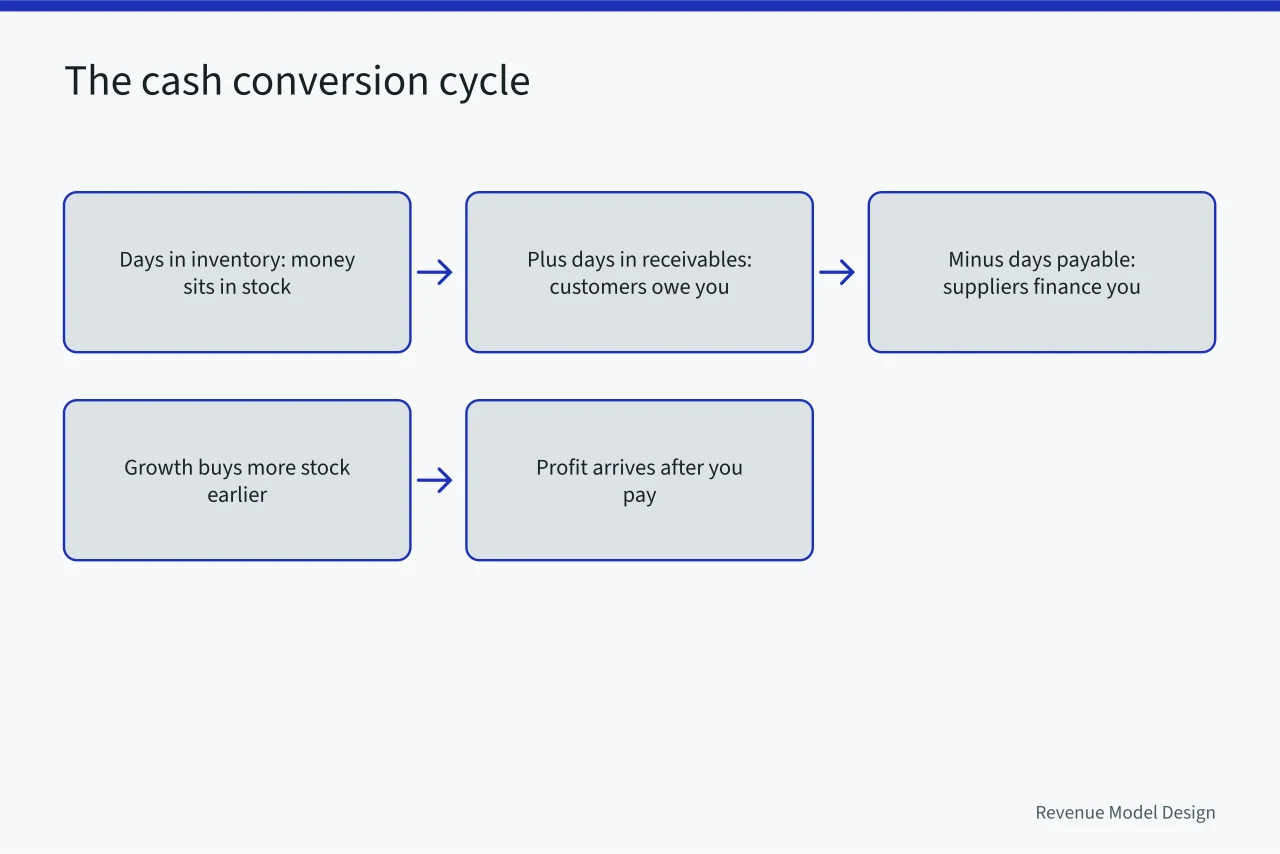
Each term is a lever: better forecasting, smaller and more frequent orders, and shorter lead times cut days in inventory, though they usually cost more per unit. Faster-paying channels and enforced terms cut days in receivables.
Days payable rises with supplier negotiation, and every day you gain there is a day of financing you are not paying for.
The consequence surprises people. In a product business, growth consumes cash. Selling more requires buying more stock, earlier. Profit on those extra sales arrives after you pay for the stock.
A product company can be profitable on every unit, growing steadily, and insolvent. That is not an edge case. It is the standard failure of a successful product launch.
The protective habit is to forecast cash rather than profit, at the level of individual purchase orders, far enough ahead that a decision is still possible.
Forecasting error is not symmetric
Ordering too much and ordering too little are different mistakes with different costs, and which one to fear depends on the product.
Too much ties up cash, occupies space, and usually ends in a markdown that destroys the margin on units you sold at full price too. Too little forfeits a sale you had already paid to create, and in a channel it can cost you the shelf position, which is far more expensive than the lost order.
For a continuity product with a long shelf life, erring high is usually cheaper. For anything seasonal, perishable, or fashion-driven, erring high is the expensive error, because the residual value falls off a cliff. Decide which product you have before you set a safety stock policy, and set it per product rather than as a company rule.
Returns cost more than the refund
A return reverses the revenue and adds costs on top: outbound shipping already spent, return shipping, inspection labor, repackaging, and a unit that may be sellable only at a discount or not at all. In practice a return is more expensive than never making the sale.
Return rate is mostly a design and description problem, not a policy one. Returns cluster around fit, expectation, and quality. Better sizing information, honest photography, accurate specifications, and clearer material descriptions prevent the wrong purchase without the customer hostility of a restrictive policy.
Track return reasons per product, because the aggregate return rate hides the two or three items generating most of it.
Repricing a product is harder than repricing a service
Your price is printed, listed, agreed in a trade term, and remembered by customers. Moving it is a project.
The instruments available are mostly indirect: change pack size or count, or introduce a new variant at the new price.
Let the old one age out, and adjust promotional depth and frequency instead of list price. Change what is included, or reset the price at a product revision. Each tactic has a credibility cost if it reads as a disguise, and customers notice pack size changes more reliably than any other tactic here.
Deciding the mechanism by which a price may move, before you need it, is the last of the layers in pricing architecture.
Where an input cost is genuinely volatile (a commodity, freight, a currency), decide in advance whether that exposure sits with you or is passed through, and if it is passed through, say so before it moves rather than after.
What to measure
Gross margin computed on full landed cost, per product, not per company. Contribution per order after all fulfillment and payment costs. The cash conversion cycle, tracked as a trend, with each of its three terms visible separately. Sell-through rate per product per period, which tells you about demand and about your ordering at once.
Return rate and return reasons per product. Inventory aging, so that units that will never sell at full price stop being carried as if they will. And the repeat mechanism you rely on, measured directly: the share of customers who place a second order, and how long they took.
For the wider frame, the sections an outside reader will expect in a plan for a physical product business, the U.S. Small Business Administration's business plan guide is a free reference.
Bottom line
Finish the cost stack before you price. Name the mechanism that produces a second order before you spend on the first. Watch the cash cycle more closely than the margin, because the margin will not save you from the timing. A product business fails at the round trip far more often than it fails at the sale.
Common questions
Which part of the cost stack is most often missing?
The fourth group. Returns, warranty work and the customer service attached to physical problems are recorded somewhere other than cost of goods, so a margin computed without them looks fine and the bank balance does not.
How do we decide a safety stock policy?
Per product, not per company, and by asking which error is cheaper. For a long-lived continuity item, erring high usually is. For anything seasonal or perishable, it is not, because the residual value collapses.
Is a low launch price ever the right call?
Where cost genuinely falls with volume and you can name the volume and the date, yes, written down as a bet. Where it is hope, it is a price you will have to raise later without having agreed how.
Why does growth make our cash worse?
Because stock is bought before it is sold, so more sales means more money out earlier. Forecast cash at the level of individual purchase orders, far enough ahead that a decision is still possible.
In this guide
- Product models examples worth copying, and whyTwelve product models examples where the obvious price is wrong, each named with the buyer's real alternative, hidden cost, or ownership burden behind it.
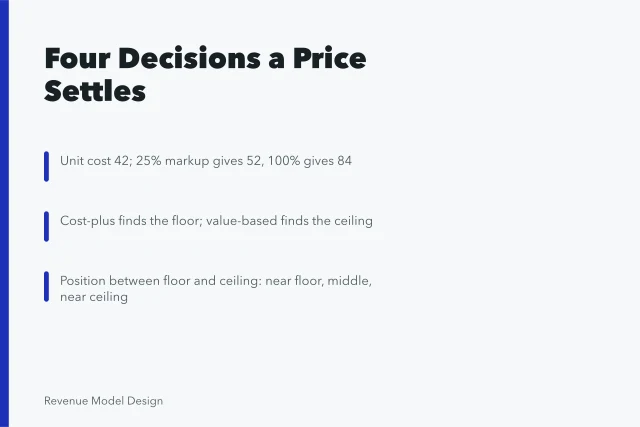
- Product models framework as practitioners see itA product models framework that separates the four decisions a price actually settles, and shows why cost-plus and value-based answer different questions.
- Product models tools compared: what the demo will not show youProduct modeling tools compared by what they store: unit cost, list and realized price, deductions, and the export test that decides a purchase.