Rules
Part of Liquidity first: the order marketplace model problems actually arrive in
Marketplace models questions: what people ask and what is true
Marketplace models questions about who pays, what the fee buys, and what happens when the two sides no longer need you, answered without a recommended number.
Most marketplace debates are the same handful of questions arriving in different rooms. Settling them in writing once is cheaper than re-fighting them per feature.
Below, grouped by who is asking. Figures are invented placeholders.
What to take away
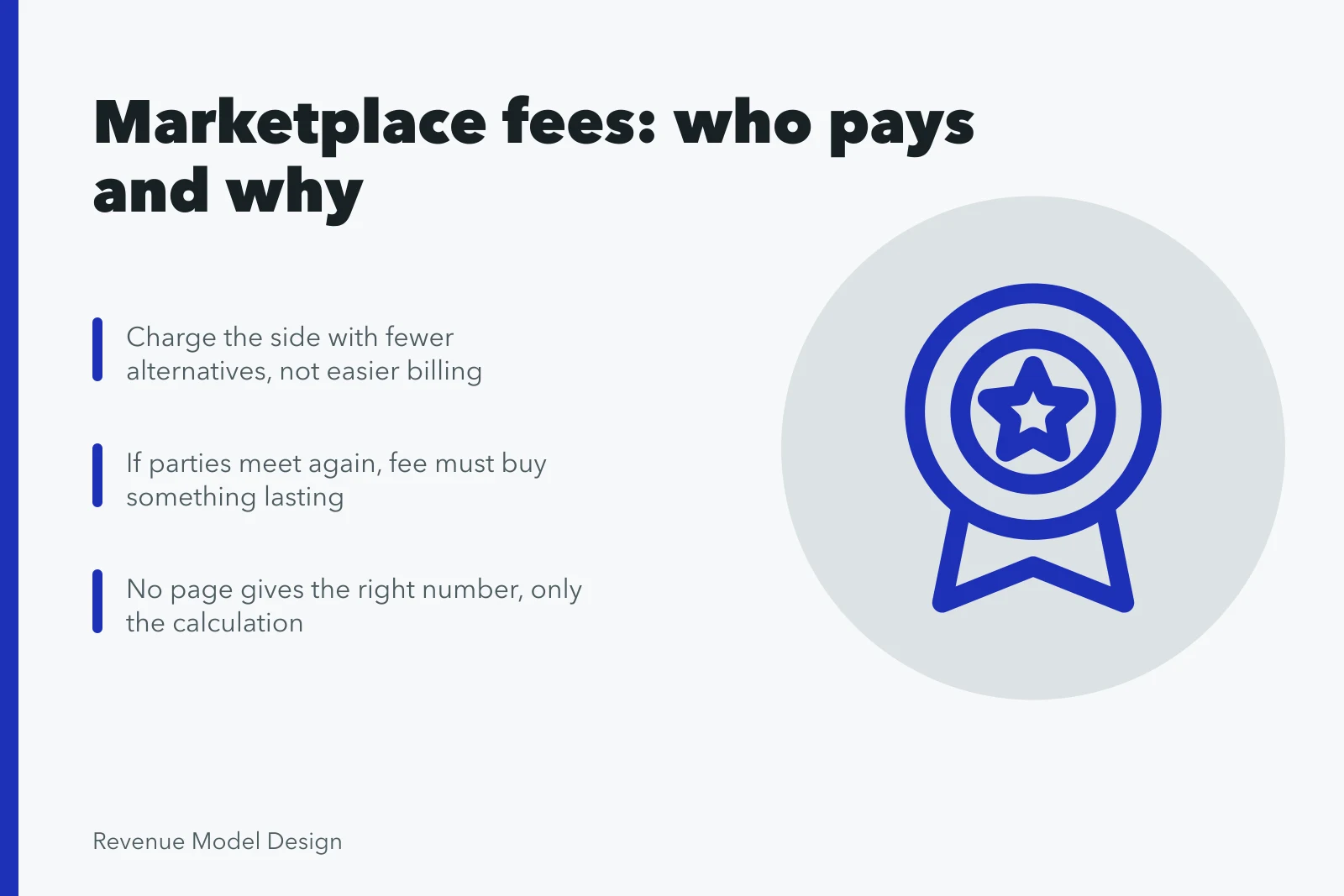
- "Who pays?" is answered by which side has fewer alternatives, not by which side is easier to bill.
- If the two parties will meet again, your fee has to buy something that survives them knowing each other.
- The honest answer to several of these is that nobody can tell you the right number from a page, only the calculation to run.
Questions from inside the company
Which side should pay?
The side with fewer alternatives and more to gain from the match. That is usually not the side that is easier to invoice, which is why the wrong answer is so common. Once the choice is made, it sets which side you are allowed to disappoint for years, because the free side organizes itself around being free.
Should the fee be a percentage or a fixed amount?
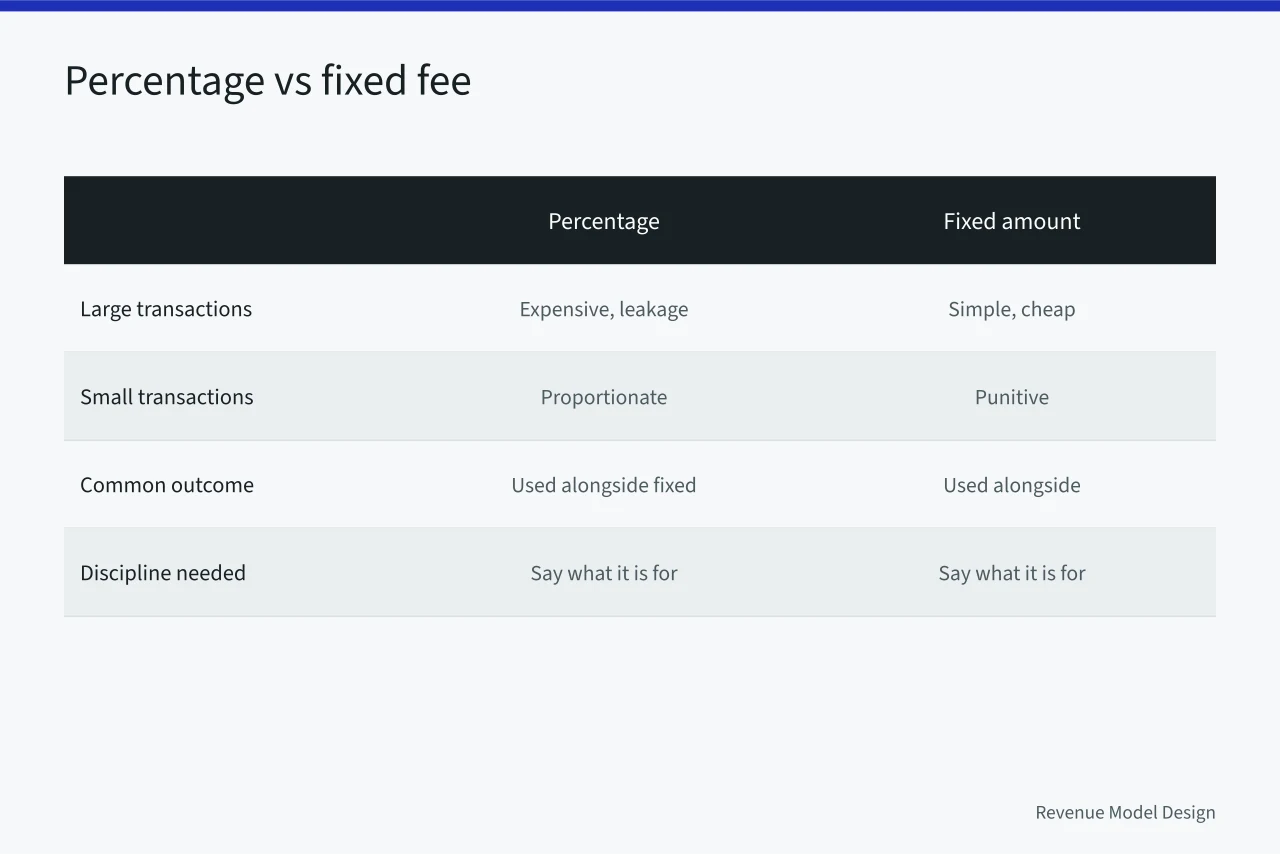
A percentage grows with the value flowing through and makes you expensive on large transactions, which is where leakage starts. A fixed amount is simple and becomes punitive on small ones. Most marketplaces end up with both, and the discipline is being able to say what each one is for. The layer version of that discipline is in pricing architecture.
What do we do about transactions that settle off the platform?
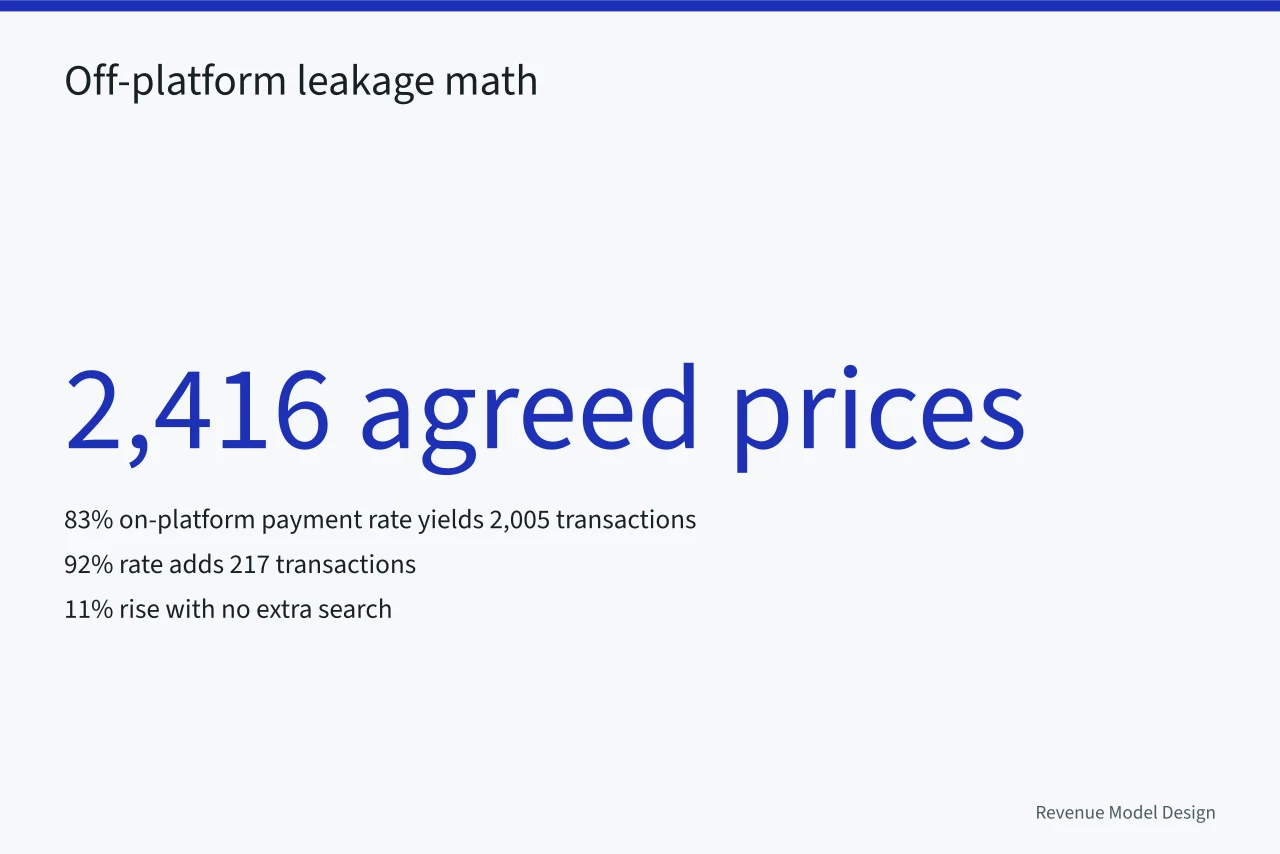
Measure before you police it: in an invented funnel, 2,416 agreed prices at an 83% on-platform payment rate yield 2,005 transactions. Moving that rate to 92% adds 217, an 11% rise, with no extra search.
Then decide whether to make staying worth more or leaving harder; those are very different strategies with different consequences.
Are we ready to expand to a second segment?
Only if the first one clears your own liquidity threshold on fill rate and time to first response. Marketplaces that expand before that are thin everywhere, which is the failure mode set out in marketplace models.
Questions from suppliers
Why should I pay you when I found this customer myself?
If the honest answer is that you did nothing, then the fee is wrong on that transaction and a rule forcing it will not survive. Where you carry the payment, the dispute process, or the scheduling, say that plainly. A fee needs a service attached that the supplier would notice losing.
Can I offer a lower price outside your platform?
This is where commercial policy meets law. Rules limiting how a participant prices elsewhere are commercial restraints whether or not they are described as such, and the monopolization provision is where that boundary is written. Take your own facts to a lawyer rather than to a competitor's terms page.
Why do I get fewer requests than I used to?
Usually because supply grew faster than demand in that segment. Say so. Suppliers who are told the truth about density make better decisions about staying, and the ones who leave were going to leave with worse feeling either way.
Questions from requesters
Why is there a fee at all when the supplier does the work?
Because finding a supplier who is available, appropriate, and accountable took work that you did not do. That is a real answer and it holds up. What does not hold up is a fee on a match the requester made themselves.
How do I know this supplier is any good?
Whatever you say here becomes a promise. Marketplaces that imply vetting they do not perform accumulate a liability, and describing a service more favorably than it is has its own legal exposure under the statute on unfair or deceptive acts. Describe what you actually check, and no more.
What happens if it goes wrong?
Write it down before it happens. A dispute process invented during a dispute is a process that satisfies nobody and sets a precedent you did not choose.
When an argument will not settle
Some of these do not resolve because they are arguments about what business you are in. A marketplace that keeps asking how to stop parties transacting elsewhere is often a business that should charge for something other than the transaction.
That is a model innovation question, not a fee question. The cost consequences of either answer are worked out in unit economics.
Common questions
Can we charge both sides?
Yes, and many do. The test is whether each charge has a distinct thing it pays for. Two charges for the same service produce a fee schedule you cannot explain in a negotiation.
Should the fee be published?
With many small participants, yes, because it becomes public anyway and looks worse when it leaks. With a few large ones, negotiated terms are normal and expected.
How do we handle a supplier who is most of a category?
Carefully, and with the concentration written down. A supplier at 30% of a segment can negotiate, and a rule you cannot enforce against them is a rule you do not really have.
Is a lower fee a way to stop leakage?
Sometimes, and it is a weak lever compared with giving people a reason to stay. A fee cut buys quiet, not loyalty, and it is hard to reverse.