Rules
Getting service models right the first time
Service models built on a perishable calendar and an uncertain estimate: who eats the variance, what the effective rate shows, and where the ceiling sits.
A service business sells capacity it does not yet have and cannot store. An hour that goes unsold on Tuesday is gone; it does not roll into Wednesday. Every structural decision in a service model follows from that, and from the second problem underneath it: you have to quote before you know how long the work will take.
Those two constraints, a perishable calendar and an uncertain estimate, explain most of what makes service businesses hard to run and most of what separates a profitable one from a busy one.
What to take away
- Every contract shape is a decision about who absorbs the gap between the estimate and the reality.
- A fixed fee is a bet on your own estimating ability.
- The revenue identity in a service business is short: billable hours multiplied by the rate you actually collect on them.
- Utilization is the number most easily pushed in the wrong direction, because pushing it feels like discipline.
Who eats the variance
Every contract shape is a decision about who absorbs the gap between the estimate and the reality. That is the honest way to read the menu.
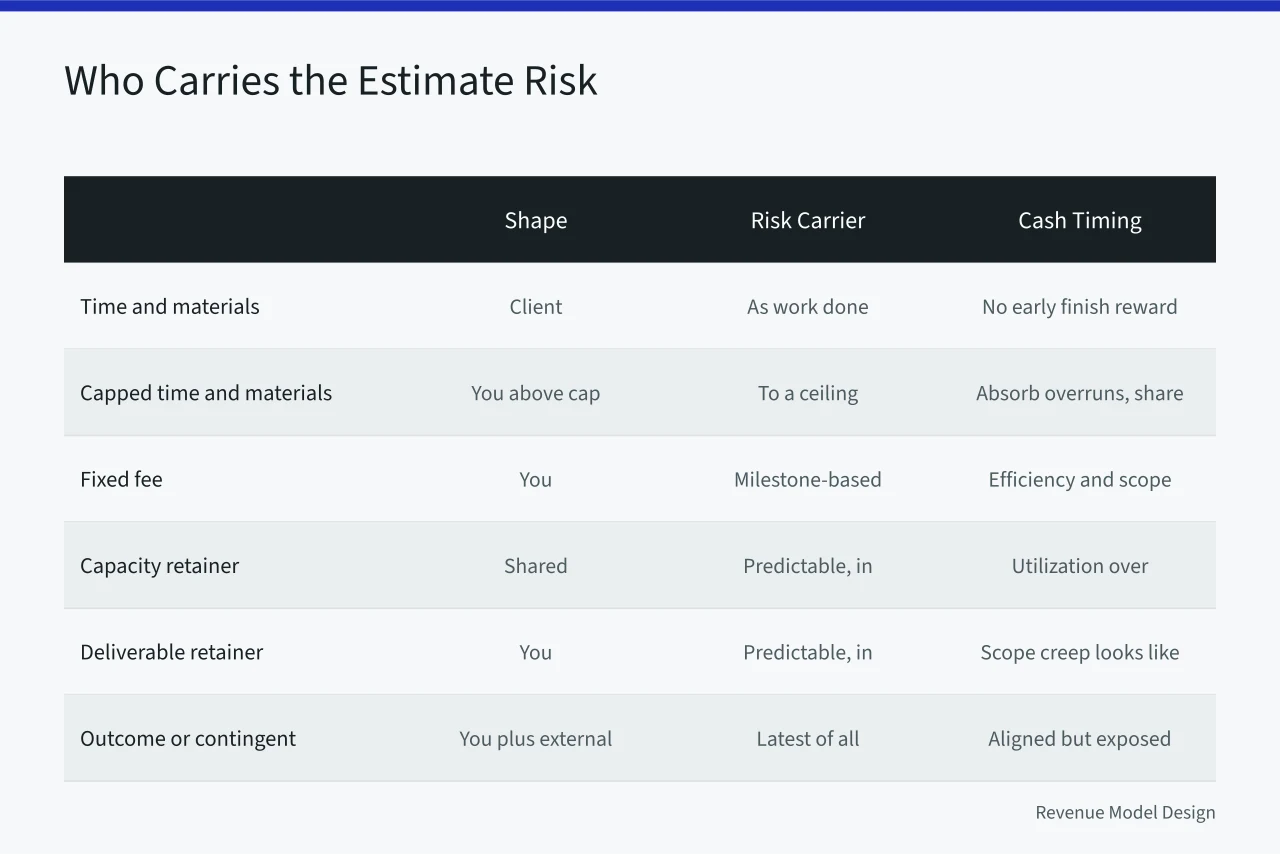
| Shape | Who carries the estimate risk | Cash timing | The incentive it creates |
|---|---|---|---|
| Time and materials | Client | Arrives as work is done | Neither side is rewarded for finishing early |
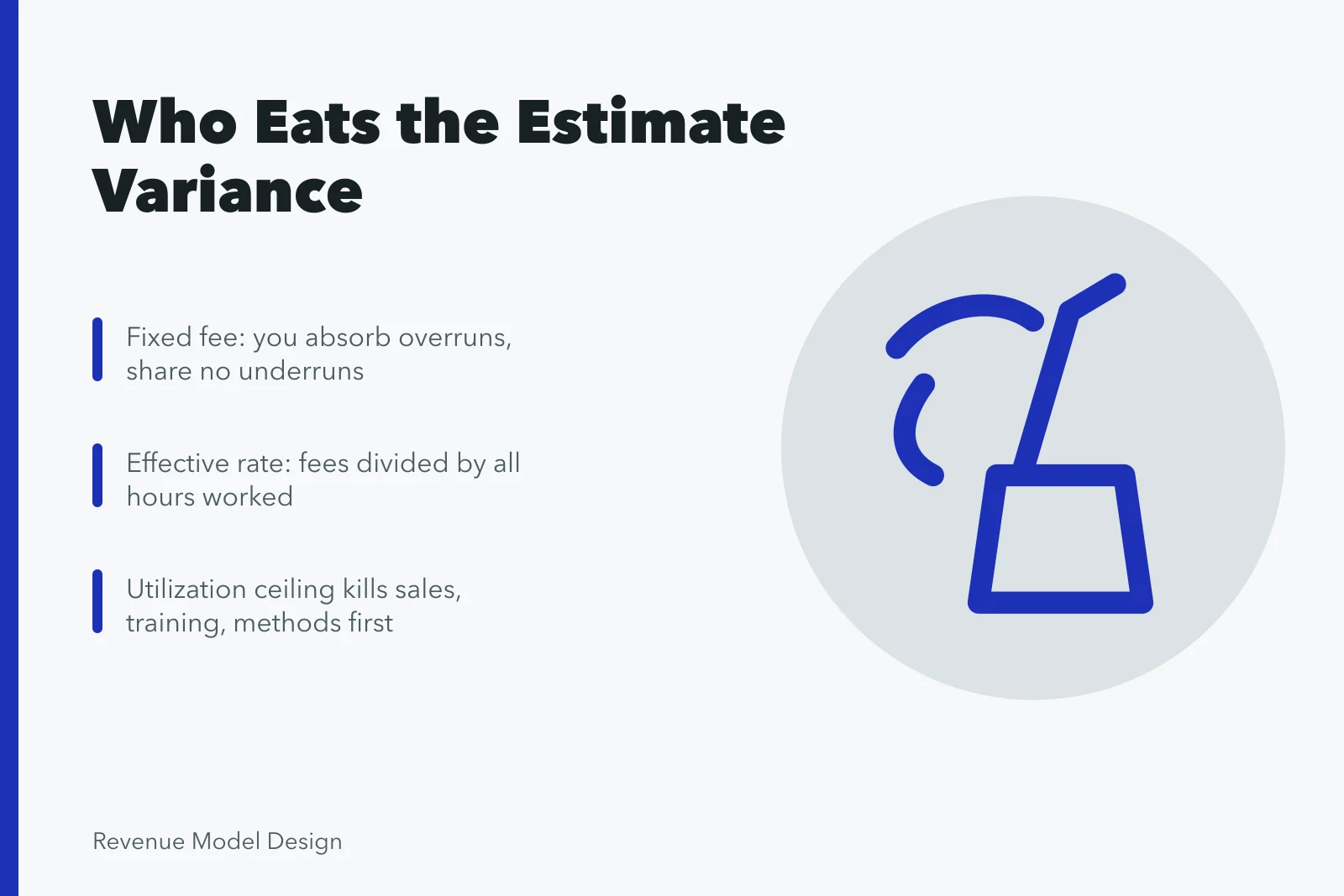
| Capped time and materials | You, above the cap | As work is done, to a ceiling | You absorb overruns and share none of the underruns |
| Fixed fee | You | Often milestone-based, sometimes ahead of cost | You are rewarded for efficiency and for cutting scope |
| Capacity retainer | Shared: client buys availability | Predictable and usually in advance | Utilization matters more than output |
| Deliverable retainer | You | Predictable, in advance | Recurring scope creep looks like good service |
| Outcome or contingent | You, plus factors outside your control | Latest of all shapes | Aligned with the client, exposed to their execution |
The "who carries" column gives the actual price of each arrangement. A higher rate for time and materials buys flexibility. A fixed fee buys certainty, and its premium is what certainty costs.
Which shape a buyer can approve is a question about the capture event. The families are compared in revenue models. Neither is generous or exploitative; they are different products.
The failure modes are specific. Time and materials fails when the client cannot forecast their own spend and starts managing your hours instead of the outcome. Fixed fee fails when your estimating is worse than you think, which it usually is on unfamiliar work.
Capacity retainers fail when the client stops using the capacity and starts asking what they are paying for. Deliverable retainers fail slowly: the deliverable set grows by one small favor at a time until the original fee covers twice the work.
Outcome pricing fails when the outcome depends on client decisions you cannot control. You then find you have taken equity risk at consulting margins.
The estimate is the product
A fixed fee is a bet on your own estimating ability. You can decline the bet, hedge it, or price it: you cannot avoid it by hoping.
Declining looks like time and materials. Hedging looks like staged scope: you commit firmly to the phase you understand, give an indicative range for the rest, and set a defined point where the range becomes a number.
Pricing it means carrying a contingency as a stated line, not padding hidden inside the rate. A stated contingency can be handed back unused, a stronger commercial position than it sounds.
The most useful structural move is to sell the estimate itself. A paid discovery or scoping engagement is short, produces the information both sides need to price the real work, and is the only part where you are paid to reduce your own risk.
Clients who refuse to pay for scoping expect to transfer the estimating risk to you for free. That is worth knowing before you quote.
The capacity machine
The revenue identity in a service business is short: billable hours multiplied by the rate you actually collect on them.
Two definitions do most of the work. Utilization is billable hours divided by available hours, while Effective rate is fees collected on an engagement divided by all hours actually worked on it, including unbilled hours.
Neither has a correct value you can look up, since it varies by service line and client. Compute it per engagement, not as a company average, and the arithmetic under both is in unit economics.
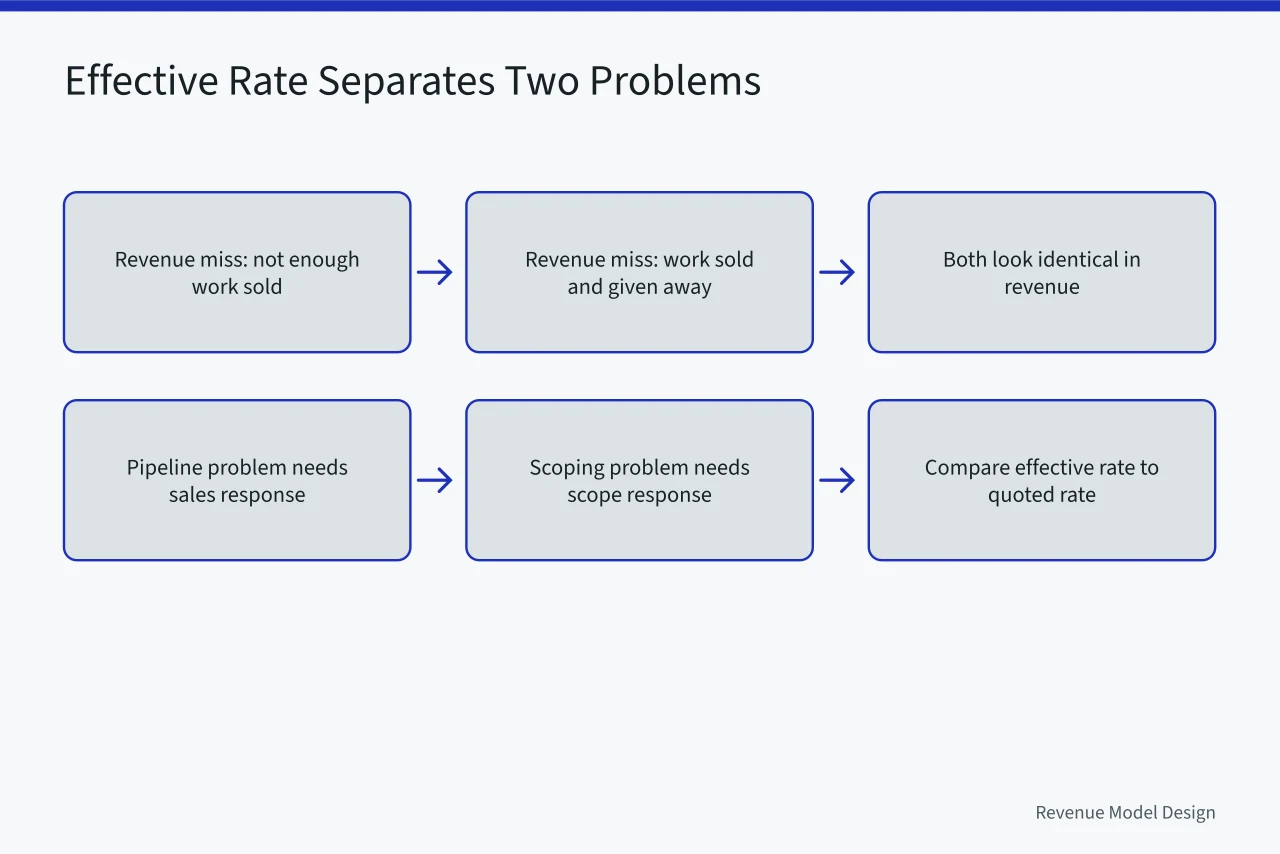
Effective rate is the more revealing of the two, because it exposes what a revenue report cannot. A firm can miss its number two ways: it did not sell enough work, or it sold enough and gave part of it away.
Those look identical in revenue but need opposite responses: one is a pipeline problem, the other a scoping problem. Comparing effective rate against quoted rate, engagement by engagement, separates them in an afternoon.
The utilization trap
Utilization is the number most easily pushed in the wrong direction, because pushing it feels like discipline.
Every hour of slack in a service business does something. It sells the next engagement, trains someone who will otherwise stay expensive to supervise, writes down a repeatable method, and absorbs the client emergency arriving Thursday.
Drive utilization toward its ceiling and those things stop happening, in that order. Sales stops first, because sales is easiest to postpone when a delivery deadline is real.
The pattern is familiar: a strong quarter of full calendars, then an empty pipeline two quarters later. The people who sell are the people who deliver, and they were fully booked.
The fix is not exhortation: protect non-billable capacity as a decision, and accept that peak utilization and a sustainable business are different objectives. Why relieving anything but the binding resource changes nothing is the standard operations reading, set out in MIT's introduction to operations management.
Delivery without your most expensive people
The share of delivery that happens without your most expensive people is the largest single determinant of margin in a service business, and it is not primarily a hiring question.
Raising that share requires work you can describe. If a task is written clearly enough that a less experienced person can do it and someone can check it, it can be delegated, and the margin improves.
If quality depends on judgment that has never been articulated, it stays with the senior person. The business has a hard ceiling equal to that person's calendar.
Take the engagements you run most often and write down what actually happens, including the decisions and the checks you make. That gives you concrete work with a high return.
Most of what feels like irreducible judgment is a sequence nobody wrote down. What remains irreducible is worth knowing too: it is your key-person risk stated precisely.
Where that ceiling becomes a case for a different business rather than a better one, the underlying decisions are the ones in the five decisions under every model.
Scope control is a system, not an argument
Change orders have a bad reputation because they are usually introduced during a conflict. Introduced at the start, as an ordinary instrument, they are the mechanism that lets you say yes to a client without absorbing the cost.
The mechanics are unglamorous. A scope written specifically enough that both sides can tell when something is outside it. A named person on each side who can authorize a change, a stated turnaround for pricing one, and a habit of raising it the same week rather than at the end.
Watch the free favor: a small unbilled addition is good client service the first time and the baseline by the third. Nobody announces it; scope moves, effective rate falls quietly, yet everyone reports the relationship is going well.
Track effective rate per engagement over time and you will see it; track only revenue and client satisfaction and you will not.
Cash arrives after the payroll
Service businesses pay salaries in the month the work is done and collect somewhere between one and several months later. The gap is financed by you, it grows with growth, and it is the reason profitable service firms run out of money.
The controls belong in the contract, not in collections. Require a deposit before work begins. Bill by milestone or monthly, not on completion. Invoice on a fixed day, not when someone remembers.
Enforce payment terms the first time they are missed. That first missed invoice sets the client's expectation for every one after it. Agree on a stated policy for stopping work before you need it.
Growth makes all of this worse, which is counterintuitive until it happens. Doubling the work doubles the payroll immediately and doubles the receivables balance you carry, and the profit that justified the growth arrives after both.
The ladder toward a product
Most service firms want to be less dependent on hours. The route is a ladder, and skipping a rung is where it usually goes wrong.
Bespoke work becomes templated when the method is written down and reused, even though each engagement still differs. Templated work becomes packaged when the scope is genuinely fixed and the same thing is sold repeatedly at the same price. Packaged work becomes a product when delivery no longer consumes your capacity in proportion to sales.
Each step trades flexibility for margin and requires the previous one. What the fee has to look like at each rung is a pricing architecture question.
Avoid the halfway house: a fixed price on genuinely bespoke work. You take the estimating risk of a package while keeping the variability of custom delivery, the worst combination available.
What to measure
Effective rate per engagement against the rate you quoted. Utilization with non-billable time categorized rather than lumped, so you can see whether the slack goes into selling or into rework. Realization, meaning the share of worked hours that made it onto an invoice at all.
The age of your receivables. Revenue concentration by client, because a service business with one dominant client is that client's department without the job security. And the share of revenue delivered by people other than your most senior ones, stated as a number.
For the wider planning frame around a service business, the sections a lender or partner will look for, the U.S. Small Business Administration's business plan guide is a free starting point.
Bottom line
Decide deliberately who carries the estimating risk, price that decision instead of absorbing it, protect the slack that keeps the pipeline alive, and write the method down so the work can leave your most expensive calendar. A service business that does those four things is not busier than one that does not. It keeps more of what it earns.
Common questions
Is a fixed fee always riskier than hourly?
For work you have done many times, no: your variance is small and the client is paying you to remove theirs, which is where the margin comes from. For unfamiliar work it transfers a risk you cannot price.
How do we start lowering the share of work that needs a senior person?
Take the engagement you run most often and write down what actually happens, including the checks. Then hand it to someone who has not done it and treat every question they ask as a gap in the document.
Should we track time on fixed-fee work?
Yes, and this is the argument people fight hardest. Without hours you cannot compute what an engagement actually earned, which means next year's fee is a guess again.
What do we do when we are already over capacity?
Decide which engagement moves, rather than how to work harder. Delivering everything late costs more than delaying one deliberately, and only one of the two is a decision.
In this guide
- 4 points on service models checklist that matterA service models checklist covering the estimate, the scope record, the senior-hour ceiling, and the collection chain, with what each answer should change.
- Service models mistakes: where estimating, staffing and pricing go wrongNine service models mistakes in estimating, staffing, and pricing, each with the arithmetic that shows what it costs and the change that fixes it.
- Where twelve service models examples hit their ceiling, and whyTwelve service models examples tied to real firms show where each hits its ceiling and which party absorbs the resulting cost overruns and delays.
- Quoted rate vs collected rate: the service models metrics that matterQuoted rate and collected rate tell different stories. Track the four leaks, the senior-hour ceiling and client concentration to see where margin goes.
- 4 things worth knowing about service models questionsService models questions worth settling before you quote: who absorbs overrun, what the rate has to cover, and when a fixed fee is the wrong product.
- Five pressures pushing service models toward fixed fees this yearService models trends worth watching in 2027: pressure toward fixed fees, senior-hour scarcity, subcontracted delivery, and what each does to the effective rate.
- Service models case study: the 2027 reviewA service models case study tracking one firm's margin decline, the three explanations its owners tested, and the senior-share call that reset its ceiling.