Industry
Ad-supported vs subscription models and the FTC rules for US publishers
State advertising tax guide ad-supported subscription: what California, New York, Texas, and Florida charge, plus FTC disclosure rules that decide your model.
What to take away
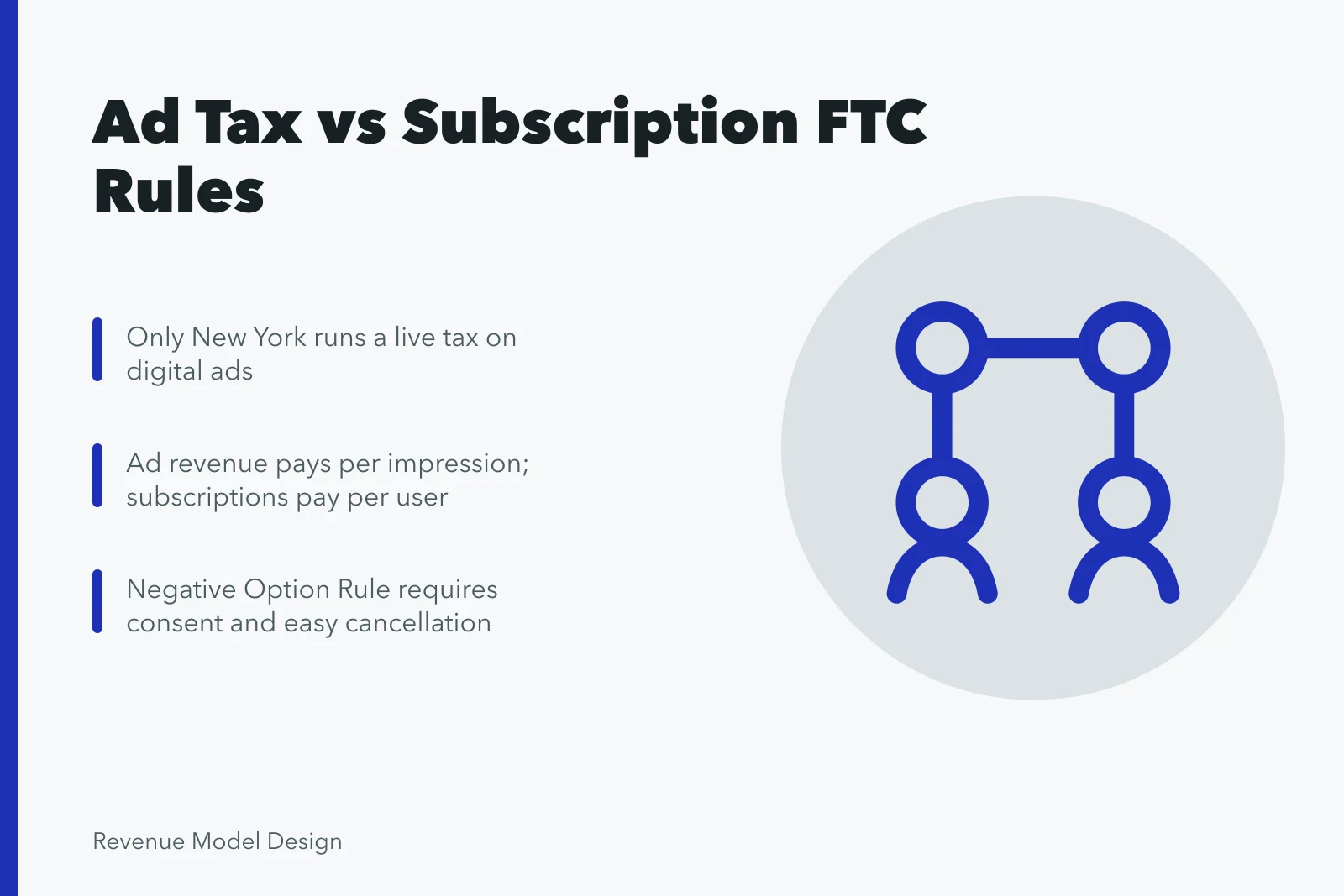
- A state advertising tax guide ad-supported subscription comparison starts with California, New York, Texas, and Florida. Only New York runs a live tax on digital ads.
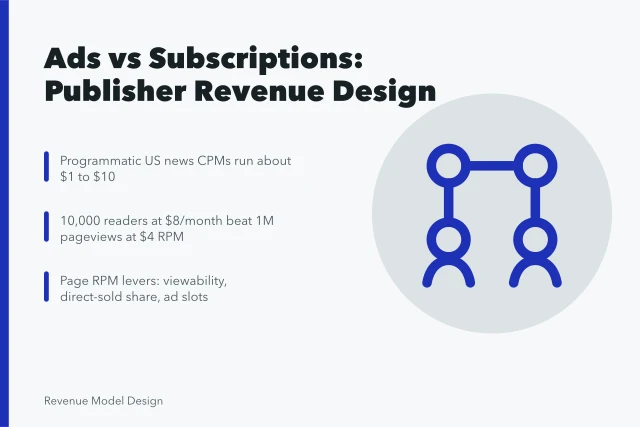
- Ad-supported revenue pays per impression and depends on scale. A subscription model pays per user and depends on retention.
- The FTC Act gives the agency power over deceptive ad claims and subscription billing. The negative option rule sets consent and cancellation standards.
- COPPA limits behavioral targeting for audiences under 13, which cuts the value of ad inventory aimed at children.
- Penalty offense notices raise the cost of repeating claims the FTC has already challenged. Ad copy needs documented substantiation.
Ad-supported versus subscription: the revenue model trade-off for US publishers
Advertising revenue arrives as a stream of small payments tied to traffic. Subscription revenue arrives as fewer, larger payments tied to willingness to pay. The two models pull editorial, product, and finance decisions in opposite directions.
An ad-supported publisher optimizes for reach, session depth, and page speed so inventory loads. A subscription publisher optimizes for habit, exclusivity, and retention so renewals hold. Most US publishers now run both, with ads on open pages and a paywall on the highest-cost reporting.
The accounting differs too. Ad revenue is recognized as impressions deliver, often with agency commissions netted out. Subscription revenue is deferred and recognized over the term, which changes cash timing and reported margins. The Financial Accounting Standards Board sets the recognition rules that both models follow.
Ad rates move with the market. Subscription prices move with perceived value. That difference matters when a platform algorithm change cuts referral traffic overnight. Ad revenue falls with it, while subscription revenue holds if the audience came for the brand rather than the link.
For a structured comparison of the two paths, see Ad-Supported Revenue Model Design.
What each model rewards
Ad-supported rewards volume, speed, and search or social distribution. Subscription rewards distinct reporting, a clean paywall, and a renewal experience that does not surprise the reader. A publisher that chases both without separating the goals usually gets weak ad yield and high churn.
The cost side
Ad tech takes a share of every impression through fees and intermediaries. Payment processing takes a smaller share of subscription revenue, but billing failures and involuntary churn eat into it. Both models carry customer service costs, though subscription support is more visible because readers call.
Which to lead with
Lead with ads when the audience is broad and cheap to reach. Lead with subscriptions when the audience is narrow, loyal, and willing to pay for coverage it cannot get elsewhere. Many publishers run ads on the free tier and sell subscriptions for the rest.
Digital advertising tax rates in California, New York, Texas and Florida
There is no single federal digital advertising tax. States treat ad services differently, and the differences matter for where you book revenue and where you place sales staff.
Maryland's digital advertising tax drew litigation and remains a cautionary example rather than a national template. The four states below are the ones most publishers ask about, and their treatment of ad revenue is not uniform.
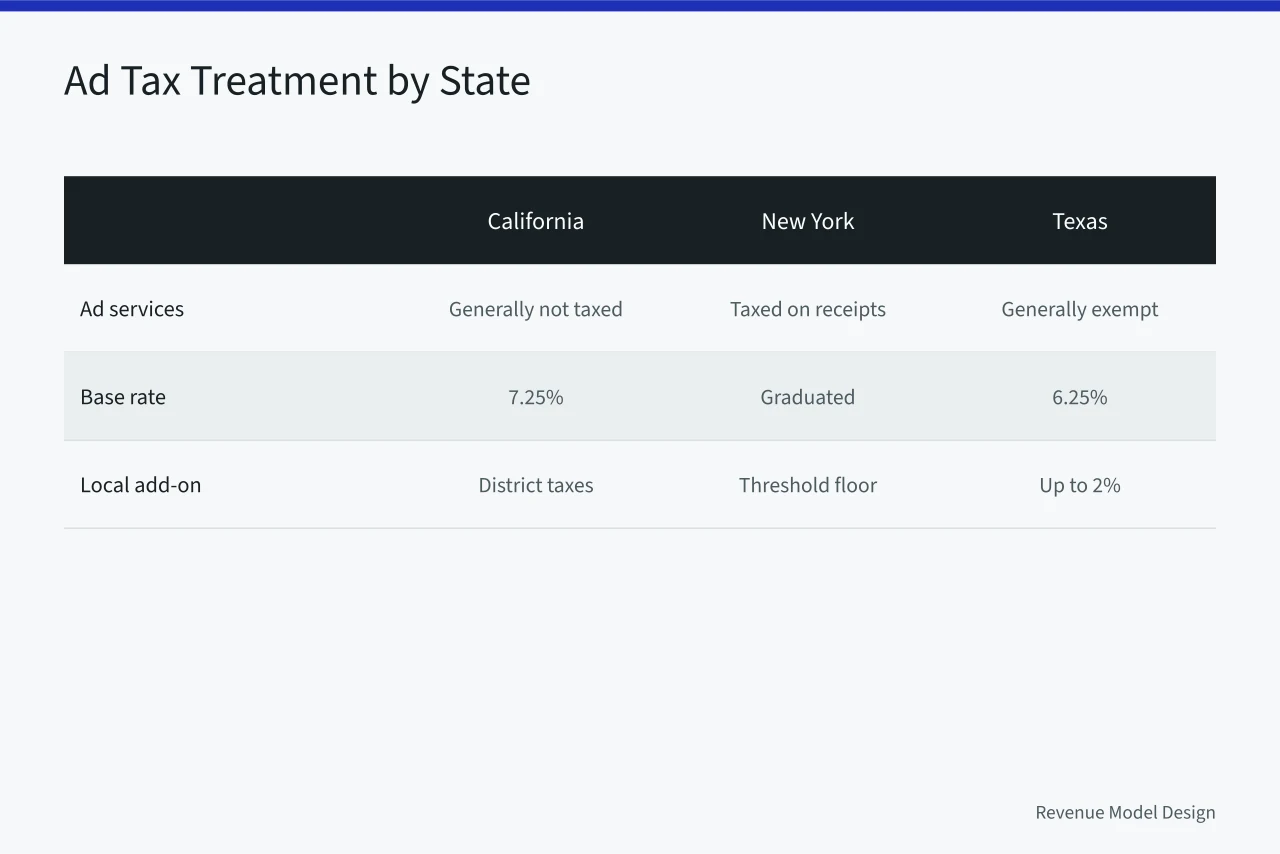
| State | How ad revenue is taxed | Rate or treatment |
|---|---|---|
| California | Sales tax on specified digital products and services; advertising services generally not taxed as such | Statewide base rate 7.25 percent, plus district taxes |
| New York | Digital advertising tax on annual gross receipts above the threshold, plus sales tax on certain digital services | Graduated rates on ad receipts, with a floor below which the tax does not apply |
| Texas | Sales and use tax on data processing and certain digital services; advertising services generally exempt | State rate 6.25 percent, plus local up to 2 percent |
| Florida | Sales tax on specified digital products and services; advertising services generally not taxed | State rate 6 percent, plus county surtaxes |
New York is the outlier. Its tax applies to digital advertising receipts, which means an ad-supported publisher with New York-sourced revenue can owe tax on gross receipts even when the ad was sold through an exchange. The threshold matters: below it, the tax does not bite.
California, Texas, and Florida do not levy a standalone digital advertising tax. They tax advertising only when it falls inside a broader category such as data processing or a specified digital product. A publisher selling display inventory is usually outside those categories. A publisher selling audience data or a data-driven service may not be.
Rates change. California district taxes vary by city and county, and Florida county surtaxes vary by county. Texas local rates vary by jurisdiction. Confirm the current rate for each point of sale before you build a revenue forecast on it.
Ad-supported subscription models also face indirect tax costs: payroll for sales staff, franchise taxes on the entity, and local business licenses. Those are not ad taxes, but they change the after-tax comparison between an ad-heavy and a subscription-heavy mix.
When you weigh the two, treat tax as one input in revenue model choice, not as the deciding factor.
Nexus and where tax is owed
Economic nexus rules mean a publisher can owe state tax without a physical office there. Most states set a sales threshold, often measured in transactions or revenue. Once crossed, collection duties begin.
Marketplace and exchange sales
When an ad is sold through an exchange, the exchange may be the seller of record. That can shift collection duties, but it does not erase the publisher's income tax exposure on the same receipts.
Recordkeeping
Keep state-by-state revenue schedules. A single national revenue number will not support a multistate filing position, and auditors ask for the split.
FTC disclosure rules that shape ad-supported revenue model choice
The Federal Trade Commission polices advertising under its statute, and the Federal Trade Commission Act gives it authority over deceptive acts and practices in commerce. That authority reaches ad claims, native advertising, and endorsements.
FTC disclosure rules require that ads be identifiable as ads and that material connections be disclosed clearly and conspicuously. For a publisher, that means sponsored content needs a label a reader cannot miss, and affiliate links need disclosure near the link.
Native advertising is the pressure point for ad-supported publishers. When sponsored content looks like editorial, the disclosure must be prominent enough that a reasonable reader understands the source. Burying a label in a footer or a hover does not meet the standard.
The agency's Advertising FAQ's: A Guide for Small Business explains the substantiation expectation: before you run a claim, you need a reasonable basis for it. That applies to ad copy a publisher writes and to claims a publisher repeats from an advertiser.
These rules push some publishers toward subscription revenue, because a reader paying for content is not reading an ad. They push others toward cleaner ad labeling, which can reduce click-through but lowers enforcement risk.
Endorsements and testimonials
If a publisher pays a creator or gives free access in exchange for a mention, that connection must be disclosed. The disclosure must be in the same medium as the endorsement, not in a separate policy page.
Health, finance, and earnings claims
Claims about health outcomes, investment returns, or income need strong substantiation. Publishers in these verticals face higher scrutiny than general news outlets.
Advertiser indemnities
Contracts often push liability to the publisher for claims the advertiser supplied. Read those clauses before you accept the insertion order.
Negative option and subscription cancellation rules publishers must follow
The Negative Option Rule governs subscriptions that renew unless the buyer cancels. It requires clear disclosure of the material terms before billing, express informed consent, and a simple way to cancel.
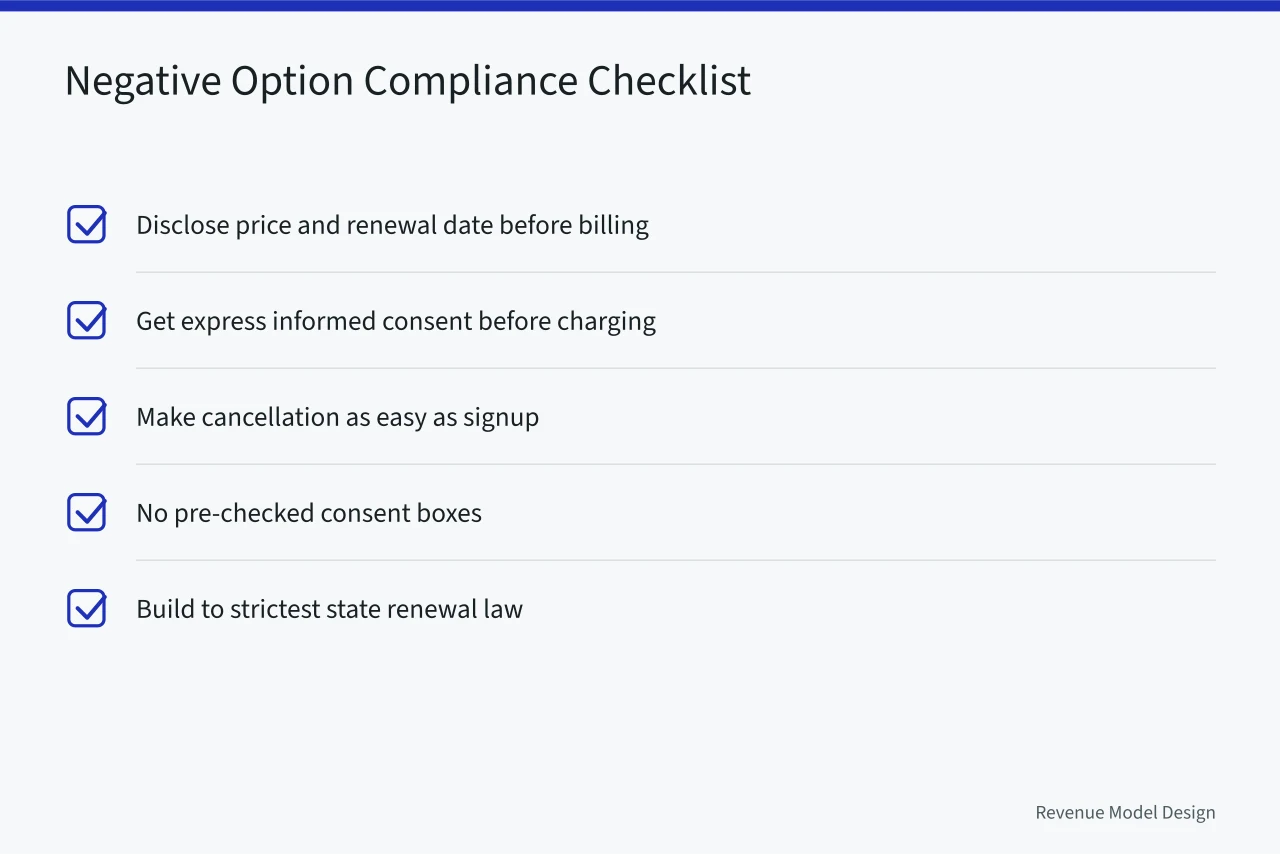
For publishers, the practical effect is that a trial that converts to paid must say so before the reader enters a card number. The disclosure must state the price, the renewal date, and how to stop it.
Cancellation must be as easy as signup. If a reader subscribed online, a phone-only cancellation path invites complaints and enforcement. Save-the-offer screens are allowed, but they cannot trap the reader.
The rule interacts with state automatic renewal laws, several of which are stricter. California, New York, and Illinois have their own requirements, and a publisher selling nationwide generally builds to the strictest standard it touches.
Subscription revenue is attractive because it is predictable, but the compliance load is real. Publishers that treat billing as a growth hack rather than a contract tend to meet the FTC eventually. For the revenue side of that trade, see subscription models.
Pre-checked boxes
A pre-checked consent box is not informed consent. The reader must take an affirmative step to agree to the recurring charge.
Free trial disclosures
State the trial length, the price after the trial, and the cancellation deadline in the same place the reader enters payment details.
Cancellation receipts
Send a confirmation when a reader cancels. It reduces disputes and gives the publisher a record if a complaint arrives.
COPPA and data limits on targeted advertising to younger audiences
The Children's Online Privacy Protection Act sets the rules for collecting personal information from children under 13. The FTC's Complying with COPPA: Frequently Asked Questions explains what counts as personal information and when verifiable parental consent is required.
Behavioral advertising depends on tracking. When the audience is under 13, that tracking requires consent that most publishers cannot practically obtain at scale. The result is that child-directed inventory supports contextual ads, not behavioral ones.
Contextual ads pay less. A publisher with a large child audience therefore faces a lower ad yield than a general news site with the same traffic. That gap is a direct cost of COPPA compliance.
Mixed-audience sites have to decide whether to treat the whole site as child-directed or to build age gates and separate ad paths. The second option is more work but preserves behavioral advertising for the adult portion.
COPPA is not the only limit. State privacy laws add opt-out rights for teens and restrictions on sensitive data, and platform policies layer on more. The practical effect is a smaller addressable pool for targeted ads on younger audiences.
What counts as personal information
Under COPPA it includes identifiers, geolocation, photos, and persistent identifiers used to track a child across sites. That last category is what reaches ad tech.
Support for COPPA compliance
A safe harbor program can provide a framework for compliance. Membership is voluntary but gives a documented process if a complaint arrives.
Ad inventory planning
If a large share of traffic is child-directed, model contextual rates rather than behavioral rates. The revenue difference can be large enough to change the model decision.
Penalty offense notices and enforcement outcomes for ad claims
The FTC's Notices of Penalty Offenses list conduct the agency has already found unlawful. Once a business receives notice, repeating that conduct can trigger civil penalties.
The FTC has sent notices covering fake reviews, money-making claims, and other advertising practices. A publisher that runs advertiser-supplied claims in those categories should know whether a notice applies.
Penalties change the math on ad-supported revenue. A single enforcement action can exceed the revenue from the campaign that caused it. That makes substantiation a cost of doing business rather than an editorial nicety.
Enforcement also shapes advertiser behavior. Advertisers with prior notices push harder for publisher indemnities and for substantiation files, and some categories become hard to sell at all.
For publishers comparing models, the compliance burden is a real line item. Ad revenue carries disclosure, substantiation, and notice risk. Subscription revenue carries negative option and cancellation risk. Neither is free of regulation.
Documenting substantiation
Keep the evidence behind each claim, including the advertiser's support. If the FTC asks, a file is a better answer than a memory.
Training sales teams
Sales staff who promise performance numbers create claims. Train them on what can be said and what needs review.
Reviewing insertion orders
Check indemnity, substantiation, and disclosure terms before signing. The cheapest ad is not cheap if it carries the claim.
A worked example
A mid-size US publisher sells display ads nationwide, runs sponsored posts, and sells a monthly subscription. Its New York ad receipts cross the state threshold, so it registers and collects there. Its California, Texas, and Florida ad sales fall outside those states' taxed categories, so it collects no ad tax but still tracks state revenue splits.
It labels every sponsored post at the top and keeps substantiation files for advertiser claims. It offers online cancellation with a confirmation email. It keeps behavioral targeting off its kids section and sells contextual inventory there instead. None of these steps is exotic, and together they cover the main federal and state exposures in this comparison.
Checklist before launch
- Confirm whether New York digital advertising tax applies to your receipts and register if it does.
- Set up state-by-state revenue tracking for California, New York, Texas, and Florida.
- Label sponsored content where a reader will see it without scrolling or hovering.
- Disclose affiliate and endorsement relationships near the link or mention.
- Make cancellation as easy as signup and send a confirmation.
- Keep behavioral targeting off child-directed inventory and model contextual rates.
- Check whether any advertiser claim falls under a penalty offense notice.
For more on how the pieces fit, see revenue models examples and revenue models questions.
Common questions
Does New York tax digital advertising? Yes. New York imposes a tax on digital advertising receipts above a threshold, which makes it the one state among the four with a standalone ad tax. Confirm the current rate and threshold before filing.
Do California, Texas, and Florida tax digital ads? They do not levy a standalone digital advertising tax. They tax advertising only when it falls within a broader category such as specified digital products or data processing.
What does the negative option rule require? Clear disclosure of renewal terms before billing, express informed consent, and a simple cancellation method. The FTC's negative option rule page sets out the requirements.
How does COPPA affect ad revenue? It limits behavioral tracking of children under 13, so child-directed inventory sells on contextual terms. Contextual ads generally pay less than behavioral ads.
What is a penalty offense notice? It is an FTC notice listing conduct already found unlawful. Repeating that conduct after receiving notice can trigger civil penalties.
Which model carries less regulatory risk? Neither is free of it. Ad revenue carries disclosure and substantiation risk, while subscription revenue carries negative option and cancellation risk. The right mix depends on your audience and your tolerance for each.