Industry
Ad-Supported Revenue Model Design: Subscription vs Advertising for US Publishers
Ad-supported revenue model design for US publishers: how advertising and subscriptions compare on CPM ranges, state privacy rules, churn and cost.
What to take away
- Advertising pays per impression and rewards reach. Subscriptions pay per household and reward retention.
- US state privacy laws shrink the share of inventory that can be targeted, and that moves revenue more than traffic does.
- Page RPM and direct-sold share decide whether ads cover a newsroom. Subscriber count and churn decide whether subscriptions do.
- Most US publishers run both, so the choice is which model carries fixed costs and which one funds growth.
- Neither model repairs a thin beat, weak direct traffic or a sales team that never calls on advertisers.
What is being compared
Two designs bid for the same reader relationship and get paid in different currencies. An ad-supported design lets the reader in free and bills an advertiser for attention. A subscription design bills the reader and pushes advertising to a secondary line, or removes it.
The unit of account differs. Ad teams manage page RPM, the revenue a thousand pageviews produce. Subscription teams manage revenue per subscriber per month and churn. Advertising revenue models trade reach against yield (advertising revenue overview).
The criteria that matter
Run the comparison on your own numbers. Off-the-shelf revenue models tools help only if section-level RPM and churn enter as separate inputs.
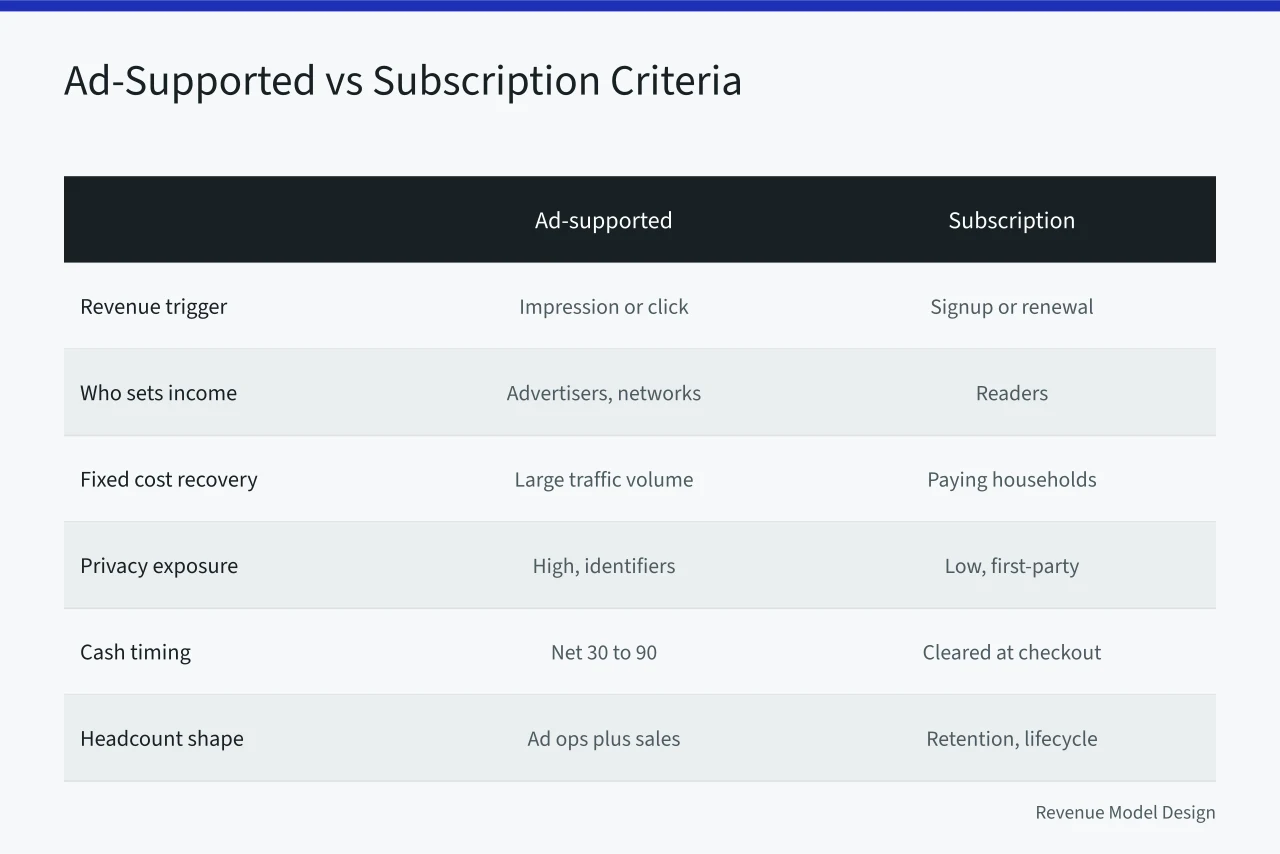
| Criterion | Ad-supported | Subscription |
|---|---|---|
| Revenue trigger | An impression or a click | A signup or a renewal |
| Who sets income | Advertisers and networks | Readers |
| Fixed cost recovery | Large traffic volume | Enough paying households |
| Exposure to privacy rules | High, targeting leans on identifiers | Low, payment data is first party |
| Cash timing | Net 30 to net 90 | Cleared at checkout |
| Headcount shape | Ad ops plus sales | Retention and lifecycle marketing |
| Ceiling | Total addressable impressions | Share of readers willing to pay |
Ad-supported revenue model design in practice
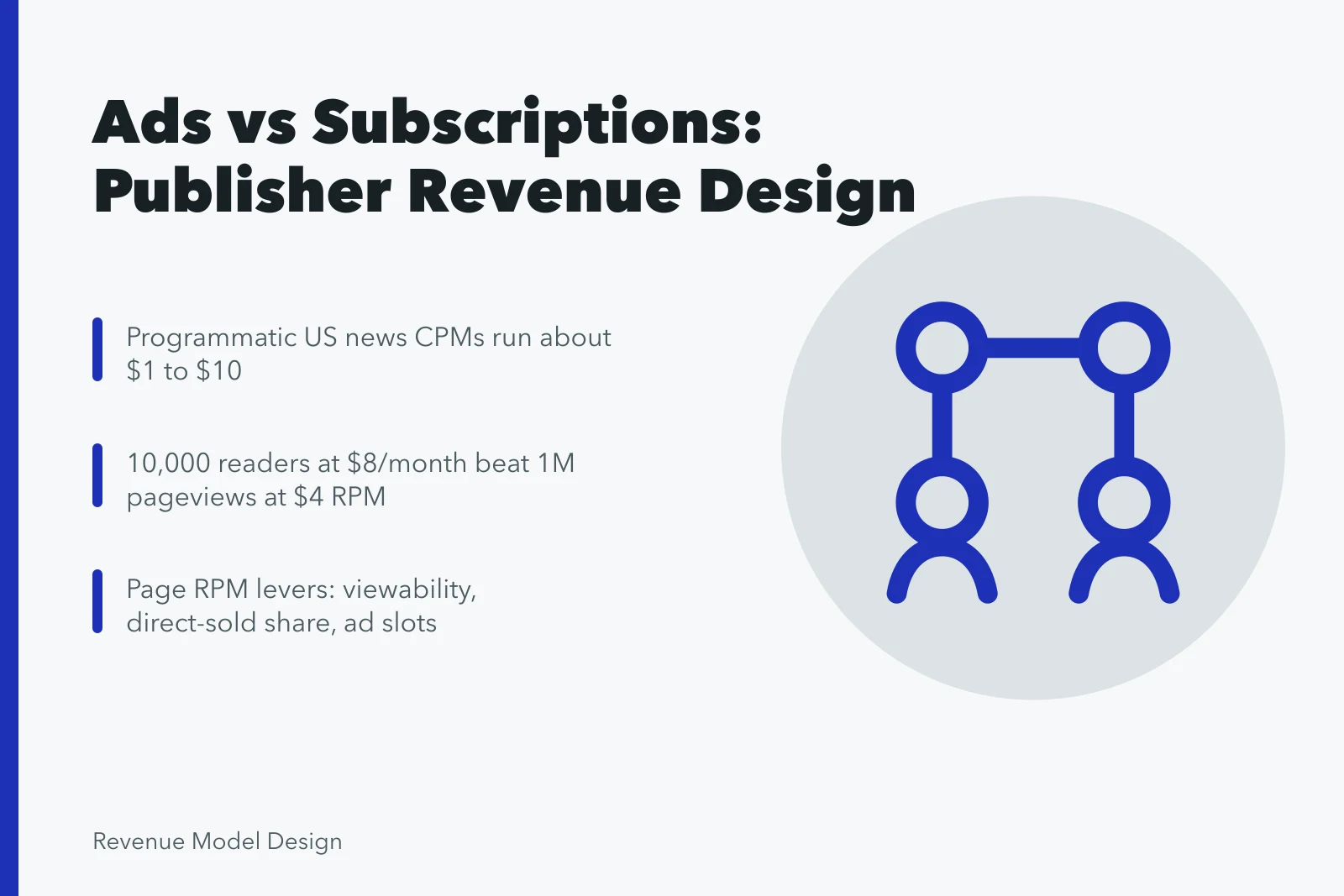
Programmatic display CPMs on US news inventory often fall between roughly $1 and $10. Direct-sold placements on a recognized metro brand can run several times that. Treat both ranges as illustrative, because they move with the quarter and the section.
Three levers move page RPM more than traffic does: viewability, the share of inventory sold direct, and the number of slots loaded before the reader scrolls. Sponsored posts pay better than banners and carry disclosure duties under FTC guidance on native advertising (FTC native advertising guide).
Privacy rules sit underneath all of it. California, Virginia, Colorado and Connecticut, among others, let residents opt out of targeted advertising and restrict sensitive data use.
Consent rates on news sites are rarely high, so a plan that assumes full behavioral targeting will miss its own forecast. The NIST Privacy Framework gives a structure for managing that risk (NIST privacy framework).
Subscription economics in the same market
Ten thousand readers at $8 a month beat a million monthly pageviews at a $4 RPM, and no ad server is involved. Cost shifts to retention. A meter set too tight kills habit; a meter set too loose never converts. Pricing, trials and annual plans surface in nearly every launch, and subscription models questions covers the ones that keep repeating.
Annual plans shift the renewal decision twelve months out, which lowers monthly churn but delays the moment a reader proves they will pay again.
Where each one wins
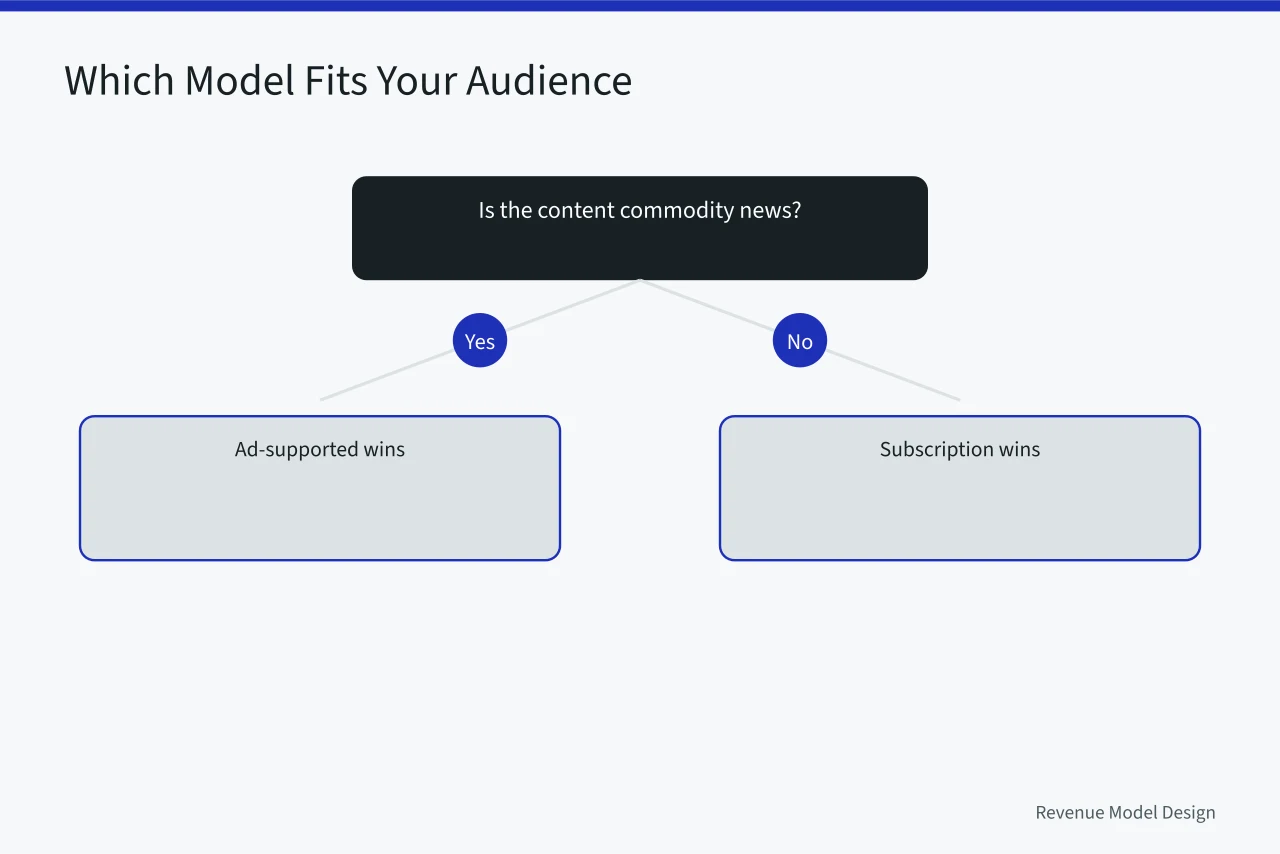
Each model is right somewhere, and the case is usually visible in the audience.
Before committing, run three steps.
- Pull page RPM by section for twelve months instead of a site average.
- Estimate conversion at 0.5 to 2 percent of monthly uniques, then halve it.
- Model both against one newsroom cost, including ad ops and retention hires.
Spreadsheets break once section-level RPM and cohort churn arrive in the same file.
Example: The Athletic and a metro daily
The Athletic built its early business on subscriptions, then added advertising and bundle revenue after The New York Times acquired it in 2022. The order was subscription, then scale, then ads.
Local dailies rarely get that order; their traffic is real but undifferentiated. National brands buy it through networks at open-market rates.
When a paper cuts reporting to protect margin, pageviews fall, ad revenue follows, and the cut repeats. That is a unit economics problem before an editorial one, and unit economics examples shows how the wrong unit hides the damage.
What none of them solve
Neither model fixes a product nobody wants. If the reporting is not distinct, ads pay only for traffic rented from search and social, and subscriptions convert at rates that never cover a newsroom.
Both depend on demand nobody controls. Ad rates follow the ad market. Conversion follows willingness to pay, which follows the news cycle. A publisher can influence both and set neither.
Getting the mix wrong is a pricing problem, not a reporting one, and pricing architecture mistakes shows how a clean split between free and paid pages collapses when both teams share one template.
Common questions
Do US publishers earn more from ads or from subscriptions? It depends on the audience. A national title with loyal readers can see subscription revenue pass ad revenue. A high-traffic commodity site usually stays ad-led.
What CPM can a local news site expect? Illustrative ranges for programmatic news inventory run from about $1 to $10 per thousand impressions, with direct-sold local placements higher. Section, season and viewability move the result more than audience size does.
Do state privacy laws change ad targeting math? Yes. Opt-out rights for targeted advertising and limits on sensitive data cut the share of impressions that carry behavioral targeting, and some states require honoring universal opt-out signals.
Can a publisher run ads and a paywall at once? Yes, and most do. The tension is page-level: ad-heavy pages and hard paywalls do not belong on the same URL. Decide which sections are free and which are paid before either team builds a template.