Rules
Franchise Revenue Model Design: Royalty Rates and the FDD's Blind Spots
Franchise revenue model design starts with the Franchise Rule: what the FDD must show about royalties, what stays hidden, and who enforces it.
What to take away
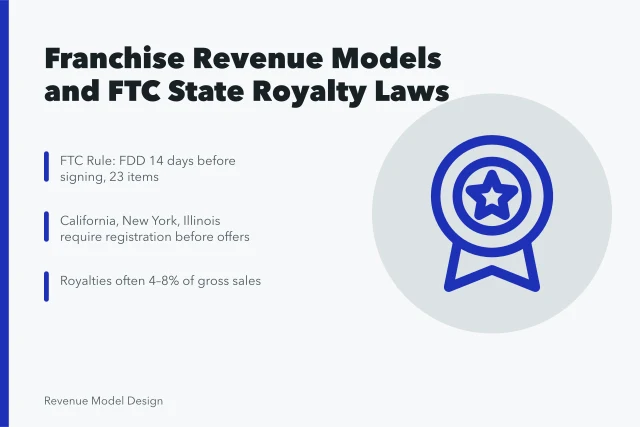
- The FTC sets the federal floor for franchise disclosure through the Franchise Rule, and states such as California, Illinois, Maryland, Minnesota, New York, Rhode Island, Virginia, Washington and Wisconsin add registration or filing steps.
- Item 6 of the Franchise Disclosure Document carries the royalty rate and the calculation method, but it rarely shows the effective rate after rebates, minimums and local fees.
- A franchisee who receives an incomplete or false disclosure can sue under state franchise statutes and the FTC can seek injunctive relief, so the paperwork is not a formality.
- Records that support every royalty figure must survive for at least three years under the FTC rule, and longer where state law says so.
Who has jurisdiction
The Federal Trade Commission administers the Franchise Rule at 16 CFR Part 436. It applies in every state plus the territories.
Three elements make a business relationship a franchise: a trademark license, a required payment, and control or assistance over operations. The FTC's compliance guide for the Franchise Rule covers those elements and the disclosure schedule tied to them.
A state can layer its own franchise law on top. Registration states review the FDD before a franchisor may offer, and some require an annual renewal filing. The Cornell Legal Information Institute's summary of franchise law describes how the state and federal definitions interact. A franchisor selling in one registration state and forty non-registration states runs two calendars, not one.
What must be disclosed
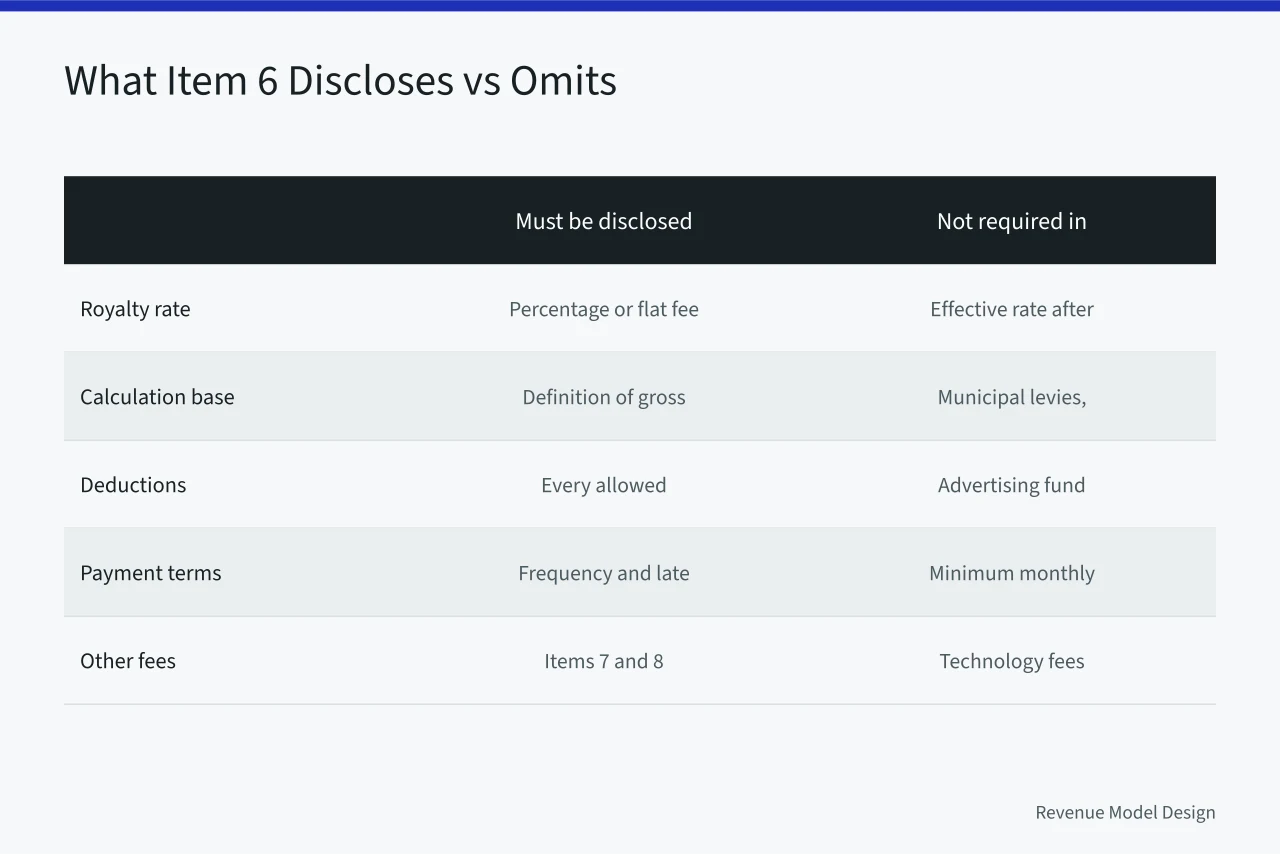
Item 6 of the FDD is where royalty rates live. A compliant disclosure states the royalty as a percentage of gross sales or a flat fee per period, names the definition of gross sales, and lists every deduction a franchisee may take before the percentage applies. It also states the frequency of payment and the consequences of late payment.
| Item | What it must contain |
|---|---|
| Item 5 | Initial franchise fee and when it is earned |
| Item 6 | Royalty rate, calculation base, payment frequency |
| Item 7 | Estimated initial investment, low to high |
| Item 8 | Supplier obligations and rebate arrangements |
| Item 20 | Unit counts and closures by year |
Item 6 does not have to show the effective royalty after advertising fund contributions, technology fees, or minimum monthly payments. Those numbers appear across Items 6, 7 and 8, and a reader has to assemble them. Item 20 matters because a royalty model that drives closures shows up in the unit counts before it shows up in a lawsuit.
Records to keep
A franchisor must keep records that support the figures in its FDD for at least three years after the close of the fiscal year in which the disclosure was used. The working file behind Item 6 should hold the signed franchise agreements that set each rate, the royalty statements franchisees submitted, and the bank records that match them.
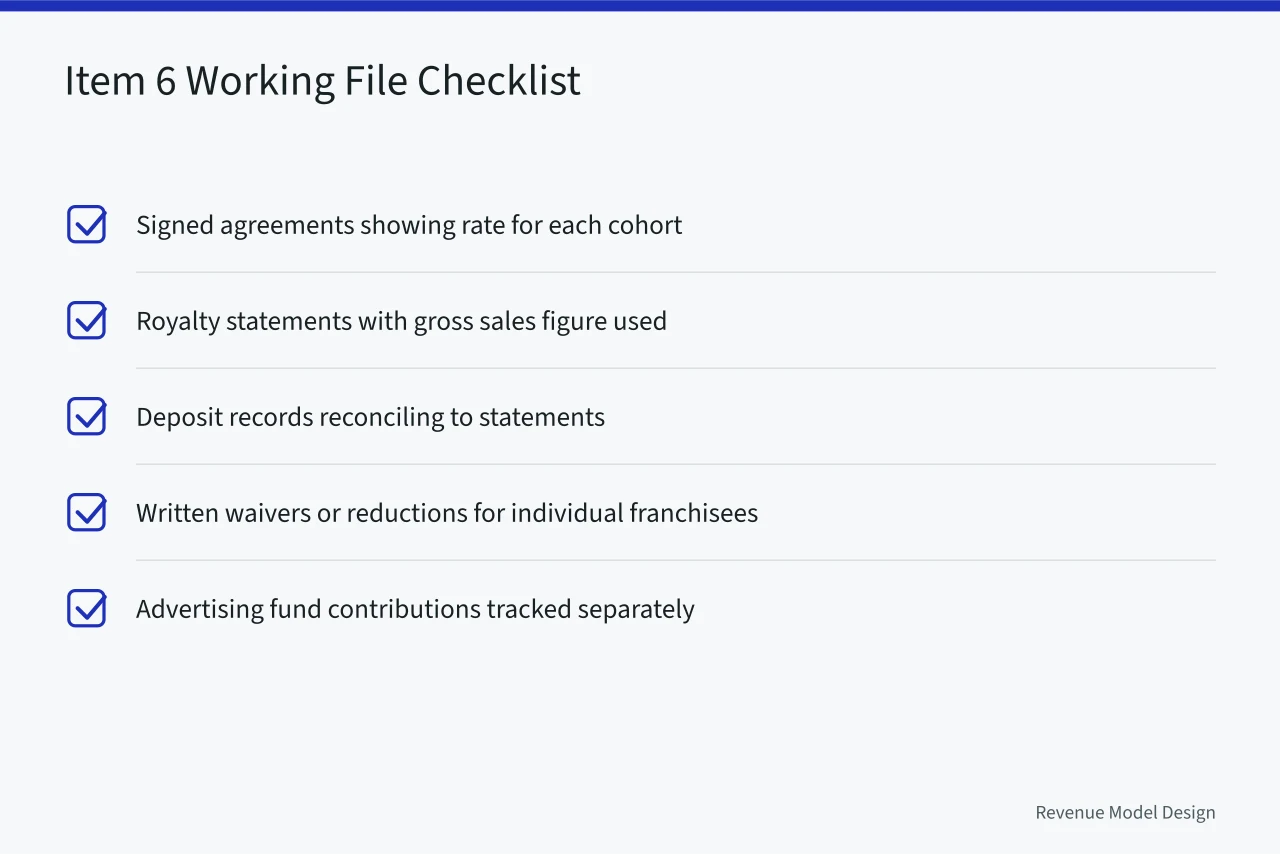
A waiver granted to one franchisee and not disclosed elsewhere becomes a problem when a second franchisee learns about it. The file has to show who got what and when.
The same discipline applies outside franchising. A company that runs several revenue lines at once needs one place where the rate, the base and the exception all live, which is the argument in pricing architecture mistakes.
What happens if you do not
The FTC can bring an enforcement action and seek injunctive relief, and a court can order rescission or damages for franchisees who relied on a false statement. State franchise statutes commonly add a private right of action with attorney fees. A missing or stale FDD in a registration state blocks the sale outright until the state clears the filing.
The quieter consequence is the royalty dispute. A franchisee who discovers that the effective rate runs several points above the disclosed percentage can withhold payment and force the franchisor into arbitration. The franchisor then defends a number it never put in writing in one place.
A royalty rate is only as defensible as the records that produced it. If the calculation cannot be reproduced from the file, the disclosure is a claim rather than a record.
Where the rules differ by place
Registration states require a filed FDD and, in most cases, an effective date before any offer. Non-registration states rely on the federal rule alone, so a franchisor can offer as soon as the FDD is complete and delivered within the required window. Some states also require a franchisee to receive the document a set number of business days before signing.
Local rules reach the revenue model through fees rather than disclosure. A royalty built on gross sales ignores municipal levies and delivery commissions that reduce the base a franchisee actually collects. Franchisors that model the rate before they model the local cost stack tend to discover the gap after the first audit.
Common questions
Does the FDD have to state one royalty rate for every franchisee? No. Rates can vary by agreement date, territory or format. What the disclosure must do is state the range and the terms that produce it, and the file must show which franchisee signed which version.
How long does a franchisor have to deliver the FDD before signing? The federal rule requires delivery at least 14 calendar days before the franchisee signs a binding agreement or pays money. Several states extend that window, so a single national calendar should use the longest applicable period.
Can a franchisor change the royalty rate after signing? Only as the agreement allows. Most contracts let the franchisor adjust the rate with notice, but a change that departs from the disclosed terms without notice invites a dispute and, in a registration state, a filing amendment.
Do royalty payments count as revenue for the franchisor at signing? No. Under ASC 606, initial franchise fees are generally recognized as the franchisor performs, while continuing royalties are recognized as sales occur. The revenue recognition overview covers the timing question, and unit economics examples shows why the unit that gets measured changes the answer.