Rules
SEC revenue recognition for SaaS founders, ASC 606 explained
SEC revenue recognition SaaS ASC 606: how the five-step model, SEC filing rules and audit pitfalls shape subscription revenue in the United States.
What to take away
- SEC revenue recognition SaaS ASC 606 replaced the old software rules with a five-step model that every subscription contract must pass through.
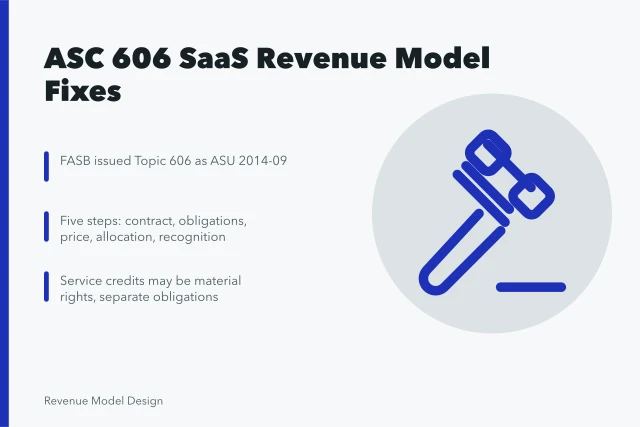
- The five steps are: identify the contract, identify performance obligations, set the transaction price, allocate it, and recognize revenue when control transfers.
- Public SaaS companies file ASC 606 revenue under SEC rules, and the deferred revenue balance on the balance sheet is the audit trail.
- Variable consideration, usage tiers and service credits are the hardest part of ASC 606 for founders.
- Common founder pitfalls before audit include side letters, free pilots and bundled implementation fees that never got documented.
What ASC 606 changed for SaaS contracts and why the SEC cares
ASC 606 is the revenue standard issued by the Financial Accounting Standards Board, and the SEC enforces it for U.S. public companies. It replaced a software-specific rule that let vendors recognize license revenue up front and spread services over time.
Under ASC 606, revenue follows the transfer of control, not the contract signature or the invoice date. For SaaS, that shift matters because the customer usually receives the service continuously, so revenue is recognized over the subscription term.
The SEC cares because revenue is the number investors use to price a public SaaS company. If revenue is recognized too early, later periods look weak and restatements follow. The SEC's Division of Corporation Finance reviews filings and asks questions when revenue recognition looks aggressive.
A restatement can delay a public offering and damage the credibility of the finance team.
ASC 606 also changed disclosures. Public SaaS companies must describe performance obligations, the timing of recognition, and the judgments behind variable consideration. Those disclosures are not boilerplate. They are the place where the SEC and investors test whether the revenue number is defensible.
For founders, the practical change is this: the contract is the accounting document. Sales teams that sign side letters, verbal discounts or free extensions create revenue problems that surface months later. A clean ASC 606 process starts with a standard contract and a documented review before signature.
The standard also applies to private companies, but the SEC sets the enforcement tone. Private SaaS companies preparing for an IPO usually adopt ASC 606 early to avoid a restatement at the worst possible time.
If your revenue model depends on usage or seats, see the design choices in SaaS Revenue Model Design Under ASC 606 before the audit begins.
The five-step model applied to subscription and usage-based SaaS
ASC 606's five-step model is the core of SEC revenue recognition for SaaS. Each step asks a question, and the answer changes when the contract is usage-based rather than a flat subscription.
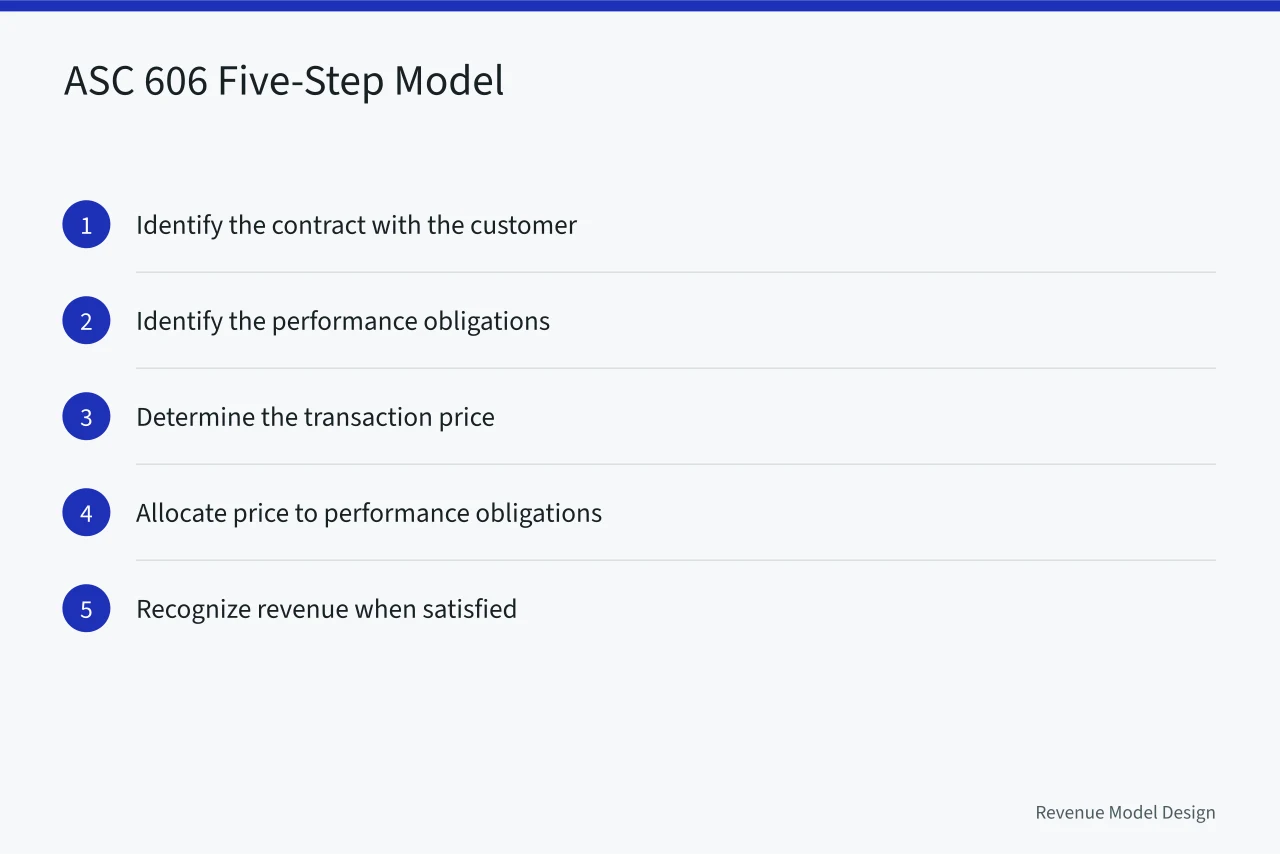
- Identify the contract with the customer. A contract exists when it has commercial substance, approved terms, identifiable payment terms and probable collection. A signed order form is not enough if the customer can cancel without penalty.
- Identify the performance obligations. A performance obligation is a promise to transfer a distinct service. The SaaS platform is usually one obligation. Implementation, training and premium support may be separate if the customer can benefit from them on their own.
- Determine the transaction price. This is the amount you expect to be entitled to, including fixed fees, usage fees and variable consideration. Discounts and credits reduce it.
- Allocate the transaction price to the performance obligations. Allocate based on standalone selling price. If implementation is a separate obligation, part of the contract value moves to it and is recognized as that work is delivered.
- Recognize revenue when the performance obligation is satisfied. Subscription revenue is recognized over time, usually on a straight-line basis. Usage-based revenue is recognized as usage occurs, which can make monthly revenue uneven.
Worked example: a subscription with implementation
A customer signs a 12-month subscription for $120,000 and pays $20,000 for implementation. The platform and implementation are distinct because the customer can use the platform without the implementation service. Standalone selling prices are $120,000 for the subscription and $30,000 for implementation, so total standalone value is $150,000.
Allocate the $140,000 transaction price: subscription gets $112,000 and implementation gets $28,000. Recognize the $28,000 as implementation is delivered, and recognize the $112,000 evenly over 12 months, about $9,333 per month.
If the implementation is not distinct, the whole $140,000 is recognized over the subscription term. That single judgment can shift millions of dollars between periods.
Usage-based contracts follow the same five steps, but step five is variable. If a customer pays per API call, revenue is recognized as calls are made. The allocation in step four still applies to any fixed platform fee. For the pricing design behind those choices, the analysis in ad supported revenue model design is a useful companion.
Performance obligation identification in practice
Performance obligation identification is where most SaaS contracts get complicated. A promise is distinct if the customer can benefit from it on its own and it is separately identifiable from other promises. Hosting, updates and technical support are usually not distinct because they are part of the ongoing service.
A data migration that the customer could hire another vendor to perform often is distinct.
The SEC expects companies to document these judgments. A short memo per contract type is enough if it explains why each promise is or is not distinct. Without that memo, the auditor will ask the question and the answer will be reconstructed after the fact.
SEC filing requirements for public SaaS companies and capital raising
SEC filing requirements for public SaaS companies start with registration. A company raising capital through an IPO files a Form S-1, which includes audited financial statements and a management discussion of revenue trends. After listing, the company files annual Form 10-K and quarterly Form 10-Q reports. Revenue recognition policies appear in the notes to those financial statements.
The SEC's capital-raising guidance explains the registration and exemption paths available to growing companies, including the choices that affect how much disclosure is required. The building blocks are set out in the SEC's capital-raising guidance, which is the starting point for any SaaS founder planning a public offering.
Revenue is a focus area in SEC review. The staff may ask how performance obligations were identified, how variable consideration was estimated, and why deferred revenue moved the way it did. A company that cannot answer with schedules and contract samples will face a longer review.
Capital raising also changes the revenue model. A company that raised on growth metrics may need to show predictable subscription revenue to support a public valuation. That pressure can tempt founders to recognize revenue early, which is exactly what the SEC looks for.
The safer path is to keep the model defensible and let the deferred revenue balance tell the story.
Entity structure matters too. Many SaaS companies operate as Delaware corporations with subsidiaries in other states, and the reporting structure affects consolidation and segment disclosure. The IRS describes the common business structures that issuers use, which is useful context when the legal entity and the reporting entity are not the same.
Rule changes do not stop after the IPO. The SEC amends disclosure requirements through rulemaking, and the Federal Register publishes those changes. The money topic collects rulemaking that touches securities and financial reporting, and the current issue shows what is moving now.
Finance teams that track these documents avoid surprises at the next filing.
Deferred revenue SaaS and the balance sheet
Deferred revenue SaaS is the liability that appears when a customer pays before the service is delivered. It is not a sign of trouble. It is the accounting result of recognizing revenue over time. Investors watch the deferred revenue balance because it indicates future revenue already contracted.
A rising deferred revenue balance with flat recognized revenue can mean billings are growing faster than delivery, or that revenue recognition is too conservative. A falling balance with rising revenue can mean the company is burning through backlog. Neither is automatically wrong, but the explanation belongs in the filing.
Variable consideration, credits and usage tiers under ASC 606
Variable consideration treatment is the part of ASC 606 that most SaaS founders underestimate. Variable consideration includes usage fees, overage charges, discounts, service credits, refunds and performance bonuses. It is estimated at contract inception and included in the transaction price only to the extent it is probable that a significant reversal will not occur.
Usage tiers are a common example. A contract might charge $10,000 per month for up to one million API calls and $0.01 per call above that. The fixed $10,000 is recognized over the month.
The overage is variable, and the company estimates it based on historical usage. If the customer has never exceeded the tier, including a large overage estimate is aggressive.
Service credits are a reduction of revenue, not an expense. If a customer receives a credit for downtime, the credit reduces the transaction price and therefore revenue. Recording it as a marketing expense overstates revenue and is a common audit finding.
Discounts and renewal options also create variable consideration. A renewal option that gives the customer a material right must be accounted for as a separate performance obligation. That means part of the current contract value is deferred until the renewal is exercised or expires.
Estimates must be revisited each reporting period. If actual usage comes in below the estimate, the transaction price is adjusted and revenue is corrected. The SEC expects the method to be consistent and disclosed. For a broader view of how pricing choices feed into these estimates, the discussion of subscription models covers the promises recurring revenue cannot keep.
A usage-tier example
A customer commits to $5,000 per month for 100,000 transactions and pays $0.05 per transaction above that. In January the customer uses 140,000 transactions. Fixed revenue is $5,000. The overage is 40,000 times $0.05, or $2,000, recognized in January because the usage occurred. Total January revenue is $7,000.
If the contract instead gave the customer a 10 percent volume discount that applies retroactively once usage passes 1 million transactions, the company must estimate whether the threshold will be met and reduce revenue across the period. That estimate is variable consideration, and it changes the monthly revenue even though no invoice has changed.
Common revenue recognition pitfalls founders hit before an audit
Common founder pitfalls before audit usually come from the gap between how a deal was sold and how it was documented. The sales team closes the contract, the customer starts using the product, and the finance team learns the details months later. ASC 606 does not care about good intentions.
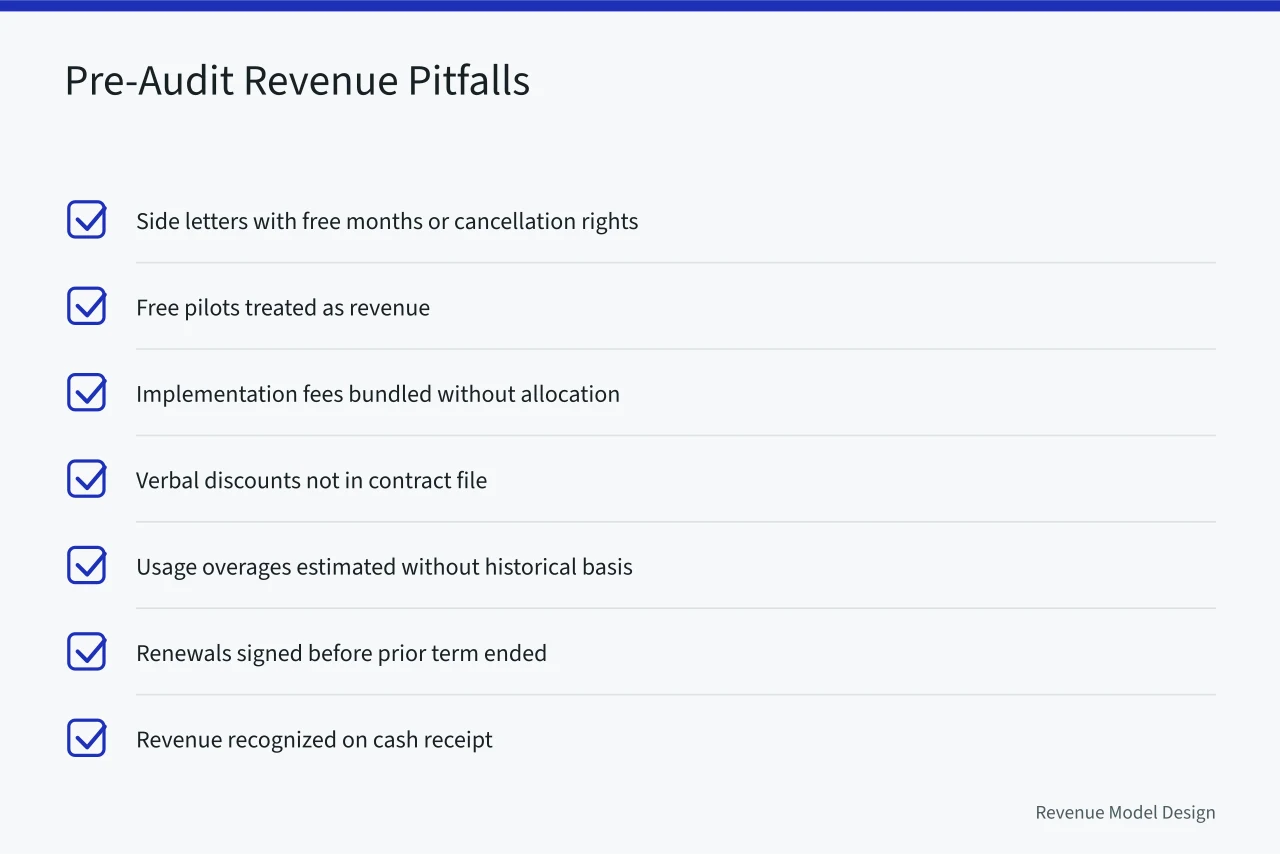
Each of these creates a difference between the contract and the accounting. Auditors test the contract file against the revenue schedule, and a missing side letter is a finding. The fix is a contract review step before signature, with a standard checklist for sales.
Another pitfall is treating all customers the same. Enterprise contracts often include security reviews, service level agreements and data processing terms that affect obligations. A contract with an uptime commitment may include a variable consideration element even if no credit is mentioned.
Founders also underestimate the cost of a restatement. Restating revenue means reissuing financial statements, notifying investors and explaining the change to the SEC. It can push an IPO back by quarters. The revenue model itself is often the root cause, which is why the questions in revenue model choice deserve an answer before the audit, not after.
Documentation that prevents findings
A revenue schedule that ties to the general ledger is the minimum. Better is a contract summary for each customer that lists the term, the fees, the performance obligations and the variable consideration estimate. When the auditor asks for support, the summary is the answer.
Contract costs, commissions and the deferred revenue balance
Contract costs are the costs to obtain and fulfill a contract. Sales commissions are the most common example. Under ASC 606, commissions paid for a contract with a term longer than one year are capitalized and amortized over the expected customer life, not expensed when paid.
That rule changes the income statement. A company with heavy upfront commissions reports lower expense in the first year and higher expense later. The amortization period is a judgment, and the SEC expects it to reflect the expected customer relationship, including renewals. If your commission plan pays on renewals, the amortization period usually lengthens.
Fulfillment costs, such as onboarding or implementation labor that does not create a separate performance obligation, are capitalized only if they generate a resource used to satisfy future obligations. Many SaaS companies expense them, which is acceptable if the criteria are not met. The policy must be consistent and disclosed.
Commissions and contract costs sit on the balance sheet alongside deferred revenue, and together they tell the story of the subscription business. The revenue models metrics that investors use, such as the ratio of deferred revenue to recognized revenue, depend on these balances being correct.
Tax treatment adds another layer. For U.S. federal income tax, revenue recognition rules do not always match ASC 606, and commissions are deductible on a different schedule. The IRS maintains resources for tax professionals that cover the compliance side of subscription businesses, which is worth reviewing with your tax adviser before filing.
Deferred revenue rollforward
A deferred revenue rollforward starts with the opening balance, adds billings, subtracts recognized revenue and ends with the closing balance. Every number in that rollforward should tie to the general ledger and to the contract schedule. Auditors use the rollforward to test both completeness and accuracy.
If the rollforward does not reconcile, the problem is usually a contract that was billed but not scheduled, or a credit that was recorded as an expense. Fixing the rollforward before the audit is faster than fixing it during fieldwork.
Working with auditors: evidence, schedules and disclosure
Auditors test revenue by selecting contracts and tracing them to the schedule, the invoice and the cash receipt. Your job is to make that trace easy. A well organized evidence package reduces the number of questions and the time the audit takes.
The evidence package should include signed contracts and order forms, side letters, invoices, the revenue schedule, the deferred revenue rollforward, the commission amortization schedule and the variable consideration estimates. Each document should reference the customer and the contract identifier.
Schedules should be maintained monthly, not rebuilt at year end. A monthly close that includes revenue review catches problems while the details are fresh. When the auditor asks why a contract was treated a certain way, the memo from the month it was signed is stronger than a memo written during fieldwork.
Disclosure follows the same logic. The revenue note should describe the nature of the services, the timing of recognition, the significant judgments and the changes in estimates. Public SaaS companies also disclose the transaction price allocated to remaining performance obligations, which is the contracted revenue not yet recognized.
Communication with the auditor should start before the audit. A pre-audit meeting that walks through new contract types, pricing changes and estimates gives the auditor time to plan. Surprises during fieldwork cost more than a conversation in advance.
The goal is not to satisfy the auditor. It is to produce a revenue number that survives SEC review and investor scrutiny. A clean ASC 606 process is a competitive advantage when the company raises capital or goes public, because the finance story matches the product story.
Common questions
Does ASC 606 apply to private SaaS companies? Yes. ASC 606 applies to all U.S. companies that issue financial statements under U.S. GAAP, public or private. Private companies often adopt it early when they expect an IPO or a lender requires audited statements.
When is SaaS revenue recognized under ASC 606? Subscription revenue is recognized over the subscription term as the service is delivered, usually on a straight-line basis. Usage-based revenue is recognized as usage occurs, and implementation revenue is recognized as the implementation is delivered if it is a separate performance obligation.
What is deferred revenue and why does it matter? Deferred revenue is cash received or billed before the service is delivered. It sits as a liability until revenue is recognized. Investors watch it as an indicator of contracted future revenue.
How are service credits treated under ASC 606? Service credits reduce the transaction price and therefore reduce revenue. They are not marketing or support expenses. Recording them as expenses overstates revenue and typically leads to an audit adjustment.
What SEC filings does a public SaaS company make? A U.S. public SaaS company files a Form S-1 at IPO, annual Form 10-K reports, quarterly Form 10-Q reports and current reports on Form 8-K for material events. Revenue recognition policies appear in the financial statement notes.
What should a founder fix first before an audit? Start with the contract file. Make sure every side letter, discount and free pilot is documented and reflected in the revenue schedule. Then reconcile the deferred revenue rollforward to the general ledger.