Features
Part of Getting service models right the first time
4 things worth knowing about service models questions
Service models questions worth settling before you quote: who absorbs overrun, what the rate has to cover, and when a fixed fee is the wrong product.
Most arguments inside a service firm are the same three questions asked in different rooms. They are settled once, in writing, or they are re-fought on every engagement.
Below are the questions, grouped by who is asking, with the answer that holds and the answer that does not. Figures are invented placeholders used to make arithmetic visible.
What to take away
- "What should we charge?" is unanswerable until you have said what happens if the work takes longer than planned.
- A rate has to cover the hours nobody bills for. If it only covers delivery, the firm loses money at full capacity.
- The honest answer to several of these is that the client is buying certainty, and certainty has a price.
Questions the client asks
Why is it a fixed fee and not hourly?
Because you asked for a number you could approve. A fixed fee moves the risk of overrun from you to us, and part of the fee is the price of moving it. That is a true answer, it survives being said out loud, and it usually ends the conversation better than a defensive one.
Can we have your best rate?
The useful reply asks about volume or term. A discount without either is a gift.
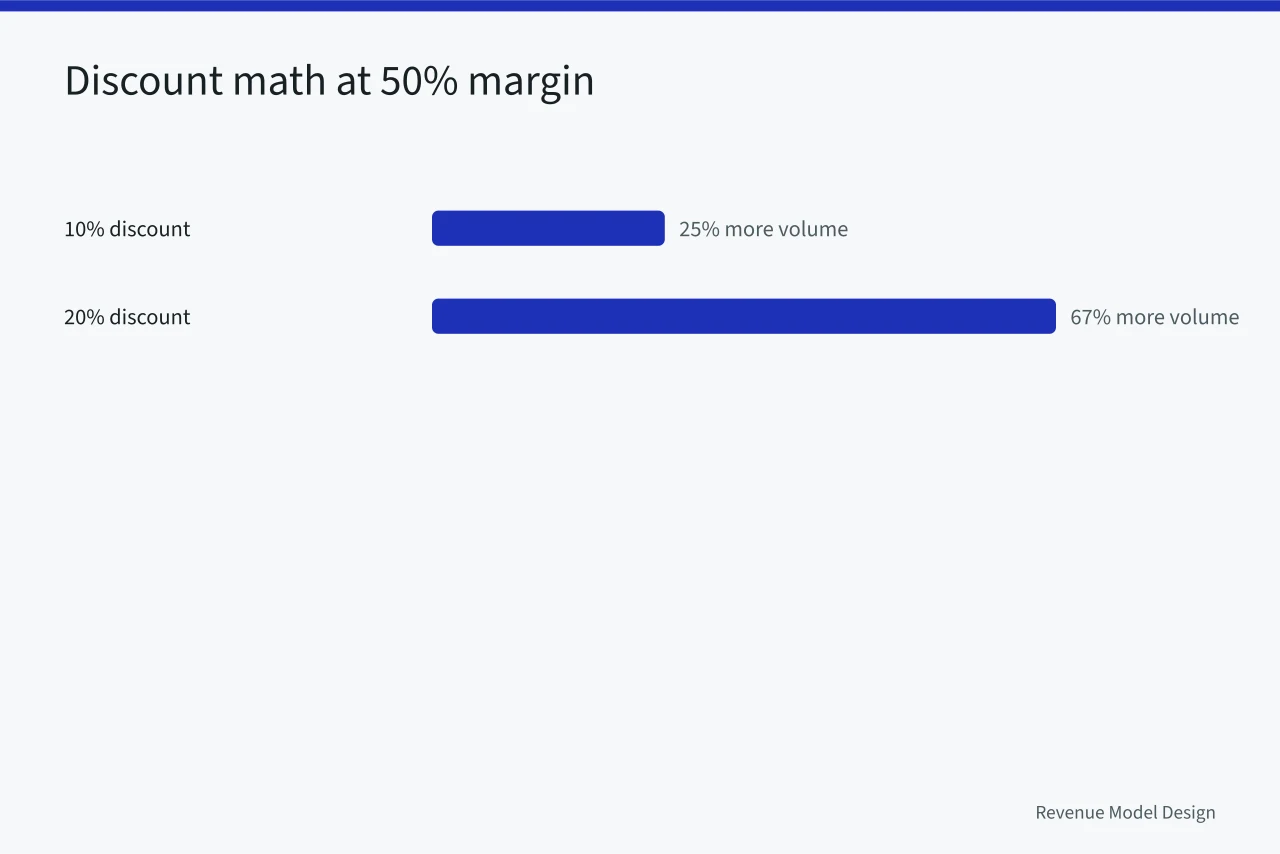
Work the arithmetic first. At a fifty percent gross margin, a ten percent discount needs twenty-five percent more volume to hold the same gross profit. A twenty percent discount needs sixty-seven percent more. If the buyer will not offer that, the discount is a transfer.
Why does your junior person cost anything?
Because the alternative is the senior person doing it at four times the rate, or the work not being checked. Firms that cannot answer this end up hiding junior time inside a blended rate, which works until a client asks for the breakdown.
Will you match a lower quote?
Only if the other quote covers the same promise, and it usually does not. Ask for their scope and their change process before answering. This is not a negotiating tactic; two proposals with different exclusions are not the same product, and matching a price across them is agreeing to a different deal.
Questions the team asks
Why did we lose money on that job when the invoice was full?
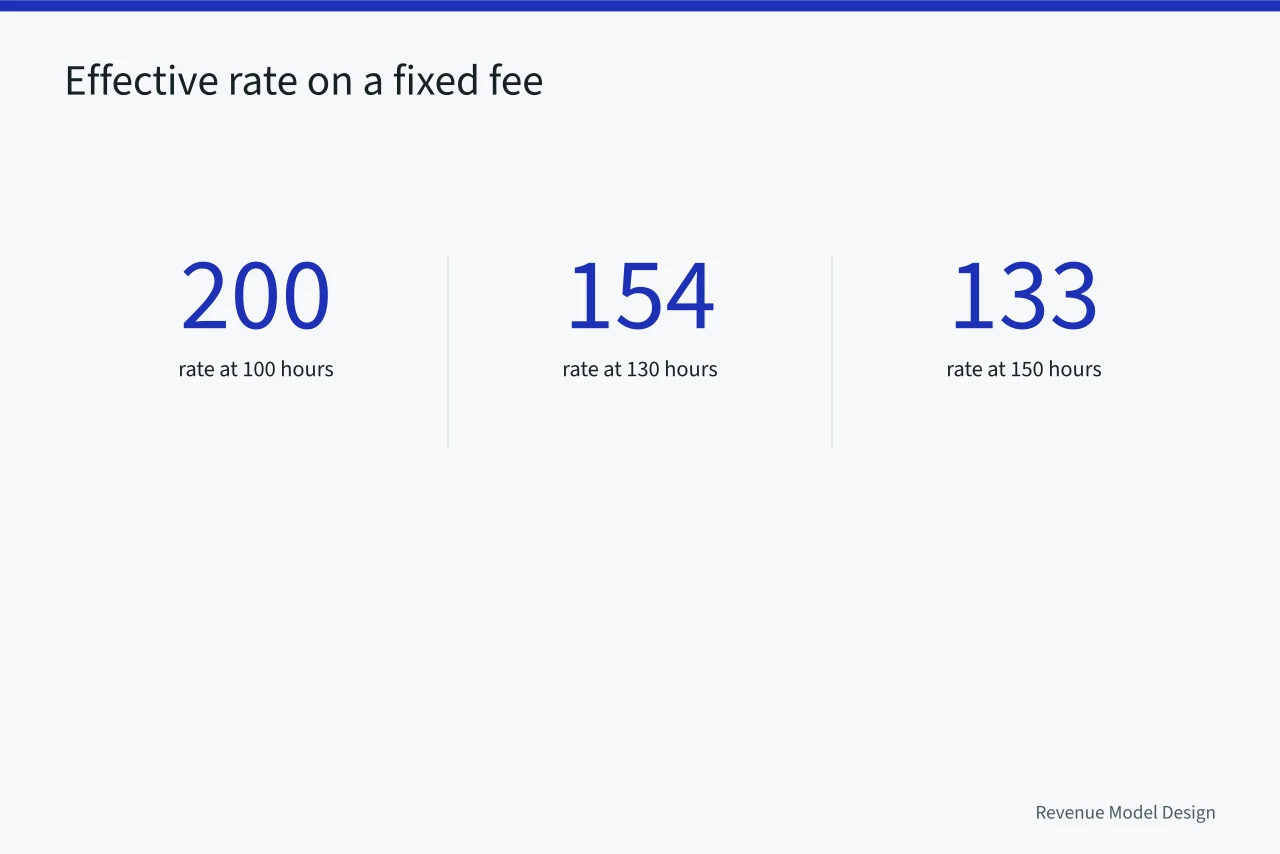
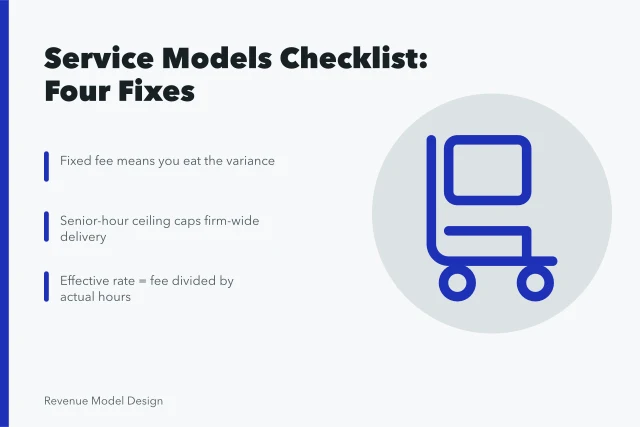
Because the rate you collected is fee divided by hours actually spent. On a fee built from a hundred hours at 200, working 130 hours gives an effective rate of 154 and working 150 gives 133. The invoice never changed. Nobody discounted anything. The measure is the effective rate, and it belongs on every completed engagement.
Why are we still the bottleneck after two hires?
Because supervision comes from the same people who were already full. Adding delivery capacity without moving review off the senior calendar raises the workload before it raises the output. The full version of this constraint sits in service models.
Do we have to record time on fixed-fee work?
Yes, and this is the one people fight hardest. Without hours you cannot compute an effective rate, which means you cannot tell a good fixed price from a bad one, which means next year's fee is a guess again.
Questions the owner asks
Should we raise rates or raise capacity?
Both run on different clocks, and a rate rise lands next quarter and is close to pure profit if volume holds.
Capacity moves over a year, and only when the share of delivered hours that requires a senior name falls. Four senior people hold 3,872 sellable hours that support 7,744 delivered hours at a fifty percent senior share or 25,813 at fifteen percent. Nothing else has that much room.
Is our largest client a strength?
At 30% of revenue it is both. Losing it means everyone else has to grow 43% to get back to level. Track the top-one and top-three shares monthly beside revenue, because growth alone never tells you fragility is rising. The same reading applies to any book, which is why it also appears among the revenue models measures.
Can we charge different clients different prices for the same work?
Commercially, yes, and most firms already do through discounting they do not call discounting. Where the buyers are themselves businesses reselling or competing, price differences have legal edges. Know them before you design a tiered rate card. The federal price discrimination provision is where the boundaries are written, and a lawyer in your jurisdiction should read it against your facts.
When does the answer stop being a better price and start being a different business?
When the ceiling is the constraint and no rate change moves it, you choose between staying at the size the calendars allow and building something that delivers without them. That is a decision about the model, not the price.
Both routes are laid out in model innovation, and the cost behavior that decides which is affordable is in unit economics.
What these questions share
Every one of them is really about who carries variance. The client wants a number they can approve. The firm wants hours it can staff. The gap between those two wishes is the whole of service pricing, and the deals that work name the gap instead of hiding it.
Formal treatments of exchange and obligation start from the same place, which is why the doctrine of consideration turns on what each side actually promised rather than on what the price was.
Common questions
Should the rate card be public?
Publishing it makes small deals faster and large ones harder, because it anchors a negotiation you might have won on value. Many firms publish a starting rate and quote engagements individually, which is a defensible middle.
How do we handle a client who always goes over scope?
Write the change process into the next engagement letter and use it on the first small change rather than the first large one. Using it early sets the expectation cheaply. Waiting until the overrun is serious turns an administrative step into a confrontation.
Is it worth quoting a range instead of a number?
Sometimes, and only with a stated basis for each end. A range with no explanation reads as uncertainty about your own work, and buyers hear the top number anyway.
What do we do when the honest answer is that we do not know how long it will take?
Say so, and sell a small first stage whose purpose is to find out. That is a real product, it can be priced, and it is far better than a fixed fee on an unknown.