Rules
Franchise revenue models and the FTC rule: how state royalty laws differ
Franchise revenue models FTC state royalties explained: what the FTC Franchise Rule requires in the FDD and how California, New York and Illinois rules differ.
What to take away
- Franchise revenue models FTC state royalties turn on one federal disclosure rule and a patchwork of state registration and fee laws.
- The FTC Franchise Rule requires a Franchise Disclosure Document 14 days before signing or payment, with 23 items covering fees, royalties and territory.
- California, New York and Illinois require registration or filing before offers, and each reviews royalty and fee structures differently.
- Royalties, advertising funds and territory fees are the three main revenue lines, and each carries its own disclosure and accounting treatment.
- Penalty offense notices let the FTC seek civil penalties for disclosure conduct it has already warned the market about.
- Trademarks are the usual protected asset in a franchise system, and federal registration is the practical route to enforcement.
What the FTC Franchise Rule requires in the Franchise Disclosure Document
The FTC Franchise Rule is the federal baseline for selling a franchise in the United States. It applies to any continuing commercial relationship where the franchisor licenses a trademark and exercises significant control or gives significant assistance. If your revenue model depends on collecting royalties from independent operators, you are almost certainly inside the rule.
The rule's core demand is disclosure before commitment. A franchisor must give a prospective franchisee the Franchise Disclosure Document at least 14 days before the prospect signs a binding agreement or pays any money. That waiting period is the single most enforced timing requirement in franchise sales.
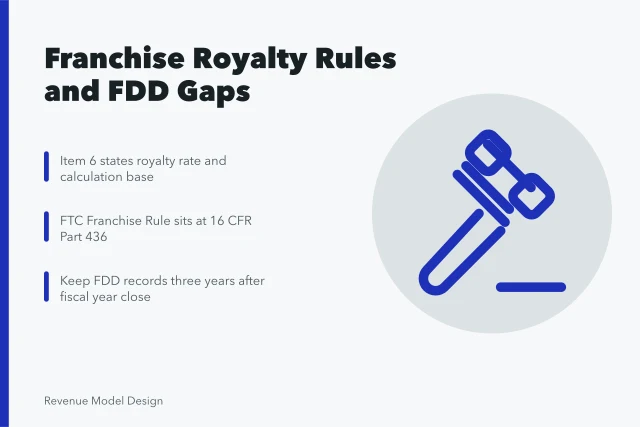
The FDD has 23 items. Item 5 covers initial fees. Item 6 covers other fees, including royalties, advertising contributions and any recurring charge. Item 12 covers territory. Those three items are where a revenue model becomes visible to a buyer and to a state examiner.
Item 5 requires the franchisor to state each initial fee, when it is payable, whether it is refundable and who receives it. If you charge a territory fee, an area development fee or a grand opening package, each one needs its own line and its own description.
Item 6 is the royalty page. It must show the amount or the formula, the due date, the base on which the royalty is calculated and whether the rate can change. A royalty stated only as "a percentage of gross sales" without defining gross sales invites a comment letter in registration states.
Item 12 covers protected territory and any restrictions on where the franchisee may sell. Exclusive territory promises affect the franchisor's ability to add units, so they affect long-run revenue per unit. The Franchise Rule Compliance Guide | Federal Trade Commission walks through each item and the plain language standard.
Financial performance representations are optional but heavily regulated. If you show average unit revenue, you must have a reasonable basis and disclose it in Item 19 with its assumptions. Many franchisors choose silence because a weak Item 19 is worse than none.
The rule also requires audited financial statements for the franchisor, attached as exhibits. A royalty-driven business with no audited revenue history raises questions from both franchisees and state examiners.
Franchisors must update the FDD annually within 120 days of the fiscal year end and promptly when a material change occurs. Royalty changes, new fee programs and litigation are material. The Franchise Rule | Federal Trade Commission page is the official text and is worth reading before you design a fee schedule.
One practical point: the FTC rule sets a floor, not a ceiling. States can and do add requirements, which is where the differences begin.
Royalty and fee structures compared across state franchise laws
States divide into registration states and non-registration states. Registration states review the FDD before the franchisor may offer or sell. Non-registration states rely on federal disclosure plus general anti-fraud law. The split shapes how fast a franchisor can launch and how much negotiation a royalty clause can absorb.
Registration states include California, New York, Illinois, Washington and Maryland. Minnesota, North Dakota, Rhode Island, Virginia and South Dakota also require registration. Wisconsin, Hawaii, Indiana, Michigan and Oregon round out the list. Texas and Florida are not registration states, though both have business opportunity and deceptive trade practice statutes that reach franchise sales.
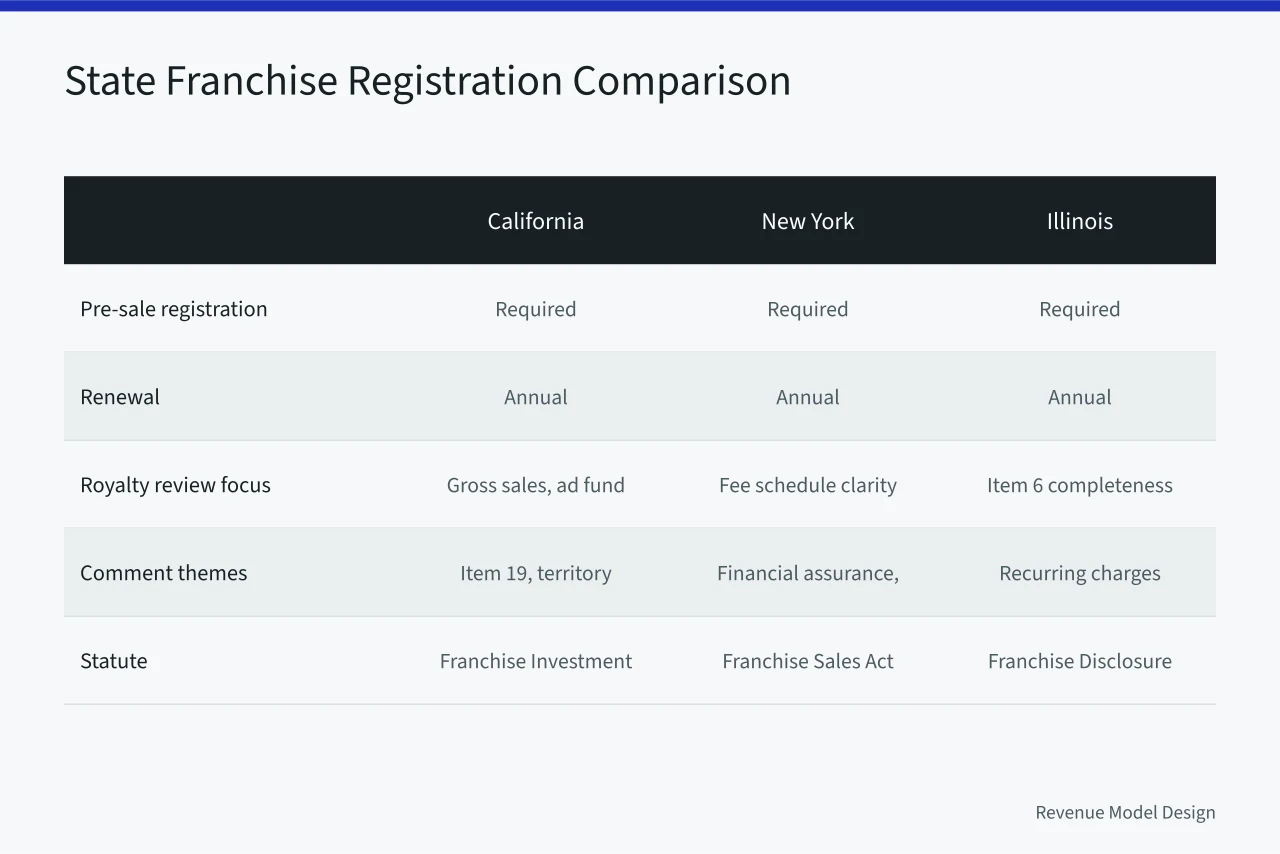
| Item | California | New York | Illinois |
|---|---|---|---|
| Pre-sale registration | Required | Required | Required |
| Renewal | Annual | Annual | Annual |
| Royalty review focus | Gross sales definition, advertising fund accounting | Fee schedule clarity, franchisee fee burden | Item 6 completeness, renewal and transfer fees |
| Typical comment themes | Item 19 substantiation, territory language | Financial assurance, escrow | Disclosure of all recurring charges |
| Statute | California Franchise Investment Law | New York Franchise Sales Act | Illinois Franchise Disclosure Act |
California franchise law is administered by the Department of Financial Protection and Innovation. It reviews the FDD, the franchise agreement and related documents before registration. Examiners commonly push back on vague definitions of gross sales, on advertising fund language that does not say whether funds are audited, and on Item 19 claims without backup.
New York franchise law is administered by the Department of Law. New York examiners look closely at the total fee burden on the franchisee and at whether the franchisor can support its obligations. In some cases New York requires financial assurance, such as an escrow or a surety bond, when the franchisor's financial condition is thin.
Illinois franchise law is administered by the Attorney General's office. Illinois focuses on complete Item 6 disclosure, including renewal fees, transfer fees, training fees and any charge that recurs. A franchisor that lists a royalty but omits a technology fee will get a deficiency letter.
Non-registration states still matter. Texas and Florida enforce their deceptive trade practice statutes, and franchisees there sue over earnings claims and hidden fees. Colorado and Massachusetts have their own franchise or business opportunity provisions that can apply.
For a franchisor, the practical sequence is to build one FDD that satisfies the strictest registration state you plan to enter, then file in the others. That usually means California-grade disclosure, since its examiners ask the most questions about royalty math.
If you are deciding how much of revenue to take as royalty versus initial fee, the revenue model choice is a strategy question before it is a legal one. Registration states will not fix a model that does not work.
California, New York and Illinois franchise registration regimes
Each of the three states runs a different process, with different timing and different fees. None of them accepts a federal filing as a substitute.
California requires registration before any offer or sale. You file the application, the FDD, the franchise agreement and exhibits, plus a consent to service of process. The state can take several weeks to clear a first filing, and longer if it issues comments. California also requires an annual renewal.
New York requires registration before any offer or sale, with a filing that includes the FDD and a separate state cover page. New York can require escrow or a bond when the franchisor lacks a financial track record. Renewals are annual.
Illinois requires registration before any offer or sale, filed with the Attorney General. Illinois also requires annual renewal and can require escrow in some cases. Illinois examiners are known for detailed questions about recurring fees.
A worked example shows why this matters. Suppose a franchisor charges a $40,000 initial fee, a 6 percent royalty on gross sales, a 2 percent advertising fund contribution and a $15,000 territory fee.
California will ask how gross sales are defined, whether the advertising fund is audited and whether the territory fee is refundable. New York will ask whether the franchisor can fund support staff at that royalty level. Illinois will ask whether any other recurring charge exists that Item 6 does not show.
All three states require the franchisor to keep the FDD current. Material changes, such as a new royalty rate or a new advertising fund, trigger an amendment. Selling in a registration state without a current registration is a violation of state law and can also be a federal problem.
Registration is not the same as approval of your business model. The states review disclosure, not profitability. A registered FDD can still describe a royalty structure that franchisees cannot survive.
For a side-by-side view of how fee design interacts with disclosure, the revenue models framework treats the FDD as an output of the model, not the model itself.
Franchise revenue models: royalties, advertising funds and territory fees
Franchise revenue usually comes from four places: initial fees, continuing royalties, advertising fund contributions and territory or development fees. Each has a different disclosure treatment and a different effect on franchisee behavior.
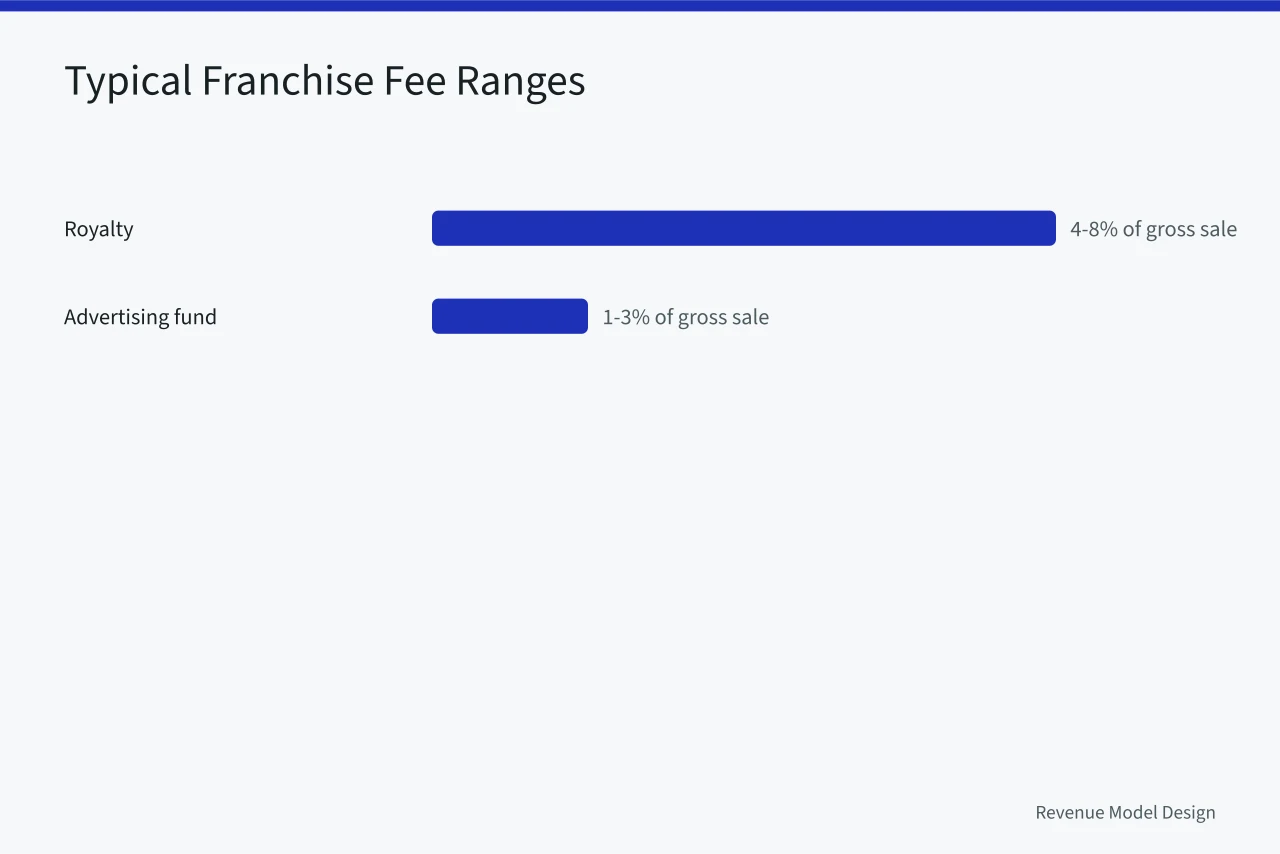
Royalties are the core recurring line. Most systems charge a percentage of gross sales, often in the 4 to 8 percent range, though the number varies by sector. Some charge a flat monthly fee instead. A flat fee is easier to administer but decouples franchisor revenue from unit performance.
Advertising funds are usually collected as a percentage of gross sales, often 1 to 3 percent, and are supposed to be spent on system marketing. The FDD must say whether the fund is audited, who controls it and what happens to surplus. Franchisee advisory councils often push for an audit requirement.
Territory fees are one-time charges for exclusive or protected areas. They can be structured as a fee for a defined radius, a population count or a set number of units. California and Illinois examiners read territory language closely because it limits the franchisor's future revenue.
Initial fees cover onboarding, training and site support. They are the easiest revenue to collect and the hardest to justify if they are pure profit. Franchisees compare initial fees against the support they receive.
A checklist for reviewing a franchise revenue model before disclosure:
- Every recurring charge appears in Item 6 with its formula and due date.
- Gross sales is defined in the franchise agreement, not left to custom.
- Advertising fund rules state whether funds are audited and who owns any surplus.
- Territory language matches the fee charged and the exclusivity promised.
- Item 19 claims have a documented reasonable basis.
- Royalty changes require notice and a stated process.
- State-specific addenda are prepared for California, New York and Illinois.
Revenue mix matters for franchisee incentives. A high initial fee with a low royalty rewards unit sales. A low initial fee with a high royalty aligns the franchisor with franchisee performance. Most systems blend the two.
The Franchise Revenue Model Design article covers how royalty rates interact with the blind spots in Item 6. The short version: a rate that looks fine in a spreadsheet can fail in a registration review if the base is undefined.
Advertising funds deserve special care. If the franchisor can use fund money for general overhead, the fund is effectively a second royalty. Examiners and franchisee associations both look for that.
Territory fees can create revenue timing problems. Collecting a large territory fee up front while delivering development rights over years creates a mismatch between cash and obligations. Some states ask about that mismatch directly.
Penalty offense notices and enforcement risk in franchise disclosure
The FTC enforces the Franchise Rule through administrative actions and, in some cases, civil penalties. Penalty offense notices are a specific tool: the FTC publishes a notice listing conduct it considers unlawful, and then can seek civil penalties against a company that engages in that conduct after receiving the notice.
The Notices of Penalty Offenses | Federal Trade Commission page explains the mechanism. For franchisors, the relevant risk is that disclosure misconduct, such as earnings claims without a reasonable basis or failure to deliver the FDD on time, can be treated as a penalty offense.
State attorneys general also enforce their franchise statutes. California, New York and Illinois can issue stop orders, require rescission offers and seek penalties. A registration violation is often the trigger for a broader inquiry into the royalty and fee structure.
Franchisee litigation is the other enforcement channel. Claims usually allege misrepresentation of earnings, hidden fees or failure to provide promised support. The FDD is the central exhibit in those cases, which is why Item 6 wording matters in court as well as in registration.
Practical risk controls are simple. Deliver the FDD early, document the delivery, keep Item 19 claims conservative and update the document when fees change. Most enforcement problems start with a stale FDD.
A franchisor that sells in a registration state without registering faces the highest risk, because the violation is easy to prove and the remedy can include rescission. That is an expensive outcome for a revenue model built on recurring royalties.
The revenue models questions article addresses how to think about enforcement exposure when the model itself is still being designed.
Trademark and patent protection for franchise systems
Franchise revenue models rest on licensed intellectual property. The trademark is the asset the franchisee pays to use. Without a protected mark, the royalty has no legal foundation.
Federal trademark registration with the USPTO gives nationwide rights and the ability to sue in federal court. The Trademark basics | USPTO page covers the difference between common law rights and registration, and why registration matters for enforcement.
Filing is done through the USPTO's online system. The Apply online | USPTO page covers the application process, the basis for filing and the examination steps. A franchisor should file before selling franchises, because a pending or registered mark is far easier to license.
Patents are less common in franchise systems but relevant in some sectors. A proprietary process, equipment or software can be patented, and the patent can be licensed alongside the mark. Patents have a limited term, so a revenue model built on a patent needs a plan for when it expires.
Confidential methods and formulas that are not patented are protected by contract, usually through confidentiality and non-compete provisions in the franchise agreement. State law on non-competes varies, and some states restrict them heavily.
Copyright covers manuals, training materials and software. A franchisor licensing a learning platform or app should own or license the copyright in it.
For revenue model design, the practical point is that the licensed asset determines what the royalty can be attached to. If the mark is weak, the royalty must be justified by support and systems rather than brand. The revenue models examples article shows how different asset bases produce different fee structures.
Registration of the mark also affects state franchise registration. Examiners expect the FDD to describe the mark and its registration status accurately. A claim of a registered mark that is only pending is a disclosure problem.
Common questions
Does the FTC Franchise Rule require a specific royalty rate? No. The rule requires disclosure of the royalty and its calculation, not a particular rate. Rates are set by the market and the franchisor's model.
Do I need to register in every state where I sell franchises? No. Only registration states require it. California, New York and Illinois are registration states, while Texas and Florida are not, though both enforce anti-fraud laws.
Can a state reject my FDD because of my fee structure? A state can require changes or additional disclosure, and can deny registration if the document is incomplete. It does not judge whether the fees are commercially wise.
What happens if I sell a franchise before delivering the FDD? You violate the FTC rule and possibly state law. Remedies include rescission, civil penalties and state enforcement action.
Are advertising fund contributions treated as royalties? They are disclosed separately in Item 6, but they function as recurring revenue. Franchisees and examiners scrutinize whether the fund is audited and controlled by the franchisor alone.
How long does state registration take? It varies by state and by the completeness of the filing. First-time filings with comments take longer than renewals, and California, New York and Illinois each run their own review calendars.