Rules
SaaS Revenue Model Design Under ASC 606: What to Change Before Your Audit
SaaS revenue model design ASC 606 sits under US GAAP, and auditors test the design before fieldwork. Here is what to change in the model and records.
What to take away
- ASC 606 is the US GAAP revenue standard issued by FASB, and the SEC reviews the filings that apply it.
- The design changes that matter sit in contract terms: renewal options, usage tiers, service credits and free periods.
- A compliant disclosure names each performance obligation, the transaction price, the allocation method, variable consideration and contract balances.
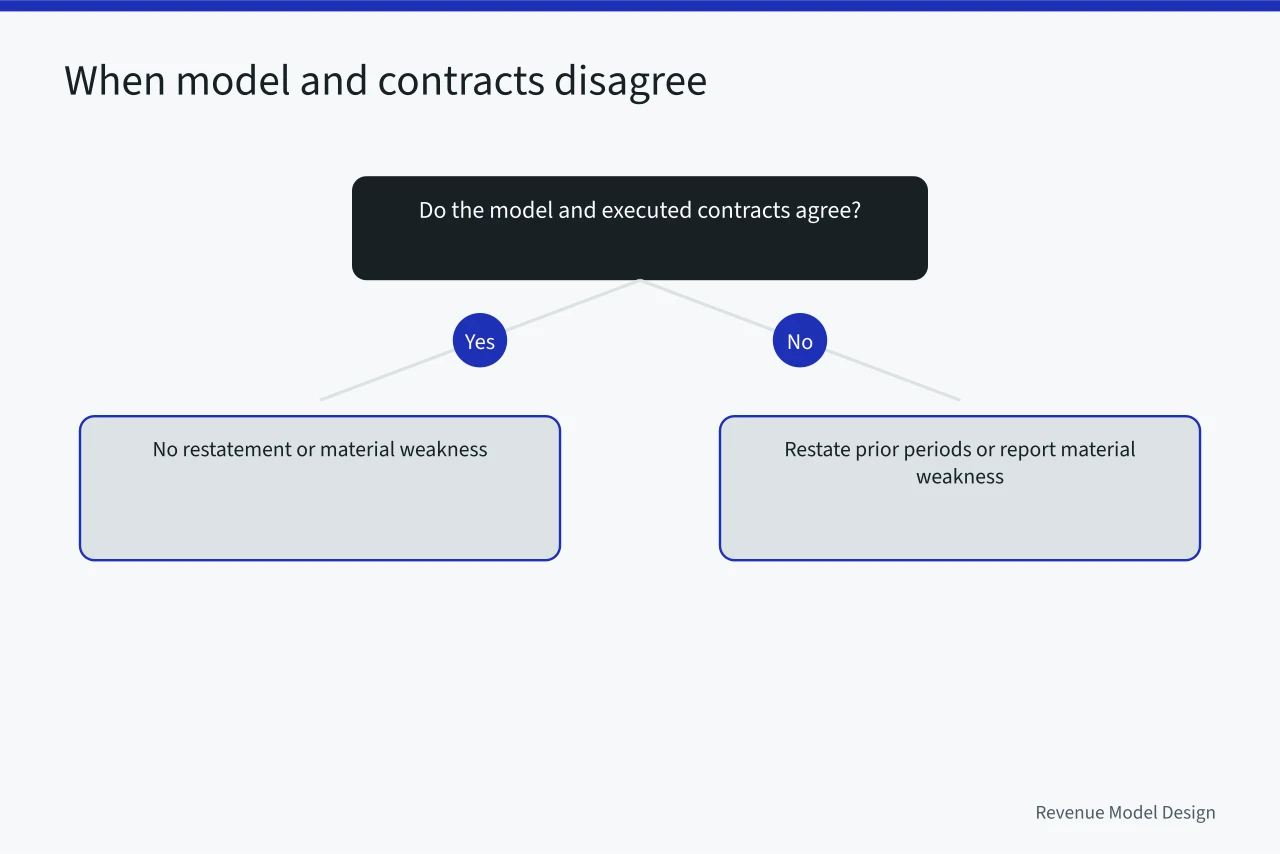
- One concrete consequence of a mismatch is a restatement, or a material weakness in internal control reported in the annual filing.
- Change the model before fieldwork starts. Auditors test the design that was in place, not the one described later.
Who sets the rule and who tests it
The Financial Accounting Standards Board issued Topic 606 as ASU 2014-09. Public entities applied it to annual periods beginning after 15 December 2017; private companies followed a year later.
SEC staff reviews filings that apply the standard, though the SEC does not write it. Comment letters on revenue notes and MD&A are public, showing what reviewers ask for first.
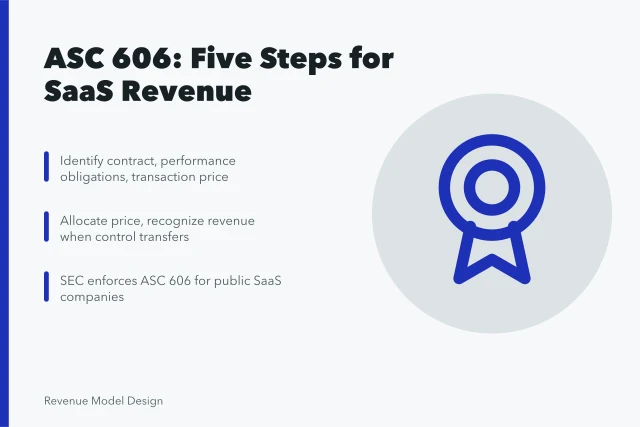
The Revenue recognition overview sets out the five-step model that sits under US GAAP. Finance teams should be able to trace any contract through those steps before an auditor asks for the trace.
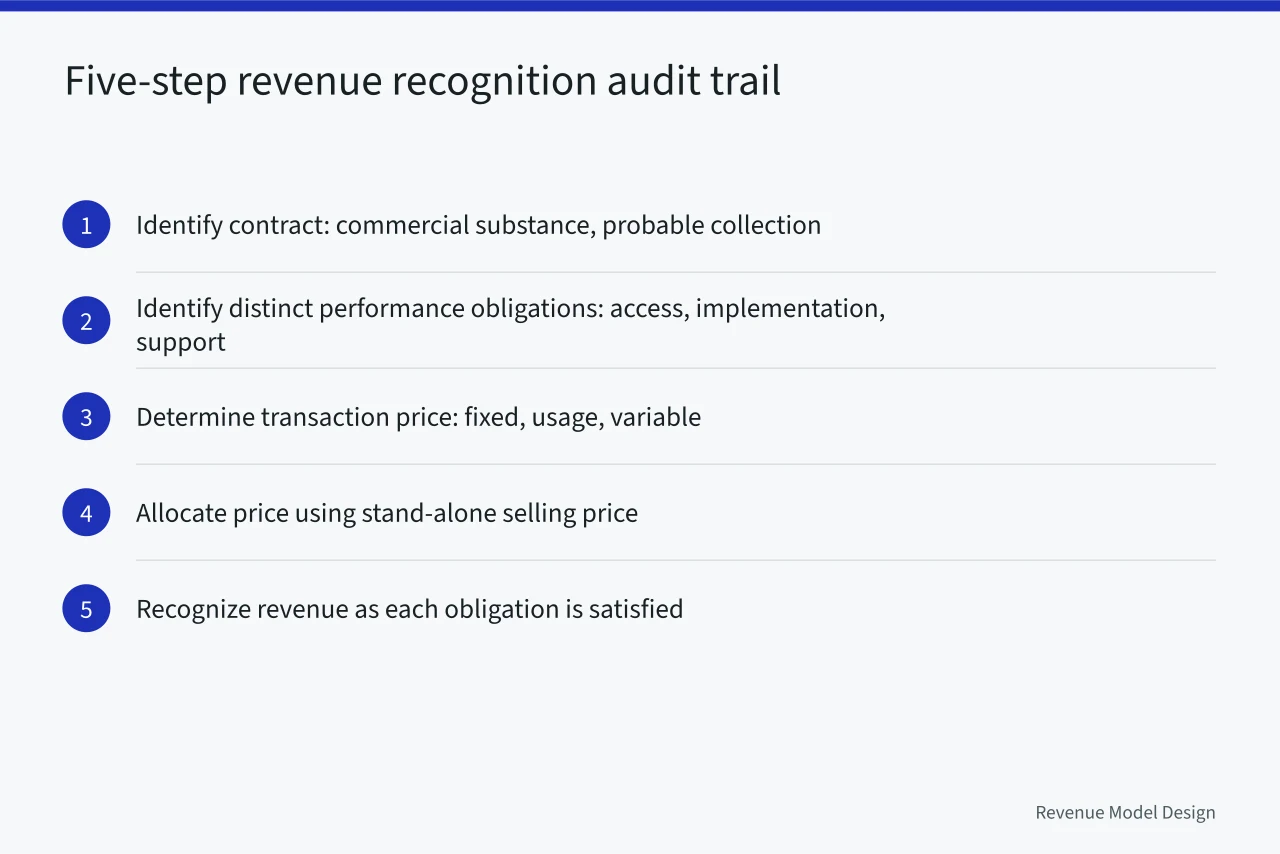
The five steps as an audit trail
- Identify the contract and confirm it has commercial substance and probable collection.
- Identify the distinct performance obligations. For SaaS, that is usually access, implementation and support.
- Determine the transaction price, including fixed fees, usage charges and variable consideration.
- Allocate the price to each obligation using stand-alone selling price.
- Recognize revenue as each obligation is satisfied, over time for access and at a point for some services.
Renewal terms and tier changes make the second step harder than it looks. The subscription models questions that finance teams raise usually start with those terms, long before anyone opens the accounting policy.
What a compliant disclosure contains
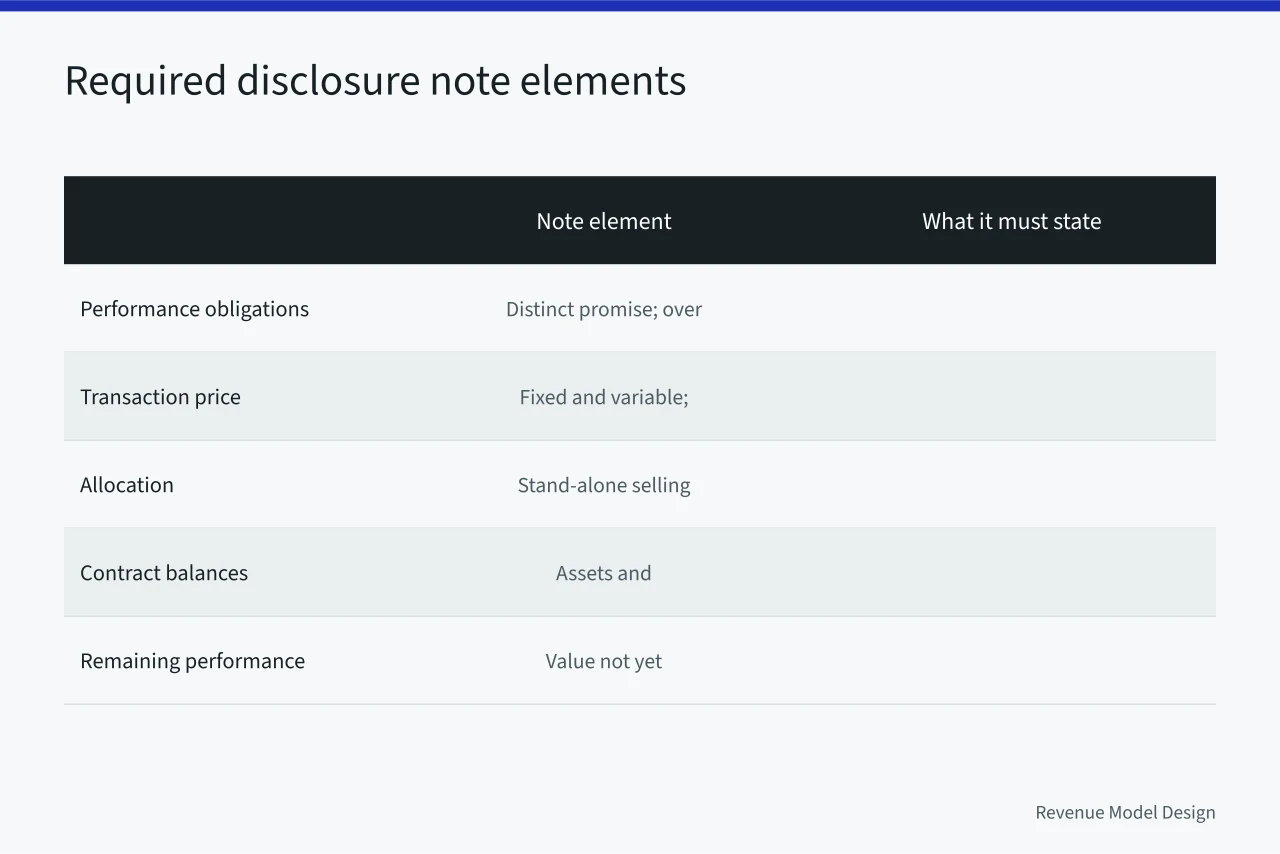
| Note element | What it has to state |
|---|---|
| Performance obligations | Each distinct promise, and whether it is satisfied over time or at a point |
| Transaction price | Fixed and variable amounts, and how variable consideration was estimated |
| Allocation | Stand-alone selling price for each obligation and the evidence behind it |
| Contract balances | Contract assets and contract liabilities, with the movement in the period |
| Remaining performance obligations | Value not yet recognized and when the company expects to recognize it |
The judgments carry as much weight as the numbers. Disclose the constraint applied to variable consideration and the method used to estimate it. A company may use the practical expedient and omit remaining performance obligations when the contract term is one year or less, but the note has to say so.
Usage charges enter the transaction price as customers incur them, and the pay-as-you-go pattern shows how those charges sit beside a base subscription fee.
Example: a service credit that changes the allocation
A customer receives a service credit after an outage. The credit reduces the transaction price, unless it grants a material right the customer would not otherwise receive. When it is a material right, the company treats it as a separate performance obligation and allocates revenue to it.
The accounting answer depends on wording that sales teams often settle late. Read the credit clause beside the pricing architecture mistakes that appear when discounts and credits are documented after the deal closes.
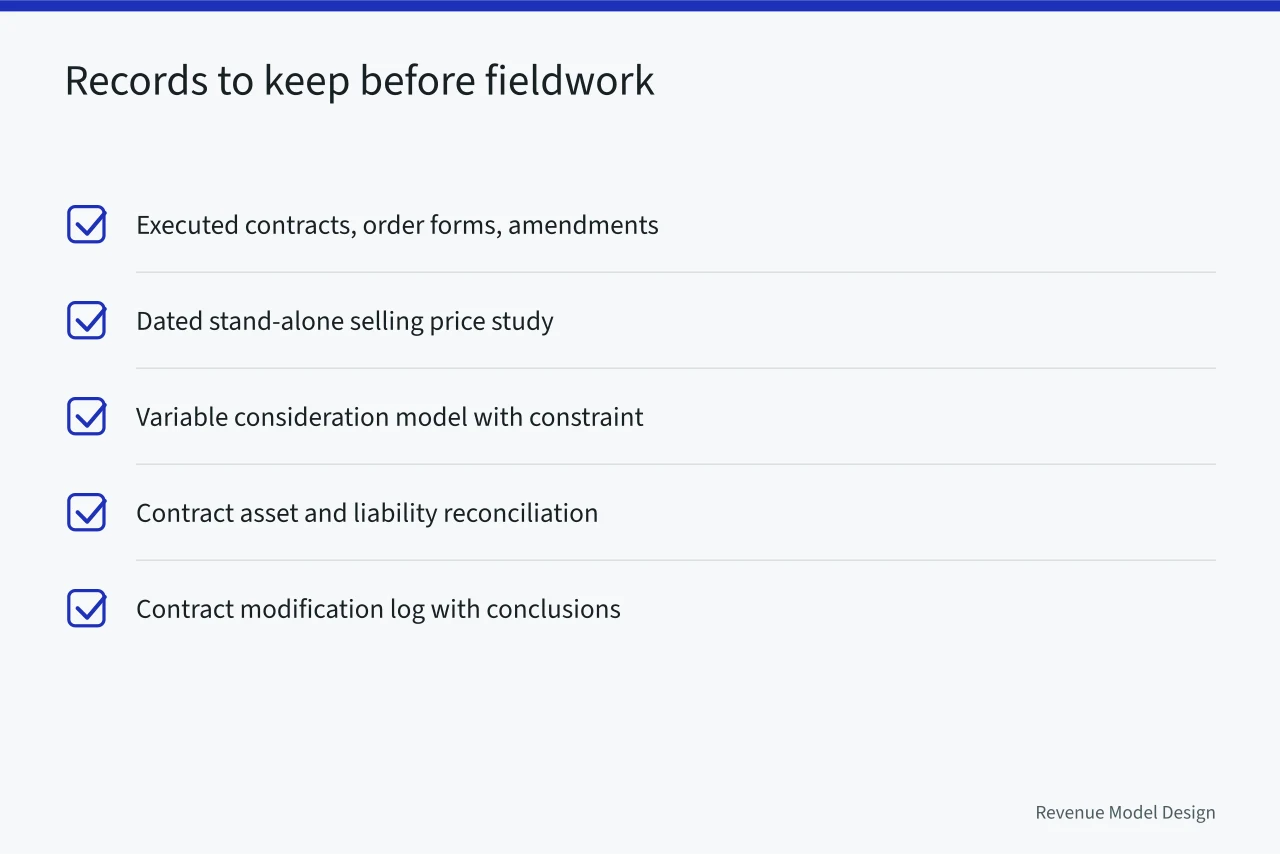
Records to keep before fieldwork
- Executed contracts, order forms and amendments for every arrangement in the sample.
- The stand-alone selling price study, dated, with the method and inputs.
- The variable consideration model, showing the constraint that was applied.
- A reconciliation of contract assets and liabilities to the general ledger.
- A log of contract modifications, with the accounting conclusion for each one.
Auditors sample from the population, so the population has to be complete. A missing amendment is a common cause of an adjustment, and it is the cheapest one to prevent.
What happens when the model and the contracts disagree
The consequence is concrete. Management either restates prior periods or reports a material weakness in internal control over financial reporting in Item 9A of the Form 10-K. Both outcomes force a delay, legal review and a conversation with lenders. The business model types checklist covers the accounts where this kind of gap usually hides, including deferred revenue and unbilled receivables.
SEC staff also issue comment letters that ask for revised disclosure, and those letters stay public. Any reader can pull them by company name and read what the staff questioned.
Where the rules differ by place
IFRS 15 and ASC 606 are converged in substance, and the differences that remain are narrow. A US parent with a foreign subsidiary still holds both sets of disclosure requirements in view, because one contract can be reported under two regimes.
Common questions
Does ASC 606 apply to a private SaaS company? Yes. It is US GAAP for public and private entities, though private companies adopted it a year later. Lenders and acquirers ask for the same numbers.
Which change prevents the most comment letters? Align the revenue note with the executed contracts. Most letters ask for detail the company already holds but never put in the note.
How early should the model change before an audit? At least one full quarter before year end, so the revised controls operate long enough to be tested. A change made during fieldwork leaves nothing to test.
Which numbers matter most to a reviewer? The ones a reader can tie back to the ledger and to a defined unit. The unit economics examples show how often the obvious unit is the wrong one.