Rules
California Consumer Privacy Act and its impact on ad-based revenue
CCPA ad-based revenue California: how the state privacy law hits targeted ads, opt-out and sale rules, enforcement, and the fixes publishers use.
What to take away
- CCPA ad-based revenue California publishers earn depends on whether personal information is sold or shared, and on how cleanly opt-outs are honored.
- Targeted advertising still works in California, but it needs a lawful basis, a working opt-out path, and honest notices.
- The California Attorney General can fine violations, and consumers can sue over breaches tied to weak data security.
- Publishers that keep contextual inventory, first-party segments and clean consent records hold more of their California revenue than those that do not.
- No other state privacy law copies California exactly, so a single national setup will not fit every market.
What CCPA requires of publishers running ad-based revenue
The California Consumer Privacy Act gives California residents rights over personal information that businesses collect about them. For a publisher, that means ad tech, analytics, newsletters and paywall accounts all sit inside the same rules.
The statutory text sets out the core duties: notice at collection, a privacy policy, rights to know, delete, correct and opt out, and limits on how personal information is used. Read the definitions carefully, because they decide which of your ad partners you must name.
The California Consumer Privacy Act (CCPA) | State of California - Department of Justice - Office of the Attorney General guidance page is the clearest plain-language summary of what a covered business must do. It covers notices, consumer requests and the opt-out link publishers are expected to post.
Coverage turns on thresholds. A for-profit business that meets the revenue, data-volume or data-selling tests falls under the law, and most mid-sized ad-supported publishers in the state cross at least one. Household-level data and deidentified data sit outside the definition if handled properly.
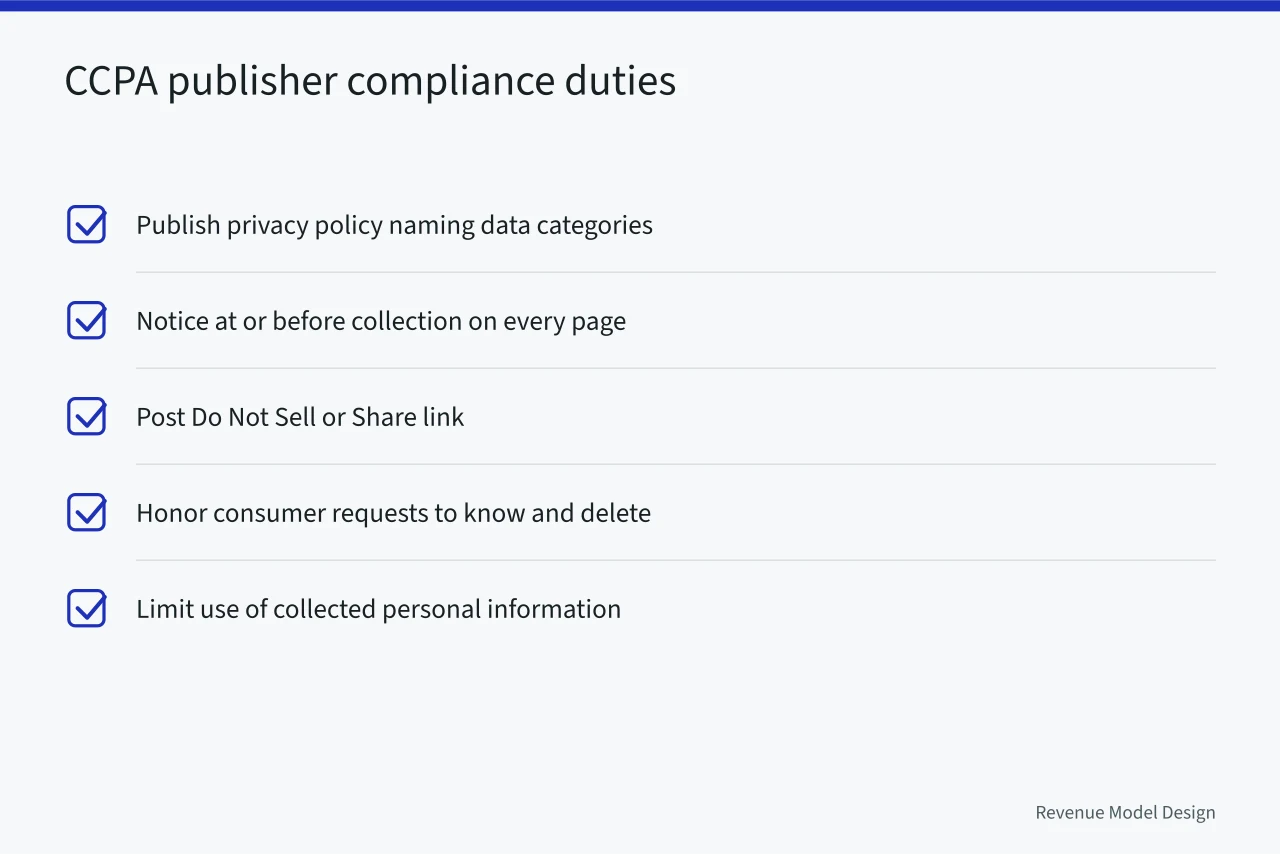
That checklist is not a legal opinion. It is the operating list most publishers end up building, and skipping items on it is where enforcement usually starts.
One structural point drives everything else. If your ad stack passes identifiers to bidders so they can build profiles, you are likely selling or sharing personal information under the state law, whatever your contract calls it.
The Codes Display Text on the legislature site carries the operative language, including the notice and opt-out provisions that shape ad operations.
How CCPA reshapes targeted advertising and audience data value
Behavioral targeting depends on linking a person to a profile across sites and sessions. The law does not ban that, but it makes the link revocable, which changes what a California impression is worth.
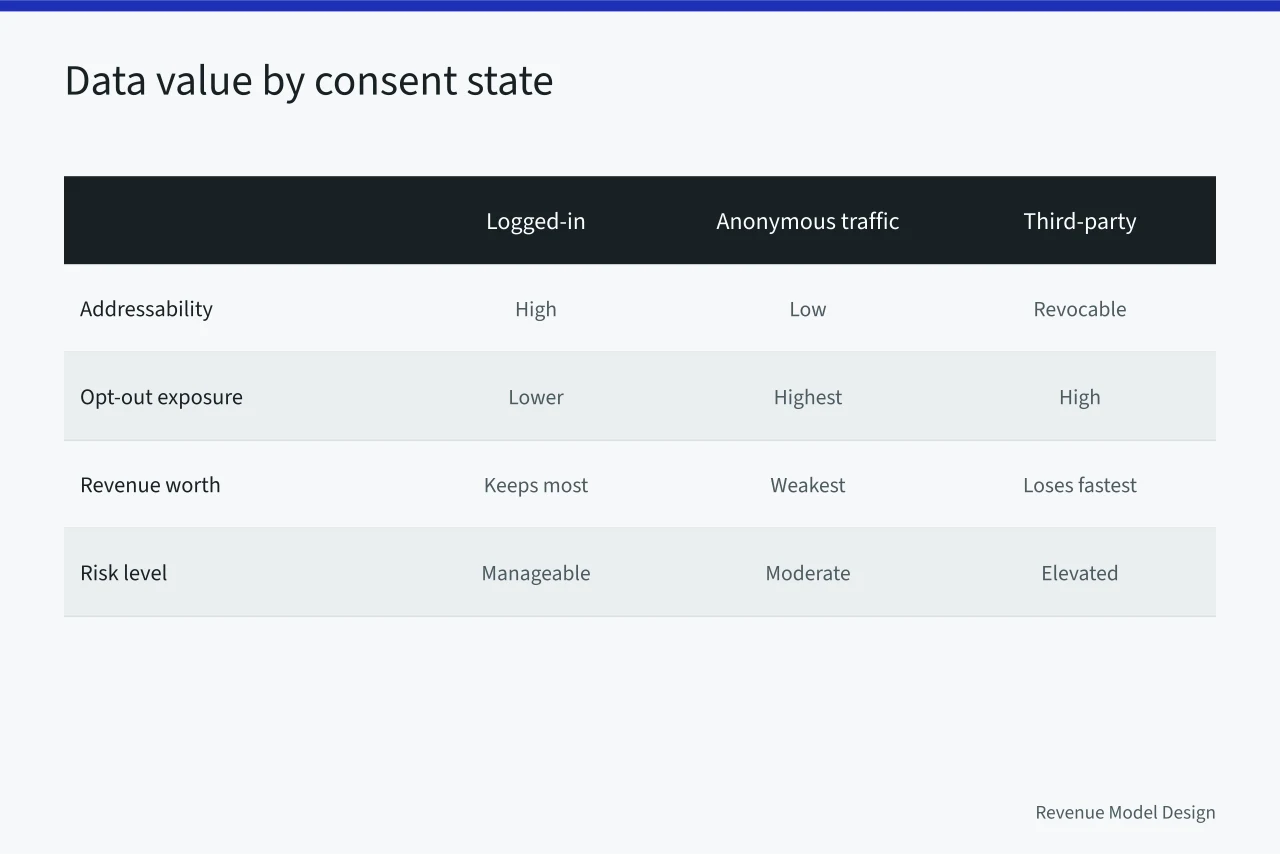
When a user opts out, the identifiers that made the impression addressable stop flowing. The bidder sees less, bids lower, and the publisher keeps the difference as a revenue gap on that impression.
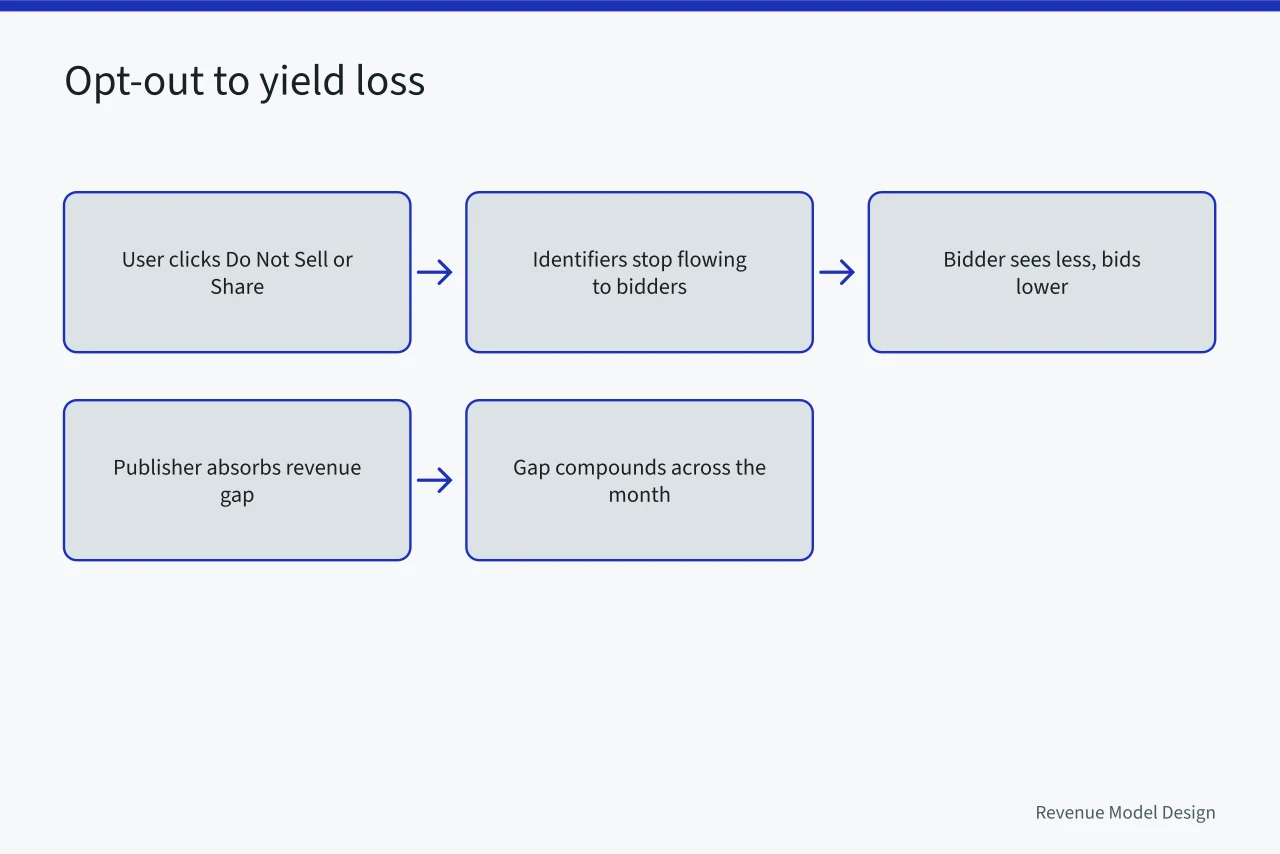
Audience data value splits accordingly. First-party data collected directly, with notice and a lawful basis, keeps most of its worth. Third-party segments resold across the open market lose value in California faster than elsewhere.
This is where the revenue model choice matters. A publisher that treats audience data as the product, rather than as an input to advertising, ends up with a different cost base and a different risk profile.
The practical effect on a California news site is uneven. Loyal readers who log in produce clean first-party signals. Anonymous search traffic produces the least addressable inventory, and that is exactly the traffic most exposed to opt-out rates.
Sensitive categories raise the bar again. Precise geolocation, health interests and data about children carry extra limits, and a publisher that builds segments around them is buying risk along with reach.
Opt-out rights, sale definitions and their effect on ad pricing
The sale of personal information definition is the hinge. It covers disclosing personal information to another business for monetary or other valuable consideration, and the word valuable is doing a lot of work.
Sharing for cross-context behavioral advertising is treated alongside selling, which means a publisher cannot escape the opt-out duty by arguing that no money changed hands for the data itself.
Opt-out rights are cheap for the consumer to exercise and expensive for the publisher to absorb. A single click or a browser signal can remove a user from addressable inventory for as long as the preference stands.
Pricing effects follow the addressable share. If opt-outs run low, programmatic yields hold close to national benchmarks. If they run high, the same page views clear at lower rates and the gap compounds across a month.
Deals soften the blow. Private marketplaces with named buyers, direct sponsorships and newsletter placements price on context and audience relationship rather than on individual identifiers, so they resist opt-out pressure better.
Publishers should also watch how they describe their own practices. Calling a data flow something other than a sale does not change the analysis, and mismatched language between policy and code is a common audit finding.
A useful reference point sits in the revenue models examples, where publishers compare what each mix of advertising and reader revenue actually returns.
Enforcement by the California Attorney General and consumer actions
The California Attorney General enforces the law, and the office has treated cure periods as a limited courtesy rather than a permanent shield. Enforcement letters and published examples focus on basics: missing opt-out links, broken request handling, and notices that do not match reality.
The Privacy and Data Security | State of California - Department of Justice - Office of the Attorney General page is where the office collects its privacy work, including enforcement activity. It is worth reading before a compliance review, not after a complaint.
Consumer protection actions run in parallel. Protecting Consumers | State of California - Department of Justice - Office of the Attorney General shows how the office frames harm to residents, which is the frame that also applies when ad tech misuses data.
The private right of action is narrower but sharper. It attaches to certain data breaches caused by a failure to maintain reasonable security, and statutory damages per consumer add up quickly when a database holds reader records.
Children's data brings federal exposure on top of state rules. Complying with COPPA: Frequently Asked Questions | Federal Trade Commission explains the parental consent and data retention limits that apply when a site is directed to children or knowingly collects their data.
Enforcement risk is not evenly spread. Publishers with documented request logs, vendor contracts and staff training tend to resolve complaints early. Those without them tend to spend the money on lawyers instead.
Strategies to adapt ad models without losing California revenue
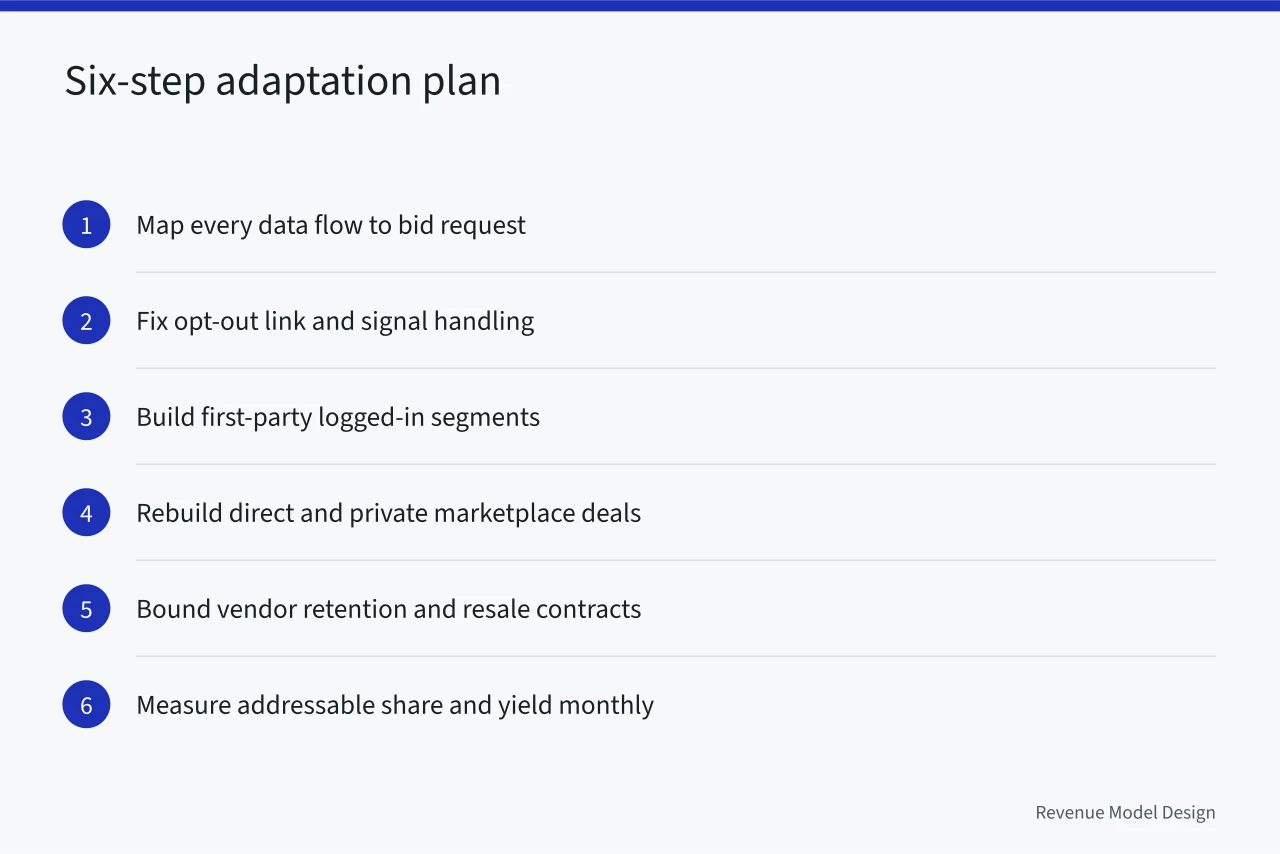
Adaptation is mostly about which inventory you sell and how you prove what you know about the reader. The publishers holding California revenue are not the ones with the most data, they are the ones with the cleanest rights to it.
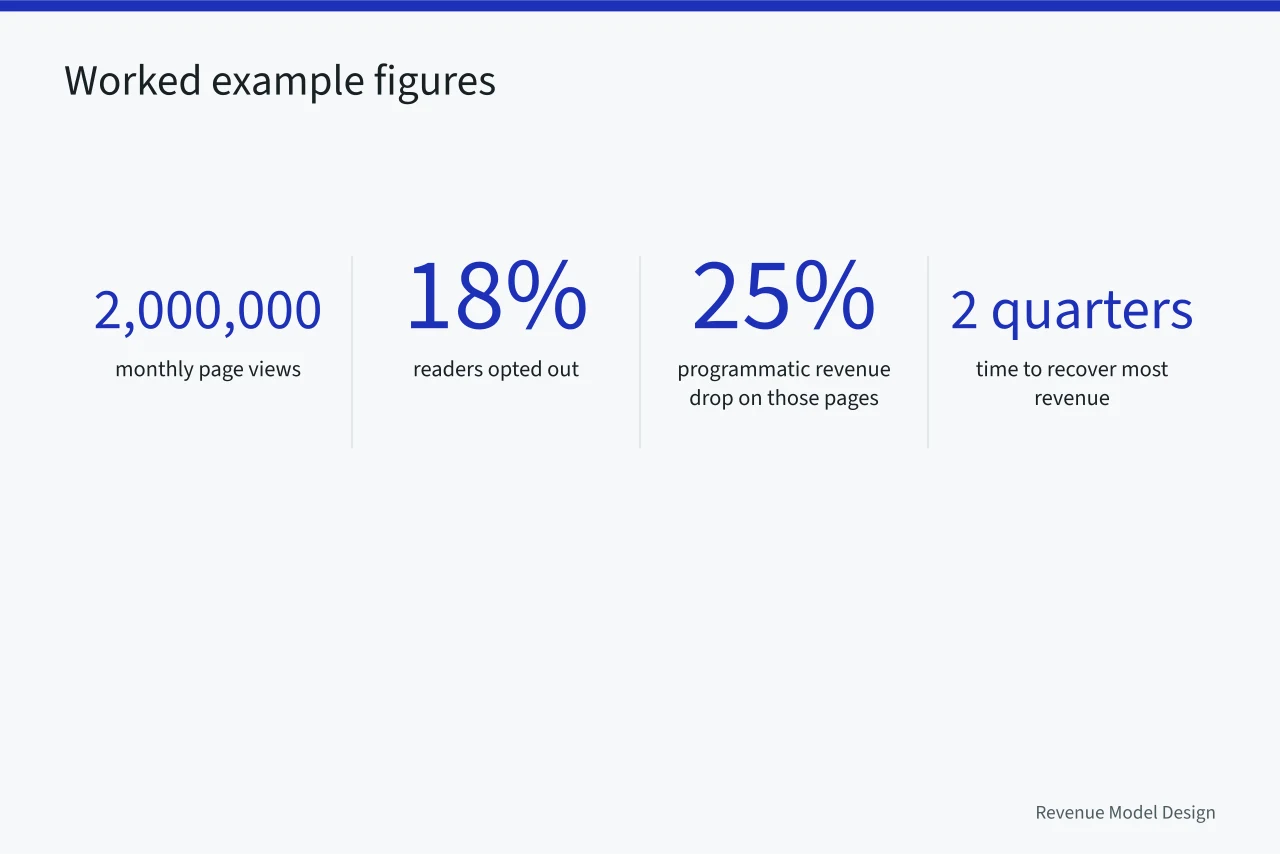
Worked example. A California lifestyle publisher with two million monthly page views finds that 18 percent of its readers have opted out. Addressable impressions fall, and programmatic revenue on those pages drops by roughly a quarter.
The publisher moves its food and travel sections to contextual packages sold directly, keeps behavioral targeting only for logged-in readers who have not opted out, and adds a sponsor slot to its newsletter. Total California revenue recovers most of the loss within two quarters, with lower data risk.
The Ad-Supported Revenue Model Design guide covers how advertising and subscription lines interact on the same audience, which is the mix most California publishers end up running.
Subscription models offer a partial hedge, because paying readers give a lawful basis for personalization and a relationship that does not depend on third-party cookies. They also raise the cost of acquisition, so the math has to be run honestly.
Neither path removes the compliance work. It only moves where the data sits and who carries the risk when a request arrives.
CCPA versus other state privacy regimes for ad-supported publishers
California moved first, and other states borrowed parts of the framework without copying it. New York, Texas, Florida, Washington and Massachusetts each handle privacy differently, and Colorado and Illinois add their own advertising and biometric rules.
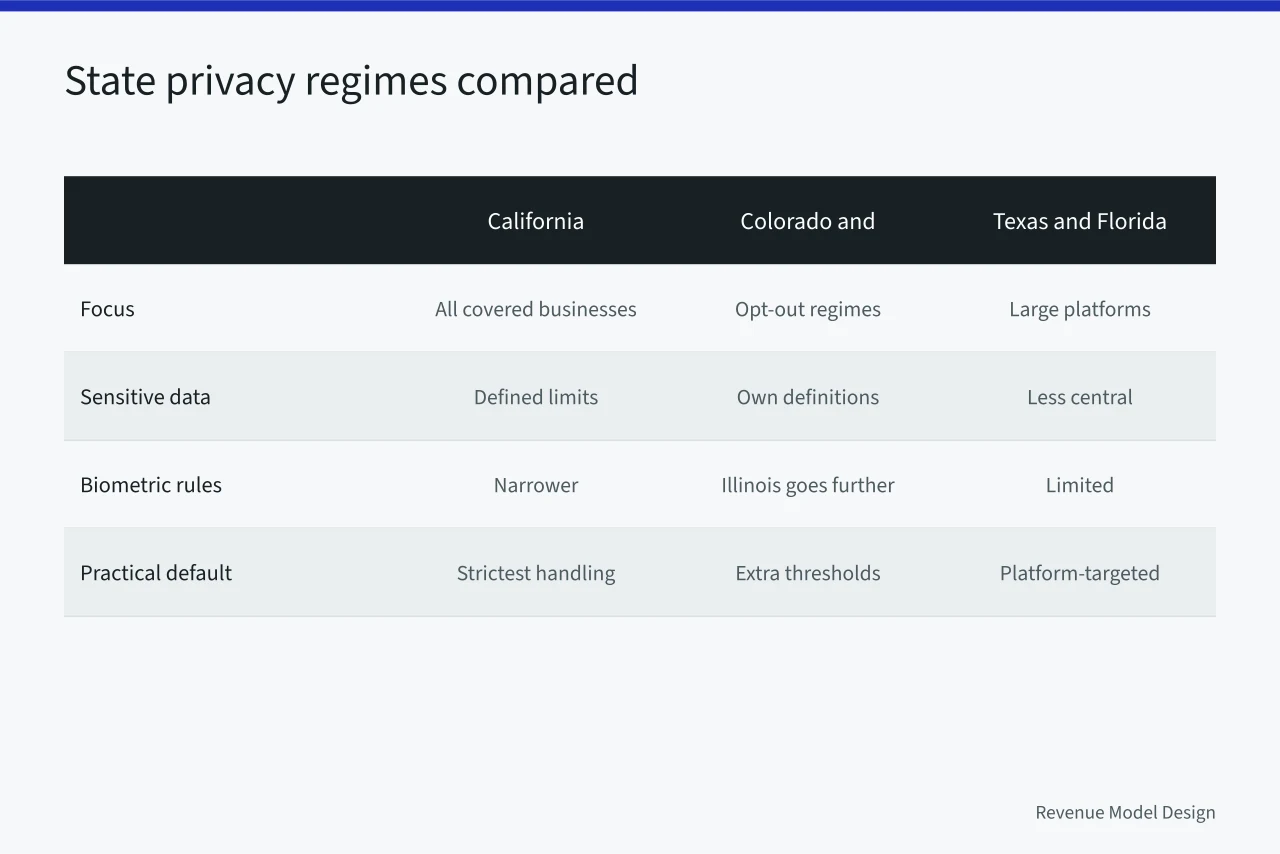
Colorado and Washington have opt-out regimes with their own thresholds and sensitive-data definitions. Illinois biometric rules reach further than California's in some respects. Texas and Florida have focused on large platforms rather than on every publisher.
That patchwork matters for national ad operations. A single consent banner and one data flow will not satisfy every state, and the differences show up in how opt-outs are honored and how long data can be kept.
The honest answer for a California publisher selling nationally is to build to the strictest rule it can afford, then document the exceptions. That usually means California-level handling becomes the default.
Federal oversight still sits underneath. The Federal Trade Commission polices deceptive practices in advertising and data handling, and the Internal Revenue Service and Securities and Exchange Commission shape how the resulting revenue and obligations are reported.
Accounting follows the money. Under FASB rules, revenue from advertising arrangements is recognized as performance obligations are met, so consent-driven yield changes show up in reported results, not just in dashboards.
Budgeting for compliance is a small-business question too. SBA guidance and Census Bureau and BEA data help publishers size their market, but neither replaces a lawyer's read of the statute.
Trademark and brand licensing issues sit at the edge of this work, and the U.S. Patent and Trademark Office is the place to check marks used in ad products and data services.
Where publishers get stuck is not the law itself. It is the number of open questions about how far to go, and the revenue models questions that follow from them are usually about risk appetite rather than compliance.
Common questions
Does CCPA ban targeted advertising in California? No. It gives residents the right to opt out of the sale or sharing of their personal information, which removes them from much behavioral targeting but leaves contextual and first-party advertising intact.
What counts as a sale of personal information? Disclosing personal information to another business for monetary or other valuable consideration. Sharing data for cross-context behavioral advertising is treated alongside selling, so the opt-out duty applies even without a cash payment.
How does the California Attorney General enforce the CCPA? Through investigative letters, published enforcement examples and civil penalties for violations. The office has focused on missing opt-out mechanisms, broken request handling and notices that do not match actual data practices.
Can consumers sue a publisher directly? Only in limited cases, mainly data breaches caused by a failure to maintain reasonable security. Statutory damages per consumer apply, which is why breach response and data retention matter for ad-supported sites.
Do other states follow the same rules? Not exactly. Colorado, Washington, Texas, Florida and Illinois each differ on thresholds, sensitive data and opt-out mechanics, and other states add rules of their own. A national publisher needs more than one compliance posture.
What is the fastest fix for lost California ad revenue? Repair the opt-out path, move value into first-party and contextual inventory, and sell more through direct and private marketplace deals. Those three changes recover yield faster than any data purchase.