Guides
Part of Subscription models and the promises recurring revenue cannot break
5 plain facts about subscription models questions
Subscription models questions answered with churn arithmetic: what a monthly loss rate does to a book, what expansion offsets, and what cancellation owes a customer.
Recurring revenue looks like a solved problem until you work out what a small monthly loss rate does over a year. It is the least intuitive arithmetic in business models. Two companies with the same growth rate can be in completely different situations.
Below, the questions people actually ask, with the calculation attached. All figures are invented placeholders.
What to take away
- A monthly churn rate is not a small number. Three percent a month leaves about two thirds of a cohort after a year.
- Gross churn sets how much new revenue you need just to stand still. Compute it before setting any growth target.
- Expansion from existing customers is what turns a shrinking book into a growing one, and it is measured separately from new sales.
How bad is our churn?
Convert it into two things people can feel: average life and one-year survival.
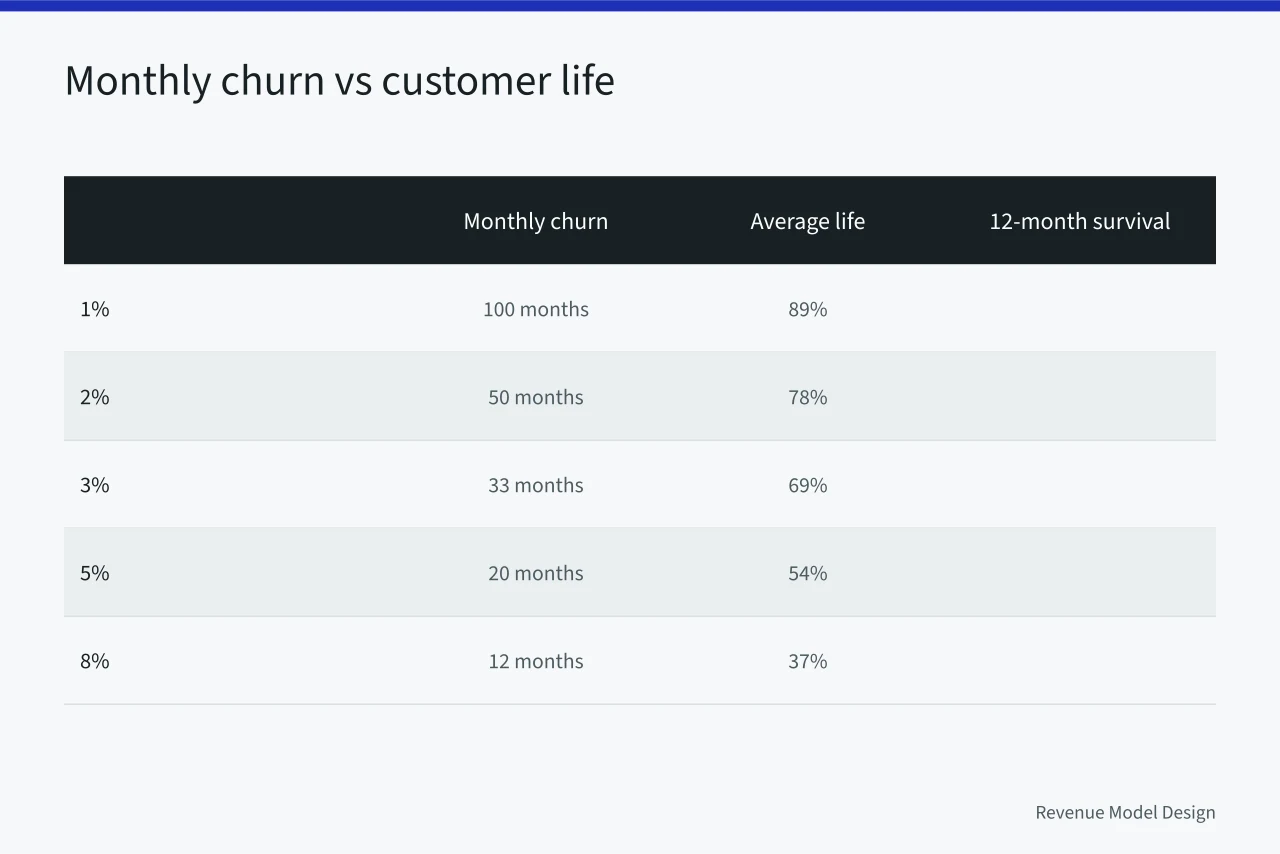
| Monthly churn | Average life | Share left after twelve months |
|---|---|---|
| 1% | 100 months | 89% |
| 2% | 50 months | 78% |
| 3% | 33 months | 69% |
| 5% | 20 months | 54% |
| 8% | 12 months | 37% |
The jump from one percent to three percent does not look like much in a monthly report. It is the difference between a customer relationship lasting eight years and one lasting under three. Everything you can afford to spend on acquisition changes with it.
How much do we have to sell just to stand still?
Gross churn multiplied by the book. On a book of 1,000,000 a year: 10% annual churn means 100,000 of new revenue before any growth, 20% means 200,000, and 30% means 300,000.
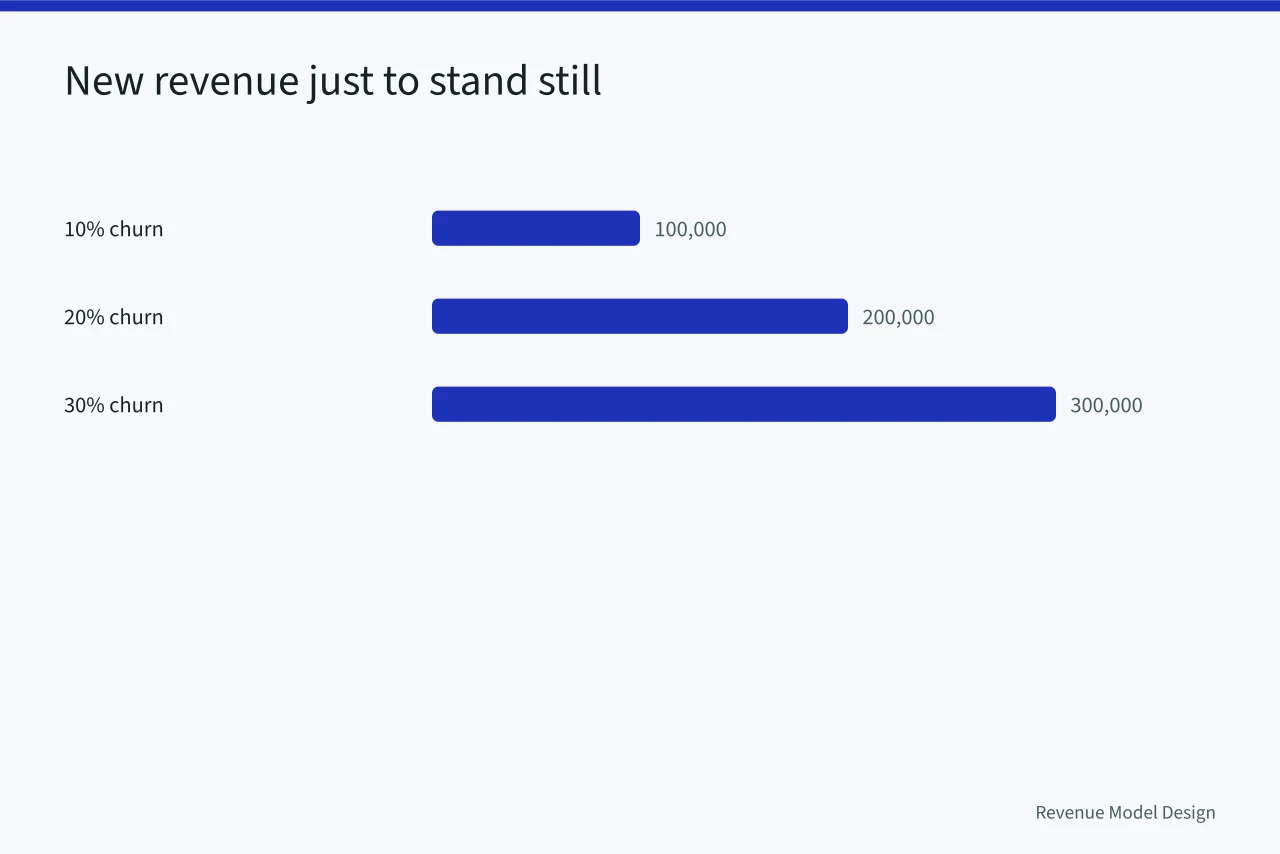
That last number is worth putting in front of a board that asked for growth. A team facing 30% churn has to replace nearly a third of the business every year before any growth appears. No amount of sales effort makes that arithmetic kinder.
What the money is actually triggered by, and whether a subscription is even the right shape, is set out in subscription models.
Does expansion really matter that much?
Yes, and the compounding is the reason. Take a book of 1,000,000 and hold it for three years:
- Lose 15%, expand 5%: net 90%, and the starting book is worth 729,000.
- Lose 15%, expand 20%: net 105%, and it is worth 1,157,625.
- Lose 8%, expand 12%: net 104%, and it is worth 1,124,864.
- Lose 25%, expand 10%: net 85%, and it is worth 614,125.
Same starting book, and after three years the best case is nearly twice the worst. The second and third rows land in almost the same place by different routes. That is why reporting a single retention figure without saying whether it includes expansion tells you very little.
What can we afford to spend on acquisition?
Payback in months is acquisition cost divided by monthly revenue times gross margin:
- Cost 900, revenue 150 a month, 75% margin: 8.0 months.
- Same cost at 45% margin: 13.3 months.
- Cost 2,400 at 75% margin: 21.3 months.
- Cost 2,400 at 45% margin: 35.6 months.
The last line is longer than the average life of a customer churning at 3% a month. That business is paying to lose money on every sale. Payback is a statement about cash rather than profit, and the full version of that distinction is in unit economics.
What do we owe someone who wants to cancel?
Whatever your terms say, the terms themselves have legal constraints. Automatic renewal arrangements are regulated: the federal provision on negative option marketing sets requirements around disclosure, consent and cancellation for online arrangements, and the rule on prenotification negative option plans covers a related shape.
What applies to your business is a question for a lawyer in your jurisdiction. The practical point is that a cancellation process designed only to reduce churn is a legal exposure as well as a bad experience.
The commercial point is separate and simpler. Churn hidden by a difficult cancellation is churn deferred, and it arrives later with a worse feeling attached. How the price and term are structured, which is where most of these fights actually start, belongs in pricing architecture, and whether the whole shape should change is a model innovation question.
Common questions
Should churn be counted by customer or by revenue?
Both, labeled, and never blended. Losing many small accounts and losing one large one are different problems, and a single figure reports them identically.
Is annual billing a fix for churn?
It defers the decision rather than removing it, and it improves cash. What it does not do is make the product more worth keeping, so a book on annual terms with a weak product shows the same loss a year later in one lump.
Does a free trial belong in the churn calculation?
Not in the same one. Trial-to-paid conversion and paid churn are different measures with different causes, and mixing them produces a number that moves for reasons nobody can name.
How long before a churn improvement shows in revenue?
Roughly the average life of a customer, because the book has to turn over before the new rate dominates. Expecting it in a quarter is how good changes get abandoned.