Features
The five tolls that decide whether platform models actually work
Platform models tested rather than claimed: whether third parties really produce on top of you, the five tolls available, and why the rules are the pricing.
"Platform" is the most over-claimed word in business model design. Almost every software company calls itself one, and most are selling a product with an integration menu. The distinction matters commercially: a platform earns money from production it does not perform, which changes what you can charge for, what you are responsible for, and what your rules are worth.
This page is a test rather than a description. First, whether you have a platform at all. Then, if you do, the ways of charging for it and what each one distorts. Then the two problems that come with the territory.
What to take away
- Sooner or later a platform is tempted to build the thing its most successful participants build.
- If you own the platform: the number of participants making a specific investment, not the number registered.
- Decide honestly whether other people produce on top of you.
The qualification test
Five questions. Answer them about what exists today, not what is on the roadmap.
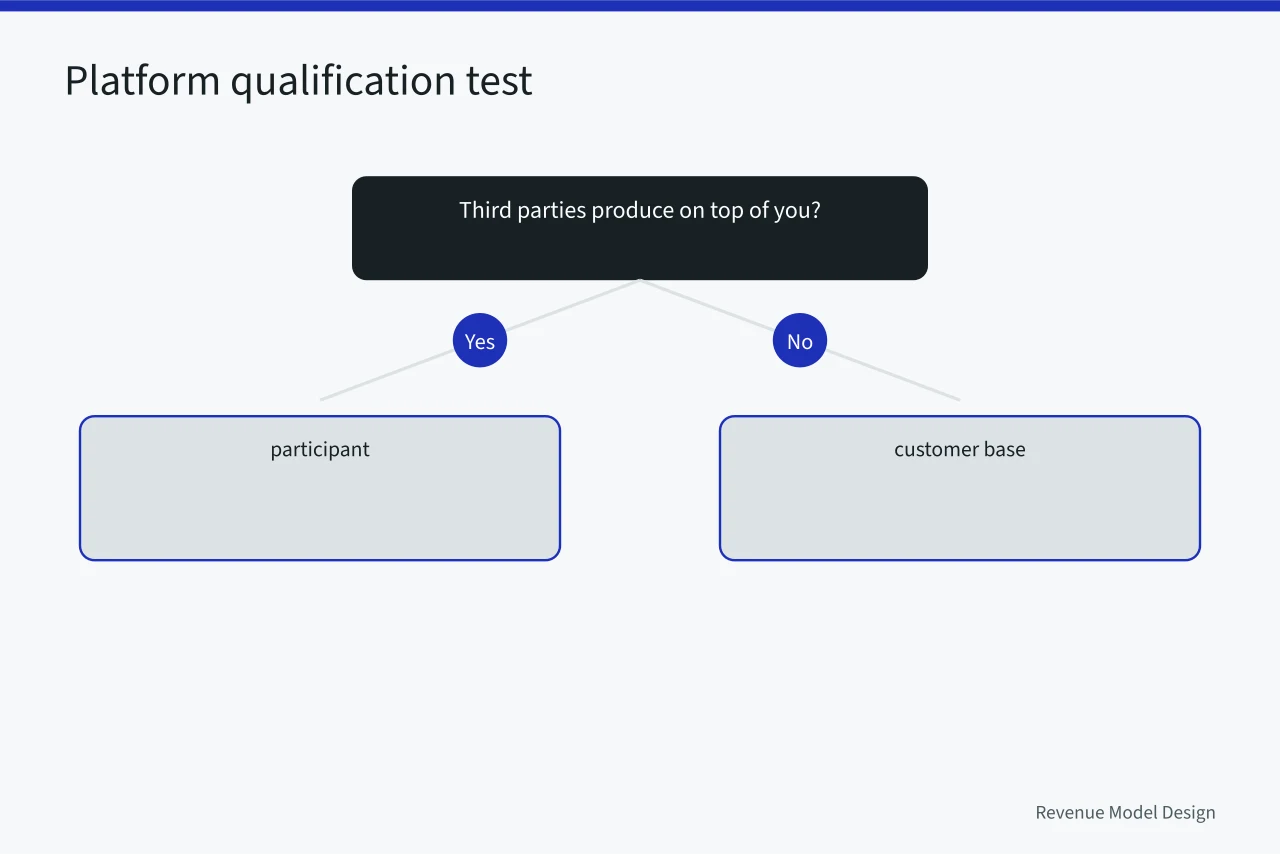
Do third parties produce something on top of you that you do not produce? Applications, listings, content, services, integrations, extensions. Not "use your product": build on it, and offer the result to someone else.
Do those parties make investments that are specific to you? Time learning your model, code written against your interfaces, a business built around your distribution. Specific investment is the difference between a supplier and a participant.
Does one participant's presence make you more valuable to a different participant? If more builders make the platform better for users, and more users make it better for builders, you have the effect. If more of either just means more revenue, you have a customer base.
Do you set the rules of exchange between other parties? Eligibility, ranking, defaults, quality standards, dispute handling. Governing an exchange is the defining function.
If you disappeared, would participants lose more than a supplier? A platform's exit destroys businesses built on it. A product's exit means a migration.
Three or more clear noes means you have a product, possibly a very good one, with an ecosystem story attached. That is not a downgrade: product economics are simpler and more predictable. It does mean platform monetization, which taxes other people's production, will read as extraction, because there is no production to tax.
Separate a platform from a marketplace, though the words are used interchangeably. A marketplace matches and clears a transaction between two sides, covered in marketplace models.
A platform hosts production and governs it. Many businesses do both, but the monetization logic differs: a marketplace charges for a completed match; a platform charges for continuing access to the conditions that make production worthwhile.
The toll menu
There are five main ways to take value out of a platform, and each one distorts something.
A share of transactions ties your revenue to participant success, the cleanest alignment available. It requires that transactions flow through you, which requires that you provide payments, or trust, or both, and which event releases the money at all is the first question in revenue models. Its distortion: it pushes you toward keeping every transaction on your rails, including ones where that is worse for the participants.
An access or subscription fee is predictable for both sides and decouples your revenue from participant outcomes. It suits platforms where value is continuous rather than transactional. Its distortion: it is regressive against small participants, and it prices out exactly the experimental builders who produce the variety your ecosystem needs.
Placement and distribution (paid ranking, promotion, featured position), monetizes the scarcest thing you control, which is attention. Its distortion is the most serious on this list: the ranking is the product, and once ranking is for sale, every participant knows that quality is no longer the only route to visibility. It works when paid placement is distinguishable from earned placement and is a minority of what users see.
Attention and data moves the money entirely off the participants and onto advertisers or data buyers. It relieves fee pressure and introduces a third constituency whose interests are not aligned with either of your first two, and whose spending eventually shapes what gets shown.
Certification and compliance charges for verification, review, or a trust badge. It is honest when the review is real and worth something to the other side, and corrosive when it becomes a fee for permission to exist.
Most mature platforms use several. The design question is which one carries the base and which are supplementary, because the base determines whose success you are betting on. How several charges are meant to fit together on one invoice is the layer discipline in pricing architecture.
The rules are the pricing
This is the point most platform plans miss entirely. On a platform, governance allocates value more powerfully than the fee schedule does.
Ranking decides which participants get demand. Defaults decide what most users end up with, and the default is worth more than any amount of paid promotion. Eligibility decides who is allowed to compete at all. Review and approval decide how fast someone can ship. Rate limits, quotas, and interface access decide what is buildable.
Every one of those is an economic instrument, and changing any of them is a repricing event even when no price moves. A ranking change can take more money from a participant than a fee increase would, arrive without notice, and be described internally as a quality improvement.
Practical obligations follow. Rule changes need notice proportionate to the investment they invalidate. Changes that make compliant work non-compliant need a transition path. A decision appeal must reach a human.
Publish the reasoning behind consequential rules. Participants who cannot predict your rules will not make specific investments in you. That specific investment made you a platform.
The complement squeeze
Sooner or later a platform is tempted to build the thing its most successful participants build. The gap looks obvious, the demand is proven, and the margin is better than the toll.
The cost arrives in three stages. Builders in that category stop investing, immediately. Builders in adjacent categories start hedging, because they have just learned what happens to a successful niche. And in enough jurisdictions, the practice has become a regulatory question rather than a strategic one, which means it is now also a legal cost with a long tail.
In the United States the conduct sits under the monopolization provision, which is a question for a lawyer against your own facts rather than a rule of thumb.
There are legitimate versions. Filling a gap that nobody has served, building infrastructure that raises everyone's floor, or providing a reference implementation that sets a standard are all defensible. What separates them from the squeeze is whether you used information only you had (participant performance data, search demand, transaction patterns), to pick the target.
If you are going to compete with your own ecosystem, the least damaging way is to publish the boundary in advance. Say which layers are yours and which are theirs, and hold to it. A predictable boundary that costs participants a category is far less destructive than an unpredictable one that costs them their planning.
Lock-in, and where it stops working
Switching costs on a platform come from four places: data that is hard to move, integrations that would need rebuilding, workflows people have learned, and a network of other participants that does not travel with them.
There are two ways to build them. Make leaving hard: withhold exports, keep formats proprietary, add exit friction. Or make staying valuable: be where demand is and where tooling is best.
The first is a decaying asset. It breeds resentment, invites regulation, and is dismantled when a credible alternative offers a migration path. The second compounds.
The strongest position available is straightforward portability combined with a reason nobody uses it. It is also, usefully, the position that survives whatever data-portability rules apply in your jurisdiction, which are worth checking directly rather than assuming.
If you are the one building on a platform
The same analysis runs in reverse, and it is worth doing before you commit.
What share of your revenue would depend on rules you do not control, and what has the platform's own product direction suggested about the layers it intends to occupy?
How much notice have participants received before a consequential rule change, and is there any commitment about future notice?
Can you contact your own customers without the platform's permission? What would a migration cost you in engineering and in lost relationships?
None of those questions argues against building on a platform. Borrowed distribution is often the fastest route to a real business.
They argue for pricing that dependency into the plan and keeping at least one route to customers outside somebody else's rules. What that dependency costs per unit is the arithmetic in unit economics.
What to measure
If you own the platform: Track the count of participants making a specific investment, not the number registered, and the share of ecosystem output from outside your team.
Measure time from a participant joining to their first real production. Watch concentration: how much platform value comes from a handful of participants who could leave. Track the interval between rule changes, weighted by how much rework each caused.
If you build on one: the share of revenue, of leads, and of delivery that depends on the platform, tracked separately, because they usually diverge and the largest of the three is your actual exposure.
For the general planning frame around either position, the U.S. Small Business Administration's business plan guide is a free reference for the sections an outside reader expects.
Bottom line
Decide honestly whether other people produce on top of you. If they do, remember that your fee schedule is the smaller half of your pricing: the rules are the larger half, and every change to them moves money. If they do not, sell a product, price it as a product, and skip the tax that has nothing to tax.
Common questions
We fail the qualification test. Is that bad?
No. Product economics are simpler and more predictable. What it does mean is that platform monetization will read as extraction, because there is no third-party production to charge for.
How much notice should a rule change get?
Proportionate to the investment it invalidates. A change that makes compliant work non-compliant needs a transition path, not a notice period, and participants who cannot predict your rules stop investing in you.
Can we compete with our own ecosystem?
Sometimes, and the least damaging way is to publish the boundary in advance and hold to it. What does the damage is using information only you have to pick the target.
Which measure matters most on a platform?
The number of participants who have made a specific investment in you, not the number registered. That is the count that says whether anything you built is hard to leave.